Alex has signed up for her first 10K trail-running competition. She asks an AI assistant for a training plan and the best shoes for someone with flat feet and a history of knee pain. In seconds, it generates a tailored plan, compares three shoe options, and summarizes hundreds of reviews.
As Alex views a post from her favorite running influencer, her assistant surfaces a stream of short videos tailored to her geography and style preferences and Reddit threads, highlighting one discussion on how shoe requirements vary by terrain. A sports brand emails generic cross-training offers, but her assistant filters them out as irrelevant.
As Alex gets ready to buy, her AI assistant flags a retailer with poor return policies. It then completes the purchase through a seller offering next-day delivery and a seamless return option before suggesting travel and accommodation options for the race that match her budget.
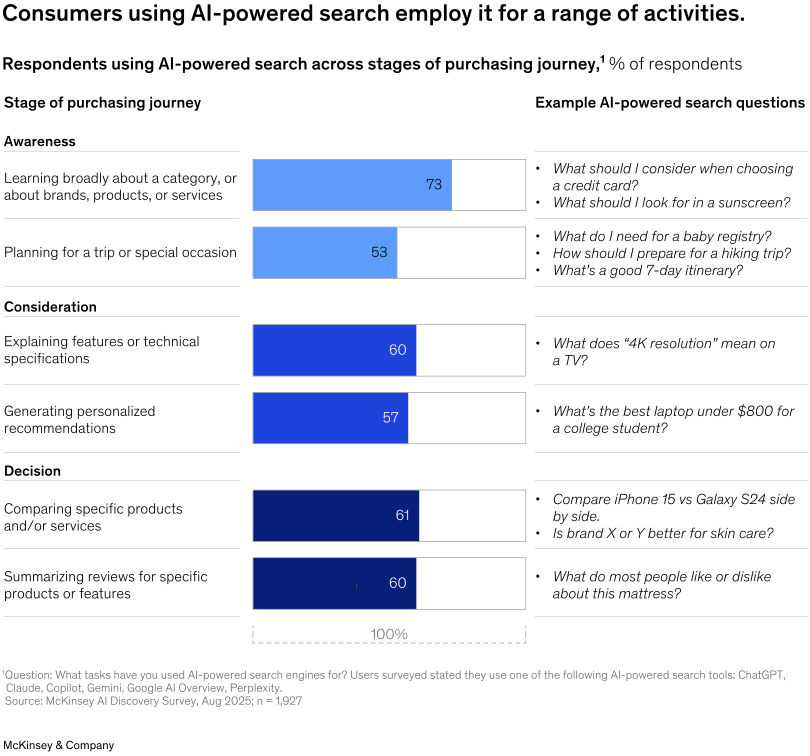
Alex’s AI experience is a reality today. As AI becomes a bigger part of consumers’ lives, shopping habits will continue to change. Nearly half of consumers already use AI-based search to help with a range of activities along their purchase decision journey (Exhibit 1).1 Shoppers today use twice as many channels on average to inform or make purchases as they did a decade ago, and as agents become more prevalent, shopping will get even faster and more agentic.
This consumer shift is pushing marketing past a structural point of no return. Many marketers are enthusiastic—86 percent are excited about the possibilities AI creates—and have launched AI initiatives in response, but the results are mixed.2 While 90 percent of CMOs are experimenting with AI use cases, less than 10 percent have either scaled it or captured value across marketing workflows.3
A primary culprit behind these numbers is that most CMOs are using AI to deliver point solutions and are taking a “bolt on” approach. Only 28 percent of surveyed organizations are pursuing a fundamental rewiring of their teams and workflows.4 AI is changing customer behavior so fundamentally that the campaign-era marketing model no longer works.
The opportunity lies not in automating marketing workflows but in redesigning marketing as a continuous growth engine powered by AI, where insight, creation, personalization, agentic commerce, and orchestration operate in real time (see sidebar “AI, gen AI, and agentic AI in marketing”). Get it right, and our experience with multiple companies indicates that 4 to 7 percent revenue growth, two- to threefold improvements in productivity, and 60 to 70 percent savings in execution-related tasks are possible with AI. That kind of value is just part of the broader opportunity, with the global B2C retail market potentially generating $3 trillion to $5 trillion from AI, according to McKinsey research.5
The five capability pillars of AI-first marketing
The winners in AI-first marketing will not be the companies deploying the most tools but those building an engine that continuously improves and drives both growth and productivity. This engine will depend on five specific capabilities.
Continuous insights
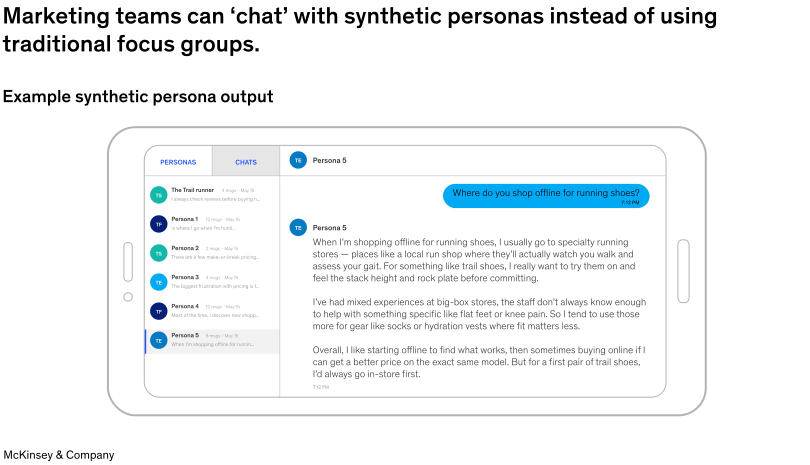
Continuous insights is the ability to translate signals from customers, markets, and channels directly into decisions in real time. Deploying gen AI can reduce costs through automated processes, reduced human intervention and errors, and expedited timelines. One instantiation of this capability is the digital twin that simulates consumer personas and can be used to test responses to campaigns, pricing, and products (Exhibit 2).
A continuous-insights capability relies on always-on structured and unstructured data flows across first- and third-party sources, strong governance, and advanced data protection protocols (for example, security as code).
Key new role: Customer Wayfinder. The Customer Wayfinder uses AI to build a deep understanding of customer behavior and needs. This role synthesizes data and insights, tests ideas with synthetic audiences, provides cultural understanding, and uses strategic judgment.
Scaled creativity
Scaled creativity is the ability to produce large volumes of tailored content for consumers and context while maintaining a consistent brand. Agents can be incorporated to continuously monitor large language models (LLMs), search, and social ecosystems to identify emerging trends and intent shifts and then generate, test, and optimize relevant content for both humans and AI agents. This capability is often where companies begin their AI transformation: The senior marketers we surveyed rated gen AI content and creative production as their most mature AI capability.6
This capability improves both efficiency and effectiveness. In our experience, some organizations are already seeing two- to fivefold increases in creative productivity and 10 to 30 percent reductions in creative costs. Campaign cycles can now shorten from six to ten weeks to same-day execution, and content that once took days to produce can now be created in minutes or hours.
This capability requires companies to treat creativity as infrastructure by codifying their brand and defining its voice, visual identity, and clear guardrails. They also need AI-enabled content factories that can generate and adapt assets at scale based on continuously integrated performance data.
Key new role: Creative Guru. The Creative Guru defines the systems and guardrails for content creation. This role ensures that all outputs are consistent with the brand and uses performance data to improve content. The Creative Guru also drives creative “concepting” and breakthrough ideas to direct content factory outputs.
Hyperpersonalization
Hyperpersonalization is a continuously learning and adapting capability that delivers tailored experiences to each individual in real time across channels. AI-driven personalization can enhance customer satisfaction by 15 to 20 percent, increase revenue by 5 to 8 percent, and reduce the cost to serve by up to 30 percent.7
Hyperpersonalization relies on clean, accessible, and protected customer data; real-time decision engines that determine the next-best action for each customer; reinforcement-learning systems that continuously refine interactions; and an offer-management system that catalogs, manages, delivers, and redeems offers across any channel.
Key new role: Hyperpersonalization Architect. The Hyperpersonalization Architect designs and manages data models, AI capabilities, and business rules that deliver one-to-one experiences. This role also oversees outputs and establishes regulatory parameters to ensure that personalization is accurate, compliant, and trusted.
Marketing to AI agents
Marketing to AI agents (that is, agentic commerce) is the ability to influence how AI systems interpret and recommend a product or service. Agentic experiences are conversational, adaptive, and continuously learning. This marks a broader shift from an attention economy toward a trust economy, where recommendation systems increasingly determine which brands get chosen.
More than half of consumers today already rely on AI to guide purchase decisions, with the result that significant portions of traditional web search traffic are at risk.8 Being visible is no longer enough; brands must be “consumable” and trusted by machines. While some companies are already experimenting with checkout features on AI platforms and deploying AI agents on their sites, the senior marketers we spoke with rate agentic commerce as the discipline where their organizations are least ready.9
Designing for agentic experiences requires companies to develop a knowledge engine that produces, for example, content that directly answers customer questions, “credibility signals” that machines can read and validate (such as detailed product specifications, verified reviews, and expert input), and consistently updated information.
Key new role: Agent Whisperer. The Agent Whisperer ensures that the brand is accurately represented in AI systems and that agentic programs both drive value and build trust with consumers. This role works with creative and hyperpersonalization capabilities to design content and data structures that machines can interpret, trust, and use to recommend the brand.
Always-on orchestration
Always-on orchestration replaces campaign cycles with continuously managed and optimized marketing through human–agentic teams.
When properly configured, our experience indicates that always-on orchestration can improve marketing ROI by 30 percent. Furthermore, it can reduce the time marketers spend on execution tasks from 60 to 70 percent to as little as 10 to 15 percent, freeing them to focus on higher-value activities.
This level of orchestration requires a unified data and orchestration layer, along with clear governance guidelines around how humans and machines make decisions.
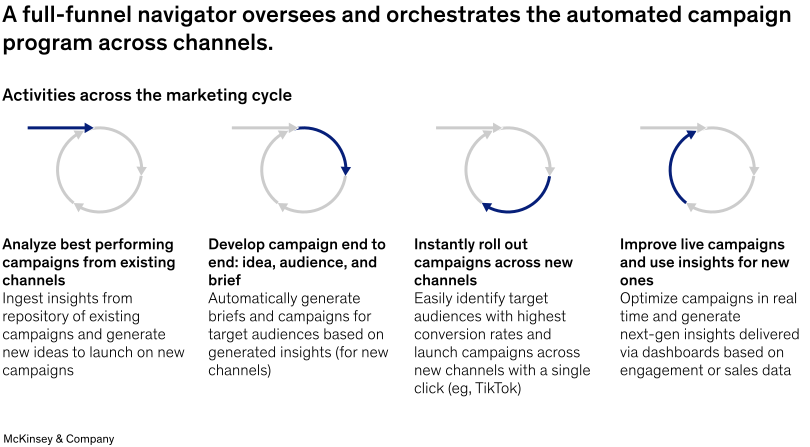
Key new role: Full-funnel Navigator. The Full-funnel Navigator oversees the entire marketing system. This role sets agendas, guides agentic systems, shapes the inputs that algorithms use to make decisions, uses AI-driven insights to optimize performance, and ensures that all parts of the funnel work together (Exhibit 3).
When these capabilities come together, the impact is powerful. One leading consumer technology organization redesigned its marketing function to become an AI-first growth engine. The company embedded reusable marketing agents to automate and optimize decision-making in near real time across core workflows: continuous insights, scaled creativity, hyperpersonalization, agentic commerce, and always-on orchestration.
The results speak for themselves: about 35 to 50 percent time savings in campaign activation, a roughly 20 percent reduction in external spend, and the compression of key AI-driven content and audience generation processes from ten to 12 weeks to minutes.
Enabling the change to deliver value
Rewiring marketing to enable these core capabilities and create value is a significant change program with many moving pieces (see sidebar “Case example: Building enablers to drive an AI engine for growth”). Executives should focus particularly on the following:
-
Rewiring high-value marketing workflows. While gen AI alone could power as much as 60 percent of marketing tasks, the biggest financial gains in the near term come from rewiring workflows around human–AI collaboration.10 That starts with breaking work down into tasks and identifying which ones humans or AI agents should perform. This approach also helps organizations determine which AI capabilities can be reused across workflows. Marketers, unfortunately, have made limited forays in this direction. Less than a quarter of those we surveyed have a clear, sequenced road map for change.11
Effectively rewiring workflows relies on having technical foundations (for example, unified data and identity layers), KPIs to track end-to-end performance, and cross-functional teams responsible for the entire workflow delivery. As marketers build their capabilities and agents become more proficient, companies can develop AI-driven growth systems where agentic AI coordinates decisioning, content, media, personalization, experimentation, and optimization across the entire marketing ecosystem.12
A leading global food company reimagined its marketing content supply chain around AI-enabled workflows. By focusing on scaled creativity and workflow rewiring, the organization deployed AI-driven content versioning to localize and adapt assets faster and with higher accuracy. The initial phases of this program delivered a reduction in campaign costs of about 80 percent, roughly 90 percent faster content production timelines, and an increase in asset output of about 15 to 20 percent through AI-enabled scaling capabilities (read more “Reinventing marketing workflows with agentic AI”).
-
Building a new human–AI hybrid organization. Many companies struggle to capture meaningful value from AI because of disconnects between enthusiasm and anxiety, growth ambitions and productivity pressures, and AI usage and business impact. These issues underscore that building an AI-ready organization is foremost a people challenge, not just a technology one. The starting place for CMOs is to set a clear and positive vision for AI that combines productivity and growth, align goals with the CEO and C-suite, and think through the implications of the key change: Marketing organizations will become smaller, faster, and organized around end-to-end workflows.
New roles will emerge for builders who create AI systems; orchestrators who manage human–agent workflows; and standard bearers who apply judgment, creativity, and quality control. That could mean a profoundly different organizational model that needs to inform talent strategies. For CMOs, the challenge is not only redesigning roles and workflows but also building the skills, incentives, and continuous coaching needed to reshape the organization. “Skills development” is the number-one issue the senior marketers we spoke with cited as a barrier to AI adoption (read more “From anxiety to advantage: A marketing organization that thrives with AI”).13
-
Investing in tech and data foundations to scale. The promise of AI and shifting consumer shopping behaviors requires capabilities that scale. Scale is where the lion’s share of value lies. Building scale requires an agentic platform architecture that integrates existing in-house systems, workflows, and data repositories; services purchased from external providers; and custom-built capabilities.
CMOs will also need to rethink partnerships in terms of how products and services are surfaced, recommended, and transacted across third-party AI platforms and agentic ecosystems. On the data side, AI depends on a data architecture with modular, interoperable frameworks and a data layer with robust pipelines that feed enriched, structured data into LLMs.
Complementing strong tech and data foundations, companies also need strong governance in place with rigorous testing standards, strong guidelines, and clear decision rights.
-
Ensuring value through active tracking and speedy reallocations. One of the biggest issues with AI in marketing isn’t that AI doesn’t generate value but that companies often do a poor job capturing it. That challenge of capturing that value has two primary facets. One is that companies measure activity rather than value. The other is that generated savings aren’t captured. AI automation might save a marketer 20 percent of their time on a task, but if that new time isn’t put to use, it doesn’t generate value.
Traditional transformation offices (TOs), built around milestone tracking and quarterly reviews, move too slowly for AI systems. The CMO needs to create a more dynamic TO. That starts with establishing explicit value goals from day one (for example, more leads, a larger share of wallet, or lower external agency costs), being dogmatic in tracking whether the identified value is hitting the bottom line, and recalibrating when things don’t go as planned. The TO needs to be deliberate in identifying productivity gains and deliberately reinvesting freed-up resources into high-growth work.
Where to start
As CMOs contemplate how to build their AI growth engine, the following actions are good starting points:
- Develop a clear view of your starting position. Companies often have a false sense of their capabilities. Spend the time to identify your maturity levels around capabilities, skills, data, and infrastructure. This will help identify where to direct investments.
- Start where AI can change the economics quickly. Identify an entry point into one of the five core capabilities where AI can materially improve speed, cost, or performance. Focus on value creation, not adoption or activity, and track it daily.
- Build to learn. Instrument capabilities to capture performance data in real time. CMOs should establish the expectation that all models and workflows are built with feedback loops so each interaction improves the next.
- Connect your capabilities from the start. The full impact of AI-driven marketing comes when the five capabilities work as a single system. Start by explicitly defining how the five capabilities will connect, even if only one or two are built initially. In practice, this requires identifying shared data models, common identifiers (for example, customer, product, intent), and interfaces that enable easy sharing. In this way, companies avoid creating “dead end” pilots.
The future of marketing will not be defined by how well organizations use AI tools but by how well they connect insight, creativity, personalization, agentic commerce, and execution into a single, continuously improving system. For CMOs, the task is to design that system so that the benefits of AI finally move from a promising opportunity to the bottom line.


.jpg?cq=50&mw=767&car=16:9&cpy=Center)