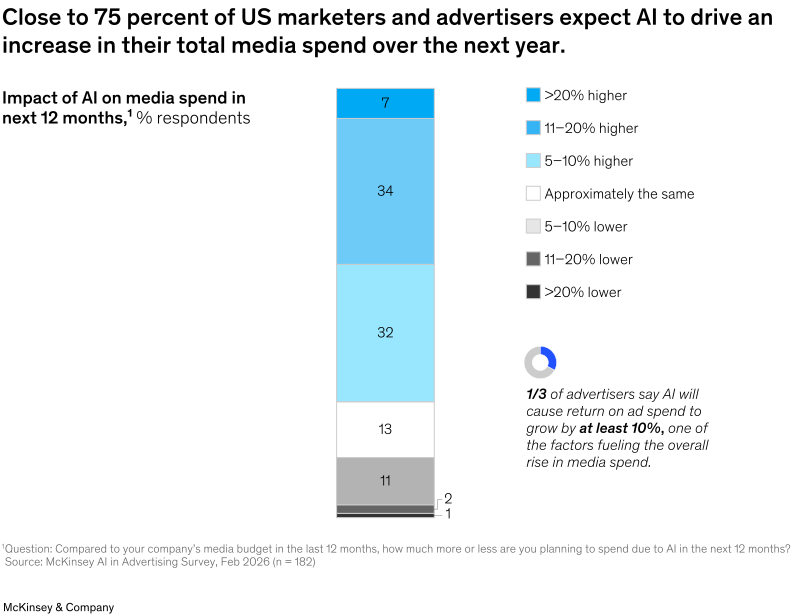
As with prior tech disruptions in advertising, consumers and businesses’ rapid adoption of AI will be a growth engine, a source of discontinuity, and an accelerant for the many tectonic shifts already underway across the ecosystem. Three-quarters of advertisers we surveyed expect AI to increase total media spend, and one-third believe it will drive at least a 10 percent increase in return on ad spend (ROAS).1 At the same time, spend may continue to move away from the open web, while direct media deals that bypass agencies and programmatic intermediaries gain share.
For the last two decades, digital advertising has followed a relatively straightforward model: Brands paid to access available consumer attention—whether through a search result, webpage, or ad slot—and a growing number of tech and data intermediaries and marketing services providers connected the buyers of attention to the sellers. The system was built for a clearly segmented consumer funnel, human decision-making, and significant data asymmetry and fragmentation.
That model is beginning to change. A growing share of consumers now use AI tools to research and decide what to buy, and over time, agentic purchasing decisions may happen with limited active human input. Advertisers already feel the shift: More than 50 percent report they believe AI has reshaped discovery and consideration.2
The result is that success for a marketer is no longer just about securing data-driven impressions with brand-controlled creative. Increasingly, it is about being surfaced, recommended, and selected by the systems shaping what consumers see and buy. Drawing on proprietary research, a survey of advertising decision-makers, and interviews with experts across the advertising economy, this article examines how AI is reshaping the advertising economy, where value is moving across the ecosystem, and what leaders can do to reposition for advantage. Given how rapidly the technology and its impacts are evolving, the article only reflects our perspective and the state of the market as of June 2026.
Three AI shifts are redefining media and advertising
Among the many ways AI is transforming the advertising ecosystem, three stand out as the most important.
1. Attention and traffic are consolidating into AI environments
Consumer discovery is increasingly moving from the open web into AI-driven environments. Over 50 percent of Google searches now include an AI-generated overview,3 while 20 to 50 percent of traffic from traditional open-web search could be at risk by 2030.4 This is not limited to the open web; arguably, the larger shift is happening inside walled gardens—social media and other tech platforms combining discovery, buying, measurement, audience data, and transaction visibility in one environment. AI ranking now shapes most consumer attention on the biggest integrated platforms: More than 50 percent of content viewed on Instagram and more than 95 percent of watch time on TikTok now come from algorithmic-generated feeds rather than followed accounts.5 Meta has reported that AI-driven recommendations lifted time spent on Facebook by 5 percent in Q3 2025 and watch time on Instagram Reels in the United States by more than 30 percent (versus the prior year).6
Across the open web and walled gardens alike, brand visibility increasingly depends on how a small set of AI systems source, rank, and recommend. As one marketing leader notes, “Brands have to work on becoming a cited source … so that AI can pick up their content and put it as a relevant answer.”
2. AI agents are increasingly helping to drive decision-making
Two distinct shifts are underway on either side of the ad transaction. On the advertiser side, more than 90 percent of advertisers state they use AI to plan media, set budgets, optimize targeting, and generate creative.7 On the consumer side, AI is increasingly mediating the purchase itself: Shopping agents and AI assistants rank products, compare alternatives, and in some cases complete transactions on the user’s behalf. In select early deployments, AI-enabled shopping and recommendation experiences have delivered up to 60 percent higher conversion rates.8 Over the next few years, 10 to 35 percent of e-commerce transactions could be initiated, influenced, or completed through AI-native experiences,9 though the precise role of stand-alone shopping agents versus retailer-integrated AI tools remains uncertain.
3. Value may be concentrating inside platforms bundling data, measurement, and transactions
As attention, decision-making, buying, conversion, and measurement move to integrated environments, value may be increasingly concentrated among the AI-native platforms and walled gardens that bundle these capabilities into a single AI-managed product—and shifting away from the intermediaries (exchanges, ad networks, traditional agencies) that historically connected buyers and signals separately.
This could increase advertisers’ dependence on platform-provided data, making measurement even more opaque. But advertisers could also lose visibility and control over where their ads actually run across products, placements, and channels within a single platform. Forty-two percent of advertisers we surveyed cite reliance on these “black box optimization” systems as a key risk AI introduces into their media investment strategy.10
Would you like to learn more about ourTechnology, Media & Telecommunications Practice?
Advertising economics are redistributing across the value chain
Our recent survey of 182 US-based media buyers revealed how these shifts are already reshaping how advertising dollars move through the ecosystem, reallocating value across channels, platforms, and intermediaries.
AI is expanding total advertising spend. Nearly three-quarters of companies we surveyed expect their total media spend to increase in the next 12 months, fueled by new use cases (such as AI shopping agents) and AI-enabled ROAS gains. In fact, one-third of advertisers believe ROAS will increase more than 10 percent due to AI (Exhibit 1).
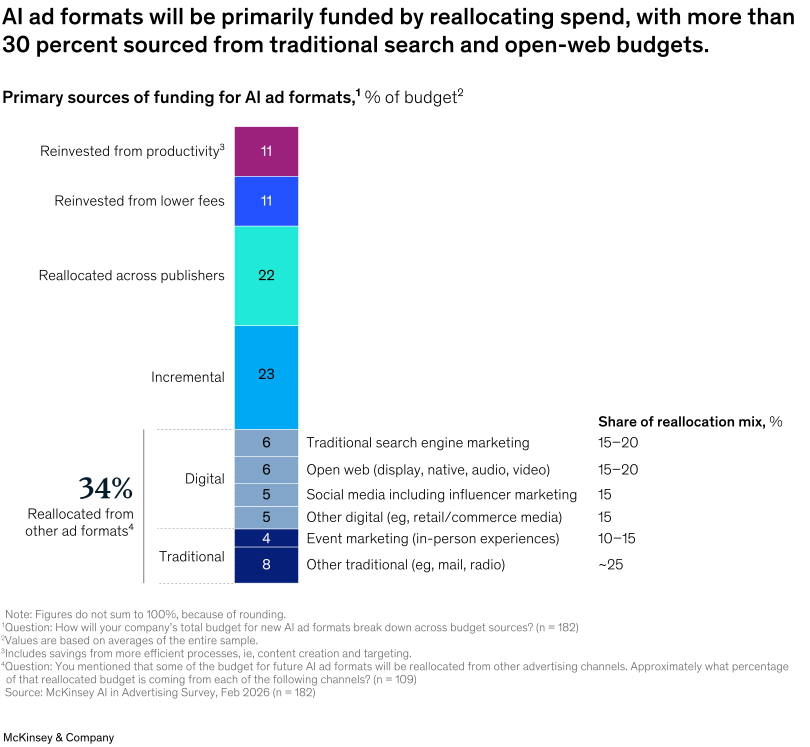
Advertisers are investing in AI-driven formats, fueled in part by reallocation. More than 50 percent of those we surveyed report investing in ads embedded in AI-generated answers, as brands experiment with formats in AI-assisted commerce and recommendation-driven environments.11 Much of those funds are not new, incremental ad dollars, however. Roughly 40 percent of reallocated AI-driven spend is shifting away from traditional search and the open web toward platforms with stronger data, measurement, and transaction capabilities (Exhibit 2).
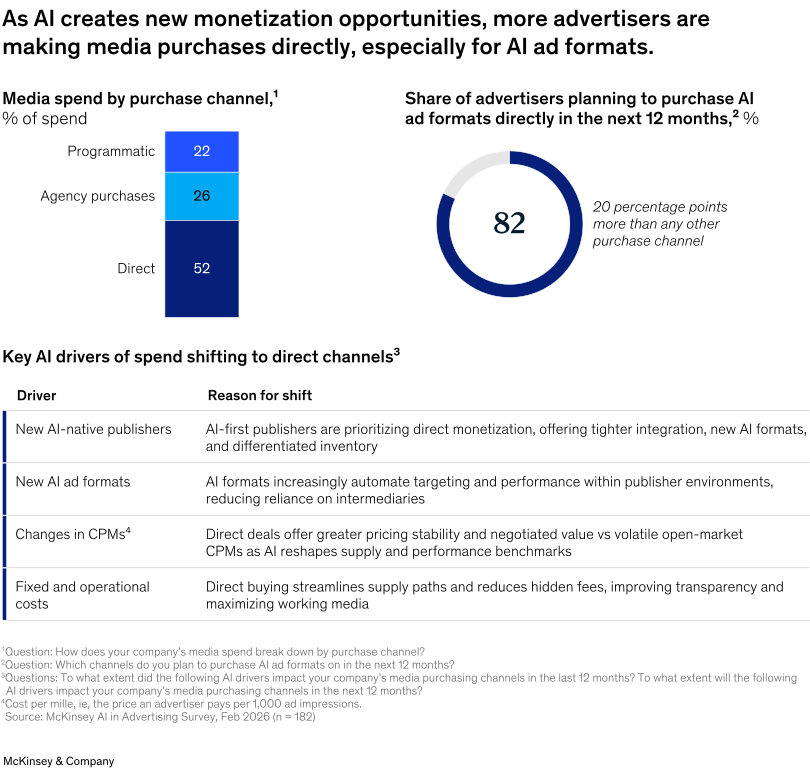
AI is fueling the already growing appeal of direct buying. Direct ad buying has been on a steady uptick over the past decade, nearly tripling between 2019 and early 2024, but AI is positioned to reinforce this trend.12 As discovery, buying, and measurement become more integrated, advertisers are increasingly bypassing agencies and programmatic intermediaries to work directly with walled gardens and AI-native platforms offering automated targeting, stronger data, closed-loop measurement that tracks the entire customer journey, and transaction visibility (Exhibit 3).
Four possible trajectories for the advertising economy
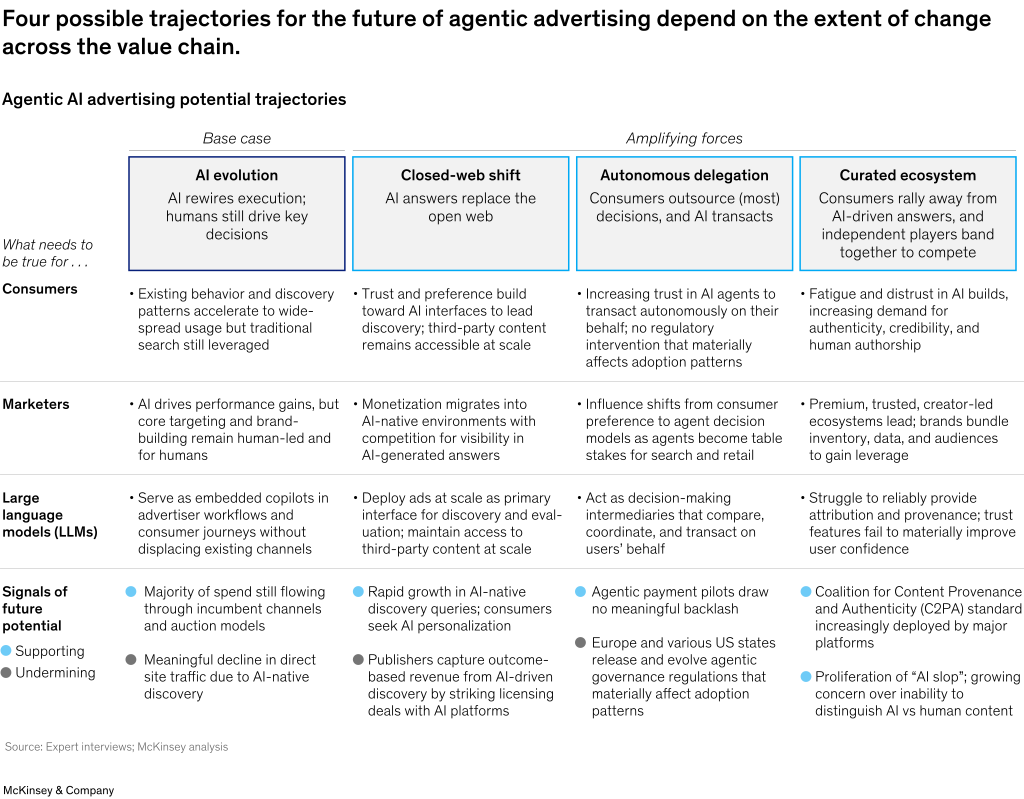
The direction of change is becoming clearer, but the extent and shape of disruption in media and advertising remain uncertain. We see four possible future trajectories for the media ecosystem beginning to emerge—starting with a base case and layering in additional forces that may individually, or in tandem, spur more materially disruptive outcomes (Exhibit 4):
- AI evolution. AI improves productivity and usage increases, with traditional, open-web search used sparingly. But humans directly drive key decisions without agents acting entirely on their behalf, and the majority of media spend flows through existing channels.
- Closed-web shift. Discovery and monetization are increasingly concentrated within AI-driven interfaces, where advertisers compete for visibility in answers and consumers seek personalized experiences.
- Autonomous delegation. AI agents research, recommend, and transact on behalf of users, with influence moving from how consumers directly express preference in the moment to the underlying decision models that act on their behalf.
- Curated ecosystem. Amid rising consumer skepticism of AI, a coalition of premium publishers, potentially joined by retailers, pool authenticated audiences and content inventory (including video) with shared measurement and likely through a subscription model or paywall.
Where value shifts across the ecosystem
Across all four trajectories, the central challenge facing players throughout the advertising and media value chain is how to position for a range of outcomes where control over data, decision-making, and transactions determines advantage. What differs is how quickly those shifts occur and how concentrated value becomes across the ecosystem.
These shifts have already begun to redistribute advantage across the advertising ecosystem, and this is expected to accelerate across trajectories. Legacy models built around traffic, manual execution, and fragmented measurement are coming under pressure, while platforms and ecosystems with stronger data, transaction visibility, and integrated measurement capabilities are capturing a growing share of value (Exhibit 5).
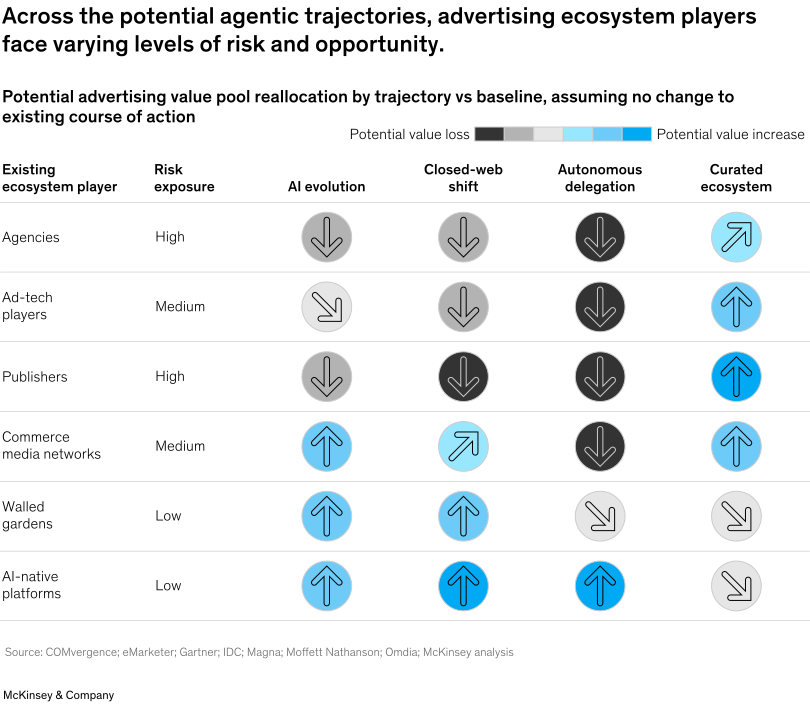
While the four trajectories vary in pace and scale of disruption, each player has a baseline level of exposure and can adapt its role accordingly.
-
Agencies: From execution to orchestration—or disintermediation
Agencies are among the most exposed players. Roughly half of media spend now flows through direct channels, and many core agency activities—planning, buying, reporting, creative production—are exactly the kind of knowledge work AI can dramatically disrupt the fastest.
Execution is becoming a less defensible position compared to orchestration, such as helping clients design AI-enabled workflows, govern automated decisions, interpret platform signals, and prove business outcomes. Early leaders are scaling back execution-heavy services and investing in three categories: proprietary AI and data assets (for instance, audience graphs, creative-generation models fine-tuned on client IP); governance offerings (including brand-safety, AI-bias, and compliance review services clients can’t easily build in-house); and outcome-linked pricing tied to verified business results. Principal media buying, long a key margin lever, is also under pressure; as more media spend concentrates inside walled gardens, agencies have a tougher time credibly promising a “better deal” on unit costs.
The pitfall is solely relying on short-term AI-advisory revenue that masks long-term disintermediation. As one holding company president told us, agencies risk “consulting our way out of a business.”
-
Ad tech: From intermediation to specialized infrastructure
The ad tech middle is compressing amid new pressures. AI-native buying agents that can replicate cross-platform optimization inside a single workflow may entirely eliminate key use cases for supply-side platforms, exchanges, traditional demand-side platforms, and undifferentiated middleware. As AI automates buying, optimization, and measurement—and 82 percent of advertisers we surveyed plan to buy AI ad formats directly in the next 12 months—intermediation layers built on cross-platform arbitrage play a smaller role.
The opportunity to stay relevant and keep growing revolves around serving as connective tissue across walled gardens and AI platforms. Such closed ecosystems are likely to build versions of this infrastructure for use inside their walls. Still, advertisers may continue to value neutral, cross-platform identity and measurement to compare performance and manage spend across these environments. With trust and governance becoming competitive differentiators, they can also offer independent AI performance audits, validation services, and testing platforms.
Leaders are responding by leaning into clean-room partnerships—positioning themselves as the unbiased measurement and secure identity layer that no single closed ecosystem will provide on its own. That neutrality is the defensible position for ad tech.
-
Publishers: From scale to survival of the most differentiated
With traditional search traffic declining and consumers becoming increasingly comfortable with AI-generated answers, AI is accelerating the already eroding economics of the open web. Click-driven, scale-dependent publishing may increasingly be unviable, and long-tail, SEO-dependent sites with little to no user subscription models are most exposed.
The credible paths forward may be alternatives to impression-based monetization: licensing content to AI platforms for training and answer data (early deals point to a meaningful but partial offset of lost referral revenue); building generative engine optimization (GEO) capabilities to ensure visibility inside AI answers; and pooling authenticated audiences and premium inventory into a curated ecosystem—the only one of our modeled trajectories in which publishers see meaningful upside.
-
Commerce media networks (CMNs): From inventory to decision advantage
Commerce media networks sit closest to the transaction, and AI strengthens that position. As sales within AI platforms account for a growing share of e-commerce, and AI-enabled shopping agents drive higher conversion, networks with closed-loop measurement that track the entire customer journey, purchase visibility, and integrated retail signals have a clear advantage.
But the moment of choice is moving. As AI assistants collapse the shopping experience, the most valuable position may be inclusion in an automated answer, agent-generated comparison set, or the default selection. Unlike traditional sponsored slots on a product results page, these placements are based on structured product data, verified claims, and measurable outcomes that AI evaluates, not through bidding alone.
CMNs can also offer higher-value, strategic omnichannel offerings beyond onsite, spanning offsite and physical or in-store locations. For offsite, the priority should be helping brands navigate and optimize performance in AI-native formats. Leading networks are already operationalizing this offsite support by rolling out conversational shopping experiences and agent-readable product information feeds that surface in their assistants, while others are investing heavily in closed-loop measurement that clearly ties media exposure to in-store and online purchases. Both are pricing increasingly based on verified sales lift rather than impressions. Finally, in-store CMN offerings remain almost entirely insulated from AI, and continued investment will be a priority for advertisers.
-
Walled gardens: From media platforms to decision platforms
Established walled gardens may be well positioned for the new advertising era. The strategic choice they face is how far to move beyond attention monetization into commerce and agent offerings. The moves are already underway: TikTok is expected to clear roughly $30 billion in commerce gross merchandise value by 2028, YouTube has named commerce a top priority, and Meta is integrating AI agents across its apps.13 How aggressively these platforms expand will help set the terms for other players in the ecosystem.
-
AI-native platforms: From interface advantage to advertising model
The new, emerging category of AI-native platforms tied to large language models (LLMs) already owns a rapidly expanding share of consumer discovery. Product research is increasingly taking place within AI tools such as ChatGPT, Gemini, Perplexity, and Claude alongside traditional search engines. Their conversational AI interfaces and agent layers are gaining traction because many consumers find them faster and more useful for recommendations, comparisons, and synthesized answers. These platforms enter the ecosystem with two built-in advantages: privileged access to the decision moment and significant behavioral data. What they lack is a mature advertising model. Sponsored answers, agent-readable claims, affiliate commerce, and bidding into recommendations are all being tested; no format has emerged as a clear leader yet.
The critical strategic question they face is how to monetize: build their own walled gardens, partner with CMNs and publishers, or remain neutral interfaces brands optimize for via GEO. Many platforms are experimenting with sponsored recommendations, commerce integrations, and proprietary transaction flows that may eventually allow them to control discovery, purchase, and measurement more directly. Early moves by certain players—such as OpenAI’s experimentation with commerce experiences and growing focus on monetizing high-intent user interactions14—suggest that AI platforms are exploring a more direct role in commercial journeys. Whether that ultimately evolves beyond discovery to integrated transactions and end-to-end measurement remains an open question, but the direction of travel is notable.

The agentic commerce opportunity: How AI agents are ushering in a new era for consumers and merchants
What advertising leaders can decide now
AI is already reshaping advertising. The urgent question facing the various players is how (and how quickly) value, influence, and competitive advantage shift across the ecosystem from here. Leaders can focus on four questions as they reposition for a more AI-mediated advertising environment:
-
Which future are we planning for?
Disruption will not play out evenly. Leaders may need to assess how different futures will impact their business and where they are most exposed to platform concentration, automation, or shifts in consumer discovery behavior. Early movers are already stress-testing how AI could reshape traffic flows, measurement economics, and customer relationships across multiple future states.
-
What is the value at stake?
As spend shifts across channels, formats, and buying models, the priority is to identify which value pools are expanding and which are narrowing. Many companies are already reallocating investment toward proprietary data, direct relationships, closed-loop measurement, and AI-enabled commerce capabilities.
-
Where can we differentiate?
Not every opportunity matters. The biggest advantages will increasingly come from assets that are difficult to copy—and are harder still to replicate within someone else’s walled garden. Early leaders are focusing less on scaling execution and more on strengthening the systems, signals, and relationships that shape discovery and purchasing decisions.
-
How do we execute at speed?
The transition is already underway. Leaders need a clear road map to build capabilities rapidly, form partnerships, and adapt operating models as discovery, buying, and measurement become increasingly automated. Organizations moving fastest are simplifying workflows, investing in interoperable measurement and data infrastructure, and redesigning teams around strategy, optimization, and AI-enabled decision support.
Across all players, the same levers—data, products, and services; business model; talent; governance and trust; partnerships; and customer focus—will be the key determinants of competitive advantage.
Some critical questions, however, differ by ecosystem player (see sidebar, “How each ad ecosystem player can get started”): Agencies can decide what to productize and how to price for outcomes; ad tech can choose where to invest in potentially valuable neutral infrastructure; publishers can pick which form of differentiation (audience, vertical authority, licensing, or coalition) they will scale; commerce media networks can decide whether to compete for impressions or for agent eligibility; walled gardens can decide whether or how much to extend their model into commerce and agent offerings; and AI-native platforms can decide what kind of advertising business—if any—they want to be.
As AI gets more embedded in media buying, advertising is becoming more automated, integrated, and concentrated within a smaller number of walled gardens and AI-native platforms.
The challenge for leaders is no longer just optimizing campaigns within channels but maintaining some influence within the systems increasingly shaping discovery, recommendation, and transactions. As AI adoption accelerates, companies with stronger data, measurement, and transaction capabilities may capture a disproportionate share of value, leaving others to compete on compressed margins within ecosystems over which they have little control.
The question now is which players will help set the rules of the next AI-driven advertising model, and which may be forced to play by rules written by others. Both groups will compete in the same market; only one will likely shape its terms and reap more rewards in the process.