Rapid geopolitical shifts are exposing multinational corporations (MNCs) to well-documented risks, but they are also opening vital arenas for growth. This presents CEOs with a dual mandate: to seize opportunities in new markets and trade corridors while managing their organizations’ geopolitical exposure and associated risks. Companies that move quickly can use the forces reshaping the global order—from regional realignments to industrial-policy measures—to expand in growing economies such as India and Vietnam, access billions of dollars in industrial subsidies and investment incentives, and gain market share from slower-moving competitors. Conversely, MNCs that don’t respond to geopolitically driven shifts may see their enterprise value eroded by tariff costs, supply chain and operational disruptions, and other challenges.
During a recent series of interviews with more than 15 CEOs of MNCs, we found business leaders grappling with a confounding new business environment. “Even in markets I once considered stable, we now have to account for geopolitical factors,” says the CEO of an automotive company. Echoing this uncertainty, the head of a US technology company notes, “In our strategic planning meetings, we had intense debates about whether the shifts are a temporal phenomenon or whether there’s more permanence.” The consensus is that geopolitical volatility is no longer episodic—it’s the new operating norm.
Two steps can help CEOs gain an edge on competitors, our research suggests: first, quantify the value at stake linked to geopolitical developments to guide growth strategies and manage risk; and second, develop the organizational agility needed to respond quickly to new opportunities and risks as they arise.
Assessing geopolitical value at stake to guide strategic bets and risk management
Geopolitical developments can significantly affect MNCs’ enterprise value—both positively and negatively. On the upside, shifts can open new markets or boost demand, rewarding companies that can adjust production volumes and prices quickly. For example, after Russia’s invasion of Ukraine, Europe’s efforts to secure non-Russian gas dramatically reshaped the market for liquefied natural gas (LNG). US companies that were able to redirect supply benefited from these efforts and raised the US share of European LNG imports from 27 percent in 2021 to 48 percent in 2023.1 Similarly, Norway’s Equinor emerged as Europe’s top natural gas supplier after expanding production to meet higher demand, increasing revenue by more than 60 percent between 2021 and 2022.2
However, the same geopolitical forces that fuel growth can also erode value. For example, Intel cut its revenue outlook in 2024 in part due to the US Department of Commerce revoking the company’s license to sell certain semiconductors to Huawei.3 More recently, Jaguar Land Rover reported that a 27.5 percent US tariff, combined with negative foreign exchange trends, reduced its EBIT margin from 8.9 to 4.0 percent in a single quarter.4
Despite the magnitude of the value at stake, few MNCs rigorously measure it. For instance, 62 percent of companies we studied consider US–China trade tensions, tariffs, and export controls to be material threats, but only 29 percent have quantified the potential impact, forgoing opportunities to transform geopolitical volatility into a competitive advantage.
Estimating the enterprise value linked to geopolitical shifts requires first understanding the company’s geopolitical profile. Various tools can serve this purpose, but in this article, we rely on the geopolitical distance index, a measure of geopolitical alignment developed by the McKinsey Global Institute (MGI) based on countries’ voting records in the UN General Assembly.5 MGI’s research shows that the average geopolitical distance between countries engaged in trade and foreign direct investment has fallen.6 Our additional analysis indicates that more than 90 percent of MNCs are exposed to countries whose political and diplomatic positions diverge significantly from those of their home governments. In Europe, for example, the share of companies with exposure to geopolitically distant contexts has risen to 95 percent, from 78 percent; in Asia, it has grown to 90 percent, from 85 percent.
Quantifying geopolitical value at stake combines geopolitical distance and financial-exposure metrics (Exhibit 1). The process involves assessing the revenue from each market, applying a probability weight based on the market’s geopolitical distance from the company’s home market (a proxy for divergence), and adjusting the result by a severity factor that reflects the impact of stabilizing mechanisms such as free trade agreements, tariff preferences, or more permissive export control environments. The outcome helps inform CEOs’ strategies by providing a directional, order-of-magnitude view of where businesses can protect and unlock value through a proactive geopolitical response (see sidebar, “McKinsey’s approach to quantifying geopolitical value at stake”).
Magnitude of corporate value: the amount of revenue tied to a geography or function i (for example, sales in that market)
Geopolitical distance: the divergence between the company’s home jurisdiction and geography i on the geopolitical-alignment spectrum (scaled 0–10, with higher numbers representing greater divergence)
Severity adjustment: factor 0–1, capturing how the trade and policy environment in trade corridor i dampens (closer to 0) the impact of geopolitical developments—as through preferred trade agreements, reduced nontariff barriers, or licensing carve-outs—or amplifies (closer to 1) through measures such as investment protections or export controls




In practice, exposure to geopolitically distant geographies without stabilizing mechanisms such as trade agreements can translate into materially higher value at stake than when such “shock absorbers” are in place. For example, the EU–Mercosur Partnership Agreement,7 which aims to remove 90 percent of duties on EU goods exported to Mercosur countries and curtail nontariff barriers, may reduce the value at stake for companies engaged in those markets under the agreement by lowering the severity of future geopolitical disruption affecting those economies.
Participating in geopolitically distant markets requires leaders to assess not only the demand and operating costs in those markets but also the durability of relations between the economies. For example, emerging markets in Africa, Latin America, the Middle East, and Southeast Asia account for a growing share of global demand, representing attractive growth opportunities, but many are geopolitically distant from Western capitals. This distance can translate into divergent data localization rules, supply chain restrictions, regulatory unpredictability, and loss of operational control, among other challenges.
To assess potential value swings associated with geopolitically distant markets, leaders need to evaluate the impact of shocks on demand, costs, and capital. This means sizing not only demand and operating costs but also the durability of relations across borders and the likelihood of sudden shifts in data localization rules or investment screening policies, for example. What’s more, they should do so not only at the enterprise level but also by function.
Measuring geopolitical distance by function
Geopolitical shifts have unique implications for every business function. “[Geopolitics] is no longer a risk-only topic,” says the CEO of a global chemical company. “We’re building geopolitical awareness into commercial, accounting, compliance, strategy, finance, and operations.” Such steps help ensure that the ability to interpret geopolitical signals is embedded across the enterprise.
The way geopolitics affects business functions varies around the world. We analyzed more than 150 multinational companies’ exposure to three geopolitically distant BRICS (Brazil, Russia, India, China) economies—China, India, and Russia—and found that European MNCs tend to have higher exposure to these geopolitically distant geographies across multiple functions, particularly technology and workforce, than MNCs based in the United States. North American companies, meanwhile, have higher exposure in IT and talent, reflecting both their heavy reliance on foreign digital infrastructure and widely dispersed workforces (Exhibit 2). A deeper look at each core function reveals varying trade-offs and levels of geopolitical exposure:
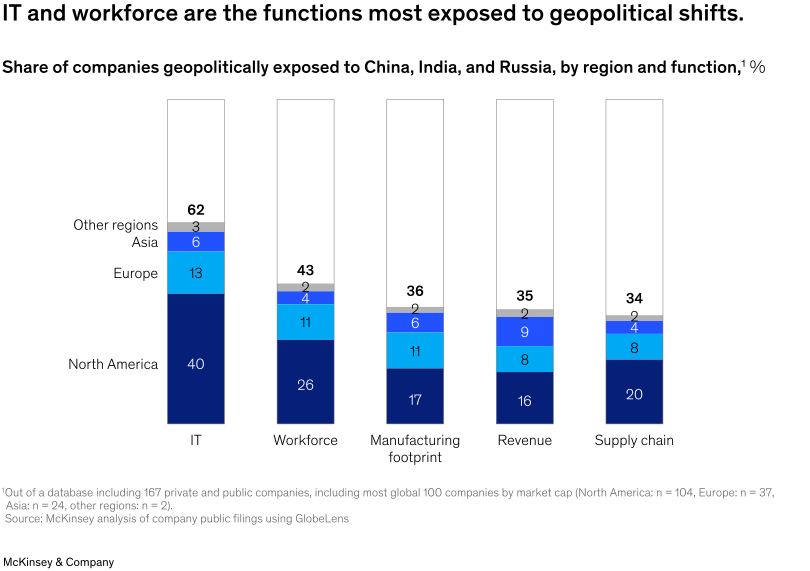
- Technology. Globally distributed digital infrastructure is common among MNCs, enabling them to quickly expand into new markets or trade corridors. However, this approach adds burdens such as the need to comply with disparate data localization and privacy laws. “It’s not just about having separate legal entities to maintain access to different markets,” says the CEO of a technology MNC. “It’s about having a completely different tech stack to comply with local regulations. The cost of doing business globally has just gone through the roof.” The leader of a European consumer goods company says that the diverging market standards have doubled or tripled the company’s technology costs. In our sample, about 40 percent of MNCs had no technology exposure to China, India, or Russia; roughly 30 percent were exposed to a combination of China and Russia; and the remainder were mainly exposed to India, a common hub for MNCs’ outsourced IT.
- Workforce. Many companies today have the majority of their employees outside their home countries. “Our philosophy has always been to find the best talent where it exists and connect them into global teams,” says the CEO of a US-based information services multinational. However, leaders face conflicting trends and complex trade-offs: Advances in AI and digital collaboration expand access to global skill pools that enable fast capability scaling, but tightening regulations around workforce mobility are limiting hiring flexibility. “Mobility of senior talent is becoming harder,” says the CEO of a North American medical-products company, noting that a Chinese member of the leadership team struggled to renew their visa. While China has been a global labor hub for several decades, fewer than 20 percent of the MNCs we studied employ talent there today. Of those, 60 percent also have employees in India, suggesting deliberate diversification to mitigate the risk of concentration.
- Manufacturing. A manufacturing footprint in a growing market can be an unassailable advantage, often delivering share and margin gains via scale and cost efficiency. Many MNCs established facilities in growing markets such as North Africa and Eastern Europe, with those investments furthered by regional trade agreements. However, excessive concentration in one region can carry a material risk of disruption. Our analysis shows that 41 percent of MNCs have more than half their production capacity in a single region, often Asia. Some companies have responded by reducing such concentration points. “We’re moving toward regional manufacturing and market-for-market strategies,” says the CEO of the medical-products company. “We’ve been transitioning to China-only operations, through joint ventures, since 2023, seeing it as the right strategic move even before the new [US] tariffs.”
- Supply chain. Reconfiguring supply chains can help ensure continuity, improve responsiveness, and expand access to supplier ecosystems aligned with growing trade corridors. More than 90 percent of the MNCs we studied refer to supply chain disruption as a critical threat, and almost half explicitly flag risks of regional supplier concentration in public filings.8 To boost supply resilience, many are building alternate or duplicate sources for their key inputs or rerouting their supply networks. For example, prior to the implementation of US tariffs last year, Apple shifted iPhone production from China to India to ensure product availability in the United States, even chartering cargo flights to ship approximately 1.5 million iPhones there.9
Having quantified the value at stake for each function, leaders can set thresholds for the geopolitical exposure they can tolerate. This is typically a three-step process:
- Establish baseline concentration guidance. This guidance sets the tone, signaling the organization’s overall posture, where geopolitical exposure is material, and where it should be addressed. “We did a deep dive on portfolios, really questioning products, countries, our footprint—there were no sacred cows,” says the CEO of a European healthcare MNC. “We asked, do we need to be in certain markets? Are we creating enough value?” The guidance signals to business leaders how and where to pursue growth and what level of risk to take. For example, in response to rising trade tensions between China and the United States, Tesla has mandated that all suppliers exclude China-made materials from vehicles destined for the US market.10
- Quantify how (and where) geopolitical exposure creates opportunities and risks. Exposure to geopolitically distant markets may be acceptable when barriers to entry are relatively low, as it is for digital services or software without on-the-ground presence. Similarly, if barriers to exit or risk of stranded capital are low—in establishing local customer support or moving global support functions to low-cost geographies, for example—leaders may be willing to accept high geopolitical distance. In contrast, companies with capital-intensive assets, high regulatory burdens, or operations in politically sensitive sectors would tend to have a lower tolerance for geopolitical distance. “The more critical the industry is seen to be to the sovereignty of a country, the more pressure there will be [to create] local entities with local governance structures,” says the CEO of a global social media service. Since manufacturing facilities, data infrastructure, and specialized talent are difficult to shift across borders, they are especially vulnerable to sudden policy shifts.
- Consider actions to lower exposure. This step is most relevant when the potential downside is high and hard to remediate, as with difficult-to-relocate assets or regulatory constraints that limit adaptation, such as export controls. For example, given the chip fabrication concentration in Taiwan, geopolitical uncertainty around Taiwan–China relations (and China–US relations) is a critical vulnerability that some semiconductor companies are trying to address. TSMC, for example, announced plans to build fabrication plants in Japan and Germany while also expanding production at its US facilities.11 Although costly, such moves reduce the company’s concentration risk while preserving its ability to serve (and grow) in new markets.
Develop organizational agility to react quickly to geopolitical shifts
Agility is central to the CEO’s dual mandate—it boosts a company’s ability to capture growth opportunities while reducing risk from exposure to geopolitically distant markets. “What matters most is the ability to mobilize,” says the CEO of a financial-services MNC. “When a crisis hits or an opportunity opens, we need to have both on-the-ground capabilities to stand up a team and the connections to headquarters so we can strategically engage without slowing down the business.”
To expand this agility, leading MNCs are going beyond tactical fixes: They’re regionalizing production, diversifying suppliers, renegotiating contracts, and localizing their technology. “We see a strategic opportunity to leverage regional blocks,” says the CEO of an information services company. “Our large manufacturing footprint now presents an opportunity to localize.” A global agriculture MNC, meanwhile, has reset its operating model: When volatility spikes, the organization centralizes risk and compliance; as conditions stabilize, it pushes decision rights back to regional and local units.
At a time of accelerating geopolitical fragmentation, optimizing efficiency alone is not sufficient—competitive advantage requires flexibility and redundancy across functions. Agile organizations preset triggers to mitigate risk and capture upside, allowing them to operate in geopolitically risky environments longer than their peers can. For example, one consumer products MNC rerouted its supply chain three times in response to changing tariffs—only to be caught out when policy changed again. “I no longer knew where [a jurisdiction] was safe for inputs from a cost perspective,” says the CEO. “I’m in a low-margin business, and this is a matter of survival.” The CEO’s takeaway? Stop chasing “perfect” low-margin locations and instead design for volatility by building flexibility through dual- and multisourcing, prequalified alternative suppliers, and contracts that allow volumes to shift quickly across locations.
Many MNCs are making similar investments in agility (Exhibit 3). Among the companies we studied, 78 percent are geographically diversifying their supply chains, 41 percent are establishing regional manufacturing hubs, and 32 percent are building inventory buffers and implementing dual-sourcing plans. “We’re not retreating from being global,” says the CEO of a global industrial company. “We’re planning our future manufacturing footprint to be more purposeful—aligned to our largest customers and capabilities that drive value.”
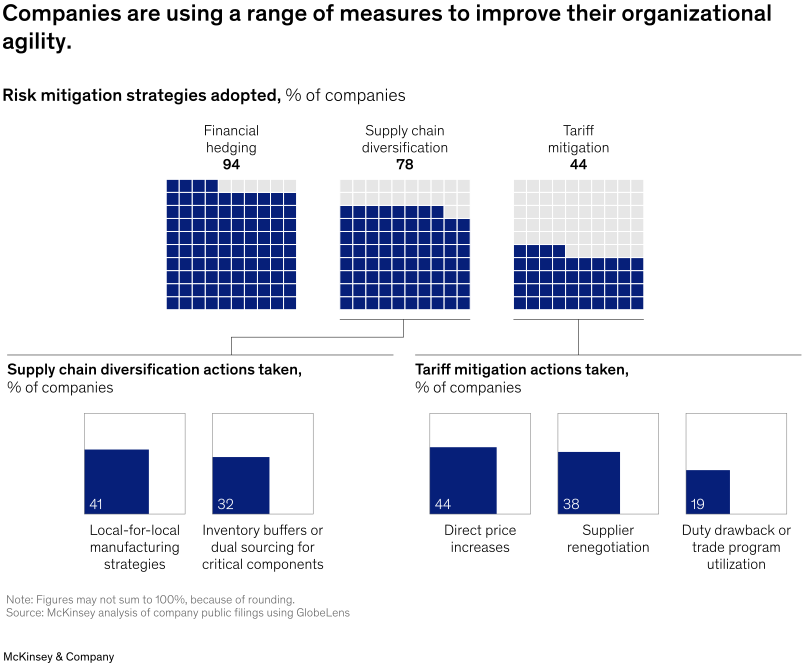
Four steps can help CEOs improve their companies’ agility—gathering geopolitical insights and creating dashboards, developing regional intelligence-gathering capabilities, determining preplanned offensive and defensive actions, and ensuring rapid decision-making to respond to opportunities and shocks:
- Geopolitical insights and dashboards. Organizations that systematically gather geopolitical insights from broad ecosystems of sources can translate those signals into exposure dashboards, scenarios, and thresholds that automatically trigger mitigation actions. “The news cycle is distracting,” says the CEO of an energy and utilities company. “We need clarity on what [geopolitical shifts] are materially affecting our business.” For example, DHL established a Global Connectedness Tracker that monitors trade policy, sanctions, cross-border disruptions, and other geopolitical developments.12 To be effective, such teams need to continuously assess the implications of different scenarios for revenue, manufacturing, supply chain, technology, and talent and regularly engage with local partners and regulators.
- Regional intelligence-gathering capabilities. Regional leaders are well positioned to monitor local geopolitical developments and share their intelligence with management. “We need to have boots on the ground to see if there are any issues in the processes and procedures on the hospital floor,” says the CEO of the European healthcare company. Some MNCs are developing curricula to train executives on the implications of tariffs, new trade corridors, and other geopolitics topics. “My entire leadership across the business has to get savvy about geopolitics,” says a CEO of a multinational agricultural supplier. Such initiatives help ensure a continuous flow of frontline insights, enabling management to adjust quickly.
- Preplanned offensive and defensive actions. Preparing sets of actions in response to trigger events can help companies mobilize to capture opportunities or mitigate risks. This preparation could involve vetting potential partners in markets that may see demand spikes, prequalifying suppliers and adapting logistics routing, or assessing options for centralizing or localizing sensitive functions. In doing so, agile organizations can preserve strategic freedom as geopolitical conditions shift.
- Rapid decision-making to respond to opportunities and crises. When external shocks hit, the ability to launch cross-functional nerve centers within hours can help companies orchestrate information flow between local teams and headquarters. Some MNCs are running scenario exercises that simulate quick decision-making around pricing resets or production shifts, for example. Clarifying decision rights in advance—on topics such as reallocating product volumes, rerouting trade flows, or repricing offerings—and devolving those decisions to local teams when speed matters (with guardrails and escalation triggers in place) can further boost responsiveness when conditions change rapidly.
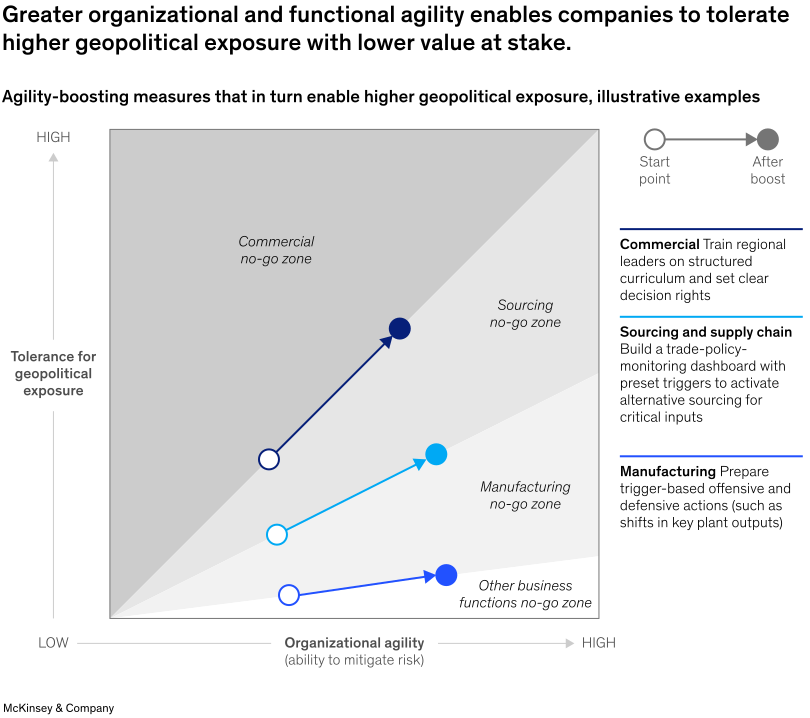
MNC leaders who assess their markets’ geopolitical distance and quantify the value at stake, then pair that with steps to develop robust agility, are best positioned to tolerate higher levels of geopolitical exposure (Exhibit 4). They can establish “tolerance curves” across functions, with generally higher tolerance for geopolitical exposure for asset-light units that can easily shift operations (such as sales) but lower tolerance in capital-intensive or asset-heavy units (such as manufacturing). Their agility then gives them a significant advantage: They can move outward on the curve because they can respond quickly to shocks and opportunities. One food and beverage MNC, for example, has made significant investments in redundancy across its supply chain to boost its agility while remaining in geopolitically risky markets. “We can lose market share quickly if we’re not present,” the CEO explains.
Intensifying geopolitical volatility has put multinational corporations at a crossroads: adapt or fade away. Companies that build flexibility into their organizational DNA will have an advantage over competitors that treat geopolitical tensions as temporary aberrations. In today’s environment, competitive advantage flows not from global integration facilitated by centralized functions but from understanding the value at stake in each unit of the enterprise that geopolitical exposure can either create or destroy—and having the operational agility to react fast.