Britain’s energy transition is moving from ambition to execution. The power system must expand and modernise at an unprecedented pace while keeping bills affordable and supply reliable. For businesses across the energy value chain, the opportunity increasingly lies in solving the bottlenecks that determine how quickly new capacity can be built, connected, and used.
In the October 2026 Budget, the UK government set out its priorities for making energy more affordable by ensuring new clean generation delivers value for consumers and can connect to the grid, reducing exposure to international gas prices, and delivering cheaper, faster grid connections.1 Delivering on these priorities while maintaining reliability will require a substantial shift in how the system is built and operated.
The challenge is already visible. Large industrial users face electricity prices of about £0.27 per kilowatt-hour (kWh), more than 60 percent above the International Energy Agency (IEA) median of about £0.17/kWh.2 At the same time, demand is set to grow at roughly 3 percent a year, driven in part by data centres and electric vehicle (EV) adoption.3 Gas still sets the wholesale electricity price around 60 percent of the time, leaving bills exposed to global gas price shocks.4 Britain starts from a position of high reliability, but the April 2025 Iberian blackout is a stark reminder that systems built for a different era struggle with the supply pluralism and volatility that come with increasingly complex power systems.5
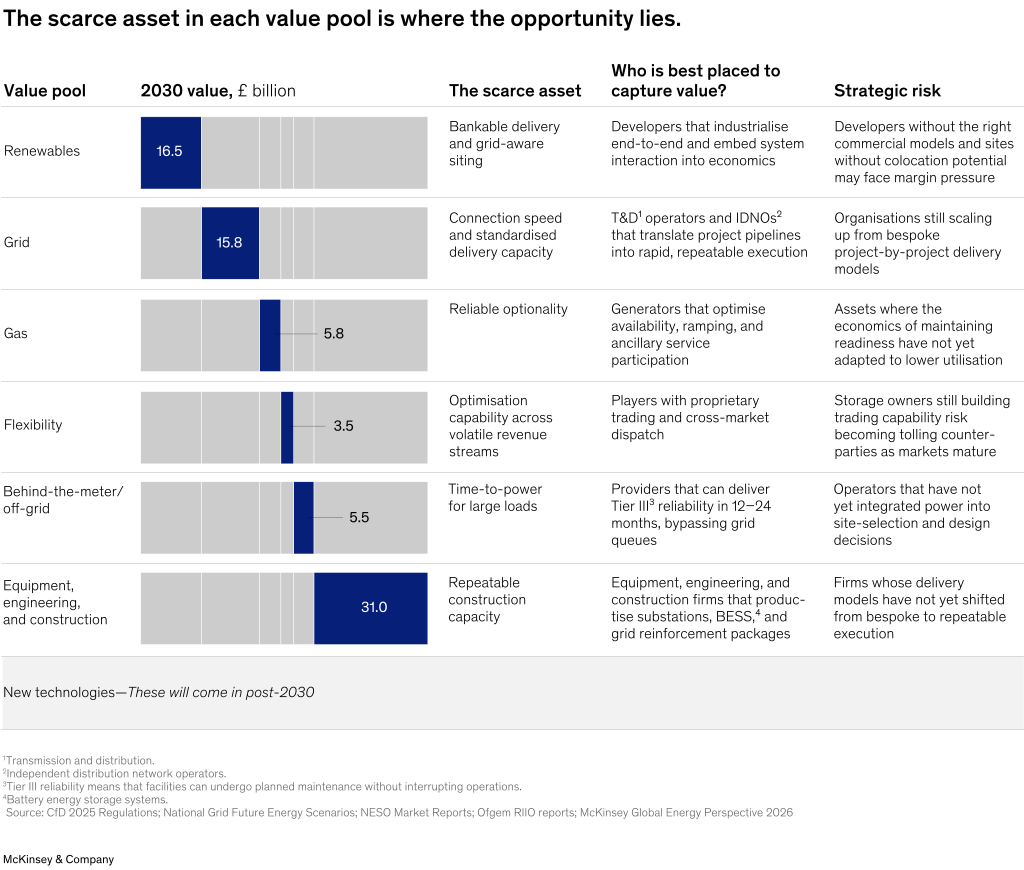
Our analysis suggests that meeting this challenge will require a different model for planning, building, and operating the electricity system, not simply incremental expansion. We estimate that, by 2030, businesses that can help remove critical bottlenecks could unlock about £78 billion a year in commercial opportunity—from developers and network operators to technology providers and flexibility services.
The commercial and consumer cases are closely aligned. The same bottlenecks that constrain business value also add to overall system costs, which affect household and industry bills. Transmission constraints are one example: The National Audit Office reports that constraint costs totalled £1.9 billion in 2025–26 and could reach £7.8 billion by 2030 without concerted action to accelerate grid upgrades.6
This article maps that opportunity across six value pools and identifies what it will take to capture it (see sidebar “Methodology”). The prize is not only value for energy businesses but also a cleaner, more affordable, and reliable power system that supports Britain’s wider economic growth.
Six value pools: How to capture the value in each
Six value pools offer opportunities for Britain’s energy leaders to 2030 (exhibit). Each of these value pools requires its own strategy to capture value and carries its own strategic risks, while new technologies offer opportunities to develop a strong position for value creation over the next decade.
1. Renewables: Making projects bankable at scale
Britain’s renewables base is expanding. Allocation Round 7 cleared a record 14.7 gigawatts (GW), underscoring the scale of the build-out.7 As the pipeline grows, what matters most for consumers and energy companies is delivering projects that are cost-competitive, financeable, and able to connect to the grid. The challenge is increasingly shifting from securing development rights to delivering bankable projects in an environment of higher financing costs, four-year equipment lead times, and grid constraints that can materially affect returns. Ørsted’s decision to pause the Hornsea 4 offshore wind project in the face of rising supply chain costs, interest rates, and schedule risks illustrates how quickly project economics can deteriorate, even for experienced developers.8
Developers that industrialise the end-to-end value chain will likely be the ones that sustain margins. This includes earlier supplier commitments, disciplined risk allocation with engineering, procurement, and construction (EPC) partners, and delivery models that reduce interface risk before bids are submitted. Co-locating renewables with utility-scale batteries could further improve bankability by enabling generators to respond to market signals, earn flexibility revenues, and reduce curtailment. The recently launched Reformed National Pricing programme reinforces the importance of storage and system-aware siting in reducing overall system costs.9 Projects such as RES’s Larks Green and RWE’s co-located solar and storage development in Devon illustrate the model emerging in practice.10
Behind the meter, new service models are also lowering upfront barriers for businesses and households. Solar-as-a-service providers can finance, install, and maintain on-site solar in return for a fixed price per kilowatt-hour, while Sunsave has introduced residential solar-and-battery subscriptions and E.ON is piloting an energy as a service (EaaS) proposition combining EV charging, heat pumps, and home energy management.11 Digital platforms are key to making these models viable at scale, allowing providers to monitor and optimise distributed assets in real time, aggregate them into virtual power plants (VPPs), and participate in flexibility markets.
2. Grids: Faster, more cost-effective connections
Approximately £70 billion of transmission investment will be needed between 2025 and 2031 to connect new generation and strengthen system resilience.12 At the same time, demand-side pressure has accelerated sharply, with Ofgem reporting that connection applications rose from 41 GW to 125 GW in under a year, with data centres accounting for at least 80 GW.13 Network congestion is already forcing curtailment, with offshore wind losing roughly 11.5 percent of output since 2023.14 Reducing network constraints and accelerating efficient connections can help lower overall system costs while supporting investment and economic growth.
The system is already responding. Accelerated Strategic Transmission Investment (ASTI) is driving major transmission projects, and RIIO-3 has moved the network into a new five-year delivery cycle. The National Energy System Operator (NESO) has reformed its connection process and now prioritises projects that are ready and aligned with national energy targets. Ofgem is developing measures to address speculative connection applications, while the government has confirmed plans to prioritise strategically important electricity demand, including data centres.15 Most recently, the UK government announced the establishment of Great British Grid, a new publicly owned body that will work alongside existing network operators to accelerate network investment and connections.16
However, planning, supply chain, and system access constraints could still slow delivery.17 The September 2026 National Planning Policy Framework asks plan-makers to consider network capacity and infrastructure needs earlier, while NESO’s emerging Strategic Spatial Energy Planning is intended to provide a more coordinated view of what should be built where.18 At the distribution level, the challenge is anticipating where electrification will materialise. ED3 and NESO’s new regional planning processes are intended to help distribution network operators (DNOs) invest ahead of demand without overbuilding.19
Within this context, operators that shift from bespoke projects to programme-level standards, modular substations, and portfolio-level supply chain management could deliver projects faster and more cost-effectively, helping to reduce overall system costs. Independent distribution network operators (IDNOs) that are able to mobilise capital and accelerate connections could also find a distinct opening. Digital technology and AI can further increase network productivity by triaging applications, forecasting congestion, identifying schedule slippage, and predicting equipment failure. Early examples include UK Power Networks’ Envision platform and EA Technology’s VisNet tools.20 The UK government’s September 2026 work on an AI-enabled clean energy system reinforces the direction of travel; the commercial test is whether these tools measurably improve throughput, reliability, or cost.21
3. Gas: Operating for system reliability
Gas is likely to remain important to Britain’s system reliability beyond 2030, even as the amount of electricity generated from unabated gas declines. Meeting demand during longer periods of low wind and solar output will require a mix of resources, with dispatchable gas remaining important until enough low-carbon firm and flexible capacity is available. NESO projects that roughly 35 GW of unabated gas capacity may still be needed around 2030.22
This changes the economics and operating model of gas generation. Plants may run fewer hours but become more valuable when the system needs reliable, fast-response capacity. More frequent starts, stops, and ramping also increase operational complexity and thermal stress. Generators will therefore need to maximise availability and responsiveness, protect bankability through capacity, balancing, and other flexibility revenues, and selectively prepare assets for lower-carbon operation.
The same shift has implications for gas transmission and import infrastructure. As domestic production declines and the system becomes more variable, these assets will need to remain reliable and flexible enough to manage seasonal swings and supply shocks, supported by stronger optimisation and balancing capabilities. RIIO-GT3 is now in operation, prioritising reliability, efficiency, and resilience.23 Selective investment in storage and readiness for hydrogen or carbon capture, utilisation, and storage (CCUS) could preserve longer-term optionality.
4. Flexibility: Optimising energy use and system costs
As wind and solar make up more of Britain’s power mix, flexibility—the ability to adjust supply or demand when the system needs it—becomes increasingly important. It is needed across timescales ranging from balancing supply and demand within the day to covering longer periods of low renewable output. The system will therefore need a mix of storage, demand response, interconnectors, and dispatchable generation. Britain could require 40–50 GW of longer-duration flexible capacity by 2030.24
As flexibility markets mature, however, simply owning an asset is not enough. Returns can fall quickly as more participants enter individual markets, and the same asset can earn very different returns depending on how effectively it is used across wholesale power, balancing, capacity, and local flexibility markets. The challenge for asset owners is therefore to combine physical assets with strong trading and dispatch capabilities, either in-house or through partners.
Emerging commercial models show how this can work. Statera Energy’s 300-megawatt (MW) project, backed by a Statkraft PPA with a revenue floor, illustrates how revenue certainty and optimisation can support investment.25 For long-duration storage, Ofgem’s cap-and-floor scheme has provisionally selected its first projects, providing greater confidence that more capital-intensive assets can attract investment.26
Consumer and business flexibility is also becoming a more established part of system operation. The July 2026 update to the Clean Flexibility Roadmap reports that NESO met its first annual target of 170 MW of new industrial and commercial flexibility and expanded the Demand Flexibility Service to include increases as well as reductions in demand.27 Octopus Energy’s Kraken platform coordinates approximately 2 GW in real time.28 Scaling further will depend on simpler propositions, greater automation, and clearer ways for consumers and businesses to participate.
5. Behind the meter: Solving the time-to-power challenge
For data centres and other fast-growing loads, access to power is becoming a critical constraint on growth. Grid connections can take five to ten years,29 while data centre capacity continues to grow rapidly across Europe.30 Against that backdrop, about 50 percent of data centre operators expect to use some form of behind-the-meter power.31
The response is broader than a simple choice between waiting for the grid and generating power on site. Options include flexible grid connections, co-location with generation or storage, demand response, and temporary or permanent on-site power. AVK and Landmark Power Holdings, for example, are developing microgrids using gas engines and carbon capture,32 while Floral Energy is combining renewables, thermal generation, and storage with digital optimisation.33
No single technology is likely to dominate. For larger sites, on-site gas generation may provide a bridge or back-up solution, but its economics need to be weighed against fuel and carbon costs, the risk of assets becoming obsolete, and the prospect of a future grid connection. Over time, technologies such as fuel cells and small modular reactors could provide reliable, lower-carbon power.
The opportunity lies in combining technologies to reduce time-to-power. Providers that can deliver Tier III-grade reliability34 in 12 to 24 months through a mix of grid access, storage, generation, and modular solutions could create significant economic value. For operators, power availability is increasingly a factor in site selection and design rather than something addressed after a site is chosen.
There is also a wider system trade-off. Heavy reliance on on-site generation can leave fewer users sharing the fixed costs of the grid, while requiring strategic projects to wait for a full grid connection can delay investment and growth. In many cases, the best solution is likely to combine grid and on-site resources, balancing speed, reliability, cost, carbon, and the ability to connect more fully to the grid over time.
6. Equipment, engineering, and construction: Industrialising delivery to unlock an affordable transition
Britain’s transition to cleaner, more affordable power depends on a value chain far beyond energy providers. Raw materials, manufactured equipment, engineering, construction, and project delivery could all become bottlenecks. Although much of the value in areas such as turbines, solar panels, batteries, and grid equipment is captured overseas, a significant domestic opportunity remains in building, retrofitting, and integrating substations, battery storage, grid reinforcement, generation assets, and nuclear projects.
The constraint is increasingly delivery capacity itself. Infrastructure execution costs have risen by about 30 percent relative to GDP per capita since 2007,35 and the Construction Industry Training Board (CITB) estimates that the United Kingdom will need more than 206,000 additional skilled workers between 2026 and 2030.36 The National Audit Office identifies planning, supply chain, and system access risks as significant threats to delivering the required transmission upgrades.37 Power projects compete for engineering talent, equipment, contractors, and delivery capability with water, roads, rail, and digital infrastructure. The UK government’s September 2026 planning framework seeks to address part of this challenge by bringing energy and water infrastructure needs into development planning earlier.38
Because capital costs affect final consumer costs, delivering infrastructure faster and more efficiently can improve the affordability of electricity. Companies that can turn recurring projects into standardised products could be better placed to deliver at scale. Standardised offshore wind platforms, for example, helped reduce levelised costs by more than 50 percent over ten years,39 while Sizewell C expects about 20 percent cost savings from replicating the Hinkley Point C design.40 Similar approaches could apply to repeatable assets such as battery storage packages and substations, reducing engineering effort, interface risk, and delivery time.
Of course, not every project can be standardised. Complex, first-of-a-kind developments such as Balfour Beatty’s £833 million Net Zero Teesside contract will still require bespoke engineering and delivery.41 The opportunity is therefore to standardise what can be repeated while strengthening control of the projects that cannot.
Digital tools can support both. The priority is a single, trusted view of design, cost, schedule, and risk across the project ecosystem, supported by common data standards and disciplined management routines. Integrated project controls, digital twins, and targeted AI-enabled workflows can then improve visibility and speed up decisions. Generative scheduling, for example, can rapidly test the effect of design changes, procurement constraints, labour availability, and site conditions. McKinsey estimates that it can enable about 10 percent faster schedules, three-times-faster capital-cost estimates, and roughly 15 percent lower capital expenditure42 (see sidebar “Beyond 2030: Technologies that could reshape the next value pools”).
Three moves could separate the leaders
Across all six value pools, three moves emerge among companies looking to capture disproportionate value while accelerating Britain’s affordable energy transition:
- Industrialise delivery. Standard designs, modular construction, portfolio-level supply chain management, and repeatable playbooks apply across all project types, from a £1 billion transmission asset to 100,000 rooftop solar installations. The common thread is converting bespoke execution into a scalable system, supported by financing models and long-term capital partnerships that enable delivery.
- Make system and asset capacity more productive. Those that get more throughput from scarce grid, generation, storage, workforce, and project delivery capacity will likely capture more value. AI and advanced analytics can help forecast congestion, optimise storage, predict failures, schedule field teams, and identify project delays earlier. The goal is measurable improvement in utilisation, reliability, speed, and cost—not technology deployment for its own sake.
- Innovate commercial models, not just tech. Commercial models matter as much as technical performance. Tolling and optimisation agreements, EaaS propositions, flexible connection structures, and project financing can allocate risk to those best able to manage it and align commercial returns with lower system costs. Organisations that make new technologies and delivery models repeatable, financeable, and system-positive could define the next phase of the market.
Delivering a cleaner, more affordable, and reliable electricity system could create about £78 billion of annual commercial revenue across six value pools by 2030. Much of that value is limited by a common set of bottlenecks, including connection and network capacity, construction and supply chain capability, optimisation capacity, time-to-power for large loads, and repeatable delivery models.
Addressing these bottlenecks can lower overall system costs as more efficient grid delivery can reduce constraint costs and support economic growth; industrialised renewable development can improve project economics; greater flexibility can reduce exposure to peak prices; and better commercial models can help bring capital forward. Success requires both rapid expansion of the system and more productive use of capacity, supported by an effective policy and regulatory backdrop and long-term private capital.
The companies best positioned to create value will be those that help deliver a cleaner, more affordable, and reliable electricity system through better infrastructure delivery, greater asset productivity, and innovative commercial models. In doing so, they could also support Britain’s wider economic growth.