Renewable energy generation, especially onshore wind and solar photovoltaic (PV), is rapidly expanding across the globe. The growth is reflected in the numbers—for example, the average portfolio capacity of the top ten onshore wind operators in Europe and North America currently exceeds five gigawatts (GW), and capacity has expanded at an average annual rate of 11 percent over the past two decades. For many leading renewables companies, onshore wind and solar PV assets now represent over 60 percent of their total company value.1
But this impressive growth has not translated into equally impressive value creation. Across the energy transition, the renewables sector is facing a new reality: Scale alone does not necessarily guarantee profitability. High interest rates, inflation, falling power prices, and persistent supply chain issues are squeezing margins.
Against this backdrop, operators have often focused on optimizing capital expenditure (capex) because of the high impact on internal rate of return (IRR), frequently overlooking operations and maintenance (O&M) as a source of value. Yet, as portfolios grow larger and more complex, O&M increasingly offers opportunities to improve profitability—especially for solar PV assets due to decreasing capex. Optimized maintenance strategies, smarter supplier contracting, and performance-enhancing technologies such as AI can meaningfully increase energy yields while reducing cost.
According to our analysis, operators that actively pursue O&M opportunities could realize tangible value of more than €9 million per GW annually for onshore wind and approximately €3.4 million per GW annually for solar PV.
Operational shortcomings are costing millions
Our annual McKinsey Onshore Wind and Solar PV O&M Benchmarking tool compares renewable energy portfolios in Europe and North America on availability, cost, and performance (see sidebar “Our methodology”).
The 2025 benchmarking results reveal a 12 to 15 percent performance gap between median and top-performing portfolios, based on a composite of cost, lost revenue from availability shortfalls, and performance guarantees (Exhibit 1).2
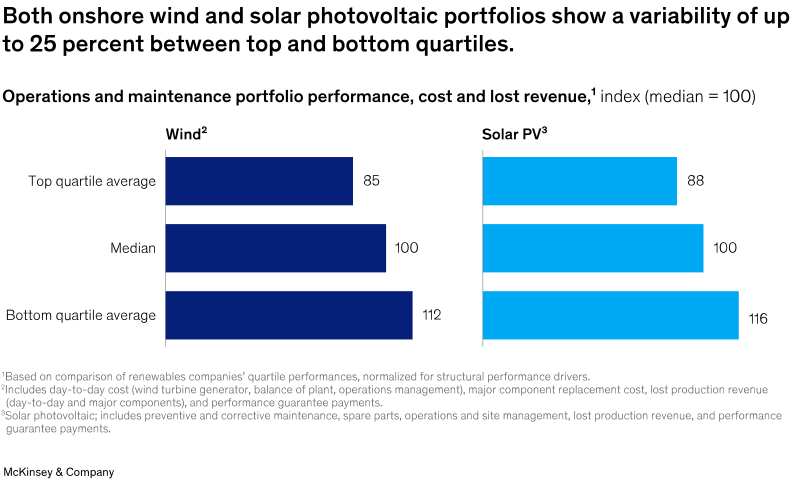
Top-quartile portfolios for onshore wind outperform the median by 15 percent, while bottom-quartile portfolios lag behind the top-quartile ones by 25 percent, on average. Our benchmarking suggests that a large share of this performance difference is driven by day-to-day operational performance rather than major component failures. Solar PV portfolios show a similar pattern: Top performers operate 12 percent better than the median, while bottom-quartile portfolios fall 25 percent below the median.
Such variability indicates that companies cannot take strong O&M performance for granted—they need to be more intentional in their approach to excel in this space.
The results of the analysis are clear: The value at stake is substantial. With the right O&M approach in place, portfolio operators could achieve significant bottom-line impact (Exhibit 2).
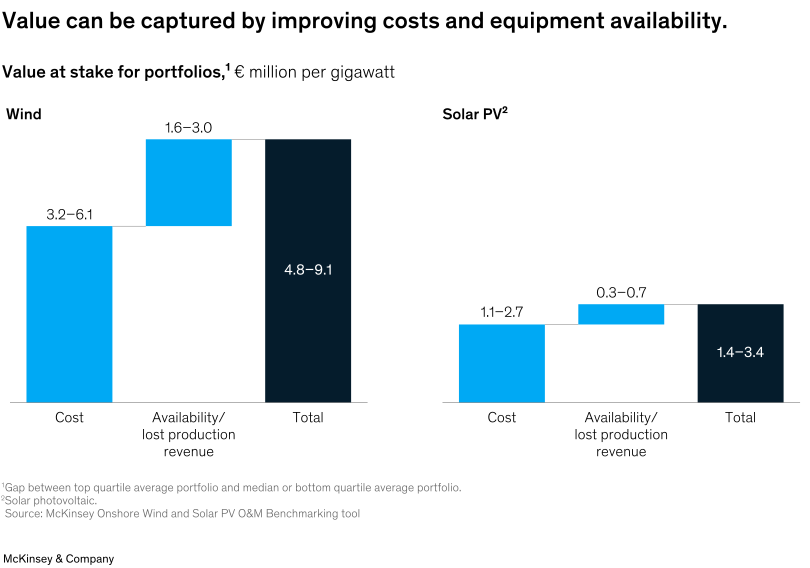
Onshore wind operators in both Europe and North America could capture up to €9.1 million per GW annually. Labor and spare parts costs, including operations management and site personnel, account for between €3.2 million and €6.1 million per GW of the total potential value. A further €1.6 million to €3.0 million per GW could be saved by reducing asset downtime, both by preventing equipment failures and shortening long repair times. The majority of the opportunity in onshore wind stems from day-to-day O&M, rather than major component replacement, which only represents about 30 percent of the opportunity.
Solar PV plant operators could capture up to €3.4 million per GW annually. This includes €0.3 million to €0.7 million per GW from reduced equipment downtime, and up to €1.1 million to €2.7 million per GW from labor and spare parts costs.
Yield enhancements could further boost this opportunity, and a number of approaches are available for operators. Wind operators could improve power output by adapting turbine parameters, and solar operators could do so by reducing inverter inefficiencies. They both could also strengthen market integration, for instance, by optimizing generation forecasts to minimize imbalances, aligning schedules with power prices (revenue-based versus availability-based metrics), and tapping into additional value pools, such as ancillary services.
O&M execution is as important as selecting the model itself
To realize the full potential of their portfolios, onshore wind and solar PV operators may need a strong O&M strategy and a robust contracting approach, underpinned by operational excellence. While choosing the right O&M model—self-perform, hybrid, or full-service agreements (FSA)—is important, our analysis shows that execution of the chosen model ultimately is what matters.
Each O&M model can deliver top-quartile outcomes, but they require different levels of effort and investment. As the service landscape evolves, not every O&M model is available for each asset. OEMs tend to focus more on newer turbine models, only renewing older ones when they are highly profitable. Third-party service options, meanwhile, are not universally available for each asset location and turbine model. As a result, operators are often pushed to adopt a more hands-on approach, either with the self-perform model or partnering with third-party service providers to expand their capabilities.
Due to the variances in models, operators should choose the one that best suits their operational context:
- Self-perform: The self-perform model gives the operator maximum control over performance. The operator manages the basic day-to-day maintenance and carries most of the operational risk, but avoids third-party risk premiums and margins and captures most of the value when operational excellence is achieved. Successful execution requires robust in-house capabilities across the O&M value chain and a fit-for-purpose, tech-enabled production system.
- Hybrid: In this model, the operator retains responsibility for select activities (such as major component replacements), while other areas are outsourced to OEMs or independent service providers (ISPs) via service agreements. Outsourced work, such as basic day-to-day maintenance with servicing and troubleshooting, may have performance and availability guarantees. The hybrid model is similarly competitive to the self-perform model in terms of value, but risk can be partially lower if guarantees are provided for outsourced scopes. Because this model involves both in-house and outsourced work, proper implementation requires a mix of skills in contractor selection and management, clear interface definitions, and internal excellence in retained activities.
- Full-service agreements: This model fully outsources the entire O&M scope. For onshore wind, service providers cover the basic day-to-day maintenance and major components at a contracted fee. FSA models tend to deliver a lower performance variance at higher median costs. To achieve optimal performance with this model, operators need to implement best practices in contractor awarding and management.
While assets across all these strategies can achieve top-quartile performance, our benchmarking found variability in performance between operators employing the same model, underlining the importance of strategy execution. For instance, 30 percent and 29 percent of self-perform and hybrid assets achieved top-quartile performance, respectively, but a similar share of assets were in the bottom (fourth) quartile (Exhibit 3). A smaller percentage of assets using the FSA model—approximately 15 percent—were in the top quartile; however, these assets tended to have a lower risk profile compared to self-perform and hybrid models.
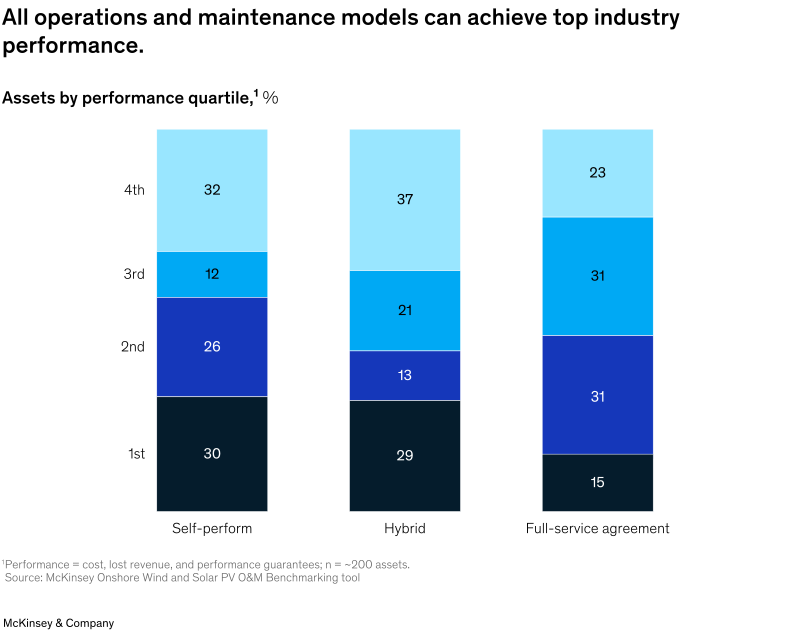
The implication is evident: Top performance is not determined by the O&M model alone, but by how effectively operators execute the overall O&M strategy. They need to decide which general O&M model archetype they want to have in their portfolio—taking into account not only risk appetite, but also which model is available, given the market constraints. Once the correct O&M model has been chosen, operators need to implement it with intention.
The distinct characteristics of top-performing portfolios
Regardless of the O&M model used, our analysis shows that the most successful portfolios consistently have several key characteristics:
- Strategic O&M model deployment: Top operators have a clear rationale for choosing a self-perform, hybrid, or FSA model—and then they design a fit-for-purpose production system around that choice. When working with OEMs, they structure contract durations to reflect long-term strategic goals. They negotiate contract terms that prioritize operational KPIs and full access to operational data, not just availability guarantees.
- Superior transversal functions and procurement: Leading operators maintain well-organized support functions, in which transversal support delivers specialized capabilities across portfolios in tight alignment with the front line to drive value. They also excel in procurement strategies that deliver cost savings across spare parts, logistics, and services, and secure competitive and flexible supply contracts.
- Operational excellence through technology: Operators with top-quartile portfolios standardize their technology-enabled processes to maximize availability and yield while minimizing costs. Lean organizational setups, resource sharing across sites, and robust monitoring and performance management systems further support the portfolios’ successes.
In contrast, lower-performing portfolios or assets often exhibit a variety of operational challenges, including:
- Frequent minor equipment failures: Common contributors to equipment failures include missed or poor preventive maintenance, failure to adjust maintenance plans to equipment criticality and age, and insufficient root cause analysis.
- Resource shortages and inventory challenges: Limited availability of specialized technicians or vehicles and misaligned stock levels of spare parts can delay critical maintenance activities. Supply chain constraints can extend maintenance timelines too, reducing overall energy production.
- Knowledge gaps and inefficient service agreements: Some of the worst-performing portfolios falter when they transition to a self-perform model, because they lack the necessary expertise to maintain their equipment. On the other hand, those that rely on OEMs may be locked into costly, underperforming service agreements, with understaffing or inexperienced technicians, leading to lapsed maintenance plans and slow response times.
Improving the core fundamentals
To achieve top-quartile performance in today’s competitive energy landscape, operators could develop a well-defined O&M strategy, centered around the right models for their needs, a robust contracting approach, and a single-minded focus on operational excellence—all underpinned by a tech-enabled system.
Developing a robust O&M strategy
As discussed earlier, the starting point for operators is to clearly define which O&M models best suit their portfolios and what internal capabilities each model requires, weighing the trade-offs between insourcing and outsourcing specific scopes of work. Establishing a clear set of guiding principles for deploying these models can ensure consistent and effective decisions.
Optimizing the contracting approach
Leading operators tailor their contracting approach to ensure maintenance is timely, of a high-quality, and cost-effective. Operators can adopt a rigorous tender strategy for selecting OEMs and ISPs, even for whole bundles of assets. O&M contracts may include robust terms and conditions, with performance guarantees, data access provisions, operational KPIs, and termination clauses. At the same time, collaborative supplier relationships and aligned incentives are essential. By regularly reviewing contracts and retendering existing contracts, operators may realize additional value and improved performance (see sidebar “A case study: How retendering saved an operator millions”).
Achieving operational excellence with technology
Operational excellence may only be achieved once robust technical, management, and people systems are in place. The technical system encompasses optimized processes, tools, and systems, ensuring efficient service and rapid troubleshooting. The management system supports these processes through solid organizational structures, good performance management, and an effective problem-solving approach. The people system focuses on building the right capabilities, fostering a performance-driven mindset, and encouraging behaviors that increase results.
Technology can help transform data into repeatable decisions across assets by streamlining the end-to-end maintenance process. This can be achieved by integrating operational data—such as supervisory control and data acquisition (SCADA), computerized maintenance management systems (CMMS) or enterprise asset management (EAM) history, condition monitoring signals, and OEM documentation, as well as inventory and procurement data. AI can move digitally nascent organizations with siloed predictive analytics toward a more prescriptive, digitally integrated, AI-first way of working with a human in the loop where necessary.
Maintenance strategy optimization and bad actor management
Technology can systematically strengthen predictive maintenance by connecting work order history, failure mode libraries, failure mode and effects analysis (FMEA), asset criticality, and OEM recommendations. This integration continually refines task lists and intervals, shifting from a one-size-fits-all approach to risk- and condition-informed programs. It also moves from part number-based to serial number-based maintenance and from historical data to real time data.
Once all data are in place, a health index for the equipment can be established to trigger actions, including automatic suggestions for adapting the preventive maintenance program (for example, frequency). Bad actor management can be accelerated significantly, and root causes identified based on pattern analyses (such as repeated equipment failure after servicing, pointing to a training issue). This helps operators focus scarce engineering capacity on the driving solutions instead of running analyses.
Planning and scheduling optimization
Digitally supported planning tools can improve weekly and daily scheduling by optimizing crew routes, task bundling, and timing around constraints, such as resource availability, weather windows, and access restrictions. Gen AI can rapidly assess schedule scenarios and propose feasible plans, which can be especially valuable in the hybrid and self-perform models where operators have to coordinate multiple internal and external resources.
Service and troubleshooting efficiency
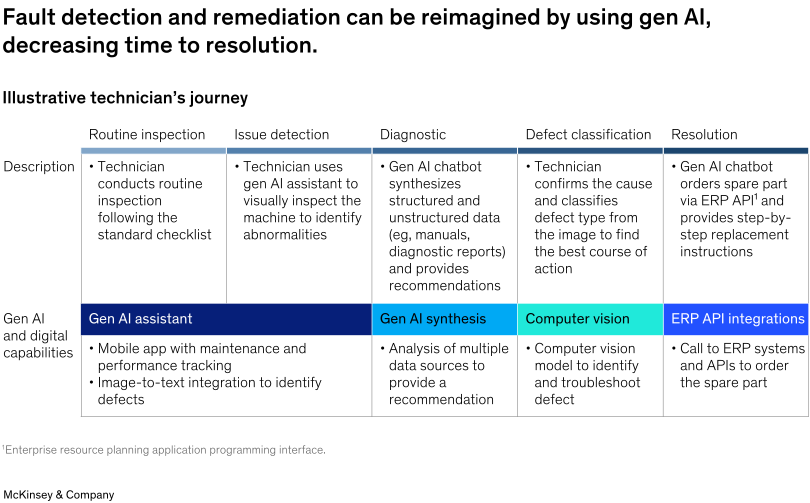
Execution quality can be improved when standard work is digitized and made usable in the field. Digital work packages (including procedures, tools, parts, time standards, and safety requirements) that are deployed through mobile applications and connected back to the CMMS or EAM can help reduce rework, improve data capture, and shorten the time to diagnose a problem. In addition, an augmented engineer or a gen AI maintenance expert can act as a copilot with the technicians to help them find the right information, troubleshoot recurring issues, and draft high-quality work orders consistently across a fleet (Exhibit 4).
Spare parts cost and availability
Spare parts are a major factor in both cost and downtime, particularly when lead times are long or stocking levels are misaligned. Inventory analytics, specifically combined with a health index, can optimize reorder points, safety stocks, and stocking locations by using demand history, lead times, and service-level targets, thereby reducing both stockouts and excess working capital. In fact, much higher service levers can be obtained with the same or fewer inventory levels. Spare parts forecasting and autonomous inventory management can prepare operators for known risk items, such as critical turbine and inverter components, while reducing avoidable spend leakage.
Contractor management
Given the prevalence of outsourced scopes in renewables, digital technology can materially strengthen contractor performance management through transparent KPIs, faster validation of service delivery, and tighter commercial governance. Gen AI can support contract analytics (for example, Contract AI3) and high-volume invoice reconciliation, helping operators detect noncompliance and reduce value leakage, while maintaining collaborative supplier relationships and aligned incentives. Communications with contractors on day-to-day performance can be substantially enhanced by gen AI’s ability to gather all required information quickly and efficiently.
Renewable energy assets have never been more important for meeting the world’s growing energy needs and decarbonization goals. However, a viable business case is critical to encourage onshore wind and solar PV operators to invest and expand, especially in the current macroeconomic climate where profitability is challenged.
Operators with top-performing renewable energy portfolios have an optimized O&M strategy that enhances contracts and drives operational excellence through technological improvements. Unlike capex, O&M’s potential can be realized even when assets are already in operation. For operators looking to boost value, O&M may present a significant opportunity.
To capitalize on this potential, operators could start by looking at their current O&M models and strategies to identify the areas with the most substantial value uplift potential. From there, a coherent value capture road map—one that blends proven conventional approached with emerging AI-driven solutions—can turn that potential into measurable performance gains. In an industry where margins are under pressure and the energy transition demands more from every asset, reevaluating O&M strategies is not just an opportunity; it is an imperative.