Telecom operators (telcos) have played a critical role in laying the foundation for the massive, technology-driven economic and financial gains of the 21st century. Yet for most of that period, the industry hasn’t managed to share in much of the spoils. While established tech titans and emerging start-ups alike were profiting from successive generations of wired and wireless infrastructure, the telcos that deployed and operated those networks found themselves weighed down by the crushing capital burden as well as intense new competition. That initial period from the late 2000s to 2015 put great pressure on the industry’s revenues and margins, leaving it with an ROIC that fell below the cost of capital.
The industry has spent much of the last decade trying to spur a recovery, but its track record has been mixed. Despite making modest progress by embracing selective consolidation, more disciplined and agile operating models, and adjacent businesses or services, it’s often seemed the best the industry could do over the past decade has been to tread water. The market value of telcos has done just that, as the persistent challenges of the prior five to ten years continued to take their toll. Regulatory constraints, a legacy business model, shifting customer expectations, and technological disruption have helped saddle telcos with both TSR and enterprise value multiples that have stayed flat at around 5 to 7 times for the past ten years, even as the tech sector’s have continued to grow to 15 or higher.
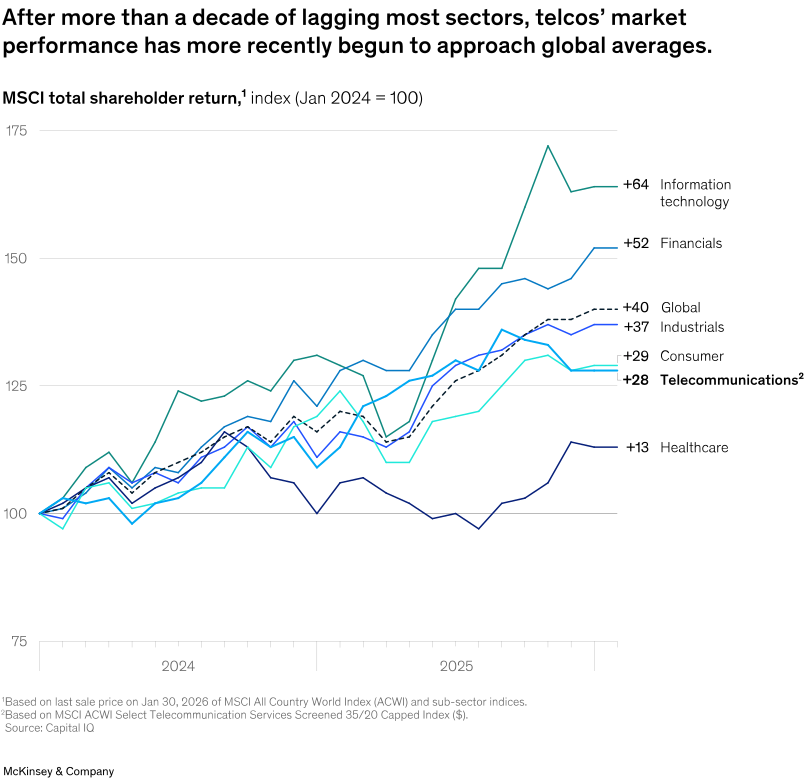
However, as the industry turns the page on the first quarter of the 21st century there are some signs that telcos may finally be poised to embark on a new era of healthy growth. While the industry experienced notably low TSR growth over the last two decades—at 29 percent versus 235 percent for all sectors globally—it has stabilized, growing 28 percent since the start of 2024, firmly on par with the overall global market (Exhibit 1).1
At the same time, in most regions, the longstanding imbalance between revenue growth and investment growth is beginning to narrow. From 2019 to 2021, for instance, investment capital (IC) at North American telcos grew at a CAGR of 1.8 percent while revenues grew just 0.4 percent; by contrast, from 2021 to 2024, IC declined at a CAGR of 0.4 percent compared with revenues’ annual decline of 1.2 percent. The industry is showing a more hesitant, wait-and-see perspective on capital outlays, fueled in part by the fact that many costly 5G and fiber rollouts are close to completion. In a survey of 152 telco executives last year, only a third said they expected investment capital growth to accelerate over the coming three to five years, a 50 percent decline from the prior year’s outlook.2
Still, driving healthy, long-term growth for telcos will require more than taking a sharper approach to infrastructure investments or reaping productivity improvements. It will take the industry embracing fundamental change and making strategic moves in four key domains:
- AI-native transformation. Comprehensive, AI-driven reinvention of the end-to-end processes and operating model across all functions requires the capability to partner strategically with hyperscalers, system integrators, and solution and change management specialists. At the same time telcos will need to harness the technology and data to help automate workflows and break down legacy silos and fragmented systems.
- Growth beyond the core. Achieving the goal of healthy, long-term growth requires using AI to redefine consumer and enterprise value propositions through hyper-personalized, automated engagement, both with core offerings as well as an expanded, diverse portfolio of low-cost adjacent products and services.
- Infrastructure innovation. As sovereign AI and data infrastructure become strategic differentiators in select markets and ownership models evolve to unlock capital and increase asset utilization, rethinking and upgrading legacy systems and technologies is critical.
- Market shaping. In an industry becoming increasingly commoditized, carefully navigating market dynamics and regulatory environments is more essential than ever; structural transformation such as the delayering of infrastructure or carve-outs of non-core assets and continued consolidation remain critical, but only if pursued as part of a broader holistic strategy and transformation.
If telcos successfully execute a number of moves across these four domains, they could increase the industry’s lagging ROIC rates and lay the foundation for renewed top- and bottom-line performance, which could in turn lead to more favorable market valuations. Over the last five years, fewer than one in five large telcos across the globe has achieved above-industry-average growth in both revenue and profits, and those were the only players rewarded with enterprise value (EV) growth, delivering around 11 percent annual EV growth on average.3 Players that fail to make these significant shifts could face growing competitive pressure in an AI-driven environment. This article explores what it takes for telcos to avoid that fate.
Four strategic moves key for a new era of telco growth
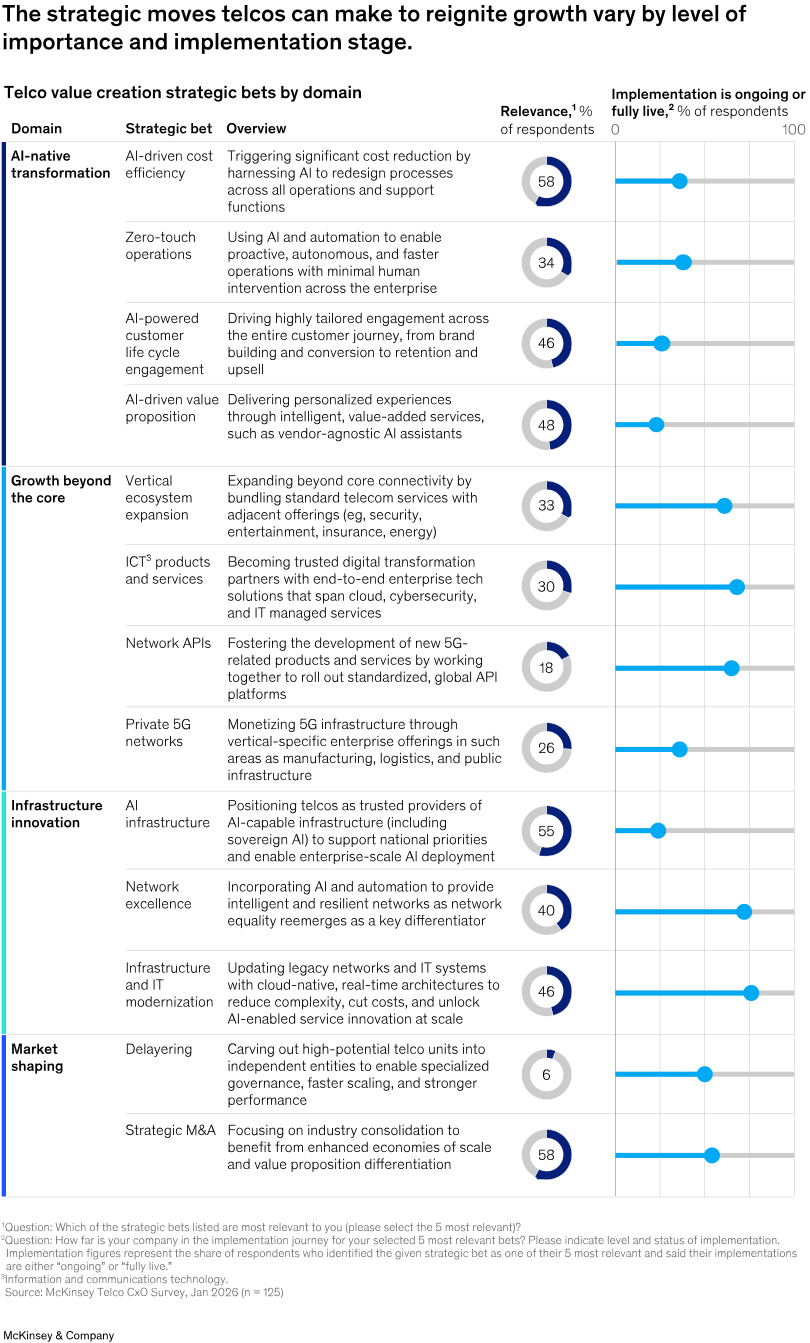
The range of strategic moves telcos can make to reignite growth is broad, spanning four primary domains, but the pace of adoption varies widely throughout the industry, and not all moves carry the same importance (Exhibit 2).
AI-native transformation
Like many other industries, telcos haven’t yet seen much top- or bottom-line impact from their experiments with gen AI across various parts of their organization. As with some of their previous technological initiatives, telcos have suffered from a siloed, piecemeal approach to incorporating gen AI or more recently agentic AI. They have tended to favor narrow use-case implementations or cost-reduction pilots over a comprehensive redesign of end-to-end domains, which have so far yielded little financial upside.
Industry leaders increasingly recognize that capturing AI’s full potential requires a more holistic transformation, supported by two critical enablers.4 First, data: access to a broad and integrated data foundation is essential to redesign processes end-to-end, and prevents data from becoming the source of a new generation of invisible silos. Second, the operating model: scaling AI requires cross-functional teams, rapid test-and-learn cycles, and continuous improvement embedded into day-to-day execution.
Though they remain relatively early in their AI journeys, with very few initiatives fully implemented, many telcos have started to make progress. Sixty-one percent of telco executives in a recent McKinsey gen AI–focused survey said they are focused on scaling gen AI use cases across functions and less on isolated pilots. And, 47 percent reported experiencing some impact from those efforts, up 20 percentage points from a couple of years ago.5 That impact is limited so far, with AI driving less than two percent of total revenues for more than half the operators we surveyed that have tested AI use cases. But the industry remains optimistic about its potential. Fully 64 percent of leaders said they expected the technology to contribute more than five percent of revenues in the near future, and 40 percent anticipated AI-driven cost reductions to exceed 10 percent once the technology is fully scaled across their organizations.6
As they attempt to achieve those goals, telcos will need to adapt to the fact that data is the core competitive asset in an AI environment. That gives even greater urgency to the industry’s pressing need to standardize its fragmented systems, break down silos, and make structured data easily accessible at all levels of the company. At the same time, standing out from the crowd could become even more challenging. The rise of AI-powered agents risks further commoditizing the telco market, with all players offering similar efficiency and service quality, a situation that could force telcos to be even more innovative and creative in communicating a distinctive value proposition.
Overcoming such risks and succeeding at an AI-native transformation will, above all, require telcos to embrace foundational change in the following areas:
- AI-driven cost efficiency. Arguably one of the most foundational elements of an AI-native transformation is to drive significant cost reduction by harnessing AI to redesign processes across all operations and support functions. It makes sense then that this area attracted the most consensus in our most recent telco leader survey, with close to 60 percent of executives choosing it as one of their top strategic priorities.7 Telstra, the leading Australian telco, achieved AU $122 million in cost savings in just the first year of its program to embed AI across all its corporate processes and business workflows. As part of what it dubbed Project T25, Telstra shifted from relying on a roster of 18 different tech vendors to establishing strategic joint ventures with just two, improving capability integration and governance in the process. Another telco developed a gen-AI powered copilot for its financial planning and analytics team that could handle much of the previously manual and time-consuming data collection and research activities, allowing employees to focus on higher value, more strategic analyses, and saving several millions in operating expenses.
- Zero-touch operations. Using AI and automation to minimize human intervention is another key piece of the puzzle. Reaching this goal of proactive, autonomous operations has the potential to radically reshape back office and support functions, but it is no small feat. It requires, among many key enablers, cross-domain data flows that seamlessly link IT, network, and operations with real-time, cross-domain data flows. BT’s procurement unit (BT Sourced) uses AI sourcing and analytics tools to automate and quicken tendering, supplier onboarding, and spend analysis, improving decision-making in the process.
- AI-powered customer life cycle engagement. Providing tailored engagement for both B2C and B2B customers is increasingly table stakes for any successful telco, and leveraging AI is essential to reaching that goal. If telcos can incorporate the technology into every stage of the customer journey, from brand building and conversion to retention and upsell, they can spur sizeable improvements in revenue (5 to 8 percent), upsell (50 percent), and churn reduction (30 percent). One telco call center struggling with periods of undercapacity and overcapacity, for example, was able to shave its customer wait times from 3 minutes to 30 seconds with no budget increase by using AI to better predict call traffic patterns and adjust staffing as a result. Another telco has used gen AI tools to cut by 70 percent the time it takes to develop and activate a new personalized marketing campaign or product offering.
- AI-driven value proposition. A key strategic bet that forms the core of an AI-native transformation is tapping the technology to provide hyper-personalized experiences and services. Such innovative offerings, which in some cases have shown the potential to increase B2C ARPU by as much as 5 to 10 percent, could range from vendor-agnostic AI assistants that help users deal with fragmented LLMs, to localized edge hosting of LLMs closer to the end user. Several telcos have already gone down this route: SK Telekom, for instance, rolled out an AI-powered personal assistant as an integrated part of its mobile plans that helps in such areas as shopping and travel.
Would you like to learn more about our Technology, Media & Telecommunications Practice?
This type of bold, multifaceted effort depends on several factors that can make the difference between realizing ambitions and encountering significant setbacks. These key enablers include:
- Change management. AI implementation ultimately comes down to helping a group of people, often after years of ingrained routines, to fundamentally reshape how they work day to day. That seismic shift requires time, committed and visible leadership, a comprehensive redesign of core processes and incentives, and a significant investment in upskilling. In a recent gen AI–focused survey of telco top executives, more than three-quarters identified slow adoption because of weak change management as the biggest obstacle to scaling AI impact.8
- AI-ready systems. These include systems that integrate and structure data from customer journeys in real time. They also include modular gen AI tools for content creation and targeting, and cross-functional, agile teams to enable personalization sprints and rapidly roll out and refine new AI campaigns.
- Cross-functional product squads. These include teams from the product, engineering, and go-to-market functions, and edge-ready infrastructure that can host LLMs locally, securely, and cost-effectively.
- Ability to form, manage, and scale strategic partnerships. These need to be made with a broader set of players complementing telcos in the AI and tech ecosystem, including hyperscalers, system integrators, specialist solution players, digital infrastructure specialists, and impact partners.
In those markets where telcos happen to be part of larger diversified conglomerates (such as those in many parts of Asia), building these enablers often presents platforming opportunities to commercialize capabilities both internally and externally.
Growth beyond the core
As traditional connectivity markets mature and competitive intensity continues to rise, telcos face mounting pressure to unlock new sources of sustainable growth. Even data, once the industry’s primary value creation engine, is increasingly commoditizing. Amid this challenging environment, telcos seeking a new commercial growth path are already testing and scaling new business models that extend well beyond core connectivity.
Telcos happen to be well-positioned for this pursuit. The sector’s position at the center of the digital economy affords it real-time access to data generated across networks, devices, locations, and usage patterns, and at a scale and granularity matched by few other sectors. This unique data advantage, combined with trusted customer relationships and ubiquitous infrastructure, enables telcos to shift from selling discrete products to delivering integrated, value-added services.
By responsibly and securely leveraging network and customer insights, operators can create differentiated, customized offerings in both B2C and B2B markets. These range from personalized consumer experiences (including energy, content, insurance, security, omnichannel retail and other offerings) built around a vertical ecosystem to industry-specific enterprise solutions that enhance security, efficiency, and performance. Leading players are already translating this shift into action by expanding into adjacent digital verticals, end-to-end ICT services, network APIs, and private 5G networks. In the process, they are converting experimentation into scalable growth, unlocking new revenue pools, and building a more resilient, long-term value creation model.
Vertical ecosystems expansion. Expanding beyond core connectivity to offer adjacent services that unlock new revenue pools is a critical component for telcos looking to drive a new era of healthy growth. These offerings could revolve around everything from security and entertainment to insurance, energy, and fintech, tapping the industry’s reach and infrastructure to dramatically expand the scope of customer relationships. Forward-thinking telcos are already leading the way in this area, shifting from a mindset of selling products into an ecosystem of varied services that can widen the value proposition. Canada’s Telus now gets a quarter of its revenues from B2B digital verticals for healthcare, agriculture, digital process and back-office solutions, part of a diversification strategy that has helped the company’s TSR outperform the country’s broader telco sector.
Several European telcos are adding additional services to their portfolio. Spanish operator MasOrange, for instance, has focused on expanding into adjacent categories such as energy, insurance, security, and health/telemedicine to serve its customer base with value-added services and to help increase ARPU and reduce churn, all while reinforcing its core connectivity value proposition. By leveraging a dynamic, TechCo operating model of independent units and agile platforms and scaling through partnerships and other flexible collaboration models, MasOrange has built a number of growing new businesses. These have included an app-controlled electricity-and-gas service, which it sold last year for 90 million euros; an insurance business (mobile, home, health, and payment protection) with a cumulative ambition of more than 7.5 million policies and over €1.5 billion in premium volume; a cobranded home security business (with ADT) that has reduced churn; and B2B focused offerings, including a cybersecurity and IoT offering that are supporting ARPU uplift and profitability through higher-value enterprise services. Italy’s WindTre has enjoyed similar initial success by rolling out insurance and energy products, using upskilling and realigned incentives to enable its store clerks to help drive interest and sales of a significant volume of policies or agreements.
- ICT products and services. As more enterprises seek out third-party support in optimizing their rapidly evolving patchwork of technologies and systems, telcos have a lucrative opportunity to play a bigger role in digital transformation. By expanding from core B2B offerings into end-to-end solutions that span cloud, cybersecurity, and IT managed services, the industry can grow B2B ICT into a dynamic business that accounts for as much as 20 percent of total telco revenue. One European telco used that model to grow its share of the domestic cloud market, upgrading its infrastructure, upskilling employees, and striking key partnership on the way to more than doubling its cloud-related revenues and earnings in four years.
- Network API. The effective monetization of 5G has been a significant challenge for telcos since the wireless technology’s debut several years ago. By working more closely together to roll out standardized, global API platforms, the industry can spur the creation of new 5G-related products and services that leverage features such as speed on demand, low-latency connections, speed tiering, and edge compute discovery. A trio of Brazilian operators recently partnered on an API initiative to help financial institutions improve digital security and anti-financial fraud efforts. Working with the industry’s GSMA Open Gateway Initiative, TIM, Claro, and Vivo developed three customized APIs focused on continuous mobile number verification, SIM card swap checking (to prevent account takeover attacks), and instant device location and validation. The services are already reaching close to 150 million customers and early results have been promising, not only generating $9 million in incremental revenue from the SimSwap API alone but also delivering tangible consumer benefits.
- Private 5G networks. Another vehicle for increasing telcos’ return on 5G is customized, vertical-specific enterprise architecture to enable advanced use cases. Many operators (including T-Mobile, O2, Vodafone, and KPN) are already launching such solutions, from smart hospitals or connected transportation to augmented retail experiences. By targeting areas such as logistics, manufacturing, and the public sector, such specialized networks could fuel incremental 5G monetization opportunities over time.
Achieving true commercial excellence requires a significant appetite for change as well as a number of specific enabling factors, including the following:
- embracing a new type of partner ecosystem and striking deals with vertical leaders to help drive the development of new offerings beyond the core; create an internal integration platform to ease the process of bundling, activation, and management of non-core services
- laying the operational and technical foundation to support ICT-driven partnerships, especially alliances with hyperscalers and provides of cybersecurity and software; that means developing a modular platform to manage full-stack solutions as well as a specialized salesforce skilled in catering to demanding enterprises and the integrated delivery and support systems that those customers expect
- establishing common application layer standards to minimize developer friction, and integrating network APIs with hyperscaler platforms to help expand the reach of new offerings
- obtaining reliable, enterprise-grade wireless spectrum access to back up private network service guarantees and design scalable solutions, often in partnership with industrial players or hyperscalers, and which combine hardware, software, and services targeting use cases in specific sectors or verticals
Infrastructure innovation
As AI reshapes economic competitiveness, digital infrastructure is becoming an even more valuable strategic asset. For telecom operators, this shift opens a path to move beyond the role of capital-intensive utility toward a more differentiated position in the digital economy. The combination of rising AI workloads, growing concerns around network resilience and security, and renewed emphasis on performance at the network edge is creating a set of concrete, near-term opportunities for telcos, particularly in areas where their assets, capabilities, and trusted role intersect with emerging demand.
Governments and enterprises are increasingly looking for secure, local, and reliable infrastructure to support AI-driven use cases, while at the same time expecting networks to deliver higher performance, greater reliability, and lower unit costs. Capturing this opportunity will require operators to think holistically about infrastructure, both their own internal systems and the wider external environment in which they compete. They’ll have to focus not just on what they build, but how they operate it, modernize it, and turn it into a true source of differentiation and returns. The key areas include:
- AI Infrastructure: With AI fast becoming a private- and public-sector imperative, telcos have an opportunity to play a valuable role as a reliable provider of the enabling infrastructure, from cloud and edge to secure connectivity. This is particularly the case in the growing number of markets where governments (and the businesses they regulate) are looking to increase their technological resilience, or sovereignty, often backed by national AI or data center strategies that include mandates and sizeable public funding. Industry leaders recognize this opportunity as one of their most promising, with 55 percent of those we surveyed identifying AI infrastructure as a top strategic bet.9 Numerous telcos are already actively exploring this potentially fertile ground, lured by the prospect of increasing their return on invested capital by as much as 50 percent and seizing a new chance to compete with established hyperscalers. In practice, telcos’ advantage relative to hyperscalers lies less in scale of compute or model development and more in trusted local presence, regulatory alignment, and control of national infrastructure assets such as edge locations, secure connectivity, and data-center footprint. As a result, sovereign AI initiatives are most often pursued through partnership-based models, with telcos providing the infrastructure and compliance layer, and hyperscalers contributing cloud platforms, GPU-based compute, and foundation models. From Spain (Telefonica) and the UK (BT) to Saudi Arabia (STC) and Southeast Asia (Singtel), telcos are planning or launching AI-ready networks, data center platforms, and other cloud or edge-based products to serve government and enterprise customers seeking out secure, locally-housed (aka sovereign) AI infrastructure with models that are trained by local teams on local datasets.
- Network excellence: As AI workloads and digital services move closer to the edge, network quality is reemerging as a major differentiator. By incorporating AI and automation across the entire life cycle—from planning, construction, and deployment to fault management and inventory—operators can provide intelligent, high-performing, and resilient networks that be a key driver of value creation rather than just a technical asset. In certain instances, such an approach has shown the potential to reduce network operating expenses by up to 30 percent and total capital expenses by as much as 15 percent. For instance, one North American telco used AI tools to improve the safety, efficiency, and customer satisfaction of its frontline technician force by unlocking 10 to 20 percent additional capacity and enabling up to a 30 percent reduction in overall field-force requirements.
- Infrastructure and IT modernization: Monetizing the past decade-plus of capital investments into 5G, fiber, and other technologies is as much about updating operators’ legacy network infrastructure and IT systems as it is about devising new products and services. If operators can’t successfully upgrade their own internal technology capabilities, they are much less likely to be able to effectively take advantage of cutting-edge innovations like AI, or to market new offerings tied to the most advanced network solutions. By embracing fiber rollouts, automation, and cloud-ready architecture that is both modular and API driven, forward-looking telcos can lay a foundation that could reduce IT costs by as much as 30 percent and boost ARPU by 10 to 15 percent; previous McKinsey research has shown that operators in the top quartile of IT maturity, on average, grow revenues three percentage points more year over year compared with their peers, and they do so at a higher rate of profitability (roughly 15.5 percent net operating profit after tax versus 14 percent).10 Several European operators (such as Norway’s Telenor and Spain’s Telefonica) have already seen encouraging results from their decommissioning of copper networks, including double-digit decreases in energy consumption and fault rates, and 7 to 14 percent increases in customer satisfaction.

The telco reinvention: How AI can fuel value creation
Successfully leveraging infrastructure as a value creation opportunity requires a number of key capabilities and approaches, including the following:
- Compute power. To seize the AI infrastructure opportunity, telcos will need to ensure they have sufficient access to compute capacity, either through GPUaaS or necloud providers, or through partnerships with hyperscalers. Their infrastructure will also have to be both AI- and edge-ready, able to satisfy power, cooling, latency, and location requirements of such advanced workloads. Maximizing the shared hardware will also be critical, such that it can simultaneously run more traditional network functions along with the AI inference demands via AI-RAN technology.
- Unified data flow. Optimizing the telco network can’t happen without a comprehensive, unified data flow to fuel automated analytics. To achieve that level of transparency and understanding, operators must aggregate real-time telemetry from all the different network domains (RAN, core, transport). An autonomous, AI-based platform is equally important, enabling operations including planning, fault detection, incident resolution, and energy optimization with little to no human involvement. At the same time, a fully AI-literate network workforce of engineers and planners is essential for integrating AI tools into operations at the outset and laying the foundation for increased automation.
- Planning and oversight. A successful infrastructure and IT modernization campaign takes more than just an embrace of more advanced technologies. On both internal and external fronts, careful planning and oversight is needed for such significant changes. That means developing thorough, end-to-end technical and operational plans for the organization’s journey from legacy to modern systems, as well as proactive, comprehensive management of customer migrations, including targeted outreach, guided onboarding, and incentive models.
Market shaping
Over the past two decades, telecom operators have faced a steadily tightening set of constraints. Capital intensity remains high, pricing pressure is persistent, and returns have struggled to keep pace with those in adjacent digital sectors. Investors, meanwhile, have become less bought in to complex, vertically integrated models that can be difficult to manage, slow to adapt, and heavily influenced by evolving regulatory environments. All of this is playing out as customers’ expectations for reliability, speed, and seamless digital experiences continue to rise.
Against this backdrop, many operators are recognizing that incremental improvement alone is unlikely to change the trajectory of the increasingly commoditized industry. Traditional levers—cost discipline, selective network investment, and product refreshes—remain necessary but insufficient to the task at hand. More leadership teams are stepping back to ask more fundamental questions about structure, focus, and scale: which parts of the business truly benefit from being integrated? where can specialization unlock value? and how can capital be deployed more effectively?
Two market-oriented strategic responses are emerging most clearly from this reassessment: delayering and strategic M&A. Each represents a distinct way of addressing structural challenges in the telco value chain, and each has the potential to materially improve performance. At the same time, both require significant organizational change and management attention, making clear strategic intent and disciplined execution essential. Two actions in particular are required:
Delayering. The challenges telcos have faced in the past decade or two, particularly with investors, have convinced some to make a dramatic break from the traditional integrated ownership model. To attempt to improve focus, innovation, and valuations, a small but growing number of operators is choosing to delayer or separate into two or more independent corporate entities, typically one built around network and infrastructure (“NetCo” or “InfraCo”) and the other(s) centered on products and services (“ServCo”). While the “NetCo” can take advantage of its new status as a carrier-neutral wholesale access provider, the “ServCo” can further specialize into distinct units based on type of customer, offering, business model, investment horizon, or skills. In many cases, the establishment of a separate NetCo helps to spur consolidation in the telecom infrastructure market and greater economies of scale.
The rewards of such a radical step can be significant—some operators that have taken it have realized as much as a ten percentage point uplift in EBITDA margins and a ten times increase in enterprise value multiple, but such positive impact is far from guaranteed. Delayering can take as much as two or three years and sizeable amounts of capital to pull off, and some industry observers think such a split can hamper each separate entity’s ability to present a seamless, omnichannel customer experience, and hence requires significant change management. Still, several carriers have already experienced positive returns through delayering: one of the earliest such moves about a decade ago, by Czech carrier O2/CETIN, produced a 27 percent total market cap increase just one year after the split. More recently, carriers such as Etisalat (based in the UAE), and MTN (based in South Africa) have found success delayering into four or five different separate units or platforms.
- Strategic M&A. The more traditional, market-driven maneuver that telcos have looked to as a possible solution to their recent woes is consolidation. Such an approach can be successful in harnessing economies of scale, value proposition differentiation, and access to new markets, with the potential to achieve synergies amounting to more than 15 percent of combined capital expenditure and 30 percent of operating expenditure (and it can be especially useful in in-country consolidation plays). The 2024 combination of Orange Spain and MasMovil is expected to realize synergies of €490 million after four years, with the new company serving nearly 50 percent of the country’s fixed and mobile subscribers and close to a third of the industry revenues; likewise, the 2025 pairing of Vodafone UK and Three UK will create the country’s largest mobile operator, serving nearly 40 percent of subscribers as well as telco revenues, with an anticipated £700 million in synergies by the fifth year. More industry leaders are contemplating such moves; close to 60 percent of respondents to our most recent survey in January identified M&A as one of their top five strategic priorities going forward, a level of consensus that was only matched by AI-driven cost efficiency.11 But combining forces is by no means a panacea for value creation. Unless it’s carried out thoughtfully, with significant cost transformation and disciplined, post-merger execution, it can be a damaging waste of time and resources.
Market-driven organizational and strategic moves that generate sustainable, incremental value are easier said than done; reaching that ambitious goal takes many key factors, such as the following:
- Operational clarity. Delayering a traditionally integrated operator in such a way that the separated parts are greater than the whole requires a number of key enablers: the clear delineation of the different assets and activities, including the decoupling of underlying IT systems, taking into account value pools, synergies, interdependencies and compliance; as part of this, it’s important to carefully draft commercial and service-level agreements between the newly distinct entities, the NetCo and ServCo, to maintain adequate continuity; and finally, the holistic redesign of each entity’s operating models and processes to spur focused execution.
- Clear assets structure. To increase the odds that strategic M&A will ultimately be viewed positively in hindsight, operators will want to have their assets in question structured with clear financial, legal, and operational separation between business units, which help to boost valuations and simplify deal-making. It’s equally important to be organizationally prepared for the aftermath of any transaction; appropriate teams and tools should already be in place to speed post-deal integration and reduce potential disruption.
Finding a place within an AI-driven economy
As telecommunications leaders contemplate their industry’s place in the emerging AI-driven economy, they have valid reasons to feel cautiously optimistic about their ability to successfully reinvent themselves for this new era. Recent improvements in financial performance, more disciplined capital allocation, the near completion of costly network buildouts, and customers’ evolving expectations have created a valuable opportunity for the sector to move beyond the challenging past two decades into a healthy era of sustainable growth.
There is, however, no single playbook or prescriptive formula for turning that opportunity into significant enterprise value. Market structures, competitive dynamics, starting positions, and policy regimes, among other factors, mean that successful telcos will invariably end up taking distinct paths, and the scale and pace of impact will vary significantly.
What the strongest performing operators have already shown is that they share a common mindset, if not a common strategy. Rather than betting on one narrow initiative, they have made progress across several of the critical broad strategic areas outlined in this article. Some have focused more on embedding AI at the core of their operating models or redefining commercial engagement, others on innovating with infrastructure or actively shaping markets rather than reacting to them. Companies such as MasOrange, Singtel, Indosat, Telus, and Deutsche Telekom illustrate this diversity: each has emphasized a combination of strategic moves and approaches, yet all have shaped transformation with a portfolio of actions rather than a single lever.
Regardless of the specific path, any brand of large-scale telco reinvention depends on a small number of critical enablers. This starts with visible, sustained leadership from the top—setting a clear strategic direction and aligning the organization behind it. Equally important is disciplined investment in data and modular IT, which form the foundation for multiple strategic bets. And finally, it requires an execution-driven culture that favors experimentation and learning by doing, with leaders willing to move from plans to action quickly and make course corrections as warranted.
For telco leaders, the overarching lesson is straightforward. Value creation may not require following a uniform template, but it does demand focus, coherence, and the willingness to act across multiple fronts. Telcos that launch a handful of bold, context-specific moves have a chance to materially improve returns and regain investor confidence; in the process, they can capture more of the value their networks enable and reestablish themselves as growth platforms at the heart of the AI economy. Those that hesitate, or pursue siloed initiatives without a broader strategy, risk repeating their recent, growth-challenged history, relegated to low-return, utility-like roles as the pace of dynamic, AI-enabled change accelerates across every industry.