Europe still faces challenges in its innovation journey, but invention is no longer one of them.
Over the past decade, the region has built many of the ingredients needed to compete globally: deep technical talent, strong research institutions, and a growing scale-up ecosystem supported by expanding early-stage capital. The European Union is home to 35,000 early-stage companies1 and attracted more than $425 billion in venture funding between 2015 and 2025.2 It is also entering a new wave of deep tech innovation across AI, defense, energy, robotics, biotech, and advanced manufacturing.3
Yet too few of those early-stage companies become scale-ups—organizations typically in the growth phase from Series B to exit, whether IPO, strategic acquisition, or private equity buyout—and grow into globally competitive businesses that remain anchored in the region, helping to spur jobs growth, productivity gains, and technological leadership. For example, McKinsey research suggests that, if Europe can scale what is already working in deep tech alone, it could create up to $1 trillion in enterprise value and one million jobs by 2030.4
This challenge the region faces is often framed around structural issues such as capital markets, regulation, or fragmentation. However, there is one significant scaling opportunity within their reach (and control) that private stakeholders have yet to sufficiently seize: stronger, more systematic partnerships between corporates and scale-ups. These partnerships, as seen in the US and Asia, can be one of the most practical private-sector levers available that can directly improve scale-ups’ access to industrial capabilities, distribution, market credibility, and growth capital. The right corporate partnership can deliver a step change in customer reach and commercialization that would take years to build independently. Corporates benefit from the relationships as well—not only through exposure to emerging disruptive technologies and talent that can strengthen their core, but by unlocking new revenue pools and new business models.
So far, however, European corporate–scale-up partnerships have yet to fully realize this potential. In many cases, stakeholders inside the corporate may not have enough reason to push adoption forward; procurement and risk processes may move too slowly for a scaling company; pilots may be too limited to prove real value; solutions can remain peripheral rather than integrated into core operations; and there may be no clear path from technical success to commercial rollout. Scale-ups also share responsibility. In some cases, they may present their technology as the basis of a proposed corporate partnership before it is fully enterprise-ready, as scaling organizations may be unprepared for the compliance requirements (such as GDPR, cybersecurity, and tech sovereignty) that European buyers specifically expect.
The partnerships that do succeed are designed to scale from the outset. They combine clear ownership and aligned incentives with discipline at each stage—at the outset in defining a real use case and aligning on value, during execution in driving adoption, and at scale in iterating, embedding, and commercializing the solution.
This article, based on research including interviews with more than 30 European founders and corporate executives, as well as our own experience in the market, examines the current state of corporate–scale-up partnerships in Europe and how both sides can work together more effectively to help the region grow and retain the fruits of innovation in the coming years.
Europe’s innovation bottlenecks
Europe’s scale-up challenge is no longer creation, it is conversion—helping more of its emerging companies scale into global leaders while staying based in Europe.
Part of the explanation lies in familiar structural challenges: fragmented markets, uneven demand conditions, and a more risk-averse operating and cultural environment than in other regions. But two of the most important barriers sit, at least in part, within the control of private-sector actors.
Barrier 1: Partnerships that fail to translate into scale
The lack of systematic collaboration between European corporates and scale-ups is a major obstacle. Only around 20 percent of European corporates actively collaborate with scale-ups, versus roughly 50 percent in the United States, and even these collaborations rarely translate into scaled commercial outcomes.5 Fewer than 5 percent of scale-up projects that are formally evaluated by corporates (for instance, through pilots, proofs of concept [PoCs], or partnership processes) ultimately make it to market.6 “European corporates are often not ‘buyers of first resort,’” says one founder of a European AI company. “They are more comfortable engaging after a company has already won validation from a US prime, while US companies buy earlier, bigger, and with clearer production paths.”7
Scale-ups also have a role to play. Many establish corporate partnerships without the operational maturity to address the questions large buyers often ask about architecture, security, and compliance. Some succeed first in the United States before attempting to enter Europe, where the more fragmented operating environment and more extensive regulatory standards on topics such as cybersecurity and data privacy can present a steeper barrier. Without preparation for these realities, even strong technologies can stall before reaching scale.
Even when formal collaborations are established, the engagement is often designed as a low-risk, exploratory exercise such as a small pilot, limited-scope PoC, or minority equity investment. As a result, partnerships often lack clear business ownership, strategic buy-in, dedicated budget, and sufficient resources to move from pilot to scaled deployment.
In other cases, the partnership is often deliberately constrained. Corporate processes, particularly procurement, budgeting, and risk management, are typically built to minimize exposure and protect margins, not to accelerate adoption. This leads to fragmented, risk-averse decision-making, slow timelines, and pilots that are too small to demonstrate scalable impact. Combined with misaligned incentives between scale-ups and corporates, partnerships frequently stall before full implementation.8 As the CEO of a mobile game developer put it: “Procurement is not just a process issue but a mentality issue. US buyers are more likely to see opportunity, while European buyers focus on risk and what could go wrong.”9
This challenge is especially acute in deep-tech and hard-tech sectors such as defense tech, energy resilience, industrial automation, and advanced manufacturing, where companies face longer development cycles, higher capex needs, and more complex regulatory and technical validation requirements.10
Barrier 2: Late-stage capital
Europe has made real progress in seed and early-stage funding, but late-stage capital remains thinner, more concentrated, and less predictable than in the United States. A recent McKinsey study notes that European software scale-ups take an average of 15 years to reach €100 million in annual recurring revenue (ARR)—five years longer than their US peers.11 Since revenue generation is the primary driver of ecosystem success, Europe’s relatively weaker demand slows the pace of scaling. And just as slower scaling is linked to the cumulative capital shortfall, investors allocate less capital where scaling is more difficult. The result is not only slower scaling, but also greater pressure for scale-ups to relocate outside of Europe, which then ultimately loses the long-term value of its homegrown innovation.
This deficit is exacerbated by the relative lack of European corporate investing in scale-ups. The European Commission notes that corporate venture capital (CVC) accounts for only 15 percent of venture funding in Europe, versus 30 percent in the United States, and highlights an investment imbalance in which EU corporates direct more capital to US scale-ups than to European ones.12 Moreover, Europe’s own corporate venture capitalists invest more of their late-stage capital abroad than at home, leaving the region’s homegrown scale-ups, in turn, to rely heavily on non-European capital (Exhibit 1).
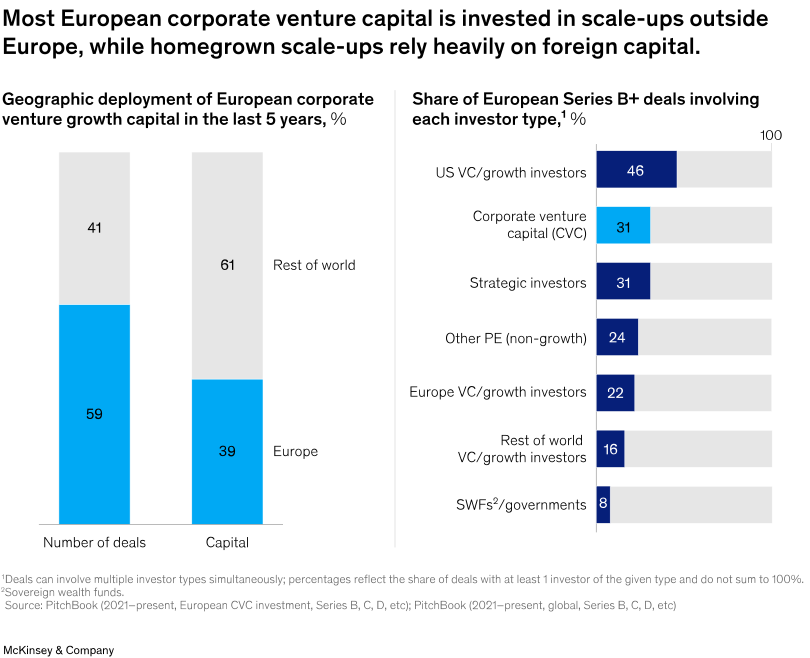
But capital alone is insufficient to close the scaling gap fully, and a relative lack of late-stage institutional capital is a much bigger issue for European scale-ups than corporate investments. However, leveraging mature commercial enterprise structures with established distribution channels is a critical way for scale-ups to gain momentum, and corporate capital investment can help deepen and accelerate that collaboration. In that way, there is an opportunity for European corporates to play a larger role in funding and guiding Europe’s next generation of growth companies—and to benefit from it themselves, both operationally and financially.
A road map for successful corporate–scale-up partnerships
Corporates and scale-ups can pursue two reinforcing pathways: collaboration with tangible business impact, and strategic capital.13
Value-creating collaboration: Corporates and scale-ups as true partners
What often determines whether a scale-up can fulfill its ambitions is access to customers, infrastructure, industrial capabilities, and routes into new markets. These are areas where corporate partners can serve as a strong catalyst helping convert European innovation into European scale—but only when these partnerships are backed by dedicated budgets and resources to move beyond pilots and into scaled deployment. Our research shows that a sample of European scale-ups that reported corporate partnerships raised roughly five times as much funding as peers without reported partnerships.14
In the process, corporates can boost their own value. Those that actively partner with scale-ups tend to outperform benchmarks, suggesting these collaborations can be a meaningful growth lever for incumbents (Exhibit 2). The signal is even stronger among corporates running multiple scale-up partnerships, which outperformed benchmarks even further over the same period. As one former European group bank chief executive puts it: “Innovation is now too diverse and fast-moving for large institutions to build everything internally. The opportunity for corporates is to become better integrators of external innovation—using their scale, customers, and operating platforms to help founder-led companies grow faster.”

Five collaboration models stand out.
- Cornerstone customer: A corporate becomes a large, multiyear reference customer for a scale-up’s ready-to-deploy product. This creates immediate, bankable demand for the scale-up while securing cutting-edge solutions for the corporate. For example, over the last few years, Stegra, a green industrial scaleup initially focused on low-emissions steel, secured long-term offtake agreements and strategic investments from industrial customers including Marcegaglia, Mercedes-Benz, Scania, and Schaeffler.15 European corporates can use this approach to innovate much faster by embedding scale-up partners’ technology into their infrastructure rather than trying to build it internally. For a model from outside the region, consider the Indonesian telecom giant Indosat Ooredoo Hutchison (IOH) and its partnership with Tanla Platforms, a leader in AI platforms for telcos. To help combat digital fraud, IOH embedded Tanla’s AI-powered anti-scam and anti-spam solution directly into its core national network, gaining much-needed advanced tech at scale-up speed. For Tanla, IOH acted as a major customer reference building credibility with other carriers.16
- Joint development and R&D: Corporates and scale-ups codevelop solutions by combining scale-up technology with corporate assets and use cases. This provides corporates fast-track, cost-effective access to innovation while helping founders refine and validate their technology. In September 2025, for instance, lithography technology leader ASML partnered with Mistral AI to explore the use of advanced AI models across its R&D and operations.17
- Go-to-market (GTM) and geographic scaling: Corporates use their established sales channels and market presence to distribute a scale-up’s proven product. This accelerates the scale-up’s commercial adoption while expanding the corporate’s value proposition. Celonis, a Munich-based process intelligence provider, partnered with enterprise platforms including Oracle18 and ServiceNow19 to embed its process intelligence into the operational systems and workflows that enterprises already use to execute work at scale across global markets.
- Industrialization and manufacturing partnerships: Corporates provide scale-ups with access to production assets, supply-chain networks, and operational knowledge. This is crucial for helping scale-ups successfully transition from prototype to reliable, scaled delivery. For instance, in December 2025, Helsing signed an agreement with automotive supplier Schaeffler20 to increase drone production and secure resilient component supply chains, pairing Helsing’s defense technology with Schaeffler’s industrial manufacturing expertise to accelerate the move toward production-ready deployment. Similarly, German fusion energy scale-up Marvel Fusion partnered with Siemens Energy to industrialize its laser-driven fusion technology, leveraging Siemens Energy’s manufacturing and engineering capabilities to accelerate the path from prototype to commercial deployment.21 In healthcare, BioNTech’s partnership with Pfizer during the COVID-19 pandemic remains a benchmark of industrialization at scale: Pfizer’s global manufacturing and cold-chain distribution network enabled BioNTech’s mRNA vaccine to reach billions of patients within a year of authorization.22
- Ecosystem activation through institutional platforms: Corporates build structured platforms—like accelerators or venture client units—to systematically engage a broad pool of early-stage scale-ups. These act as strategic radar to help identify and nurture future, deeper commercial partnerships. SAP, with its SAP.iO Foundry Munich23 program, partners with scale-ups to integrate and jointly offer solutions across enterprise utility and infrastructure systems, providing access to SAP’s technology and customer base to support deployment across real-world energy networks and industrial operations.
Across these models, success depends less on picking the right archetype up front than on giving the partnership the time, budget, and discipline to iterate on the working model, integration, and joint solution.
Strategic capital: Financing scale and preserving European ownership
Europe’s scale-ups do not simply need more capital; they need capital that is better suited to the realities of scaling in Europe—more patient, more strategic, and more willing to support industrialization and market expansion. In that context, equity can anchor commitment, align incentives, and create a more durable basis for collaboration than a contract alone—especially when companies are scaling through volatile markets or valuation uncertainty. Such a multifaceted relationship can make all the difference between success and failure. As one CEO of a European ride-sharing app notes, “Corporate capital does not become strategic simply because it is corporate. When investment is not tied to business-unit engagement, commercial milestones, or a clear deployment path, it risks becoming passive exposure rather than a lever for scale.”24
Corporates can leverage four primary investment archetypes to get exposure to founders looking to scale their companies’ operations. Each strategy should be judged not only by financial returns, but by whether it helps unlock commercial and operational value through a broader strategic relationship.
- Corporate venture capital (CVC): Corporates invest directly in early-stage companies to act as a strategic radar for market adjacencies. This serves as an outsourced innovation engine, providing early intelligence and relationships before markets fully mature.
- Direct growth investments: Corporates take significant stakes in later-stage rounds to serve as anchor investors. This accelerates a scale-up’s industrialization while securing the corporate direct, strategic access to breakthrough technology.
- Indirect limited partner (LP) investments and VC partnerships: Corporates allocate capital to external venture funds rather than investing directly. This provides diversified, curated exposure to emerging technologies without the overhead of building an internal direct-investing team. For example, Nestlé invests in scale-ups through LP positions in external venture funds, including commitments from its Sustainability Fund to specialty VC funds.25
- Acquisitions: Corporates outright acquire mature scale-ups to rapidly integrate synergistic technology and talent. This deep operational integration provides scale-ups with a global route to market while recycling capital and talent back into the ecosystem. For example, technology company ABB made an initial minority investment in Sevensense in 2021 and, following successful pilots, fully acquired the AI navigation scale-up in 2024 to integrate the technology into its robotics portfolio.26
Corporates that pursue frequent, smaller acquisitions consistently outperform those relying on large deals or organic growth. This pattern is particularly pronounced in technology-intensive sectors such as advanced industries (including electronics, manufacturing, aerospace, and defense) and TMT (technology, media, and telecom), where capabilities, talent, and product adjacencies evolve quickly, making smaller, more frequent acquisitions critical for maintaining competitiveness and accelerating innovation. In North America, companies completing more than five deals per year generated 7.9 percent excess TSR versus 3.4 percent for organic growers and 1.0 percent for large-deal acquirers. Europe shows the same pattern—albeit at lower levels—with frequent acquirers generating 3.6 percent excess TSR, while both organic growth and large deals underperform. This highlights a clear opportunity for European corporates to increase deal frequency and close part of the performance gap.27
Laying the foundation for a successful corporate–scale-up partnership
The partnerships that succeed are typically designed to grow from the beginning. They are effectively industrialized, and often rely on the following steps:
- Treat the partnership as a core business priority. Partnerships with active executive sponsorship, dedicated business-unit ownership, and sufficient budget allocation can significantly outperform those managed peripherally. In practice, the most effective collaborations tend to be those where the corporate brings its “A-team”: dedicated resources, clear accountability, and sustained executive attention throughout the partnership life cycle.
- Design explicitly for cultural and operational differences. High-performing partnerships from the start frequently address the organizational differences between corporates and scale-ups that can often become challenges, aligning on ways of working, decision-making processes, and integration approaches. While partnerships and M&A differ structurally, the cultural challenge they often face can be similar. McKinsey research shows that lack of cultural fit and friction is the most common reason M&A integrations do not meet value expectations. Conversely, when organizations get the culture piece right and consciously manage these gaps, they are over 40 percent more likely to meet or surpass cost synergy targets, and up to 70 percent more likely to surpass revenue targets.28
- Align on value creation with partnership-specific KPIs that do not constrain speed and scale. Previous McKinsey research shows that only a minority of scale-ups reported having clearly defined, measurable goals and milestones, yet establishing these up front increased satisfaction significantly.29 Importantly, the metrics used can reflect the nature of the partnership. Successful partnerships track a combination of leading indicators—such as product development milestones, customer adoption, or pipeline generation—alongside longer-term financial outcomes such as EBITDA or ROI.
- Build pilots that are designed to scale. The “pilot trap” is a common issue within corporate–scale-up partnerships, in which initiatives that generate insights fail to be implemented at scale. Effective partnerships instead typically treat pilots as scaled-down implementations—large enough to show meaningful business impact, with predefined success criteria and agreement on what is needed to move forward.
- Focus on quality over quantity. Scale-up engagement programs (such as accelerators and hackathons) can serve as useful scouting funnels for identifying potential partners—but value rarely accrues from breadth alone. The most effective partnerships are usually those that graduate from broad engagement to deeper, focused collaboration, where corporates concentrate capital, talent, and integration effort.
A coordinated path to scale in Europe
Europe’s ability to strengthen competitiveness and retain more value from its own innovation may depend in part on deeper, more systematic partnerships between corporates and high-growth scale-ups. Some €500 billion to €1 trillion in annual value could be at stake by 2030.30
Corporates can play a vital role in helping capture the value at stake—not only as sources of capital, but as customers, distribution partners, industrialization platforms, and anchors for commercialization at scale. For that reason, they may treat scale-up engagement less as a peripheral innovation activity and more as a core strategic lever. Corporates can not only use their balance sheets, but also procurement, partnership models, technical capabilities, and operating platforms to strengthen the core business, become more agile, and gain earlier access to the technologies, talent, and business models shaping the future.
For scale-ups, the opportunity is equally clear: The companies that engage corporates not only as sources of capital, but as partners in commercialization, industrialization, and expansion, may be better positioned for their growth journeys. The right corporate relationship can provide faster impact, customer access, implementation insights, and credibility in the market, while also helping the scale-up navigate Europe’s fragmented operating environment more efficiently. In many cases, that can reduce the capital, time, and friction required to scale. Having your main customer or operating partners financially invested can strengthen the base of the business, reduce risks, and increase valuations.
For Europe as a whole, partnerships are necessary, but far from sufficient. Closing the scale gap may also require institutional late-stage capital, less fragmentation, stronger talent and infrastructure, and an evolving policy environment for scaling and industrialization. But stronger corporate–scale-up collaboration is one of the clearest near-term levers available to the private sector. It can help more innovation reach commercial scale, remain anchored in the region, and support a broader agenda of competitiveness, resilience, and economic growth.