For two decades, European economic growth has challenged the continent’s global competitiveness and inhibited its rate of per capita income growth. AI adoption could help economies accelerate labor productivity, driving growth and countering potentially negative economic, political, and societal consequences. But it also has the potential to worsen Europe’s competitive position if the continent misses the opportunity to take a more central role in AI’s development.
Europe’s window of opportunity to accelerate its embrace of AI is narrow but clear. The biggest impediments to AI adoption across the continent are concerns over trust, security, and (national) dependency. Addressing these will likely accelerate adoption and, as a result, help reinvigorate the world’s third-largest economic region while building economic resilience. Sovereign AI capabilities potentially provide such a path if Europe can develop and control critical AI capabilities, enabling greater flexibility in the form of national, economic, operational, and technical independence.
This article lays out the potential shifts likely required across all stakeholders if such an ambition is to be realized. It examines the existing strengths Europe could take advantage of to grasp the opportunity AI presents for reigniting economic growth. There is still time: While 92 percent of global businesses plan to ramp up their investment in gen AI over the next three years, only 1 percent say their efforts have reached maturity, and just 20 percent report tangible earnings impact.1 But seizing this chance requires urgency, scale, and collective resolve from Europe’s public and private sectors. The continent will need to move with speed and unity.
Changing the trajectory of Europe’s productivity and growth
Europe’s prosperity and values were built on strong economic foundations, a history of innovation and entrepreneurship, and public and regional support for growth in pursuit of socioeconomic well-being.2 This approach created globally leading industries and products and underpinned societies offering broad opportunities and relative economic stability. For instance, inequality across Europe is significantly lower than in the United States,3 and the world’s top ten most-socially-mobile countries are in Europe.4
Declining economic growth, however, is affecting this prosperity. From 2000 to 2024, the five-year weighted average of GDP growth in the European Union slowed by 3.8 percent a year (Exhibit 1).5 As a result, GDP per capita has grown less quickly than it could have, from an average of $44,737 in 2000 to $59,649 in 2025—an increase of 33.3 percent. By comparison, GDP per capita in the United States grew by 38.9 percent during the same period, from $62,543 in 2000 to $86,699 in 2025.6
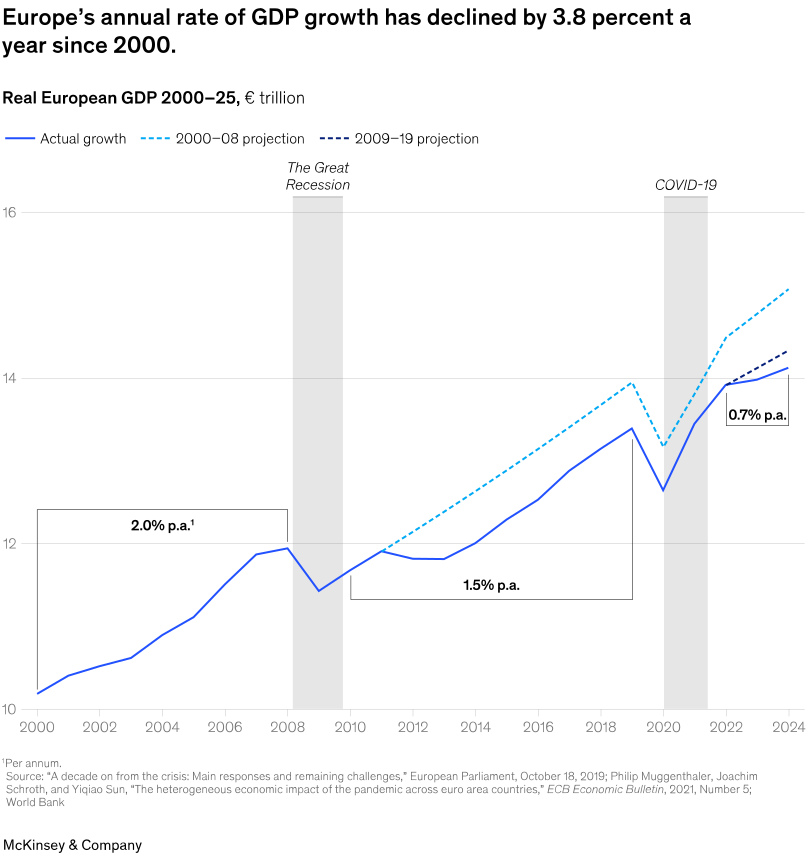
A core factor has been slowing labor productivity growth, the single largest driver of long-term GDP and wages. Europe’s labor productivity growth has fallen by an average of 1.2 percent annually from 2000 to 2025, resulting in almost stagnant growth of 0.2 percent for the period from 2022 to 2025.7 This is the result of a significant decrease in the growth of labor productivity driven by the slower adoption of innovation, lower investment in tangible and intangible assets, and structural rigidities in the market that limit competitiveness. The impact of this trend persisting could be stark. When GDP per capita grows by 2.5 percent to 3.0 percent each year, incomes double every 25 to 35 years. When it decelerates to growth of 0.5 percent to 1.0 percent each year, doubling incomes can take 70 to 100 years.8 In a low-growth environment, citizens can no longer look forward to living standards continuing to rise for them or their children, which may result in an overall sense of stagnation. Many economic leaders have recognized this risk and multiple efforts are under way to address it. But the more widespread adoption of AI could be a powerful new tool to reignite labor productivity growth.
Grasping the AI opportunity to reignite growth
The emergence of AI presents a material opportunity for Europe to drive productivity growth and economic prosperity by innovating, investing, and adopting the technology across the continent. Time remains not only for Europe to place its bets and embrace the AI opportunity9 but to do so in a way that provides greater flexibility across the provider landscape for European citizens, companies, and governments.
While there is a solid range of leading-edge European firms across the layers of the AI technology landscape, the continent today is competitive in only a few areas and dominant in almost none. In addition, public European corporations with revenue of more than $1 billion annually invest less than their US peers in key areas such as R&D,10 and the difference is even more pronounced when it comes to funding for AI (Exhibit 2).
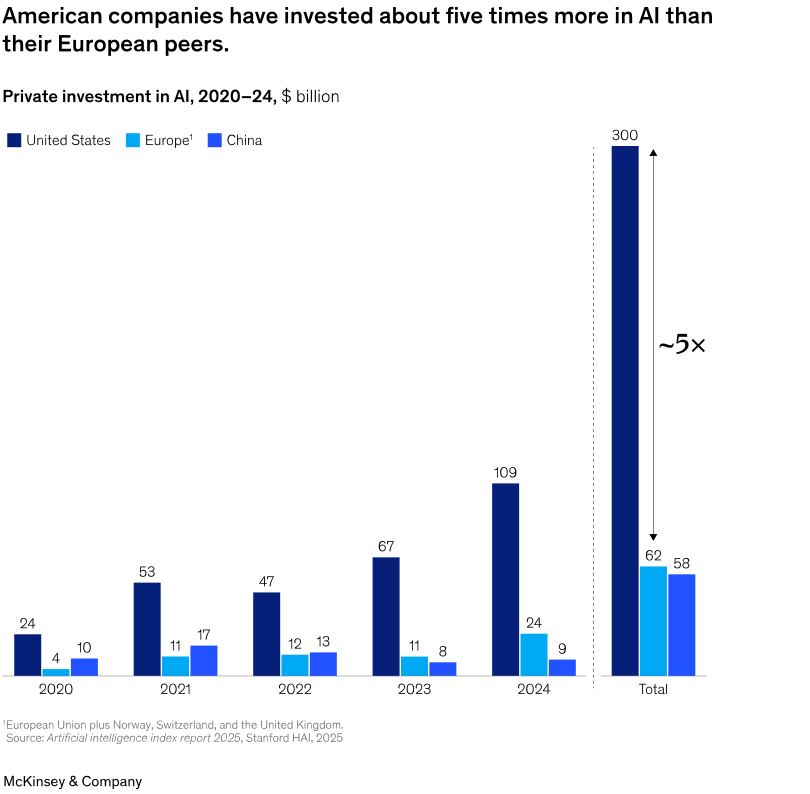
Exhibit 3 provides an overview of the AI technology stack and a perspective on Europe’s relative position in each layer, including its key players. In layers three and four—that is, in data centers and hardware—AI capabilities are largely provided by non-European suppliers, albeit with notable exceptions in select parts of the semiconductor supply chain. These areas of European competitiveness include ASML in lithography, ASM in deposition equipment, and Zeiss in advanced optics.11 In layers five to seven—spanning cloud platforms, models, and applications—European players exist, but they lack critical scale compared with global peers.
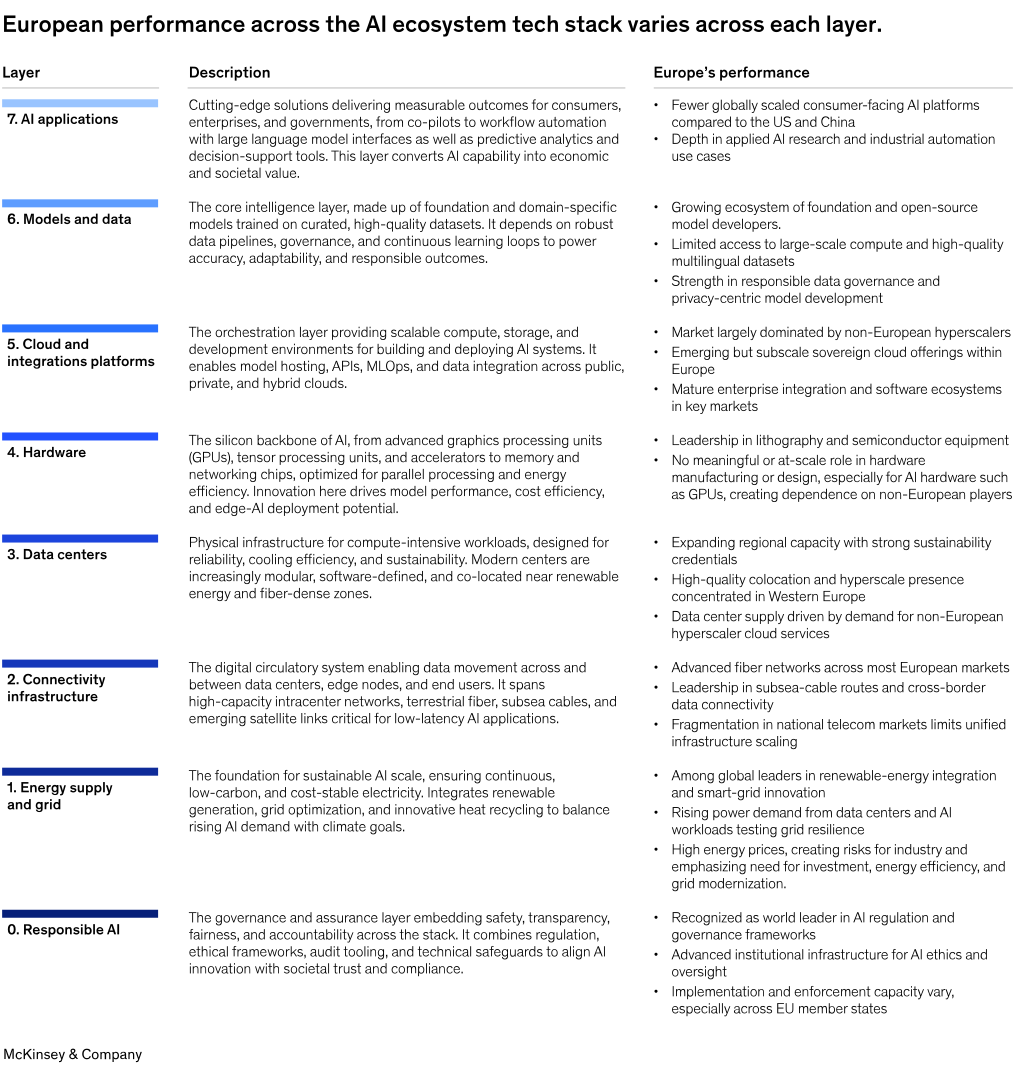
It is unlikely Europe can advance everywhere; it will be important to be mindful of the layers and capabilities in the AI ecosystem where it is realistic and beneficial for European players to gain more competitiveness and seek scale. The continent will want to be strategic about where and when it places its bets to ensure it has the right capabilities where it decides to compete.
The potential and benefits of boosting Europe’s AI sovereignty
Across Europe, concerns over trust, security, and dependency are impediments to AI adoption that, if mitigated, are likely to accelerate adoption and productivity growth.12 Sovereign AI capabilities provide such a path, and we define it as a nation or region’s ability to develop and control critical AI capabilities to provide greater technological optionality and autonomy within their economic, political, and social context.13
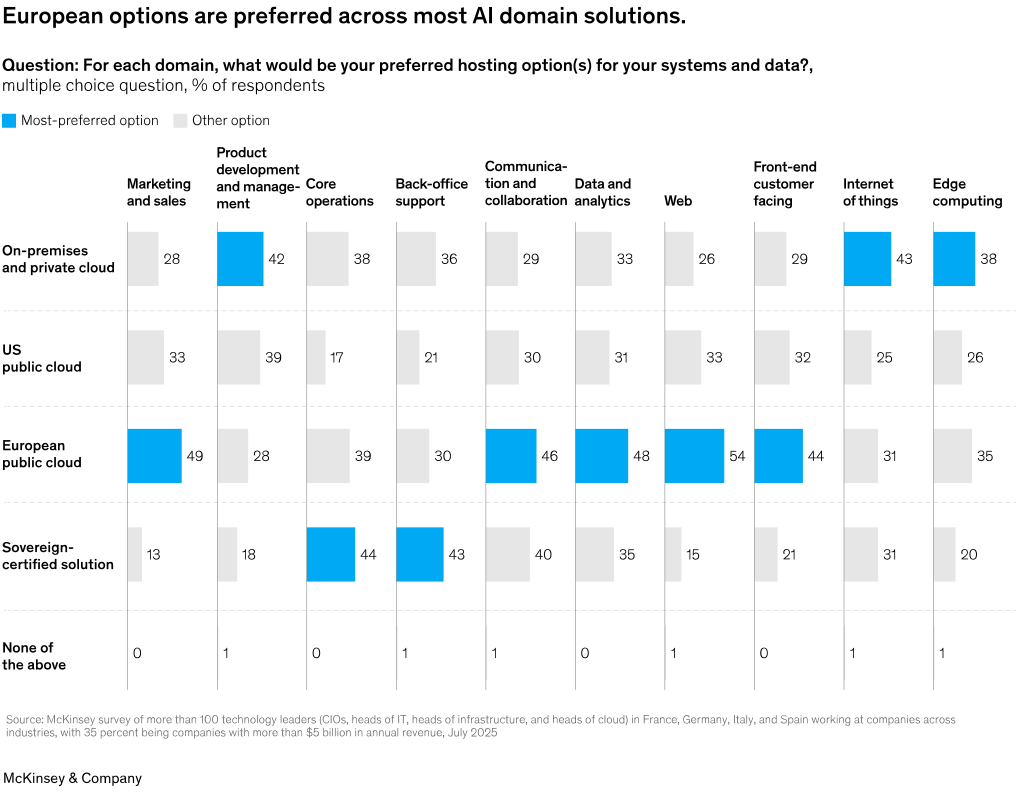
The trend toward sovereign AI has accelerated globally, driven by a greater appreciation for the transformational impact of these technologies and the desire of individual countries to ensure autonomy and optionality; there have also been instances in which dependencies on nonlocal providers have drawn attention to the importance of sovereignty.14 Our recent survey of European companies’ uptake of cloud and AI service solutions found security and sovereignty topics were a material driving factor behind lagging adoption: 44 percent of technology leaders cited concerns about data security as a reason for not using the public cloud, for example, while 31 percent said the need to store data in a specific country or region prevented them from doing so.15 Given the choice, leaders exhibited a preference for European hosting options for systems and data (Exhibit 4).
In practice, this could result in different forms and degrees of AI sovereignty as governments, enterprises, and providers require and offer services based on specific needs for security, independence, and speed. But one thing seems certain: There is clear demand for sovereign solutions. In sizing Europe’s sovereign AI opportunity, we found it could unlock up to €480 billion in value annually by 2030 (Exhibit 5). In this European digital sovereignty scenario, a high level of technological sovereignty would drive high levels of AI adoption and have a resulting impact on overall GDP (for more, see sidebar, “Assumptions for AI adoption and sovereignty scenarios”).
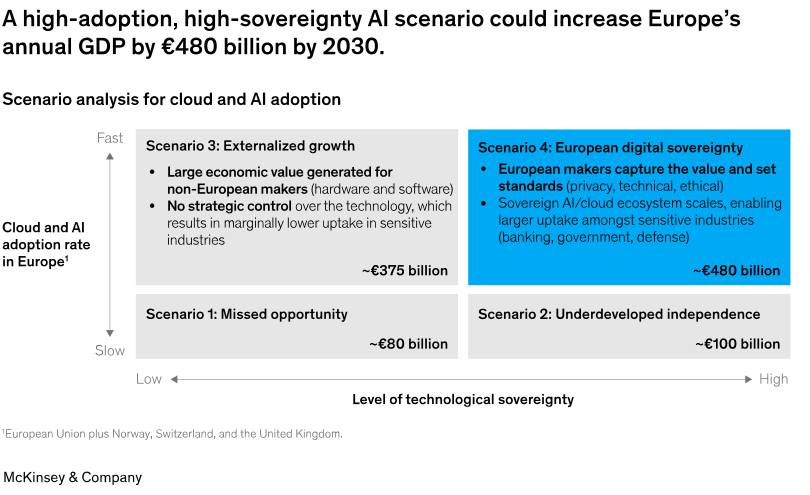
This scenario estimates European makers in the AI ecosystem will contribute an annual GDP uplift of €63 billion from the locally retained share of value created by companies selling AI ecosystem services. At the same time, we forecast €416 billion in additional GDP from takers, which represents the productivity gains across the economy due to increased adoption of AI.
The path forward: Building Europe’s AI capability
Building sovereign AI is not about isolationism but ensuring Europe has AI-first solutions and full technology stacks in domains that both play to the continent’s strengths and imminent needs, from healthcare to defense, industrials, B2B software, and insurance. This is not to suggest it will be easy. It requires focusing on AI adoption beyond the pilot phase16 and a step change in European efforts, generally demanding investment, cross-border coordination, innovation, and, most importantly, targeted decisions about where to compete. It may not be necessary or realistic for Europe to seek a leading position in every vertical domain. But it should aspire to lead decisively in those areas that both secure autonomy and unlock productivity growth, which are foundations of future prosperity. Looking at our AI ecosystem stack (see Exhibit 3), Europe has an opportunity to focus on three layers in particular: AI applications, models, and tools.
Focus on AI applications that unlock economic opportunity
The greatest value creation in the AI ecosystem accrues at the top of the stack in applications and use cases that directly transform productivity, customer experience, and decision-making. Together, they capture the highest operating margins in the ecosystem, typically 25 to 35 percent, reflecting their proximity to end users and their ability to generate tangible business outcomes. Europe has an opportunity to break the cost curve of technology, turning its industrial depth and research excellence into scalable AI products that solve high-value, domain-specific problems—and lead to breakthroughs in the efficiency of the software development life cycle are highly correlated to innovation power in broader product development.
In manufacturing, European industrial powerhouses can combine industrial data with open standards to create a software-driven growth engine. For example, Germany’s machinery sector is one of the largest and most advanced in the world, with €262.9 billion in annual turnover in 2023.17 Its vast installed base of connected equipment continuously generates operational data on performance, energy use, and maintenance. Similar potential exists across Europe’s key verticals, from AI-enabled drug discovery and diagnostics in life sciences to autonomous grid management in energy, where domain-specific models and applications can deliver both productivity and new exportable services.
Focus on targeted AI tools where there is a right to win
Europe’s competitive advantage lies where its regulatory rigor, technical depth, and sector expertise converge, especially in industrial AI, applied research, and regulated-market applications such as healthcare, mobility, and energy. These are areas in which trust, precision, and domain know-how matter as much as compute power. In industrial automation, for example, European firms such as Siemens18 and Bosch19 are already demonstrating how AI can be turned into products as software, leveraging machine-building data to develop applications, such as Siemens’ Industrial Copilot for engineering code generation and Bosch’s ctrlX application ecosystem for AI-driven machine control.
European companies are also home to vast unstructured proprietary data not accessed by the large language models powering gen AI globally. Tapping into that data could lead to the development of “small language models” that are particularly valuable to specific domains, further enhancing Europe’s competitiveness.
Focus on applications and models that matter for productivity
Applications and models are also where AI’s productivity payoff can be realized. According to the McKinsey Global Institute,20 gen AI could automate activities that consume 60 to 70 percent of employee time. In a high-adoption, full labor redeployment scenario, this uplift could reach 3.1 percent annually by 2030,21 enough to close much of the productivity gap with the United States. In Europe’s industrial sectors, those gains can be amplified by AI, including through copilots, predictive analytics, and optimization tools that target complex, high-value workflows. Predictive maintenance, energy optimization, and intelligent scheduling can already deliver up to 40 percent increases in labor productivity and almost 50 percent reductions in lead times in lighthouse factories,22 while AI-assisted R&D and drug discovery can accelerate development timelines by an average of more than six months.23 Focusing investment at the application layer ensures productivity benefits diffuse fastest across the economy.
Aspire for sovereignty where it is necessary
The same layers that offer the most economic and productivity value also carry the greatest sovereignty risk. Applications, models, and tools are where the most sensitive information resides, such as industrial intellectual property, health data, and public records, making them especially vulnerable to dependency on non-European providers. Critical services could run on European-controlled (but not necessarily European-owned) cloud, while physical assets such as data centers and hardware can be localized, secured, and governed within European jurisdictions. These foundational layers, when combined with sovereign cloud and data policies, provide a base of resilience. But long-term autonomy requires extending sovereignty upward into software and data, ensuring European optionality over the systems that interpret, generate, and act on information.
By innovating and competing at the model and application layers, Europe can turn its industrial and research advantages into a competitive AI engine while progressively deepening capability further down the stack. Building models attuned to a European context, including multiple languages, regulations, and industrial strengths, would not only accelerate adoption but also strengthen Europe’s right to win in global AI markets.
Ensure a secure, cost-competitive AI foundation
Focusing on Europe’s strengths—applications, models, and tools—does not mean neglecting the rest of the AI ecosystem. The continent can remain strategic in leveraging its existing strengths across the AI technology stack, from ASML’s global leadership in lithography to Infineon’s power electronics, for example,24 and has an opportunity to leapfrog into lower-cost energy-efficient chips, optical and quantum computing, and new model architectures, as well as attracting leading global companies.
Ensuring the foundations for AI scale are secure and cost-competitive requires facing the challenge of high energy prices by accelerating investment in abundant, low-carbon energy, grid modernization, and the availability of cutting-edge compute capacity so access to power and graphics processing units does not become a constraint on European innovation.
Europe’s technology ecosystem should remain open and interoperable. Competing globally will likely require partnerships and coexistence with non-European providers, particularly in hybrid architectures in which sovereign solutions coexist with public offerings. For many industries, the winning model seems likely to combine the trust and control of sovereign AI with the scale and flexibility of global platforms. Striking the balance between autonomy and openness as well as specialization and scale will be essential to turn Europe’s AI ambition into sustainable, system-wide competitiveness.
Implications for European enterprises and innovators
Europe’s AI approach stands at an inflection point. The AI race is no longer about experimentation but execution, scale, and strategic positioning. Closing the competitiveness gap requires European enterprises to focus their efforts on building distinctive AI applications, models, and ecosystems that combine world-class engineering with European standards of trust and responsibility. It short: Incumbents should go all in to build AI-first businesses, cannibalizing themselves and finding new value propositions before others do.
AI makers can build the foundation for sovereign scale
Europe’s telcos, data center operators, and cloud providers are the industrial backbone of its digital future. Competing globally means accelerating the build-out of sovereign, scalable, and sustainable AI infrastructure. They can do the following:
- Invest where scale meets sovereignty. Makers can expand AI-ready data centers powered located in Europe while partnering with hyperscalers through sovereign cloud agreements that ensure local legal and operational control (examples include T-Systems’ Open Telekom Cloud and OVHcloud’s sovereign approach25).
- Form vertical alliances. Infrastructure makers can integrate with application developers and industrial users, using European platforms such as Manufacturing-X and CERN openlab, which connect data owners, telcos, and OEMs to create trusted data pipelines.26 Scaling these networks can help Europe capture synergies between compute, connectivity, and applied AI innovation.
- Co-invest in compute and energy efficiency. Large-scale public and private investment will be required to build the data centers needed to meet demand for an expected tripling of compute capacity by 2030.27 Enabling this will require data center builders and energy providers to coordinate their growth plans; the most competitive European data center operators will be those combining energy efficiency with regulatory compliance and data sovereignty.
AI takers can accelerate from pilots to transformation
Europe’s enterprises, the takers of AI, should have a clear priority: shifting from experimentation to scaled transformation. The productivity potential is enormous, but realizing it demands a transformative approach, integrating AI into products, processes, and people. In our experience, most organizations remain trapped in pilot purgatory, deploying gen AI in isolated proofs of concept rather than reengineering end-to-end business processes. To make the transition to scaled transformation, they can do the following:
- Focus on value-adding AI applications. Companies should prioritize building AI copilots and domain-specific models tailored to their industries, such as intelligent maintenance systems for manufacturing and generative design tools for engineering. Start-ups such as France’s Mistral AI and enterprise leaders such as Siemens—which now embeds AI across its industrial digital-twin platforms—show European innovation thrives when technical depth meets sector expertise.28
- Invest in end-to-end workflow transformation. Many European firms still lack the organizational muscle to scale AI. According to McKinsey’s 2025 state of AI survey, high-performing organizations are three times more likely to redesign workflows end-to-end when adopting AI.29 This kind of vertical focus turns AI from a cost center into a growth engine, linking every use case directly to measurable productivity and performance outcomes.
- Engage with public sector anchor demand. Governments and public institutions can be critical anchor customers for early AI deployments by enterprises, providing the stable demand and regulatory clarity that help private innovation scale. But taking advantage of the public sector’s ability to anchor demand as both a maker and taker requires acting quickly to demonstrate AI’s value by deploying it at scale to transform the customer experience and productivity and to supplement labor shortages.
Europe’s pockets of opportunity—and how to unlock them for policymakers
Europe has time to embrace the AI opportunity and secure both prosperity and sovereignty, but it depends on decisive, coordinated policy execution over the next five years. Incremental programs are unlikely to be as effective as a coherent European AI industrial strategy, underpinned by an EU-wide corporate legal framework to spur the creation of a single AI market. That could provide a foundation for the following.
Mobilizing sovereign capital at scale
Europe could launch an EU-level sovereign AI fund within the next two years, pooling resources from the institutions including the European Investment Bank with national co-financing via the Important Project of Common European Interest (IPCEI) framework. The fund could invest €15 billion to €20 billion a year in compute infrastructure, foundation model development, and sovereign data spaces through 2030. Europe could build on the IPCEI microelectronics and batteries programs to create a new IPCEI AI and compute track that funds cross-border projects, prioritizing locations with a surplus of renewable energy and existing industrial density to minimize costs, leverage existing talent, and accelerate time to deployment.
Building a true single market for AI
Fragmentation remains Europe’s greatest structural disadvantage. A single market for AI is essential for scale, underpinned by harmonized regulation, integrated financial markets, and cross-border venture flows. Accelerating the capital markets union and European Tech Champions Initiative could help achieve interoperable APIs for data spaces under the Data Governance Act and create a “passporting” regime for AI service providers that meet EU standards. A single market with an integrated legal framework could enable AI start-ups to access capital at a continental level and avoid country-by-country legal set-up issues. For example, building a digital registry and management dashboard could enable digital pan-European incorporation in one hour online and standardized investment instruments. Europe could also combine regulatory leadership with agility to avoid stifling innovation, establishing global benchmarks for safe and responsible AI with regulatory sandboxes, AI “freeports,” and testbeds allowing start-ups and enterprises to innovate under controlled conditions. These could have significantly simplified labor laws and investor tax benefits to enable rapid hiring and investment.
Using public procurement to anchor AI demand
The public sector can become the single-most-powerful market maker for European AI. For example, European countries could earmark at least 10 percent of their digital transformation budgets (or specific procurement budgets) for sovereign AI solutions and create the demand signals needed for early scaling, especially in defense, health, mobility, and public administration. By deploying AI across public services, governments can demonstrate viability and trust in European technology, mirroring initiatives such as France’s Interministerial Digital Directorate, which coordinates incubators to accelerate AI adoption and embed domestic innovation directly into state operations.30
Investing in talent and mobility
Europe can attract the talent required to enable the building of a world-class AI ecosystem by combining high-skill migration reform with Europe-wide reskilling programmes and easier mobility for technical workers. After all, without an integrated skills agenda, Europe risks building infrastructure without engineers to run it. One option is to launch AI fellowships and AI talent visas by 2026 to attract top global researchers. Another critical factor would be building and attracting more leading firms, thus strengthening the continent’s corporate ecosystem and providing greater opportunities for talented workers.
Aligning AI growth with sustainable energy and infrastructure planning
Compute is the new industrial resource, and, like any resource, it requires reliable energy and resilient infrastructure. AI growth should be aligned with sustainable-energy expansion, integrating AI data center demand forecasts into national energy and grid planning and working together to ensure national energy regulators integrate AI-related data center demand forecasts into 2030 grid capacity plans. Europe can also build renewable-powered data centers and cross-border energy infrastructure using investments under the EU Green Deal, Connecting Europe Facility, and REPowerEU. This may help prevent AI compute from becoming Europe’s next strategic bottleneck.
The opportunity is now
For two decades, Europe’s economic engine has slowed, its productivity growth stalled. AI is arguably the most transformative general-purpose technology of our time and offers a potentially once-in-a-generation chance to reverse that trajectory. The continent is still in the AI game, but it should act with urgency, scale, and collective resolve.
Investing in sovereign AI infrastructure and capability provides an exciting path to restoring productivity and securing long-term prosperity. It means building and owning the compute, models, and applications that power economies and institutions, while ensuring the value generated by Europe’s creativity and data flows back in a virtuous circle to spur European innovation.
Europe has the means achieve this: world-class research institutions, leading industrial players, deep pools of private capital, and a public sector that understands the link between innovation, competitiveness, and sovereignty. What is missing is not capability, but coordination and conviction. That conviction needs to come from both the public and private sectors. It’s by working together that ambition can translate to action.
It can be done if Europe moves with speed and unity. By building on its strengths, partnering where it must, and acting together with purpose, it can secure its position at the technological frontier. With focus, cooperation, and belief in its own ingenuity, Europe can be a builder of intelligence, and secure prosperity for generations to come.