‘We believe physical retail will serve two genuinely distinct missions: targeted visits focused on speed and certainty, and browsing visits focused entirely on experience, inspiration, and human connection.” That’s how McKinsey Senior Partner Tom Kilroy describes the evolution of shopping over the next five years. The challenge, he says, is that “a store can’t fully optimize for both of those at the same time.”
Kilroy, along with McKinsey Senior Partner Colleen Baum, explores that idea on a recent webinar discussing the report Shopping in the age of AI: Redefining stores for a new era. This episode of the McKinsey on Consumer and Retail podcast features excerpts from that conversation. (Subscribe to the podcast.)
What’s changing in retail
Colleen Baum: Thank you all for joining us today. Tom and I are so pleased to be here with you to share our report, Shopping in the age of AI: Redefining stores for a new era, which was done in partnership with ICSC.
We’re at a real inflection point in retail right now. AI isn’t just on the horizon; it’s already changing how people research and discover products, compare prices, and decide not only what retailer they will shop from but whether they’ll go into the store. At the heart of this research effort was understanding what all this change in shopping behavior means for the physical store. Today, we’ll talk through what we did, what the data tells us, and what that might imply about decisions you could and should be making over the next five years.
Before we jump into the details of the report, I want to ground us on the foundation of the research. We used a combination of three sources of insight. The first is a survey of more than 3,000 US consumers, which was fielded in January 2026. It covered all retail categories: grocery, fashion, health and beauty, home electronics, home decor, leisure products, and food and beverages. We then paired that survey with a set of C-suite interviews at major retailers, real estate operators, and others within the broader retail real estate ecosystem. Finally, we tapped our global network of McKinsey experts to learn about what’s happening not only in North America but also globally.
Before we get into the findings from the consumer research, it’s worth taking a step back on some of the macro forces—the first being the rise of agentic AI. Our research suggests that agentic commerce tools could generate up to $1 trillion in the US retail market alone by 2030.1 We’re talking about AI that can both help you research and find what you’re looking for and fully orchestrate a purchase for you. For household staples, like toilet paper, AI won’t just identify the need and decide what brand—it will anticipate when you’ll need to replenish those items.
A second macro force is around hybrid work. Approximately 40 percent of US workers are still in a hybrid or remote arrangement, which has really changed where people are shopping in their daily traffic patterns. A third macro force is massive intergenerational wealth transfer—approximately $100 trillion moving to younger, digitally native generations, specifically Gen Zers and millennials. These younger consumers have grown up in an omnichannel world. They expect more experiential retail, and they are increasingly comfortable using AI and digital tools to automate routine purchases. As their spending power grows, we expect it to have far-reaching impacts across the retail sector.
Our consumer survey and executive interviews pointed to four core themes. The first is that the idea of convenience—what convenience means—has shifted. It’s not just about fast delivery or a convenient location. It’s a location that fits into my daily trip and daily activities. Convenience also means I can easily find the item I am looking for and at the price I expect.
The second theme is around experience. Superior experience is what earns a browsing visit or a discovery visit. Because of the rise of e-commerce and AI, consumers no longer have to go to a store, so the store has to give them a reason to go. The retailers that will win going forward are those that are thinking about a true showroom—an immersive experience for consumers supported by knowledgeable associates.
The third theme is around AI. We know that AI is already playing a bigger role for consumers, particularly around research and pretrip planning, but we expect that to move into broader orchestration over the next five years.
The fourth theme was a bit surprising: the importance of connection. Particularly for younger generations, coming to a store is a basis to create community. The store becomes a “third place” for Gen Z consumers and younger millennials who are increasingly looking for more forms of connection beyond the digital world. With that, let’s dig into each of the four themes.
Convenience redefined
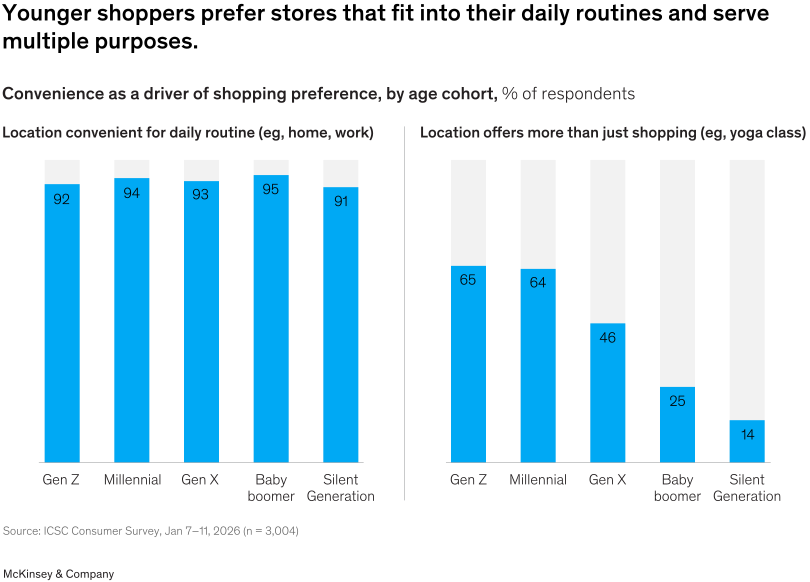
Tom Kilroy: Let’s start by going deeper on convenience. Over 90 percent of consumers across every generation say that a location that is convenient to their daily routine is a top factor in choosing where to shop. That part isn’t surprising. What is surprising is what convenience has come to mean and how that differs across generations.
For younger generations in particular, convenience is less about proximity and more about being multipurpose: 65 percent of Gen Z and 64 percent of millennials—but only 25 percent of boomers—say they prefer a location that allows them to do more than just shop [Exhibit 1]. Yoga class, the vet, a coffee shop—these are frequent experiences and services that these cohorts engage in. Younger generations want to stack errands around these experiences. We think this is an interesting generational shift that will only accelerate given the expectations that folks have around convenience.
You might ask why. Hybrid work is part of what’s going on here. The old model, where people are streaming through the same corridors on the same commute schedule every day, is gone. Retailers and landlords need to think about new consumer daily patterns: They’re often near home, near the gym, near school—not always the office.
Convenience today means the whole journey, not just the last mile. Think about predictable inventory, clear pricing, and a seamless handoff between online and what you do in store. If any of those breaks down, you’ve broken down convenience. All those things matter just as much as a fast checkout.
Physical retail is not in decline—it’s bifurcating. The visits that are growing in importance are the ones that can’t be replicated online. It’s the discovery visit, the browsing trip, the experience-driven occasion, the visit that you make with friends. When we asked consumers what drove them to choose one store over another for those visits, product testing came in at 78 percent, product guidance at 76 percent, and immersive environments at 65 percent. Two-thirds of consumers specifically called out a showroom experience that enables product discovery as a key driver of retailer preference [Exhibit 2].
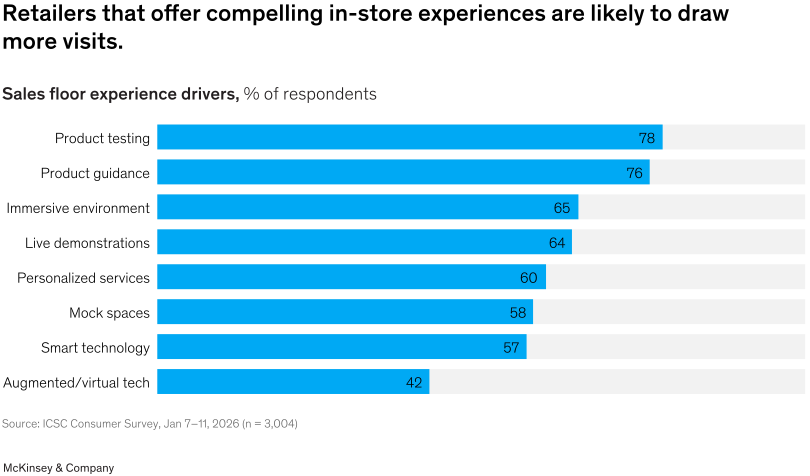
What that tells us is that discovery-led stores need to earn time, not just transact. The design goal isn’t to get people through faster—it’s to give them a reason to stay longer. Think curated vignettes, rotating collections, limited-edition drops, live demonstrations.
By 2030, we believe physical retail will serve two genuinely distinct missions: targeted visits focused on speed and certainty, and browsing visits focused entirely on experience, inspiration, and human connection. The challenge is that a store can’t fully optimize for both of those at the same time.
AI-orchestrated commerce
Colleen Baum: Let’s turn to this idea that consumers will be shopping differently, led by AI-orchestrated commerce. We already know AI in shopping is moving quite fast. To date, consumers are using it early in the journey: to search, compare prices, browse promotions, read reviews, and decide which products to buy. But we are finding that trust is building quickly across generations, and by 2030, we expect AI agents to handle a meaningful share of routine or classic subscription purchases entirely autonomously.
What does that mean for stores? For routine purchases—the pack of diapers or other household staples—the consumer may show up already knowing exactly what they want, exactly how much it should cost, and how many of those units are on the shelf. Or they may not show up at all, because they’ve decided to make that purchase through an agent. So the store’s job for these agent-orchestrated trips would be fulfillment, validation, and access to the product. In those situations, being in stock and being accurate to what the consumer researched in advance are the price of entry; they’re table stakes.
If an AI agent is comparing your store to a competitor’s before the consumer even leaves home, it’s important that the information online or in the app is accurate. So things like low perpetual inventory accuracy, disconnected pricing, or inability to easily apply a coupon online can really compromise the ability of the consumer or agent to make the right choice.
The other piece that we probably are not spending enough time on when talking about AI-orchestrated commerce is the role that AI can and should have on operations within the store. We’re observing early signs that AI tools are supporting more knowledge, training, and easy access to information for in-store associates. AI can be a huge unlock there as well.
Finally, let’s turn to the fourth theme: the role of connection. Gen Z is the most digitally native generation. It is also the loneliest. As a result, they’re turning to physical retail as one of the places to find connection: 71 percent of Gen Z consumers said they would be more likely to shop at a retailer that creates a community space, and 64 percent of millennials said the same [Exhibit 3].
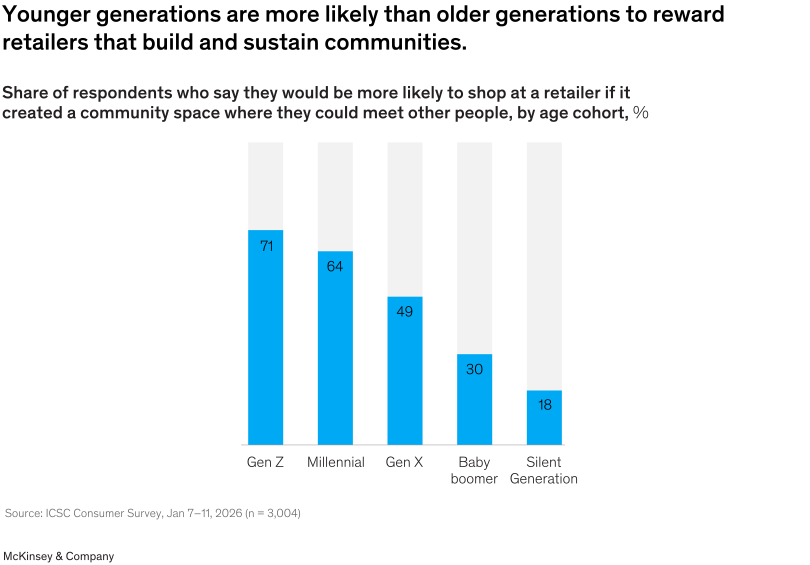
In particular, Gen Z gravitates toward spaces for cocreation and community—such as workshops, classes, events, and activations. Gen X, on the flip side, tends to prioritize dining. What that means for landlords and retailers is that they need to think carefully about who they’re designing for and which consumer they’re most hoping to access. Community strategy is not one size fits all.
Focusing on the shopper’s mission
Colleen Baum: Now that we’ve discussed those four themes, let’s take a step back and talk about what they mean. The report was grounded in one fairly simple idea: There needs to be a reason for people to go to a store. And when a consumer goes to a store, they’re going for one of two reasons: either a convenience trip or what we call a discovery trip. What drives those two trips is completely different.
When a consumer goes to a store for a convenience trip, they already know what they want. They’ve done the rough math of how much time it will take to go through the store. Success is going to be measured in, “Did I get what I needed? Was I able to find exactly what I wanted? And did it take the amount of time that I expected?”
Now, let’s switch to discovery visits. In these cases, the consumer wants to be surprised and inspired and find something they didn’t know they needed or wanted. While they may have done some online research, they’re going to the store to see something different, perhaps to be guided by an in-store associate.
Our research found that retailers often go wrong by trying to serve both of these missions equally in every store. As a result, your individual location is not optimized for anything. It either slows down the shopper on a convenience mission or underwhelms the shopper on a discovery mission.
One of the most common questions we hear is, “Does that mean, as a retailer, I’m either convenience or discovery?” Not at all. What we mean is that each store location should be optimized primarily for either convenience or discovery, grounded in who your consumer is and the types of trips they make.
Another common question is, “Do stores really have to choose? Can’t a retail location be built for both convenience and discovery?” We would say a store cannot be both at the same time. It’s not that grocery locations, for example, can’t also be places to go for discovery and inspiration—but at 5:15 p.m. on a Wednesday, the mom who’s popping in to get something urgently does not want to be inspired. She wants to find what she needs. She wants to get out as quickly as possible, and she probably wants to pick up something else in the shopping center on her way home. But if that same mom is coming in on a Saturday afternoon without kids, maybe she’s coming with a different mindset, so you might think about in-store events and staffing models slightly differently on a Wednesday at 5:15 p.m. than on a Saturday at 2 p.m.
Subscribe to the McKinsey on Consumer and Retail podcast
What does this idea mean for landlords? Does an individual shopping center have to choose either convenience or discovery? Here, our answer is slightly different: A mall or outdoor center can support both convenience and discovery, but we’d encourage a landlord to think carefully about how to create a concentrated convenience zone, with the right parking access, the right quick-hit tenants, and support for buy online, pick up in store [BOPIS]. We’re talking about intentionality: being intentional about creating convenience and then being intentional about mixing tenants to support discovery, perhaps in another zone.
Decisions about design and operations
Tom Kilroy: What does it look like for a specific store to optimize for each of these missions? For a convenience-oriented store, the core idea is that every single design and operational decision should serve one goal: removing friction. In today’s digital world, you’ve got to assume that the consumer has already done their homework before they visit the store, and the store’s job is to make sure that the digital promise holds. That means accurate inventory, real-time availability, and a clear way to know what’s there before they leave home. If that breaks down, you’ve already lost the trip up front.
In the store, the things that help reduce friction are an intuitive layout, a shorter path from entry to checkout, high-velocity items that are easy to find, and bringing together the most frequent kinds of missions to make it easier and faster to get in and out of the store. The associate’s role here is going to be more reactive: answering questions quickly, resolving issues, keeping the flow moving. They shouldn’t be intercepting every customer for a conversation. The convenience shopper doesn’t want that.
A few other things worth saying about the convenience trip. There’s no such thing as free returns for apparel and discretionary categories. The economics of clearing returns through the store are significant, and a return trip has to be as frictionless as a purchase trip, or you’re losing the customer twice. And one more frame on the convenience-oriented store: Think of it as a forward-distribution hub. It’s already the closest physical asset you have to your consumer. Routing BOPIS traffic through it improves speed and avoids the capital cost of new distribution centers. For retailers making hard allocation choices between store remodels, supply chain investments, and technology, the store can do double duty as a fulfillment node, and that can be a real unlock.
Colleen Baum: Discovery stores have a completely different design objective. The goal is extended dwell time, and everything should flow from there. It should begin in advance of the visit—building anticipation with the consumer through things like exclusive invitations, early access, personalized recommendations, and events—to make the consumer feel like the store was built specifically for them. Those types of things give shoppers a reason to come in that feels curated rather than generic.
Then, within the four walls of the store, you’re designing for exploration. This could be immersive layouts that encourage wandering across categories, curated vignettes, visual storytelling, and rotating collections or pop-ups. Limited-edition drops and exclusive collaborations that are available first or only in store can create urgency and give people a reason to come back. And the best discovery stores are offering selection with clarity. It’s not overwhelming—it’s not “everything is possible”—but rather a rich presentation of merchandise that allows the customer to find something they didn’t know they wanted.
The associates in a discovery store are a critical reason why people are shopping, why they’re coming in. They’re not just transaction facilitators. They provide information and storytelling that go beyond what a consumer is getting from AI. Equipping them with clienteling tools—such as real-time access to a consumer’s purchase history, their individual preferences, and “next best” recommendations—allows for highly personalized conversations at scale. We used to think about these clienteling tools as only for the highest level of luxury, but we believe they can and should be democratized to support discovery trips and can be a real differentiator when used well.
Layering discovery elements onto a store that’s fundamentally designed for transactions can confuse the consumer. For example, an immersive display right in the middle of checkout lanes can make a consumer feel like you’re trying to slow them down, or they might not understand the point of view. It can also cause confusion for associates who are trying to get a consumer out as quickly as possible when, all of a sudden, they’re answering questions about an immersive display. The biggest thing that we’re hoping you take away from this discussion is that a truly optimized convenience store is fundamentally different from a discovery-oriented store.
What could that mean for retailers? The first imperative is to clearly define the role of each store location with precision. This is not something your store’s team can do in an afternoon. It requires a data-backed view of how each location creates value. You’d then classify your fleet into mission types based on consumer behavior and catchment area. Is this location intended to be a convenience hub? Is it a discovery flagship? Is it a fulfillment node? You will align every element of the store to that: layout, assortment, staffing model, service experience, and technology. This is about choosing what the store both will and won’t do.
The second imperative is about technology’s role in reinforcing the mission, not just modernizing it. For a convenience location, the technology investments need to reduce friction: clean catalog data, perpetual inventory accuracy, and AI-driven staffing models that allow you to align labor hours with peak traffic. These are no longer “nice to haves”; they’re the infrastructure that holds up when a consumer or their AI agent is comparing your location to alternatives in real time.
In a discovery store, technology is about elevating the experience and extending dwell time. Associates who surface personalized recommendations are the differentiator here. And your technology investments should reflect the mission that you’ve defined in the first imperative.
Finally, you need to upgrade the talent model to match the mission of the store. In a convenience location, associates need to be broadly cross-trained and able to seamlessly move between customer service tasks to resolve issues quickly and create a frictionless experience. In a discovery store, they need deeper specialization. They’re bringing expertise, styling, recommendations, and clienteling skills. These are, between the two models, genuinely different ways of working and different methods of training.
Tom Kilroy: One prediction I’ll make is that we’ll see more services in stores, because they will be a driver of traffic and will be what consumers expect beyond the transaction. There will be demand for it. Luxury is a great example of where this plays out visibly. When a store associate has AI-powered access to live inventory and a customer’s full purchasing history, they’re not being replaced. They’re able to offer a higher level of service. I think you’ll see more examples of that, where the human element of service will become even more productive and valuable.
Colleen Baum: The era of a uniform store fleet—every single location looking the same—is over. The retailers and real estate players who earn their place will be those who pick a mission for each location and execute it with precision.