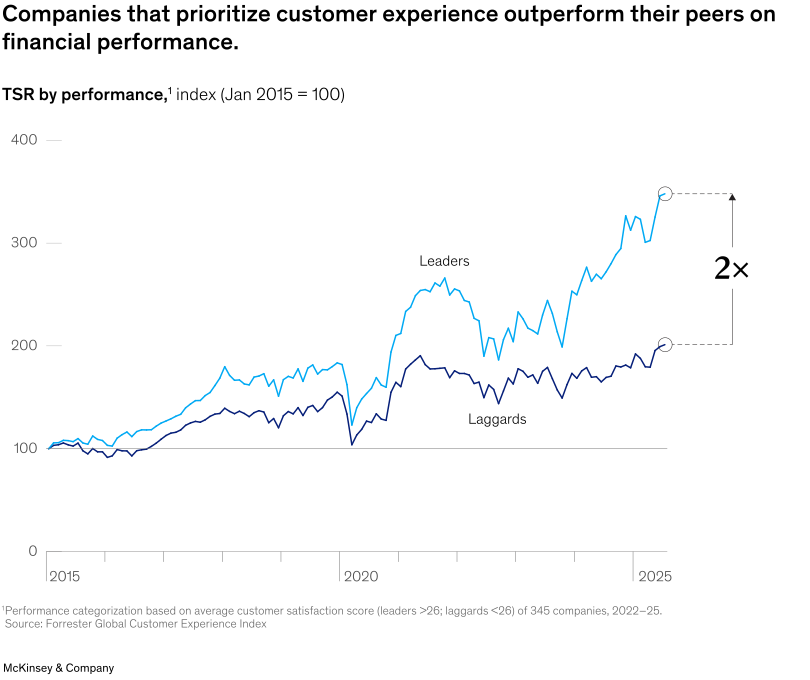
Customer experience (CX) has been one of the clearest sources of durable competitive advantage for companies. Businesses that lead in CX outperform peers on growth and total shareholder returns, often by as much as two times, by deeply understanding customer needs, redesigning end-to-end journeys, empowering frontline teams, and rigorously managing performance (Exhibit 1).
Now, the same capabilities that once distinguished CX leaders are becoming the minimum requirement for success. Experience-led growth is no longer novel; it is table stakes. AI provides a tool for organizations to drive durable competitive advantage. But many organizations have so far achieved only limited success. That’s because they are layering AI on top of fragmented journeys, optimizing steps rather than decisions and allowing handoffs to break context. Most CX programs continue to treat the customer journey as the unit of design. But customers experience the business through decisions in motion: what offer is shown, what policy is applied, what help is triggered, and when a human steps in. Without redesigning the underlying workflows and decision rights, AI simply scales what already exists, including inconsistency.
Even in the age of AI, CX is still built on the same fundamentals: a clear customer promise, human-centered design grounded in real customer and frontline insight, and disciplined measurement tied to business outcomes. Trust is part of that promise, because relevance and ease only create loyalty when customers also feel protected and treated fairly. AI does not change those fundamentals; it raises the bar for how deliberately organizations must design and run customer journeys so the technology amplifies what is working rather than exposing what is broken. Those fundamentals succeed or fail in thousands of small decisions across the journey.
Agentic AI introduces a structural shift in CX, from designing journeys to governing decisions in motion as a real-time system. Journeys are static representations of how companies expect customers to move; decisions in motion are the live choices that determine what customers actually experience. Instead of relying on predefined paths built around assumed intent, organizations can deploy goal-driven agents that continuously interpret context, resolve ambiguity, and decide when, and when not, to act across channels and operational systems. Human judgment does not disappear; it moves upstream, defining objectives, guardrails, and escalation points while agents manage moment-to-moment execution at scale. This is a shift from static optimization to dynamic orchestration.
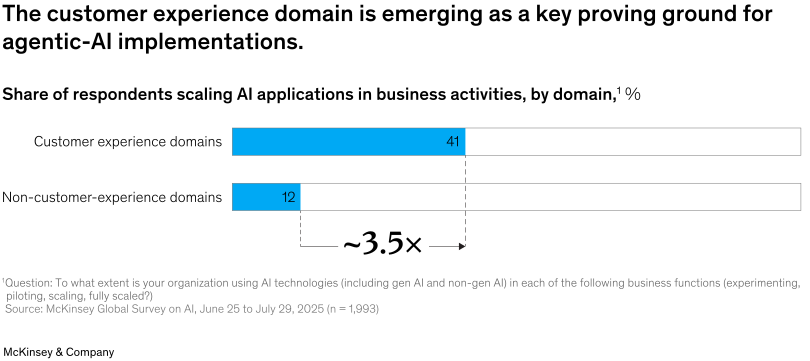
Customer experience, in fact, is emerging as a proving ground for scaling agentic AI. While many enterprise AI initiatives struggle to move beyond pilots, CX stands apart: McKinsey research shows that 41 percent of AI deployments in customer-facing functions—including personalization, service operations optimization, and contact center automation—have fully scaled, making them 3.5 times more likely to scale than deployments in other business domains (Exhibit 2). In practice, CX agents are reaching production faster, delivering measurable impact, and sustaining adoption.
The reasons for this are structural. Over the past decade, CX-driven organizations have invested heavily in digital infrastructure, journey redesign, and performance management. In doing so, they have built the foundations that agentic AI systems require: observable workflows, explicit decision rights, structured data, and established human-in-the-loop models. CX therefore plays a dual role in agentic transformation. For organizations early in their AI journeys, it offers a practical launchpad to demonstrate value and build momentum. For more advanced enterprises, it provides a high-impact arena to move from isolated use cases to coordinated, workflow-level autonomy.
Rethinking the CX journey with agentic AI at the center
The practical path to agentic CX is a progression in decision authority: first improving decisions inside a single workflow, then coordinating decisions across a domain, and eventually optimizing decisions across the broader ecosystem. Companies are adopting agentic CX across three horizons defined by the scope of coordination and decision authority—that is, how broadly agents can make, coordinate, and optimize decisions from a single workflow to the full ecosystem. A workflow in this context is a repeatable process that takes a user from a starting need to a completed outcome, such as setting up an account or resolving a billing issue.
In Horizon 1 (workflow rewiring), agents autonomously execute a single, well-defined workflow end to end within strict guardrails and escalation rules; these capabilities are already here and being adopted and scaled by organizations across industries. The capabilities that define the next two horizons are still developing but are poised to become part of the agentic-powered customer experience. In Horizon 2 (domain orchestration), agents begin to coordinate multiple workflows within a CX domain, optimizing decisions across workflows rather than isolated tasks. And in Horizon 3 (ecosystem experience engine), agents will help orchestrate decisions across functions, channels, and partners to optimize the full end-to-end experience against shared objectives.
Horizon 1: Workflow rewiring
Most agentic production deployments within CX sit in Horizon 1, where the value case is clearest and the path to scale is shortest. These agentic solutions are designed to run one well-defined workflow end to end and under clear guardrails; they tend to work best in repeatable, high-volume moments such as support, service, and sales assistance. Delivering CX in this horizon requires clean process design, structured data inputs, explicit business rules and guardrails, defined escalation paths, and tight human-in-the-loop controls from day one. When these foundations are in place, organizations can move quickly from pilot to production and generate measurable CX and productivity impact.
Yet workflow rewiring is only the starting point. If companies automate a single workflow without clarifying the decision layer beneath it—what the agent can decide, what context it must use, when it should escalate, and how decisions connect to adjacent workflows—they risk hard-coding fragmentation into a faster system. The value of Horizon 1 comes not just from executing a workflow more efficiently but from proving that decisions can be made consistently, transparently, and safely within clear boundaries.
The following examples illustrate how companies have rewired workflows to deliver measurable CX and productivity impact.
- Hyperpersonalized support: Agentic AI enables hyperpersonalized support by embedding customer knowledge directly into interactions, allowing AI agents to autonomously resolve queries with the most appropriate actions. One large energy retailer in the United Kingdom—with about 3,500 call-center employees serving some six million customers and handling about seven million calls annually—deployed a natural-voice agent to handle initial contact and the resolution of high-volume and low-complexity issues. In less than five months, the system was able to understand about 75 percent of customer needs and achieved 85 percent of intent classification accuracy. This resulted in a 6 percent increase in customer satisfaction scores (CSAT) and an annual run rate impact of more than $10 million, driven by greater automation, reduced handling times, and broader coverage of customer needs.
- Agent-augmented resolution: Agentic AI also can act as a frontline copilot, augmenting human agents with real-time guidance, contextual insights, and rapid information retrieval for complex cases. A US-based premium automotive OEM, for example, did exactly this to improve customer satisfaction and efficiency. The company, which has some $700 million in revenue and manages more than 50,000 customer cases a year, deployed an AI agent that synthesizes structured and unstructured data to deliver personalized issue resolution. Integrated performance reporting and feedback loops enable continuous improvement of both AI and human workflows, driving a 24 percent increase in first-contact resolution and a 30 percent productivity improvement among human agents.
These examples showcase the ability of agentic solutions to add value quickly when anchored in high-volume moments. Building on that, we mapped 17 core CX workflows, identifying six that stand out as the best candidates for delivering near-term impact with strong implementation feasibility (Exhibit 3). These workflows stand out because they contain high-stakes, repeatable decisions that drive both customer outcomes and cost:
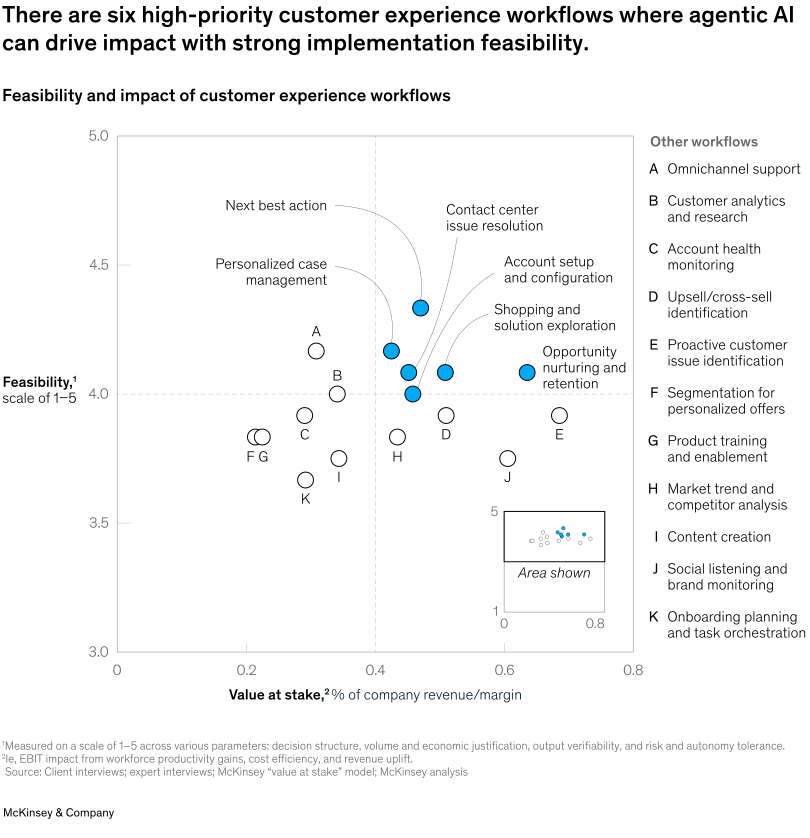
- Next-best action: Uses real-time signals across channels to choose the right intervention at the right time.
- Account setup and configuration: Removes a major activation bottleneck, with structured steps that agents can execute for customers.
- Shopping and solution exploration: Helps customers choose the best options tailored to their unique context, improving conversion and transaction size.
- Contact-center issue resolution: Improves one of the biggest drivers of cost and trust, with agents addressing common issues and exceptions escalated to human workers.
- Personalized case management: Assembles full customer context when resolving customer issues, providing white-glove service at each stage with faster turnaround, ensuring cases move faster with fewer handoffs.
- Opportunity nurturing and retention: Triggers personalized customer outreach at key moments to reduce churn and drive growth.
These six workflows constitute the priority use cases for agentic CX deployments and are high-impact avenues to test, refine, and scale agentic capabilities within a single workflow. Once established, these workflows also provide a foundation for the more ambitious transformations that characterize horizons two and three.
Horizon 2: Domain orchestration
AI agents can make individual workflows more efficient, but that does not automatically improve the customer’s experience end to end. Customers move across multiple workflows: a voice agent, for example, may resolve an immediate issue, but activation still stalls or churn signals go unnoticed because the next decisions sit elsewhere. Horizon 2, domain orchestration, coordinates multiple workflows within a domain so decisions stay aligned, handoffs carry context, and the journey feels like one continuous flow.
This is where value begins to compound. Instead of optimizing isolated moments, domain orchestrators align timing, interventions, and priorities across the life cycle. Agentic commerce is an early signal of this shift, linking discovery, purchase, and onboarding into one coordinated motion: Your agent already knows your preferences, narrows options, verifies terms, completes the purchase, schedules delivery or setup around your calendar, and carries that context into tailored configuration and onboarding so nothing resets at the handoffs. Early behaviors suggest momentum—a recent McKinsey survey, for example, found that 44 percent of European consumers who have tried AI search say it is now their primary search method, and about half of consumers use AI when they search for products online.
Companies are starting to use agentic capabilities to monitor engagement as it occurs and then coordinate the next best set of actions across channels, rather than pushing isolated offers from one team at a time. One of Europe’s largest telecommunications providers, with about €40 billion in revenue, built predictive models that connect signals across domains and channels to decide not only which offer to present but when, where, and with what supporting actions—for example, a proactive service fix or eligibility check. The system delivered a €40 million margin impact through higher engagement and conversion, illustrating how outcomes improve when decisioning is connected across the life cycle rather than optimized in a single channel. However, even strong domain orchestration can fall short if it remains confined to one domain, since customers still move across domains and will notice when the logic, tone, or priorities change from one part of the life cycle to another.
Horizon 3: Ecosystem experience engine
Over time, genuine transformation of the customer experience will come when workflows no longer operate as domain-specific capabilities but instead share context, objectives, and memory so decisions in motion can be optimized across the full customer life cycle. This integration defines Horizon 3: the stage at which agents begin coordinating decisions across functions, channels, and partners against shared objectives, so the experience is optimized end to end rather than improved in isolated silos.
Delivering CX in this horizon will require more than scaling use cases. It depends on a shared decision layer with persistent customer identity and unified context, clear enterprise objectives that balance customer value, cost, risk, and capacity, and the ability for agents to act across systems under strong governance, standards, and auditability. Imagine this: A customer experiences a billing issue and a service interruption, and their recent behavior signals rising churn risk. Rather than treating the visible issue as the whole story, the agentic system looks across the customer profile to identify other likely drivers, such as failed setup steps, repeated contact history, a pending order problem, or declining usage that suggests unmet needs. It then resolves the situation end to end: It restores service, fixes the billing error, proactively credits the account, routes a short follow-up to confirm closure, and adjusts the renewal path or plan recommendation based on what will rebuild trust. The compounding value is that each action reinforces the next, turning what could have been a churn moment into a recovery experience that feels coordinated, fair, and personal.
No organization operates fully at this level today. Those that move early and invest in the foundations, operating model alignment, and incentives needed to support system-level optimization will be positioned to capture outsize benefits as Horizon 3 becomes feasible.
What it takes to succeed: A six-step playbook for getting started
Moving from journey design to decision orchestration requires leaders to redesign not just workflows but the way decisions are owned, made, measured, and improved. After several years of gen AI experimentation and early agentic deployments, six CX-specific patterns distinguish organizations that are turning agentic AI into measurable impact. Across all six, one theme stands out: Success depends on a true partnership between business and technology to define which decisions agents can make, which they must route to humans, what objectives they should optimize for, and how decision quality should improve over time. Rather than treating agentic AI as a technology layer added onto existing processes, leading organizations redesign customer journeys, decision flows, operating models, and governance together.
- Define what the agent is optimizing for and what trade-offs are allowed. Translate business value into clear objectives for the agent, such as retention, trust, cost to serve, and time to value, and make trade-offs explicit, so the system does not optimize the wrong thing. This clarity also makes it easier to pick the few moments where autonomy will matter most and to measure impact early.
- Redesign workflows around decisions, not just steps. Do not layer agents onto fragmented workflows. Redesign the end-to-end flow and handoffs, so decisions are consistent across steps, otherwise AI will simply scale today’s inconsistencies faster.
- Let customer context travel to every decision point. Invest early in shared identity and a unified customer record so context carries across channels, customers do not repeat themselves, and agents act with the full picture rather than partial snapshots.
- Set decision ownership and escalation rules with frontline teams. Involve frontline teams from day one to define decision ownership, escalation thresholds, and handoffs between agents and humans. This builds trust, makes adoption stick, and keeps humans central where judgment and empathy are required.
- Make consequential actions reversible and keep humans in control. Design agents in a way that allows important actions to be undone and gives humans clear override points when the agent is wrong. Capture those overrides and the rationale, so the system improves rather than repeats the same mistakes.
- Build decision-level tracking, testing, and control. Scale requires more than governance. Put monitoring and evaluation in place to track what the agent decided and why, confirm decision quality over time, and continuously tune performance alongside strong safety and privacy controls.
As companies accelerate their agentic CX journeys, they also must treat risk with the same rigor as value. Because agents take actions across systems, data, and workflows, even small errors—such as pulling the wrong record, misapplying a rule, or triggering the wrong kind of escalation—can quickly compound into privacy issues or broken customer promises. CX is therefore a higher-stakes environment than other business functions, one in which speed and personalization must be matched by control. Toward that end, agentic CX systems should be designed and managed with clear human and agent roles and decision boundaries, defined escalation paths, continuous monitoring and feedback, and strong identity, access, and audit controls to ensure actions are transparent and reversible. Organizations that build these safeguards early can scale autonomy while protecting customer trust. (All these ideas are explored in greater depth in McKinsey’s Rewired framework for AI transformation.)
The next source of CX advantage
Agentic AI will not simply improve customer experience—it will redefine how it is delivered. As decision-making shifts from static workflows to intelligent orchestration, the boundary between strategy and execution begins to blur. CX becomes less about designing better journeys and more about governing living systems that continuously learn, decide, and adapt. In that environment, advantage compounds: Organizations that embed agentic capabilities deeply into their operating model will accelerate learning cycles, respond to customers with greater precision, and redeploy human talent toward higher-order judgment, creativity, and relationship building.
The question for leaders is no longer whether agentic AI will reshape customer experience but how deliberately they are prepared to redesign around it. Treat agentic AI as another use case, and the gains will be incremental. Redesign CX around governed decisions in motion, and companies can fundamentally change how they serve customers: with experiences that are more coherent, responsive, personal, and trusted.
At its core, however, this transformation is not about technology—it is about the relationship between a business and its customers. At a time when customers have more choice, more voice, and higher expectations than ever, that relationship has become the ultimate source of differentiation. Agentic systems offer a rare opportunity to strengthen it: to move beyond reactive service and fragmented journeys toward experiences that are genuinely attentive to individual needs. Organizations that seize this moment will not just operate more efficiently; they will build deeper trust, greater loyalty, and more enduring connections. In that sense, agentic AI is not just a new capability. It is a chance to reimagine what it means to truly serve the customer.