Once a pure cost center and now increasingly seen as a lever to drive growth and customer loyalty, customer care is under increasing pressure to innovate with AI. Care leaders are being asked to deliver use cases that show measurable impact and fulfill the vision of humans and AI agents working together to reduce friction from customer journeys and deliver delightful customer experiences.
This is not an easy shift to make. Having been through a number of technology waves before, customer care is not new to disruptive ideas, but AI, and especially agentic AI, is different. It calls on customer care leaders to not simply adopt a new solution into their existing technology stack, but rather to completely rewire the way work gets done, and by whom.
This moment calls for bold strategic thinking at precisely a time when many care leaders are caught up in day-to-day operational challenges amid squeezed margins, limited budgets, and ever-increasing customer expectations. The result is that many organizations are approaching the opportunity of AI from a technology-first perspective, rather than through a more expansive lens that considers issues such as talent, legacy operating models, governance, and trust.
Many organizations are also failing to recognize that innovating with AI and agentic AI is not a cost-cutting opportunity, but rather a chance to improve the customer experience and keep customer care costs flat while supporting organizational growth.
Despite the challenges, McKinsey’s latest State of Customer Care survey shows that some companies are beginning to pull ahead in their adoption of AI. Agentic AI is crossing the threshold from promise to proof, with leading organizations already demonstrating measurable gains in customer experience, efficiency, workforce productivity, and even revenue generation.
These leaders are putting themselves in a strong position to ride the coming wave of AI transformation, where use cases will shift from efficiency-driving assistants toward multiagentic systems, with agents executing end-to-end workflows autonomously, or in collaboration with other AI agents and humans. This will increasingly free up human capacity to focus on higher-value customer interactions.
The shift will require both a rewiring of existing operational models and a rethink of the role of humans in customer care, recasting reactive customer care approaches as intelligent solutions that sense issues, orchestrate resolutions, and improve continuously. Importantly, the shift will also task customer care leaders with building trust in the technology so that leadership, employees, and customers embrace this hybrid care future.
Starting now, even if only starting small, can set companies on a path of experimentation and learning that may prove critical as AI-led customer care becomes the norm across industries and the expectation among customers.
The state of AI in customer care: A growing adoption gap as leaders pull ahead
While the future-state vision of an AI-first, always-on service channel where humans and AI collaborate to serve customers is beginning to take shape, AI adoption is uneven. A gap is emerging between the leaders and laggards.
For the first time, our State of Customer Care survey segmented organizations in terms of their strategy, operations, and technology maturity to understand what distinguishes customer care leaders, and what may be holding back the laggards (see sidebar “Segmentation: Maturity in care strategy, operations, and technology”).
What we found is that AI is becoming the differentiating line between organizations that are realizing measurable gains in customer experience, efficiency, and growth—and those who remain reliant on manual workflows and legacy systems.
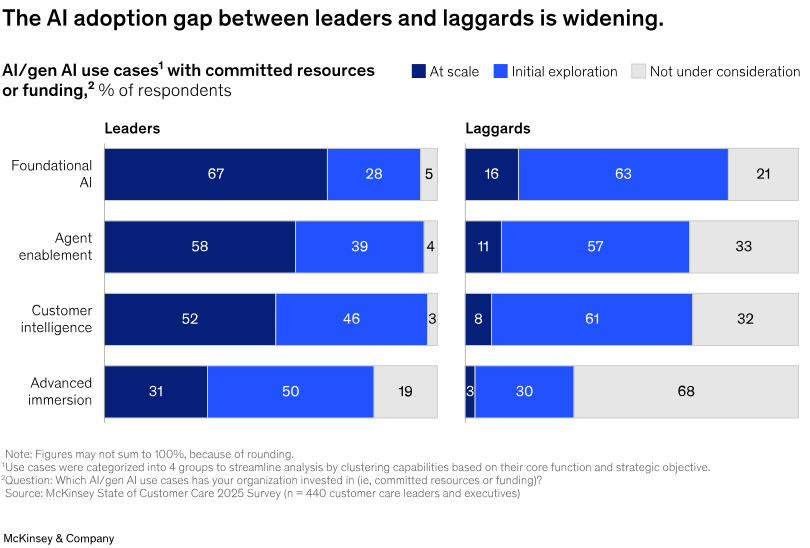
Some 67 percent of leaders have now invested in foundational AI use cases (see sidebar “Four categories of AI use cases”) at scale across their organization, compared to only 16 percent of laggards (Exhibit 1). Even in more complex or frontier use-case categories, such as advanced immersion, 31 percent of leaders have already committed resources and funding at scale, compared with just 3 percent of laggards who have done so.
While adoption is key for kickstarting the learning cycle, achieving early impact from AI investment is also critical. For all the excitement about the potential impact of these technologies, there remains some skepticism that this latest technology wave may end in underwhelming returns. A recent McKinsey survey on AI found that, despite widespread piloting and experimentation, just 39 percent of organizations are reporting EBIT impact at the enterprise level.
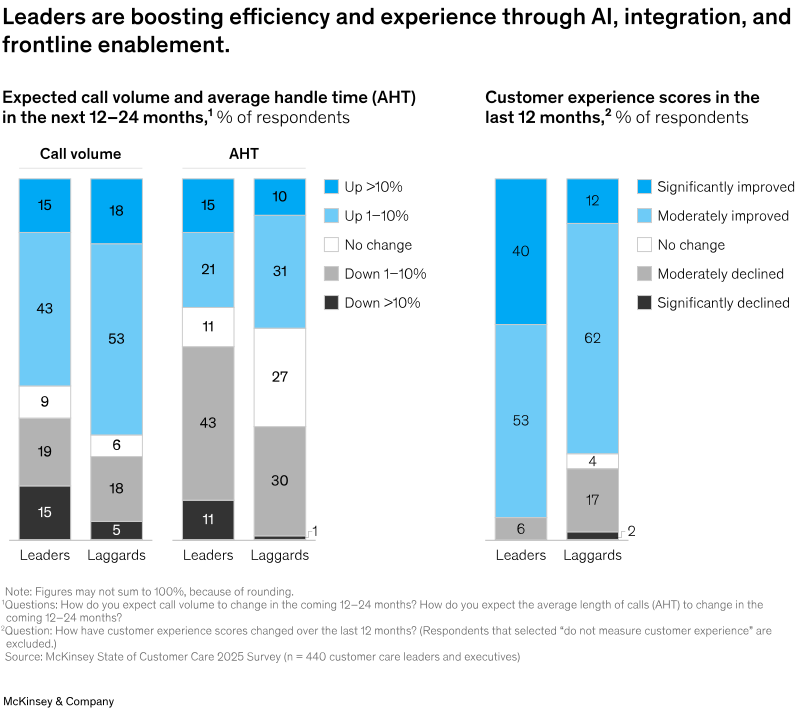
The leaders in our customer care survey are bucking this trend. Some 42 percent have reversed increasing inbound volumes through smarter self-service and digital deflection, and many are now using AI strategically to solve critical frontline challenges and elevate performance. Their efforts are starting to translate into meaningful impact, with 40 percent of leaders reporting significantly improved customer experience scores in the past 12 months, versus 12 percent of laggards (Exhibit 2).
What ultimately separates leaders from laggards is not access to AI technology, but whether organizations treat agentic AI as an operating-model transformation, rather than simply a set of new tools. Agentic AI stalls less because models underperform and more because organizations lack the orchestration, governance, and operating discipline required to scale.
Organizations that are beginning to invest in AI in the fullest sense—focusing on processes and people rather than the technology alone—are beginning to demonstrate earlier impact, while those that remain underinvested may risk being left behind.
Register your interest for our upcoming Customer Experience Leadership roundtables
Turning hype into reality: Building trust among employees and customers
Organizations face a number of hurdles in their efforts to achieve value with AI in customer care: Beyond the typical challenges of technology adoption, businesses must navigate questions of risk tolerance, regulatory compliance in certain industries, and the willingness of humans (employees and customers alike) to trust and embrace the technology.
The trust issue is often ignored or underestimated and can stealthily derail even the best-intended AI strategies. Organizations need to first build trust at the leadership level to unlock investment and set the right transformation vision. And they need employees to trust the technology and embrace it as part of their day-to-day work.
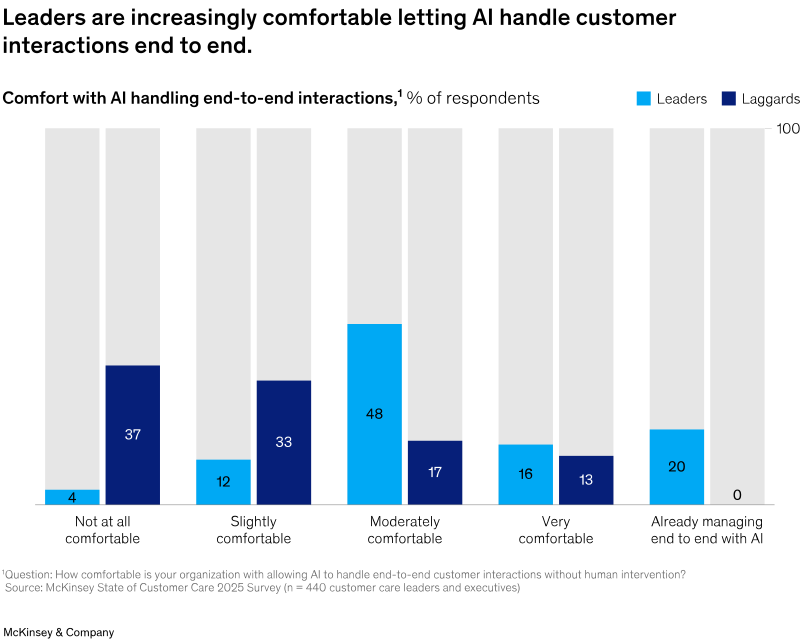
Confidence in AI from a legal, reliability, or model-risk governance point of view is a critical foundation for these other layers of trust and could be a key factor holding companies back. Here again, a gap is emerging. Some 37 percent of laggards say they are not at all comfortable with AI handling end-to-end interactions, compared with just 4 percent of leaders (Exhibit 3).
Customer trust is crucial, too. Trust from customers is often won—or lost—within the first moments of an interaction, and once it is lost, even highly capable AI struggles to recover it.
Many customers still see AI-led self-service options as solutions that drive efficiency and cost reduction benefits for companies, rather than as value-adding solutions for themselves. Organizations need to address this perception so that customers come to see AI as equally or even more capable than a human in meeting their customer care needs.
The way things stand, however, customers often prefer to speak to a human when “things go wrong,” entrenching the persistent human-first model in customer care. To transform the care function, companies will need to successfully bring about a change in customer preferences, where AI is perceived as faster, more accurate, and even more enjoyable than the traditional human-first approach.
This trust element emphasizes the importance of getting customer experience right in any AI transformation. Many organizations appear to understand this, with half of customer care executives in our survey ranking “improving customer experience” among their top strategic priorities. This signals an ongoing shift from cost cutting to value-driving differentiation.
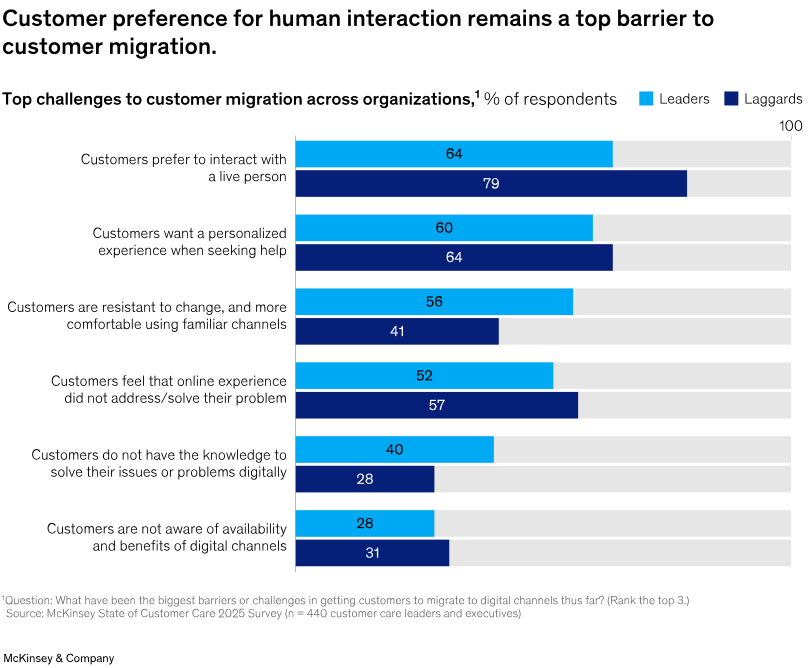
At present, however, customer willingness to use new AI-enabled service solutions continues to be a barrier for a majority of companies. Seventy-nine percent of laggards cited customer preference for interacting with a live person as a top challenge to migrating customers to digital channels. Fewer leaders, though still 64 percent, say the same (Exhibit 4).
While undertones of skepticism remain, customer preferences are expected to evolve quickly as exposure to high-quality agentic support increases, and customers start to expect 24/7 availability and zero average speed of answers (ASA).
The role of humans in the future: Adapting now for the changes to come
Despite the significant potential of AI to transform customer care, the prevailing view today is that humans will continue to play a meaningful, yet different, role in the future. In our survey, almost 70 percent of respondents agree that empathy and trust will always require human involvement. A hybrid customer care environment could therefore set a higher bar for human agents in terms of their capabilities and their inherent qualities such as empathy.
Naturally, the transition from a human-first to an AI-enabled organization will not happen overnight. It will happen, instead, as employees become increasingly "fluent" in AI, whether through reskilling or by sourcing talent with the required profiles. Intentional talent strategies will also be needed to support humans to take on AI orchestration roles where they design, train, or govern AI agents, or even manage hybrid teams of agents and people. This will demand a rethink of existing operating models and a redesign of current processes and ways of working.
In this hybrid environment, humans will likely play a bigger role in value creation than they do today. AI is projected to unlock up to 60 percent of addressable care volume, freeing human capacity to focus on high-stakes interactions that drive value and loyalty. As customer care continues to evolve from a cost center to a value driver, organizations that fail to modernize their lead generation strategy and anchor it on behavioral signals and omnichannel data run the risk of missing opportunities for precision targeting and scalable growth.
Nine in ten leaders are already scaling AI across core workflows, shaping talent for the future by focusing human involvement on complex, high-value interactions where AI still falls short. In this way, progressive players have transformed the contact center into what can be described as an AI-guided revenue lab.
Overall, our survey found that leaders approach customer care as a strategic growth engine, proactively investing in initiatives that drive organizational improvements and generate revenue. Laggards, on the other hand, tend to adopt a more reactive stance, focusing on cost control and preventing care from becoming a resource drain, rather than positioning it as a profit center.
The way forward
With clear benefits now accruing to organizations that are investing correctly in AI in their customer care operations, the question for those seeing lackluster results, or still deciding where to invest, is what to do next.
Before the arrival of agentic AI, when the focus was squarely on gen AI tools, the answer was simply to get started. Unlocking value with agentic AI, however, requires a more thoughtful approach, given its potential to rewire end-to-end processes. A “zero-based design” of customer care journeys and workflows can allow for this reimagining to happen, without the constraints of traditional approaches or policies.
Today, the best next step for organizations is to develop an independent view on where AI applies in their business—and how it could link to impact—starting with a deep root-cause analysis of why customers call, and their intent. These insights provide a business-first perspective and an important starting point for an agentic blueprint, before companies engage with their potential technology partners.
Following this root-cause analysis, organizations can prioritize three key activities to increase their speed to impact:
- Build the internal muscle for AI enablement by focusing on speed of execution, developing proofs of concept in weeks rather than months, and knowing they will not all be successful the first time.
- Design for genuine scale and not just with technology deployment in mind, focusing on processes and people, and how to drive adoption.
- Develop AI fluency among customers and employees alike, treating trust as a core capability and building confidence in the technology across all stakeholder groups.
As customer care moves further toward human and AI collaboration, underpinned by reimagined agentic workflows, a small group of leading organizations is getting closer to this future state. They are putting bold visions into action by using clear road maps, making strategic investments, and ensuring their leaders, employees, and customers are enthusiastic adopters.
In the agentic era, advantage will come not from having more AI, but from designing how work, decisions, and trust scale together.