The US retail landscape is entering a new era. As consumers accelerate their use of AI for making routine purchases, stores will remain a critical part of the shopping journey—but the role of the store will change. Store visits may become less frequent but more valuable.
In this environment, retailers and real estate players will need to clearly define the specific mission of each store and shopping center and determine how to meet consumers’ evolving needs—whether focused on convenience or discovery. The portfolio, operating, and investment decisions that these companies make over the next three to five years will determine which stores and centers earn their place in the future of shopping.
For this report, McKinsey partnered with ICSC, an organization serving the commercial real estate and retail industries, to survey more than 3,000 US consumers about their shopping preferences (see sidebar “About the research”). Drawing on this data, interviews with retail and real estate executives, and McKinsey analyses, we explore the structural shifts shaping the future of shopping; changes in when, why, and how consumers decide to shop in person; and steps that retailers, landlords, and developers can take to create value (for more, download the full report).
Three structural shifts that are reshaping shopping
We believe three structural forces will most materially change the store’s role over the next few years: increasing use of AI in purchase decisions, growing expectations for transparency and convenience, and a shift in consumer spending power.
The rise of agentic AI may be the most profound of these changes. For now, AI use is most common in the early stages of shopping. But that is likely to change quickly as consumers develop more trust and begin to use agentic tools for basket building, automated replenishment, and postpurchase support, particularly for household staples and other routine essentials. As AI takes on more of shoppers’ research and comparison tasks—and even completes purchases—consumers may increasingly turn to stores for order fulfillment, product validation, immediate access, or differentiated experiences.
Transparency and convenience are also major factors in shoppers’ behavior. Consumers have come to expect immediate access to information on pricing comparisons, inventory, and delivery timing, plus a quick-and-easy purchasing process. Meanwhile, hybrid work schedules have also changed shopping patterns, making retail locations embedded along daily routes—near home, school, the gym, or essential services—especially convenient. Convenience is not just about speed at checkout—it’s also about daily-routine-friendly locations, predictable inventory, clear pricing, and smooth transitions between digital and physical channels.
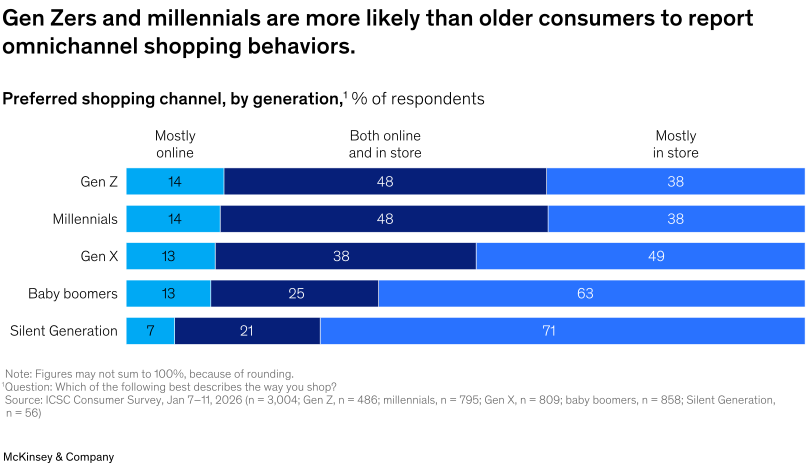
The third transformational force is the increase in spending power among younger generations. Millennials’ and Gen Zers’ behaviors and preferences are already changing the retail landscape. In our survey, Gen Z and millennial respondents were significantly more likely than older cohorts to shop both online and in store (Exhibit 1). Younger consumers were also more likely to prefer retailers that have a website or online presence, to feel comfortable automating routine purchases, and to prioritize frictionless payment options and newer commerce features when choosing where to shop. In addition, more millennials and Gen Zers expressed a preference for experiential retail.
The new shopping trip calculus
Often, store trips serve one of two purposes: convenience or discovery. For both kinds, consumers are applying a new calculus: weighing the time and effort it takes to shop against what they expect to get out of these trips.
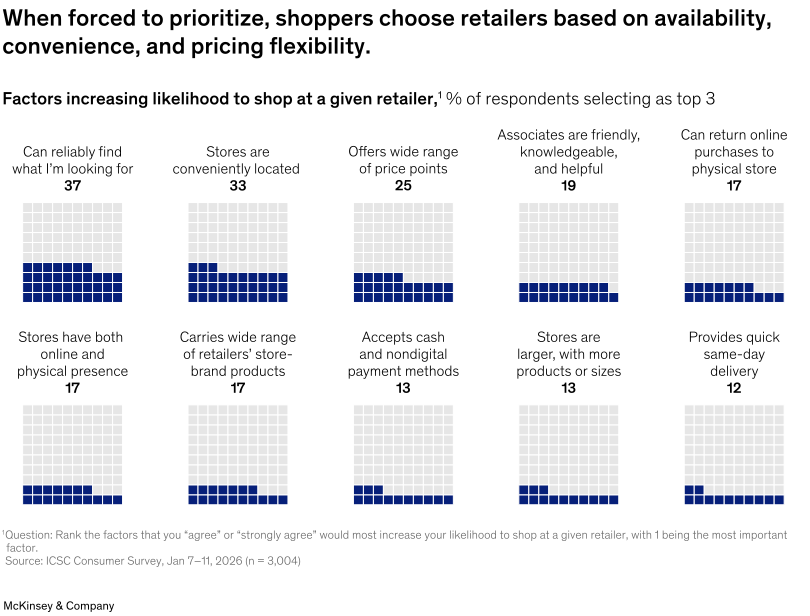
For many convenience-oriented trips, shoppers prioritize efficiency. Thirty-seven percent of survey respondents ranked in-stock reliability among their top three reasons for choosing to shop at a certain retailer (Exhibit 2). Convenience-driven consumers often know what they want to buy before they leave home, and they often check product availability, compare prices, review selection, or look for coupons online. Once they’re in the store, they seek an easy experience and product availability.
For many consumers, particularly younger generations, physical stores are still destinations for exploration and connection. The ICSC consumer survey revealed that shoppers across age groups shop across in-store and online channels; shopping “mostly online” is not the leading method for any generation or category. Younger generations expressed stronger preferences for curated environments with edited assortments, pop-ups, and showroom-style formats. Across categories, consumers were most likely to report shopping mostly in store for groceries and health, beauty, and personal care (Exhibit 3).
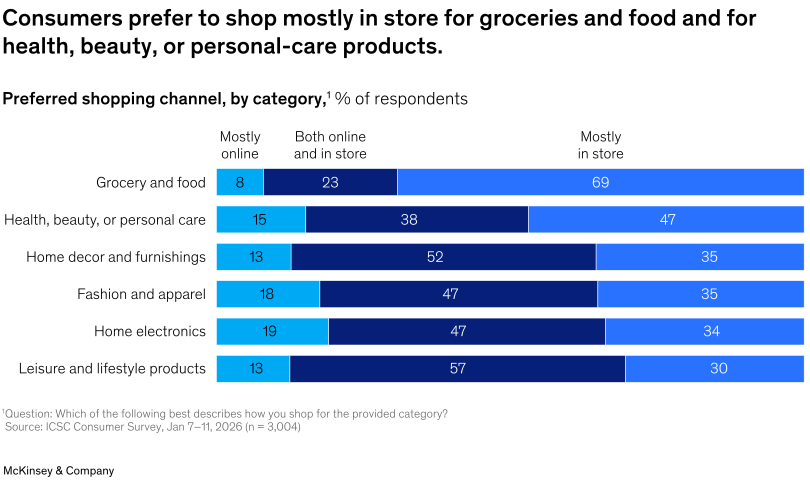
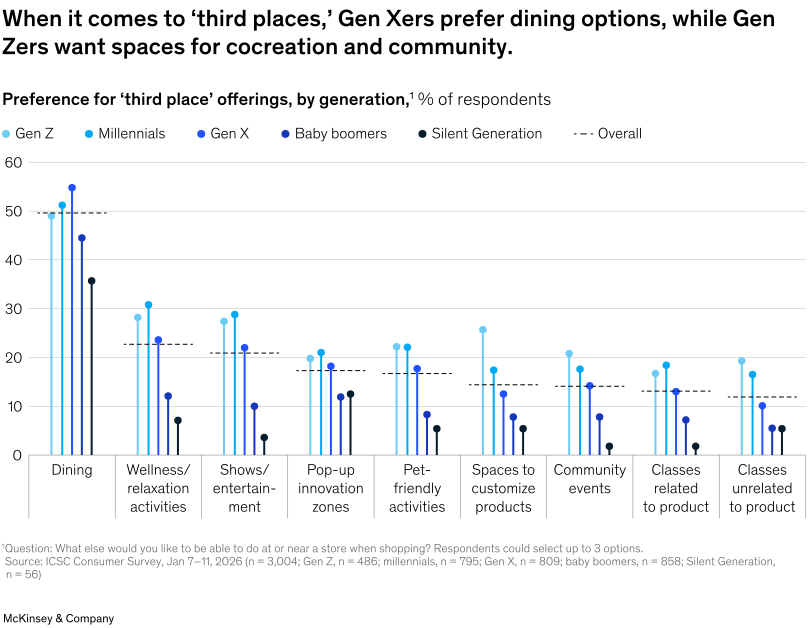
For discovery-oriented visits, respondents expressed interest in some personalization features, including tailored promotions and product recommendations. These consumers are often looking to gain some social benefit from their shopping experiences. As remote work and digital-first lifestyles reduce the frequency of in-person interactions, consumers across age groups are seeking “third places” outside home and work—spaces where people can gather and linger without planning or pressure, such as shopping centers and mixed-use retail environments. To that end, younger shoppers expressed strong interest in nonshopping offerings near retail locations, including dining and community-oriented spaces (Exhibit 4).
Designing stores for distinct shopping missions
As AI becomes a default entry point for discovery and routine purchasing, more of the shopping journey happens even before a consumer ever enters a store or visits a retailer’s website or app. With shoppers growing more intentional about the purpose of their visits, retailers must differentiate their physical locations to satisfy these more discerning customers.
This means convenience-optimized stores must be designed for speed and simplicity, with shorter paths between entry and checkout, guaranteed inventory for in-demand products, visually clear pathways, and intuitive navigation. Retailers can use digital-twin capabilities to simulate and optimize in-store operations before making physical changes, helping to improve reliability and customer experience. In convenience-focused stores, associates should be facilitators, helping shoppers locate items quickly, resolving issues efficiently, and maintaining operational flow. These stores should also offer enhanced checkout and fulfillment processes, such as expanded self-checkout, mobile pay, curbside pickup, and clearly defined pickup and returns areas.
By contrast, discovery-led locations aim to maximize the time consumers spend in store by encouraging browsing across categories and offering visual storytelling, curated vignettes, and rotating collections to engage shoppers. They might also introduce limited-edition product drops, exclusive collaborations, or emerging brands. The best discovery-oriented stores provide selection with clarity and confidence. Crucially, they also equip their associates with AI-supported “clienteling” tools; these tools, once reserved for luxury players, enable store associates to access real-time inventory visibility, customer context, and clear next-best actions at scale. Some retailers miss the mark by attempting to layer discovery elements onto otherwise transactional stores.
Winning in a world of selective shopping: Imperatives for retailers
Retailers need to think about how stores are designed, operated, and measured from the ground up. Those that continue to manage stores uniformly—differing only by size or geography—risk creating locations that are partially optimized for every mission and fully optimized for none, slowing productivity and eroding return on investment. To truly differentiate themselves, retailers must take three key steps:
- Define the role of each store with precision. Retailers must assign each location a primary mission—such as convenience hub, discovery flagship, or fulfillment node—and then design the layout, assortment, staffing model, and service experience around that purpose. Assigning a mission means choosing what the store will not do as much as what it will (and making that role clear to customers so they know which location to choose for a given need). To put this into practice, retailers should move beyond high-level labels toward a data-backed view of their stores, classifying their fleets into mission types based on how each location actually creates value.
- Deploy technology to reinforce each store’s mission. Retailers should ensure that their digital systems are providing their store and district managers with the visibility they need to make better decisions so stores operate consistently and respond quickly to demand and inventory shifts. On top of that foundation, technology investments within the store should reflect its primary mission. In convenience-oriented stores, technology must remove friction and guarantee reliability. For example, clean catalog feeds, accurate local availability data, and live pricing updates can boost a store’s credibility when a shopper, or their AI agent, compares alternatives. AI-driven demand forecasting can also help stores align staffing with peak traffic periods to provide better service. In discovery-led stores, technology should elevate service, exploration, and product understanding rather than simply accelerate transactions—for example, by allowing customers to check availability, compare options, or request assistance without leaving a fitting room.
- Upgrade store capabilities and talent models to match the store’s mission. All stores require knowledgeable associates, but different store missions—and the growing use of automation and AI—require different ways of working. Retailers should redesign store roles, workflows, and performance expectations so teams can deliver against each location’s mission. In convenience-oriented locations, associates need to be broadly cross-trained to move quickly between tasks, help customers find items, resolve issues, and support pickup and checkout without delay. Discovery-led store associates may require greater specialization, with some focusing more deeply on areas such as styling, product expertise, or in-store experiences that require longer customer interaction. Training and coaching should reinforce these differences and increasingly empower associates to use digital tools and AI-enabled systems.
Curating retail ecosystems: How landlords and developers can thrive
In an AI-shaped marketplace, landlords and developers need to act as curators of effective shopping ecosystems by making strategic, data-backed decisions about how their properties can align with shoppers’ missions.
To attract convenience-focused consumers, landlords must provide options that will satisfy these shoppers’ most important needs: speed, certainty, easy access, seamless pickups and returns, strong service, and the ability to complete multiple missions in a single trip. They can enhance convenience by evaluating and optimizing key points along the shopper’s journey that typically introduce friction, such as traffic, parking, and coordinated online order pickup.
Discovery-oriented properties, meanwhile, must be designed to earn more of consumers’ time by creating reasons for them to browse, discover new products and experiences, and engage with brands in ways that cannot be replicated digitally. Landlords and developers need to act more urgently to go above and beyond what retail tenants can do to boost visitor numbers and dwell time and keep them coming back for more. They must evolve into “placemakers”—creating destinations that combine retail, dining, and experiences to attract and engage visitors. Examples of this approach include New York City’s Rockefeller Center, which offers curated retail, dining, and experiential options to appeal to visitors beyond traditional tourism seasons, and The Battery Atlanta, a mixed-use development built around a baseball stadium that is designed as a year-round destination, not just a game day venue.
Curating more vibrant shopping ecosystems will require landlords to make better use of consumer behavior data and predictive analytics to understand how different retail and nonretail tenants will perform collectively. While saying “no” to a prospective tenant may carry the risk of a temporary vacancy or a short-term revenue hit, the long-term strategy for the center’s ecosystem and performance may require it.
Landlords will need to be more disciplined, data driven, and creative in how they lease their spaces. For example, they can try attracting smaller-format stores as new tenants, offering more performance-based leasing structures, and providing space for pop-ups to experiment with buzzier brands without the pressure of trying to lock in a long-term lease. They can also look for opportunities to enhance collaboration with important tenants to better understand the customers they have, those they want, and where else those customers are likely to spend time.
Physical retail will remain a critical part of the shopping experience even as consumers grow more accustomed to using AI to discover and purchase products. But the role of stores will evolve as shoppers’ preferences and behaviors continue to shift. To thrive in this environment, retailers and real estate developers must reimagine store formats and shopping center ecosystems to ensure they are meeting consumers’ needs—whether they are seeking speed and convenience or exploration and social connection. Success will come from clearly understanding their role and earning their place in consumers’ daily lives and routines.
Download the full report on which this article is based.