The pulp and paper sector is a core component of Europe’s industrial base and circular bioeconomy, generating approximately €95 billion in annual turnover, contributing around €21 billion to EU GDP, and supporting about 620,000 jobs across the value chain.1
But long-term sector trends—such as demographic shifts and changing consumer patterns—are reshaping the industry’s demand base. At the same time, structural pressures—including an increasingly complex regulatory environment, rising cost pressure, and growing global competition—are leading to weaker demand growth. Europe’s pulp and paper industry is entering a decisive period of transformation.
At the same time, lower asset valuations, tighter balance sheets, and rising competitive intensity are accelerating consolidation, vertical integration, and restructuring activity across the sector. For European players, demand growth alone can no longer compensate for operational underperformance. Instead, leaders will need to master productivity, commercial discipline, and operating model effectiveness.
In this article, we examine the structural pressures facing Europe’s paper and packaging industry and outline four factors that can help players establish a more integrated operating model (see sidebar “Methodology”).
Pressure is becoming structural
The population in the European Union is projected to decline by 1.5 percent from about 452 million in 2025 to 445 million in 2050, while the share of residents 65 and older is expected to increase from 22 to 29 percent over the same period.2 These shifts, which point to weaker consumption growth across several end markets, are likely to reshape the mix of paper and fiber-based consumption. In Japan, for example, sales of medical and incontinence specialty products for the elderly have far outpaced sales of diapers for infants.3 Additionally, digitalization continues to change how consumers, advertisers, and businesses use media and information: Internet penetration in Europe is about 93 percent today, up from 75 percent in 2015, reducing demand for graphic paper.4
In parallel, structural pressures are intensifying the challenge: Demand growth has weakened across several grades, input costs have remained volatile, competitive pressure has increased within Europe and globally, sustainability demands are linked to regulations rather than consumer demand, and balance sheets are becoming a strategic constraint. Today, sustained performance depends on operating agility, productivity, and the ability to manage volatility across the value chain.5
The current environment is shaped by several reinforcing pressures rather than a temporary cyclical slowdown:
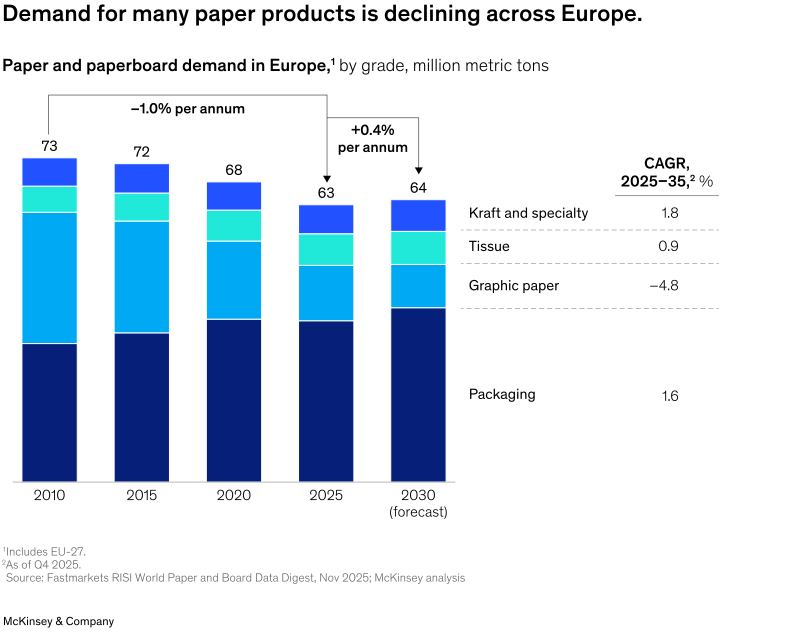
- Demand is realigning across grades in European markets. Graphic paper continues its long-term contraction as digitalization accelerates and print demand weakens. Packaging and specialty grades remain more resilient (Exhibit 1), but growth is more selective even in packaging. The move from plastics to fiber-based solutions continues but more slowly than expected, while value is replacing volume as the primary growth driver.
Zooming in on Italy’s pulp and paper market
Italy is one of Europe’s largest pulp and paper markets, with an industry that generates roughly €8 billion in annual turnover and supports about 100,000 jobs across the value chain.1 The Italian market remains deeply integrated with fast-moving consumer goods, retail, logistics, and industrial supply chains.
But Italy is facing many of the same sector trends as the rest of the continent. For example, the country’s population is projected to decline from about 59.0 million today to 54.7 million by 2050, a drop of 7 percent, while the share of residents 65 and older is expected to rise from 24.3 percent to 34.6 percent.2 Combined with cost pressures and increased competition, these shifts are affecting demand across segments:
- Graphic paper continues its structural decline as digitalization accelerates; internet penetration has increased to 90 percent today from about 60 percent ten years ago.3 Volumes in Italy are expected to contract faster than the European average.4
- Packaging board remains the country’s largest and most strategic segment, representing just over half of Italian paper production5 and benefiting from e-commerce, industrial exports, and sustainability-driven substitution trends.
- Tissue remains comparatively resilient, supported by stable hygiene demand and Italy’s strong converting base—particularly in the Lucca district, which is home to several leading industry players. However, the segment increasingly faces import-led competitive pressure and input cost volatility, and demand is declining compared with the rest of Europe.
- Specialty papers and premium packaging continue to offer attractive pockets of growth, particularly where innovation, sustainability, and product differentiation support stronger pricing and margins.
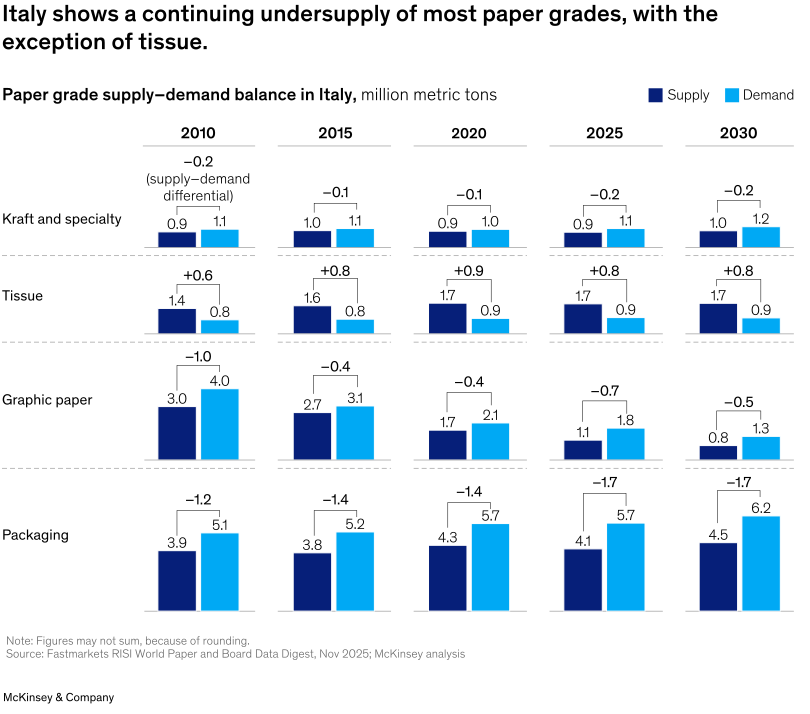
In terms of supply, kraft and specialty, graphic, and packaging all point to current and expected undersupply in Italy. Tissue is the only grade in oversupply (exhibit).
These dynamics suggest that as structural and competitive pressures intensify across Europe, Italian players may need to accelerate their own operating model review to remain competitive and capture the next wave of value creation.
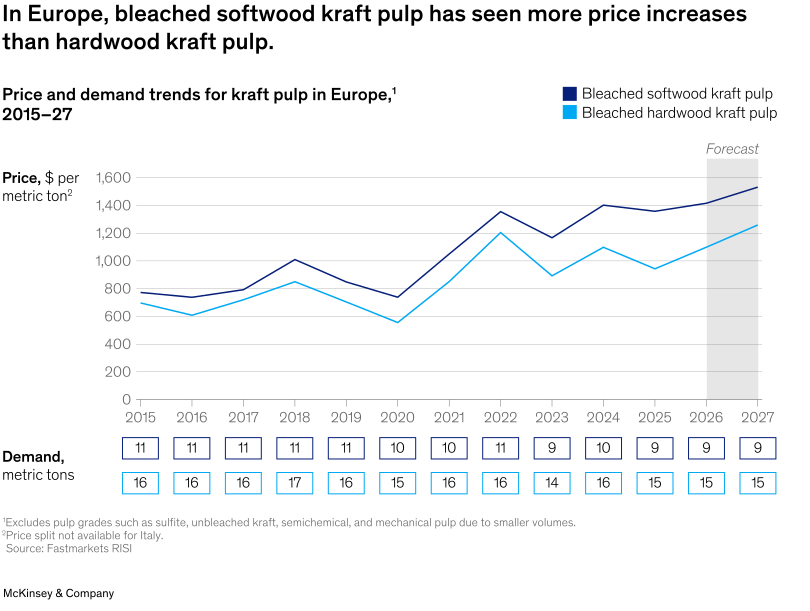
- At the same time, cost pressures remain elevated. Pulp, recovered fiber, wood, and energy prices have become more volatile over the past five years; pulp prices in Europe increased 3 to 6 percent per year from 2015 to 2025, with bleached softwood kraft pulp increasing more than bleached hardwood kraft pulp (Exhibit 2). The loss of Russian wood imports, biological disruptions, weaker construction activity, and structurally tighter fiber availability have all contributed to sustained inflationary pressure. Energy competitiveness has also become a major differentiator between regions and between integrated and nonintegrated mills—that is, those that produce their own pulp and those that don’t. This is particularly relevant in Italy, where papermaking remains heavily exposed to natural gas6 and where many nonintegrated mills lack the internal energy advantages of integrated pulp sites, such as black-liquor recovery (see sidebar “Zooming in on Italy’s pulp and paper market”). It is also relevant in Germany and, to a lesser extent, in France.
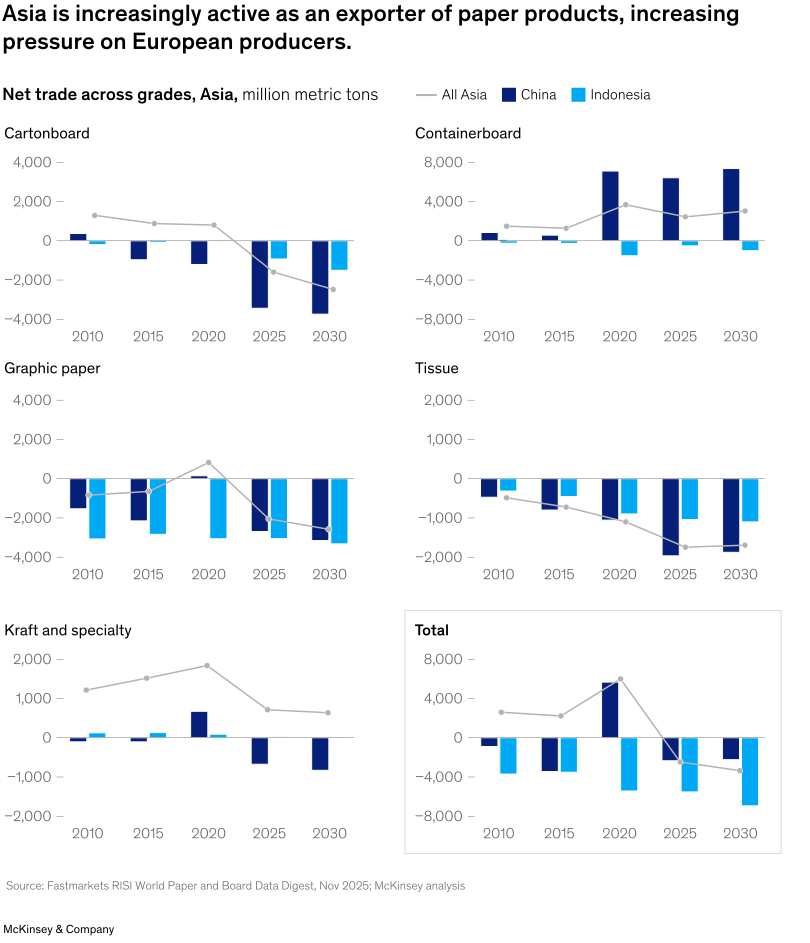
- Global trade dynamics are adding further complexity. Asia is increasingly serving as a structural export platform across several grades, including cartonboard, tissue, and graphic paper (Exhibit 3). As capacity additions continue to outpace domestic demand, excess supply is flowing into international markets, intensifying competitive pressure for European producers and limiting opportunities for sustained price recovery.7
- Sustainability remains strategically important, but its role is evolving. The sector already achieves recycling rates above 70 percent (ten percentage points higher than North America),8 yet sustainability is shifting from differentiation toward a baseline requirement shaped by regulation and economics. Consumers continue to care about sustainability, particularly recyclability and circularity, but willingness to pay more for it has weakened amid inflationary pressure and macroeconomic uncertainty.9 As a result, sustainability investment is driven by regulation rather than by broad-based consumer pull. Packaging purchasers continue to face six persistent barriers to adoption: affordability, performance trade-offs, lack of alignment on sustainability definitions, regulatory uncertainty, supply limitations, and limited visibility into available solutions.
- Balance sheets are becoming a strategic constraint. Higher interest rates and lower asset valuations are limiting flexibility for a growing number of players. In response, many companies are prioritizing preserving liquidity, optimizing their footprint, leveraging procurement synergies, and pursuing restructuring programs.
Consolidation has continued in this environment, but the logic is changing. While scale remains important, the strongest transactions are increasingly differentiated by integration quality, commercial synergies, procurement leverage, and portfolio fit.
Why operational underperformance is becoming more visible
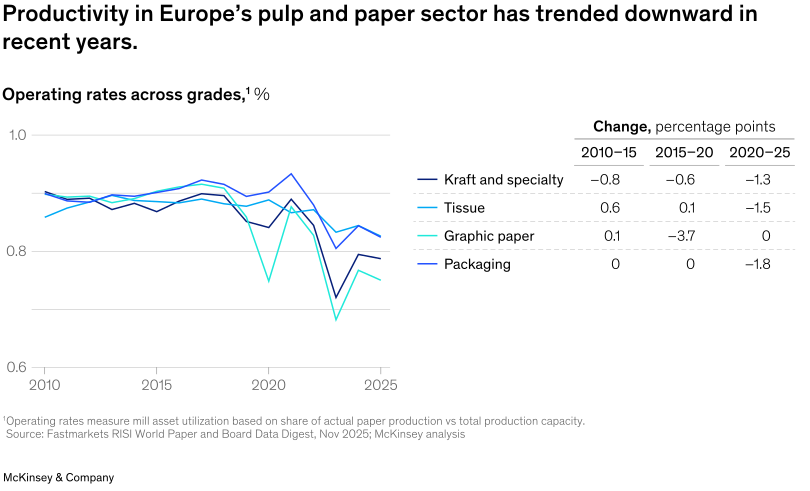
Industry players may be tempted to attribute underperformance primarily to external pressures. Those pressures are real, but they do not fully explain the sector’s performance gap. Productivity across pulp and paper has remained below historical levels (Exhibit 4). Many pulp and paper players still lag behind other industrial sectors in automation, digital integration, and end-to-end operating model redesign. The next wave of value creation is likely to come from operational and productivity improvements and commercial excellence.
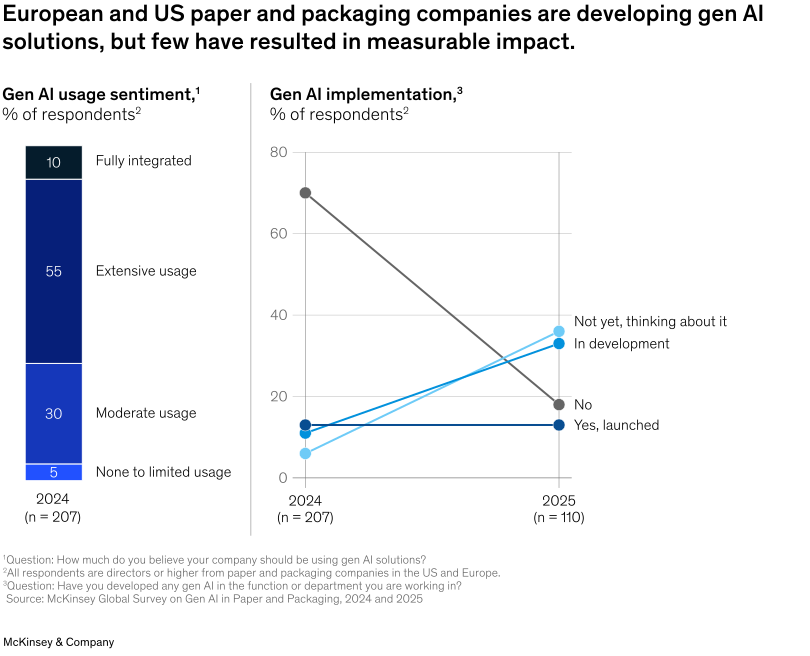
AI and advanced analytics are emerging as critical enablers to navigate the increasingly constrained market environment. From optimizing mill operations to enabling more-precise pricing, customer targeting, and product development, these tools provide a tangible way to address cost pressures and capture new growth opportunities. Across the paper and packaging industry, companies are rapidly moving from experimentation toward implementation: More than 80 percent of leaders report that they have active gen AI initiatives under consideration, in development, or already launched.10 But most efforts remain at an early stage (Exhibit 5). Many companies continue to deploy digital and AI tools as isolated use cases rather than embedding them into how the business is managed. The gap between pilot programs and enterprise-wide impact remains substantial.
Transforming the operating model
European pulp and paper companies can no longer respond to volatility, cost pressure, and regulatory complexity with incremental initiatives layered onto legacy ways of working. The core challenge today is fragmentation. Procurement programs are often disconnected from mill performance, commercial excellence efforts remain separate from capital allocation decisions, and digital tools are deployed as standalone applications rather than as integrated management systems.
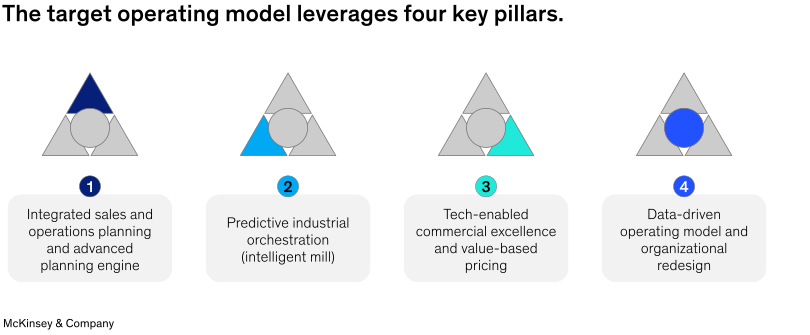
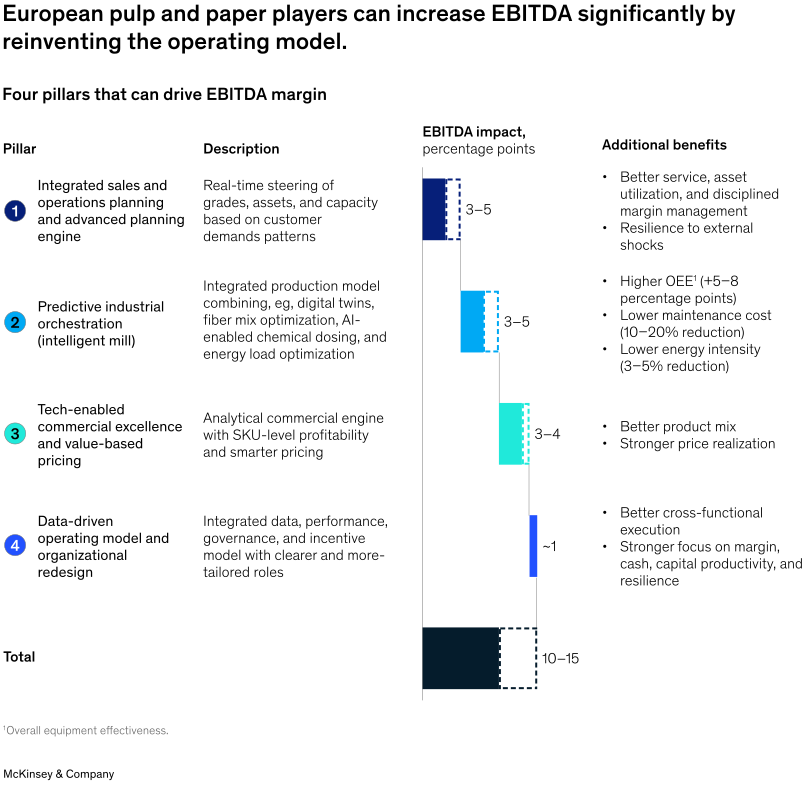
In an environment shaped by fiber and energy volatility, uneven segment demand, carbon exposure, and rising capital intensity, achieving competitive advantage will require organizations to redesign the enterprise around a more integrated operating model (Exhibit 6). McKinsey analysis suggests that, depending on their starting point and execution maturity, midperforming pulp and paper players in Europe could potentially realize as much as ten to 15 percentage points of EBITDA improvement through a combination of better portfolio steering, intelligent operations, commercial discipline, and organizational redesign (Exhibit 7).
Integrated sales and operations planning and advanced planning engine
Many pulp and paper companies still rely on annual planning cycles and fragmented sales and operations planning (S&OP) processes, managing demand, production, procurement, logistics and commercial decisions through separate tools, decision forums, and processes. This model is under strain as volatility rises across customer demand, fiber availability, raw-material prices, energy costs, and logistics flows.
The future model is likely to include an integrated S&OP and advanced planning engine that connects demand sensing, supply chain planning, production scheduling, procurement, logistics, and commercial priorities into one cross-functional decision process. Modern advanced planning and scheduling (APS) systems can now go beyond traditional forecasting, which are based mainly on historical correlations, by incorporating “weak signals” (for example, early indicators such as customer order patterns, promotion performance, inventory movements, macrotrends, weather, logistics disruptions, or competitor moves) to detect demand shifts before they fully materialize. On top of this, AI and agentic workflows can continuously monitor the gap between forecasts and actuals, triggering recalculations when deviations widen and recommending corrective actions across production, inventory, and logistics. This speeds up the cycle for decisions related to sensing processing. For example, if a customer promotion overperforms, the system can rapidly update demand forecasts, adjust production priorities, and rebalance inventories; if it underperforms, it can revise plans before excess stock builds up.
More broadly, APS enables companies to evaluate trade-offs across grade mix, machine allocation, inventory levels, service commitments, energy costs, and margin before decisions are made. Thanks to this, leadership teams can move from periodic planning and reactive adjustments toward faster, data-backed decisions—which demand to prioritize, how to allocate production across machines and mills, when to rebalance inventories, and how to respond to disruptions or changing input-cost economics. As a result, companies could see better service and lower cost-to-serve as well as stronger asset utilization, more-disciplined margin management, and greater resilience to external shocks, potentially supporting about three to five percentage points of EBITDA improvement.
Predictive industrial orchestration (the intelligent mill)
Most pulp and paper companies have already launched initiatives in automation, maintenance, or process optimization. The step change comes when those capabilities become embedded in the mill’s core operating system.
The intelligent mill combines digital twins, real-time fiber mix optimization, AI-enabled chemical dosing, predictive maintenance, throughput debottlenecking, energy load optimization, automated quality control, and self-learning root cause systems into one integrated operating model. In practice, this means integrating data from sensors, control systems, laboratory results, and planning tools into a common digital layer that can predict issues, optimize process settings, and dynamically coordinate trade-offs across cost, quality, throughput, and energy use. The result is a mill that can respond quickly to variability and operate with greater stability and precision.
This is particularly relevant in countries such as Finland, Sweden, and Germany with structurally higher gas costs for industry consumption,11 which continue to weigh on the competitiveness of nonintegrated mills. Energy management must be integrated directly into production and operational decision-making.
The objective is to make mills more adaptive, more predictable, and easier to optimize across the network. Early adopters are already demonstrating measurable impact through increases in overall equipment effectiveness (five to eight percentage points), lower maintenance costs (10 to 20 percent), reduced energy intensity (3 to 5 percent), and more stable quality performance, according to McKinsey analysis. These levers may create meaningful EBITDA upside—likely three to five percentage points of improvement—although the magnitude varies significantly by company starting point, asset base, product mix, and execution maturity.
Tech-enabled commercial excellence and value-based pricing
Commercial excellence is emerging as one of the most important value creation levers for European pulp and paper companies. Packaging leaders increasingly see gen AI and advanced analytics as critical enablers of growth, particularly in lead generation, customer prioritization, pricing, and sales effectiveness.
Yet many companies still rely on broad segmentation and static pricing logic, which provide limited visibility into SKU-level profitability. That approach is increasingly ineffective in a market in which growth is selective, customer willingness to pay varies materially across applications, and value pools are shifting toward higher performance and sustainability-linked products.
The next-generation commercial model requires the following:
- SKU-level profitability visibility. By integrating pricing, cost-to-serve, product specification, and service data, organizations can create a granular view of margin by SKU, customer, and application.
- AI-enabled pricing corridors. Companies can use AI to define deal-specific pricing ranges based on customer segment, order profile, competitive intensity, and historical willingness to pay.
- Elasticity and contract risk modeling. Modeling how customers and segments respond to price changes, contract terms, and service levels can help leaders anticipate volume and margin impacts before making decisions.
- More-precise customer targeting. By combining internal commercial data with external signals, businesses can identify the most attractive accounts, prioritize sales efforts, and tailor propositions more effectively.
- Better visibility into where sustainability attributes create pricing power. For example, companies can link sustainability features such as recyclability, traceability, or lower-carbon performance to customer preferences, tender outcomes, and realized price premiums across applications.
The new model looks beyond volume growth to achieve higher-quality growth, stronger price realization, a better product mix, and more-disciplined margin management. Companies that do this well could see three to four percentage points in EBITDA uplift. This is particularly important in fragmented markets such as Italy, France, and Spain, where the customer base often includes a long tail of small and medium-size enterprises and pricing discipline can vary significantly across applications and customer segments.12
Data-driven operating model and organizational redesign
The industry cannot capture the full value of digital and AI if organizations continue to operate in silos. Lessons from early leaders show that the most successful transformations use digital and AI to redesign how the business operates end to end. Leading players are moving toward integrated data architectures, single centers of control across the organization, embedded analytics teams, and more centralized governance across operations, energy, procurement, and commercial decisions.
Organizational redesign is equally important. Decision rights are becoming simpler; there are fewer handoffs; and incentives are becoming increasingly aligned around margin, cash generation, capital productivity, and resilience rather than volume alone. Sustainability needs to be embedded into the operating model rather than managed as a parallel agenda. By linking product performance, traceability, circularity, and carbon footprint data directly to commercial decisions and customer value propositions, companies can increasingly position sustainability as a source of differentiation and growth.
Europe’s pulp and paper industry will likely continue to face structural pressure from weaker demand growth, cost inflation, regulation, decarbonization economics, and rising global competitive intensity. Structural trends suggest that many companies may need to accelerate transformation. The question now is how quickly leaders can evolve their operating models to compete in a more volatile and execution-driven environment.
Companies should consider connecting planning, operations, commercial decisions, sustainability, and capital allocation into one coherent management system so they can respond faster to volatility, allocate capital more effectively, and operate with greater commercial and operational discipline.