This is the first article in a series on gen AI’s emerging role and impact in enabling the next stage of growth in packaging.
The packaging industry is looking to gen AI to fuel growth—and the data shows it is making rapid progress. Our second annual survey of packaging leaders reveals that companies have moved from experimentation to execution on gen AI initiatives. While a noticeable gap existed in 2024 between companies’ intent to use gen AI and its actual implementation,1 in 2025, more than 80 percent of surveyed leaders from across the global packaging industry reported that their companies had a range of gen AI solutions under active consideration, in development, or even being launched.
Now, leaders are exploring where gen AI can best reignite growth in practice. As adoption increases, expectations are high. For example, respondents anticipate revenue gains of 8 percent or more from implementing gen AI applications in commercial excellence (sales, marketing, and customer service). To achieve this value, however, companies will need to address intellectual property (IP) and privacy concerns and build a firmer understanding of gen AI use cases.
In this series, we explore how packaging companies can overcome barriers and realize gen AI’s promise of faster, more sustainable growth. We focus on the three functions in which gen AI use cases in packaging are the most advanced: commercial excellence, procurement, and supply chain and logistics.2 This article lays out our overall survey findings and dives into our insights on commercial excellence, the area with the fastest gen AI adoption among packaging players. We show how gen AI can enhance lead generation and customer prioritization, and we outline what companies need to consider to move from early wins to sustained commercial impact.
Survey results on the state of gen AI adoption in packaging
After several challenging years marked by destocking, economic uncertainty, and soft volumes, the packaging sector is looking to reignite growth.3 Gen AI could help packaging companies in multiple areas, but before making any moves, organizations need to understand where they stand in the relative maturity of their efforts.
To gain insights into where the industry stands regarding gen AI, the 2025 McKinsey Global Survey on Gen AI in Paper and Packaging gathered responses from 110 senior leaders from packaging companies in the United States and Europe (47 and 53 percent of respondents, respectively),4 with a focus on key decision-makers (all respondents are directors or higher). The survey represents all major substrates (flexible and rigid plastics, glass, metal, and paper) and end markets (cosmetics and beauty, e-commerce, food and beverage, industrial products, pharmaceuticals and medical, and retail).
Our core findings show how much companies have moved from discussion to implementation, what barriers to adoption remain, and where gen AI is already being used.
Companies are moving from intent to action
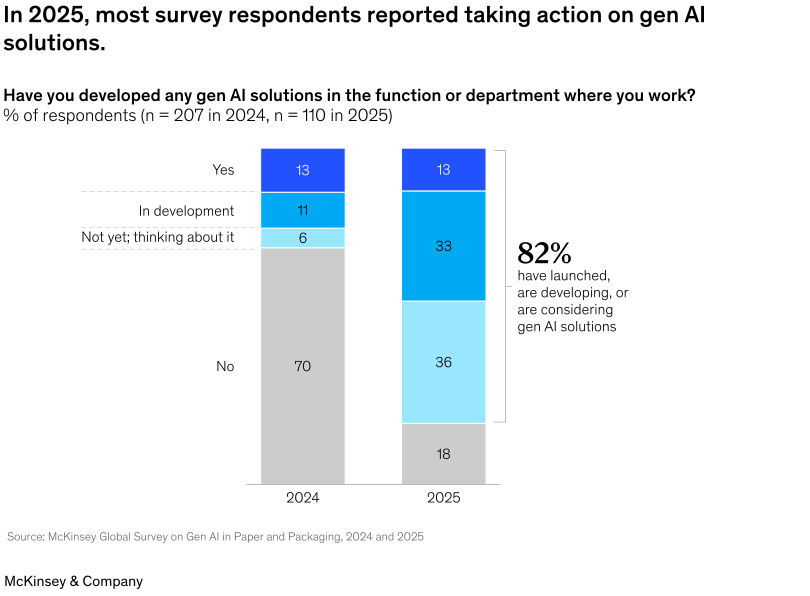
The packaging industry has taken action on gen AI. In the 2024 survey, 65 percent of respondents believed their companies should be using gen AI extensively or that they should fully integrate it. At the same time, 70 percent reported there was no gen AI development in their own function, and only 13 percent said they had launched solutions. In 2025, this picture flipped: More than 80 percent reported movement on gen AI within their function, and only 18 percent reported no activity (Exhibit 1). This rapid deployment is a sign that packaging leaders see great potential in gen AI technology.
Barriers to adopting gen AI have evolved
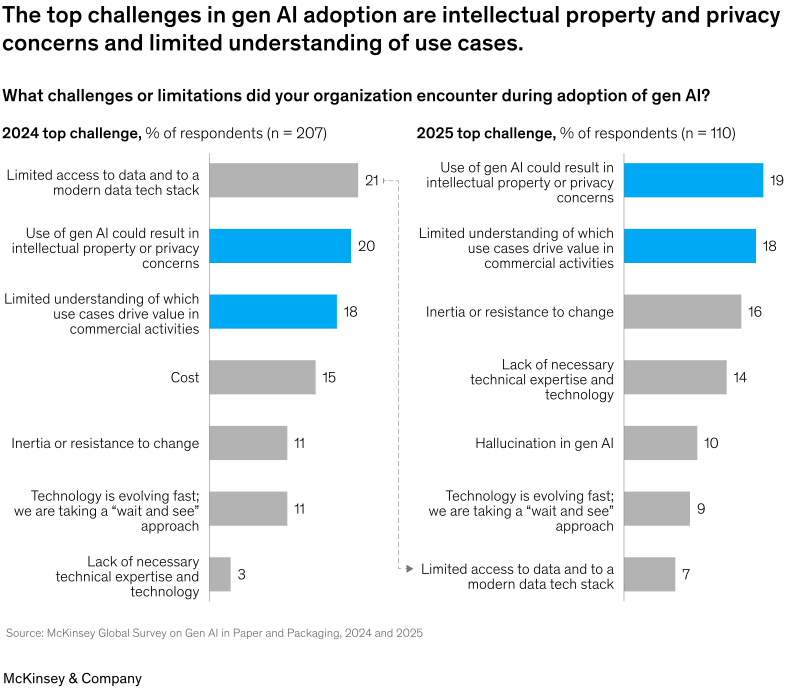
As companies have implemented gen AI, the nature of adoption barriers has shifted. In 2024, limited access to data and modern data stacks was the most commonly cited top challenge (21 percent of respondents), but by 2025, only 7 percent cited it as their primary barrier (Exhibit 2). This suggests that respondents recognize the power of gen AI to handle unstructured data. Meanwhile, IP and gen AI understanding remain high on the priority list as regulations on AI (and AI technology itself) are still being developed.
Where are companies implementing gen AI?
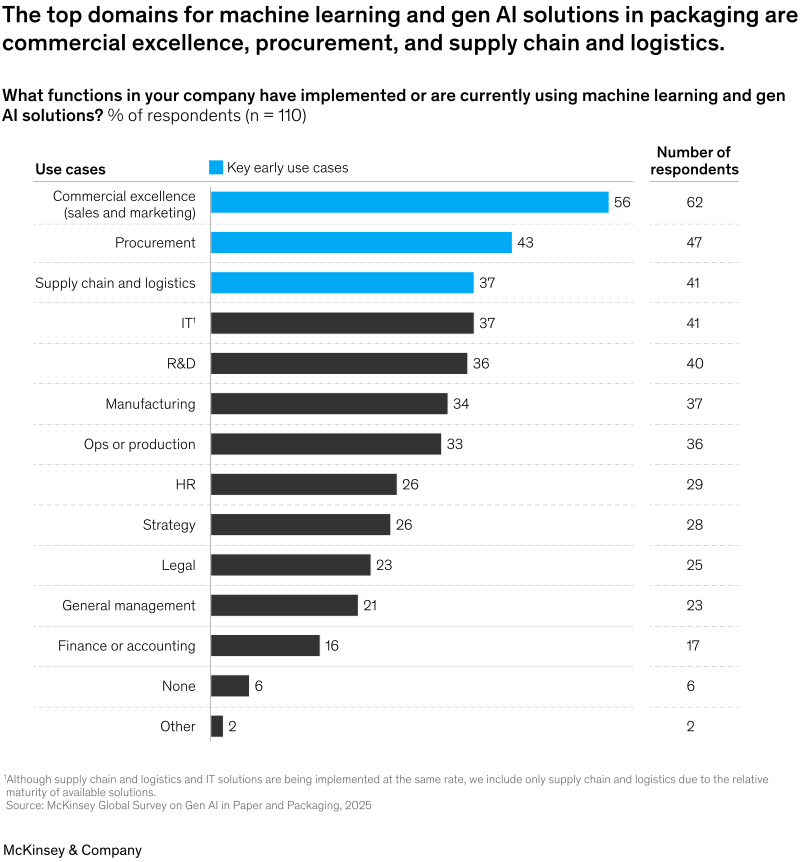
With more solutions being rolled out, the results of our survey indicate that gen AI in packaging is no longer experimental. The primary question for packaging companies to answer now is in which domains (and on which capabilities) they should get started. Most respondents (56 percent) indicated that their companies already use machine learning or gen AI in commercial excellence (Exhibit 3). This was followed by procurement (43 percent) and supply chain and logistics (37 percent). These were also the functions in which respondents saw the largest revenue potential, with expected uplift of more than 8 percent in commercial excellence, 3 to 5 percent in procurement, and 6 to 8 percent in supply chain and logistics.
Packaging leaders cited a few key applications for gen AI within commercial excellence, procurement, and supply chain and logistics where they have started to make progress:
- In commercial excellence, more than two-thirds of respondents viewed two key applications as high-impact: identifying and prioritizing leads, and generating market reports. These applications demonstrate that commercial leaders are using gen AI to rapidly identify attractive markets, assess opportunities, and focus on the prospects most worth pursuing. Together with traditional levers such as sales effectiveness, these gen AI–powered levers can further optimize the total ROI from sales.
- In procurement, gen AI is primarily focused on information-intensive tasks. Respondents reported that leading applications include tools that generate customized market trend reports as well as tools that build detailed packages of requests for information, proposals, and quotations from technical specifications, order histories, contracts, and external data. These use cases are seen as both high-impact and highly implementable.
- In supply chain and logistics, leaders see high-impact opportunities but are more cautious about near-term execution. Inventory health assessment and shipment status chatbots are viewed as the use cases with the most potential, yet only a minority of respondents expect to implement them in the near term. The reverse is true for automating transportation documentation, which has the fastest expected implementation rate despite being perceived as having a relatively lower impact. This imbalance suggests that in supply chain, simpler workflow automation is advancing more quickly than the more transformative, analytics-heavy applications that respondents believe could ultimately deliver the greatest benefits.
As front-runners explore applications of gen AI in each of these areas, they may find new opportunities for growth. Below, we explore applications in the top-ranked area—commercial excellence—to help packaging leaders better understand initial areas to explore.
Using gen AI for lead generation in commercial excellence
The case for gen AI in commercial excellence is strong. Total shareholder returns in packaging have lagged behind broader indexes in recent years, and low asset utilization5 is common in many parts of the industry. Against this backdrop, organic growth could come less from adding capacity and more from finding and winning the right opportunities by leveraging the sales function.
Yet finding these opportunities is structurally difficult. Customers are spread across many fragmented end markets, and sales teams have not always been equipped or encouraged to systematically identify white space. Because of this fragmentation, finding leads has historically been time- and data-intensive, relying on manual analysis to validate pipelines and improve conversion rates. In many organizations, account plans still rely on individual experience and informal networks, making it difficult to identify new segments or emerging challengers.
Gen AI could change this equation by directly addressing these long-standing challenges. Gen AI tools could expand and refine commercial lead generation by rapidly mapping value pools, generating verified customer lists, and continuously refreshing insights from both structured and unstructured data. This could enable faster sales cycles and increased sales force productivity. For this reason, surveyed packaging executives expect gen AI to deliver the most significant top-line growth in sales—more than 8 percent.
Due to its high potential, gen AI adoption in packaging is most advanced in commercial excellence. In terms of specific interventions, organizations could apply gen AI in sales through three key steps:
- Identify all relevant markets and customers by scanning large volumes of public and internal data. Sales teams in packaging companies often build account lists by stitching together data from customer relationship management platforms, contacts, web searches, and other ad hoc sources. Because this coverage is often incomplete, many white space opportunities stay below the radar. Gen AI could continuously scan public and internal data to identify relevant customers across segments and geographies, creating a comprehensive and up-to-date universe of potential targets.
- Size the opportunities for each segment and customer. In many packaging businesses, potential is still estimated from simple revenue bands or rough volume counts in spreadsheets. This top-down view blurs the distinction between small buyers and high-potential customers, so sales coverage and investment decisions often fail to align with the underlying opportunities. Gen AI could bring together firm-level data, historical orders and prices, and technical information to estimate addressable volume and margin by market segment, customer, and plant. This would make the largest and most profitable pockets of demand visible and comparable, allowing commercial teams to allocate their time to the opportunities that matter most.
- Prioritize leads for the front line. Packaging pipelines are often long, inconsistent, and not prioritized by value. Sales teams tend to work on opportunities in a simple list order or mainly react to incoming requests, so time is spent on small or poor-fit accounts while attractive opportunities remain underserved. Gen AI could score and rank leads using expected volume, fit with the existing asset base and service footprint, distance from plants, and historic win rates so sales and account managers know exactly where to focus first.
Taken together, these capabilities could turn lead generation into a faster, more objective, and more accurate process. For packaging companies, this would provide a clearer view of where growth truly lies—and a better chance of capturing it.
Other gen AI applications in commercial excellence
Beyond lead generation, gen AI can accelerate commercial excellence functions and value capture in paper and packaging in other ways, including the following applications:
- Free up sales time by letting gen AI take on routine commercial tasks. Packaging sales teams often spend more time on administrative tasks (for example, preparing technical quotes, maintaining customer files, and writing visit reports) than on customer interactions. Gen AI could help shift this balance, freeing more time for customer visits, design work, and negotiations.
- Unify sales funnels and key account plans with gen AI. In many packaging businesses, account plans and opportunities are split by market segment (for example, region, business unit, or substrate), making it difficult to identify stalled deals, gaps in coverage across end markets, or true white space. Gen AI could create a consolidated view and rank accounts by potential opportunity size so commercial teams could prioritize their focus.
- Set prices at the SKU and customer levels with gen AI. Pricing is often slow and manual in packaging companies. It can erode revenue and profitability by delaying quotes, creating errors, and causing wide inconsistencies in prices, discounts, and margins for similar orders. Gen AI could scan past deals and cost data, suggest clear target prices by SKU and customer, and flag margin-dilutive quotes before they are approved.
By addressing these points, packaging players could be well on their way to building gen AI–powered lead engines. These lead engines could in turn create a practical route to stronger, more sustainable growth—especially when coupled with targeted efforts to make sure sales impact (volume, margin, and sales effectiveness) is optimized across the end-to-end journey.
How packaging companies can seize the commercial excellence opportunity
Technology alone will not be enough to ensure sustainable organic growth from gen AI in sales. To fully benefit, companies could consider using a complete “rewiring” approach, moving beyond point solutions and striving for an end-to-end, gen AI–powered commercial system grounded in business value.6 In practice, this means selecting commercial excellence applications with high potential for implementation and building capabilities around them. Successful companies do this by following a few key guidelines:
- Put existing data to work with gen AI rather than waiting for perfect data. In packaging, data on orders and customers is often scattered across systems and spreadsheets. This fragmentation creates gaps and inconsistencies. Gen AI could match records, standardize fields, and create a “good enough” view of potential opportunities in commercial excellence. This allows decisions to be improved now rather than after a multiyear system integration.
- Design pilots as building blocks for the entire commercial road map rather than as one-off tests. Pilots should generate quick wins, but they also need to fit into a scalable commercial blueprint. Otherwise, impact stays isolated.
- Train commercial excellence teams to use gen AI in their day-to-day work. Even the best tools fall flat without a sales team trained to apply them in account planning, pricing, and negotiations.
Gen AI in packaging is no longer experimental; it now gives companies a path to revitalize performance after years of industry slowdown. However, most companies have not yet seen value from gen AI. Delivering promised growth, especially in commercial excellence, will require a sharper view of where to play: Organizations need to develop a granular, forward-looking picture of customer value pools to identify high-potential targets and no-regret moves. With strong governance, gen AI could act as a key enabler and accelerator of the growth that packaging companies are seeking.