Where will the next wave of growth for insurance come from? At a time when the industry is under increasing pressure to find new sources of value beyond traditional lines and mature risk pools, our latest research suggests that 18 high-growth industries or “arenas” represent an underappreciated next wave of disruption. Arenas directly related to AI or enabled by it are a part of the mix, but other arenas are also emerging, including those related to electrification and new bio-frontiers such as obesity drugs.
These arenas collectively are creating new asset categories, technologies, liabilities, and behaviors that will reshape risk exposures across the economy, creating new demand for insurance. To meet this demand, insurers will need to innovate on new product and distribution models. They will also need new capabilities to price, underwrite, and service the associated risk.
These arenas will not only shape new premium pools; they have the potential to reconfigure the industry’s economics by changing what is insured, against which risks, and with what cost structure. Many of the new risks may lead to less frequent but more severe claims, while expense ratios shift and compress costs across the value chain.
This article details these new arenas and how they may affect life and property and casualty (P&C) insurance, both personal and commercial, and outlines key questions for insurance leaders to address as they build them into their strategy.
18 future arenas of competition are reshaping the global economy
Research from the McKinsey Global Institute (MGI) has identified 18 potential arenas of the future that are reshaping the global economy, with the potential to generate $29 trillion to $48 trillion in revenues by 2040 and drive up to one-third of global growth.
The 18 arenas were identified based on already observable markers. Three factors underlie their growth and dynamism: first, they begin with technological step-changes; second, investments in them escalate in a race to improve and commercialize innovations; and third, they have large or growing addressable markets.
These arenas range from AI software and services to cybersecurity, from future air mobility to drugs for obesity and related conditions, and from robotics to biotechnology. They fall into five main themes: AI foundation, which includes semiconductors and cloud services; digitization, including digital advertising and e-commerce; electrification, including electric vehicles (EVs) and batteries; hard tech, including space and robotics; and new bio-frontiers, which include obesity drugs and biotech. Together, they account for a growing share of economic activity and experience rapid market share changes.
Revenues in these 18 industry arenas grew about ten times as fast as those of other industries between 2022 and 2025, adding about $18 trillion in incremental market capitalization. AI has led this growth, accounting for $11 trillion of the gains, but other arenas have also seen substantial gains (Exhibit 1).1
The AI foundation theme drove three-fifths of arenas’ market cap gains of nearly $18 trillion.
1Market cap data cover 2022–25 (with 2021–22 used as the baseline average). For private companies without a market cap, company valuations are used interchangeably. Figures may not sum, due to rounding.

All arenas are still at an early phase of growth and dynamism. Digitization and AI foundation are more scaled today, while hard tech and new bio-frontiers are generally earlier-stage.
For insurance, the arenas could present a new frontier of growth and disruption
The impact of these arenas on financial services, including banking and private capital, is likely to be significant, according to McKinsey research. For insurance, which has long played a role in nurturing new technologies and helping protect individuals, households, and businesses against new risks and their possible financial consequences, the arenas present considerable opportunity, but also a world of change.
The emergence of the arenas comes as insurers, especially in P&C, enter a more moderate growth phase after a period of strong premium expansion. Much of the expansion in global premiums in recent years has been driven by rate increases rather than underlying coverage expansion. As rate growth has slowed over the past 12 months, insurers have seen overall premiums growth slow as well, with limited growth in underlying coverage in many markets. Against this background of an industry-wide slowdown in premium growth, carriers are looking for profitable growth beyond traditional lines and mature risk pools.
Most notably, climate change, cyber threats, and geopolitical volatility are already reshaping global risk pools, raising loss uncertainty and correlation across risks. Global insured losses from natural catastrophes exceeded $127 billion in 2025, well above long-term averages.2 McKinsey has estimated that individuals, governments, and companies currently spend about $190 billion each year on capital and operating expenses for protection against heat, wildfires, drought in agricultural areas, and flooding. Other trends are reducing risk, such as through predictive maintenance, which improves safety and overall health.
Less remarked, arenas introduce new physical assets, technologies, and customer behaviors that create demand for new forms of insurance. Insurers will accordingly need new products, underwriting approaches, and risk-sharing models to serve them. The arenas thus present opportunities to access new premium pools, build differentiated capabilities, and improve profitability. At the same time, the underlying risks across many arenas are more interconnected, evolve more rapidly, and have limited historical loss experience compared with the risks the industry is accustomed to covering. This will consequently drive a need to innovate.
Our research suggests that arenas may transform insurance along four dimensions.
- New risks to insure: From a risk perspective, arenas reduce some traditional risks while introducing novel, complex, and systemic exposures that existing products were not designed to cover. These exposures require new coverage categories, liability frameworks, and risk-sharing structures.
- Changes to claim frequency and severity: Arena risks tend toward less frequent but far higher-severity events. For example, much of the technology innovation will reduce frequency but increase severity in auto claims and potentially homeowners’ claims.
- Shifting expense ratios: Arena technologies can improve insurance economics. Drones, AI, Internet-of-Things (IoT) sensors, and other arena technologies enable more efficient and accurate underwriting and inspection, proactive risk prevention, and faster claims handling. The cumulative effect will be to reduce costs and improve outcomes at different points across the value chain.
- Changing life and health assumptions: Biomedical innovation may change the mortality tables in life insurance and shift the claims patterns in group life insurance, as well as short-term and long-term disability claims. AI-augmented decision-making could enhance consistency in human judgment across claims and underwriting. Continuous monitoring (by connected vehicles and IoT sensors, for example) enables predict-and-prevent models, reducing losses and operational costs—and transforms insurers from payers to preventers.
The effects of the arenas are likely to vary for life insurance and personal and commercial P&C lines. AI software and services will affect all lines, but other arenas are more relevant for specific insurance lines than others. For example, obesity drugs and biotech may affect life insurance. Personal lines may be most affected by EVs, shared autonomous vehicles, future air mobility, and robotics. Commercial coverage may be affected by rapid growth in space, cyber, cloud, and future air mobility.
In the following sections, we look in more detail at life insurance, personal lines P&C, and commercial lines P&C insurance. We focus on the arenas that are most significant to these lines and their likely effects, including shifting risk types, claim severity and frequency, expense ratio, and prevention. We also cite examples of insurers that are already reacting to these opportunities and changes, in some cases offering new types of policies. These examples are illustrative rather than exhaustive.
We also discuss some arenas to watch (see sidebar, “Nuclear fission and quantum computing are among developments with emerging insurance implications”).
While not our primary focus in this article, we note two critical macro issues raised by the growth of arenas. First is the implication for insurance balance sheets, which tend to be very large. Investments in the arenas may affect insurers’ return and asset-liability management. For example, exposure to certain arenas affects duration; thus, infrastructure investments could help match long-duration liabilities. The second relates to concentration risk as industries become increasingly linked to the development and adoption of AI. We return to these cross-cutting issues in our concluding strategy discussion.
Arenas affecting life insurance
Exhibit 2 shows the arenas with the largest likely effect on life insurance. Arenas that impact human lifespans and lifestyles will have the greatest effect on life and annuities carriers. These include bio-frontiers, through GLP-1 (glucagon-like peptide-1) obesity drugs, biotechnology in the form of genetic modification, and personalized medicine.3 Obesity drugs and these biotechnology advances may transform life and annuities most directly by shifting the assumptions on which mortality and morbidity pricing is built. As with other insurance lines, AI software and services may lower expense ratios through changes to underwriting processes, and other arenas, including shared autonomous vehicles, may also have some impact on life, but ultimately are likely to have a greater impact on other lines.
Note: Blank cells indicate no material impact identified; color shows the assessed impact level. Hover or tap a cell for detail.
12040 industry size midrange estimate times 6.8% risk premium (RMIS Risk Report 2019).
The data relating to value at stake in this and subsequent charts reflects a qualitative assessment that combines MGI research on the size and trajectory of each arena with expert judgment on its likely impact on insurance economics, including premiums, claims, underwriting, operating costs, and prevention. The rankings indicate relative importance rather than precise quantitative estimates.
Group life insurance will be affected by many of the same forces as individual life, particularly the mortality and morbidity improvements associated with GLP-1 drugs and advances in preventive and personalized medicine. The directional effects are similar: improved population health can reduce claims frequency and alter long-term mortality assumptions. The key difference lies in the transmission mechanism. While individual life is influenced primarily through applicant-level underwriting and selection, group life is affected through employer benefit design, wellness programs, healthcare coverage decisions, and workforce-level claims experience.
GLP-1 obesity drugs could rewrite the disease burden basis for life pricing
GLP-1 receptor drugs have the potential to change the disease burden, which serves as the basis for life, disability, and annuities pricing. Trial data show that these drugs can lead to a 20 percent reduction in major cardiovascular events.4 Munich Re’s analysis of 41 million insured US lives estimates additional annual mortality improvement of between 0.2 and 0.5 percent for approximately 20 years.5 Accordingly, policies priced on pre-GLP-1 assumptions may systematically overprice treated populations.
Given the growing popularity of these drugs, insurers need to consider the implications for their patient and economic models. Depending on the long-term effectiveness of the drugs, pricing could be affected. Long-term effects of the drugs could potentially also emerge, bringing risks that aren’t yet foreseeable.
For annuity and pension writers, Swiss Re notes that GLP-1-driven increases in lifespan could extend pension payout periods.6 To reflect potentially changing population outcomes, annuity and pension providers would need to reassess pricing, reserving, and longevity assumptions.
Bio-frontiers: Genetic testing and personalized medicine could enable individualized mortality and morbidity assessments
Bio-frontiers also cover a range of biotechnology products and services. Many of the arena-creating technology breakthroughs are nonmedical, for example in agriculture and biomaterials. Here we focus on two medical aspects: genomics and personalized health. Genomics moves life insurance from pooled risk models to highly individualized mortality and morbidity assessments. As genetic data becomes more predictive, the actuarial basis of life pricing shifts from population-level tables toward individual-level risk profiles. This will potentially fundamentally alter how life risk is segmented. It may also raise ethical and regulatory questions about how to use genetic information in practice.
Personalized medicine could reinforce this shift by tailoring prevention and treatment to an individual’s biological characteristics, health history, and response to therapy. More effective and targeted care could improve health outcomes and change expected mortality, morbidity, and disability patterns, creating a need for insurers to update pricing and underwriting assumptions.
Some insurers are already responding by offering eligible life insurance customers genomics-based testing and personalized health insights.
Among life insurers, early adopters who integrate genomic insights into underwriting within regulatory and ethical boundaries may be better positioned to differentiate their underwriting capabilities. Insurers relying primarily on pooled models may face increasing pressure to evaluate how individualized risk information is incorporated into underwriting. At the same time, insurers will need to navigate disclosure rules and evolving guidance on genetic information.
Arenas affecting P&C personal lines
Five arenas in home and auto insurance stand out for personal lines carriers. They introduce novel, systemic exposures that existing products were not designed to cover (Exhibit 3).
Note: Blank cells indicate no material impact identified; color shows the assessed impact level. Hover or tap a cell for detail.
12040 industry size midrange estimate times 6.8% risk premium (RMIS Risk Report 2019).
As with life, AI software and services may lower expense ratios and additionally allow more personalized intervention. Among the arenas representing digitization, e-commerce especially affects insurers as they look to embed distribution in new online channels. EVs and batteries may also pose new risks, including from battery fires and higher repair costs for EVs.
Insurance embedded in e-commerce explicitly covers previously uninsured or indirectly covered risks
Insurance embedded in e-commerce turns coverage into part of the purchase itself. For example, customers buying an e-bike from Cowboy can select theft insurance directly at checkout via Qover’s embedded insurance platform.7 In this way, a risk that might otherwise have gone uninsured or been covered only indirectly through another policy becomes an explicit, transaction-level product. For insurers, the economics shift toward securing access to the digital customer journey, pricing coverage attractively enough to encourage adoption, issuing it instantly, and efficiently handling a high volume of relatively small policies and claims. Profitability consequently depends increasingly on customer adoption rates, claims automation, and access to transaction and platform data rather than traditional annual risk pooling.
Cybersecurity becomes a stand-alone and fast-growing risk class
For personal lines, cyber coverages have long been more of a niche product. As cybersecurity gains ground as an arena, cyber risk is becoming a growing risk class addressing ransomware, AI-enabled attacks, identity theft, and smart home vulnerabilities. These developments open an entirely new personal lines market while also changing the ways of underwriting, as device and network data become continuous risk signals. Multiple insurers now offer stand-alone personal cyber coverage for risks such as ransomware, identity theft, and cyberbullying.
Drones offer faster damage assessments but also create a new liability category
Drones support the faster, cheaper, and safer assessment of physical assets, replacing manual, slow, and hazardous inspection processes. They can reduce loss-adjustment expense, accelerate claims cycles, and improve accuracy, particularly in catastrophe response. Several insurers already use drones for post-catastrophe damage assessment, reducing inspection times and improving safety. Drones also can create a new personal liability category as consumer and commercial drone delivery scales across residential areas.
Electric vehicles and batteries increase severity claims for auto
EV adoption brings benefits such as lower fuel and operating costs, reduced tailpipe emissions, and a responsive driving experience.8 At the same time, for insurers, EVs are propelling higher claims severity across auto. Battery damage frequently triggers total-loss write-offs rather than repairs, and when repairs are possible, they cost 20 to 30 percent more than internal combustion engine equivalents.9 Thermal runaway introduces a fire propagation risk that crosses from auto into property lines, particularly in home garages. Insurers face compounding exposure: fewer claims but significantly higher per-claim costs, with a new correlation between auto and homeowner books.
Among others, one large European insurer has adapted its underwriting models to account for damage caused by operating errors, overvoltage, overcurrent, deep discharge, or charger malfunction.
Shared autonomous vehicles shift risk to higher-severity system risks
As shared autonomous vehicles roll out, risk moves from frequent claims that are uncorrelated with human error to less frequent but higher-severity, correlated system risks: software defects, outages, cyberattacks, and embedded decision errors across fleets. Liability shifts from individual drivers to platforms, OEMs, and technology providers, fundamentally reshaping the personal auto policy. McKinsey research suggests that by 2030, about $5 billion in annual US premiums will migrate from personal auto to commercial insurance, while $140 billion to $160 billion of the personal mobility total insurance market will be disrupted by connected, shared, and autonomous mobility.
Insurers already taking these risks into account include AXA, which has partnered with autonomous-mobility players to develop fleet and liability coverage, shifting underwriting from driver behavior to system performance and operational data.10
Arenas affecting P&C commercial lines
Exhibit 4 shows the arenas that will most affect P&C commercial lines. As with P&C personal lines, multiple arenas have the potential to disrupt commercial insurance, across all the themes our research identified, from evolving cyber to novel space risks.
Note: Blank cells indicate no material impact identified; color shows the assessed impact level. Hover or tap a cell for detail.
12040 industry size midrange estimate times 6.8% risk premium (RMIS Risk Report 2019).
Six arenas are already significant for commercial carriers, and two more are nascent. These arenas concentrate value into fewer, larger, more interconnected assets that can create systemic exposures requiring new capacity models, specialist underwriting, and continuous risk monitoring. Two of these arenas, cybersecurity and air mobility, have already been mentioned in the personal P&C section above; here, we discuss the commercial insurance impacts specifically, which differ to some extent.
Cybersecurity: New risks of AI-enabled dynamic threat environments
Cyber risk has evolved from isolated threats at the perimeter to dynamic threat environments amplified by AI-enabled attacks. The fundamental challenge is systemic correlation: A single vulnerability in widely deployed software can trigger simultaneous claims across thousands of policyholders, more akin to a natural catastrophe than traditional liability. Portfolio diversification provides less protection than underwriters assume, and tail correlations exceed what traditional reinsurance can absorb, requiring new capital structures.
Insurers have been moving to address this growing issue. Beazley launched the market’s first cyber catastrophe bond in 2023, opening a new capacity channel for a risk class that traditional reinsurance alone could not absorb. Today, Beazley has issued $670 million in cyber catastrophe bonds and more than $1 billion in cyber excess-of-loss cover.11 Munich Re integrates cyber risk analytics for real-time monitoring and dynamic underwriting. Munich Re, Beazley, and Gallagher Re jointly developed a transparent cyber accumulation model combining actuarial modeling, cybersecurity expertise, and underwriting to better quantify systemic cyber risk.12
Data centers and cloud services raise new challenges of outsize insured values and business interruption risk
Data center construction creates outsize demands on property and construction coverage. Hyperscale facilities often carry total insured values above $10 billion, pushing the boundaries of what property markets can accommodate.13 The sheer size requires special facilities and capital structures. Among others, FM Global and Aon have significantly expanded their solutions for data centers,14 while Marsh launched Nimbus, a dedicated insurance facility for large-scale data center construction, backed by a panel of insurers from Lloyd’s and company markets.15
For their part, cloud services can create correlation issues: One outage could trigger business interruption claims across tens of thousands of dependent businesses simultaneously. AI data centers that use the cloud are also vulnerable to disruption, which can potentially affect services from banking to e-commerce. When a major cloud provider goes down, losses cascade across multiple tenants, operators, and programs. This violates the independence assumption of standard property underwriting.
Space moves from niche exposure to commercial asset class
Space risk is scaling from niche exposures to a growing commercial asset class. Launch failure, satellite malfunction, and in-orbit collision risks are all increasing as the number of active satellites has grown from about 2,000 in 2019 to more than 18,000 today.16 Space risk requires specialized underwriting, engineering expertise, and syndication, given the high severity per event, limited historical data, and accumulation risk across assets sharing the same orbital environment. Several major brokers operate dedicated space insurance practices, providing specialist risk assessment, program design, and placement for launch and in-orbit risk.
Semiconductors face large-scale business interruption risks
Semiconductors have one of the most concentrated risk exposures in the global economy. For example, about 90 percent of advanced chips come from facilities in Taiwan, a concentration intensified by surging AI demand.17 A single disruption, whether it be an earthquake, water shortage, or some other event, could cascade across automotive, electronics, defense, and data center supply chains simultaneously, creating contingent business interruption at a global scale. Insuring for such risks requires scenario-based, geopolitically informed underwriting. Dedicated semiconductor practices are emerging across commercial insurers, combining engineering-based property coverage with specialized supply chain risk management.
Robotics creates new liability risks
Autonomous robots moving beyond factories into warehouses, hospitals, and public spaces create new liability potential and situations in which fault attribution is ambiguous. Software failures, fleet interconnections, and AI decision-making can make it harder to establish causation than with traditional machinery. Claims shift from workers’ compensation to product liability, requiring fundamentally different underwriting approaches. Several large insurers have begun introducing dedicated coverage for humanoid and embodied-AI robots, including protection against physical damage, system failures, cyber risks, and third-party liability across production and deployment.
Future air mobility creates new commercial liability risks
Just as drones create new personal insurance risks, commercial drone fleets scaling across logistics, inspection, and delivery likewise create new liability for fleet operators, manufacturers, and airspace providers. Unlike manned aviation with decades of loss history, drones introduce novel questions about fleet aggregation, software-driven failures, and third-party damage in urban environments. The premium base is small today but growing rapidly. One fleet insurer provides dedicated enterprise drone fleet insurance covering drones flying beyond visual line of sight (BVLOS) and autonomous swarm operations, with up to £50 million ($66 million) in fleet liability.18
AI software and services are reshaping the operating model of insurance across all lines
As we have described in other publications, AI is reshaping the operating model of insurance itself, beyond individual business lines, and it is a cross-cutting factor across all insurance lines.
First, AI is creating new liability and loss exposures for insured individuals and businesses. Indeed, many of the risks described in the arenas above are fundamentally about insuring products and services with embedded AI, including robotics and AI software elements such as cybersecurity and e-commerce. AI-enabled systems can create new exposures, such as faulty decisions, cyberattacks, privacy and intellectual property risks, requiring insurers to clarify liability and assess whether existing coverage is adequate.
Second, AI will have an operational impact on insurers, including changing insurance distribution. Just as the e-commerce arena reshaped insurance in a prior technology wave by opening direct online distribution as a major new sales channel and spawning a generation of insurtechs, so too could the added layer of agentic commerce reopen the playing field. A life insurer detecting mortality slippage, a P&C carrier pricing autonomous vehicle risk, and a commercial underwriter modeling semiconductor supply chains all draw on the same underlying capability. AI’s impact occurs at the infrastructure layer rather than the product layer, unlike in other arenas such as cyber or space. This is why AI cuts across every line of business simultaneously rather than creating a discrete new market.
Third is the structural impact on industry economics and decision-making. By automating routine back- and middle-office activities, including policy servicing, AI can lower expense ratios and improve customer responsiveness. In underwriting and other expert-led processes, AI’s ability to synthesize information and support decision-making can also allow professionals to focus on complex cases and critical judgments. These changes represent a structural shift in cost structures rather than merely incremental efficiency gains.
Fourth is improved risk assessment and prevention. For personal and commercial lines, AI enables continuous risk monitoring, more accurate pricing, and stronger underwriting decision-making within applicable frameworks. For life, it enables health interventions, early detection of risk changes, and proactive engagement with policyholders to reduce claims before they occur.
Insurers globally have been scaling up their AI use cases. For example, Ping An has automated nearly 60 percent of accident and health claims.19 Zurich, Switzerland, for example, uses an AI-supported fraud-scoring tool to assess most of its more than 600,000 annual non-life claims and help investigators identify cases requiring closer review.20 Other insurers have deployed AI-enabled servicing tools to respond more quickly to customer requests. They have also introduced tools that ingest and structure underwriting submissions, identify relevant information, and flag key risks for underwriters.
The arenas continue their rapid growth. How could insurers address their emergence and implications?
As we have documented above, the growth of arenas is already affecting insurers and, in many cases, leading to action. But this movement is in its early stages, and our research suggests it will continue to build in importance and reach across the entire insurance landscape.
Exhibit 5 shows the growth potential for revenue in the arenas over the next 15 years to 2040, based on our research. E-commerce tops the growth chart, starting from the largest base, followed by AI software and services, but all the arenas are projected to increase their total revenues substantially.
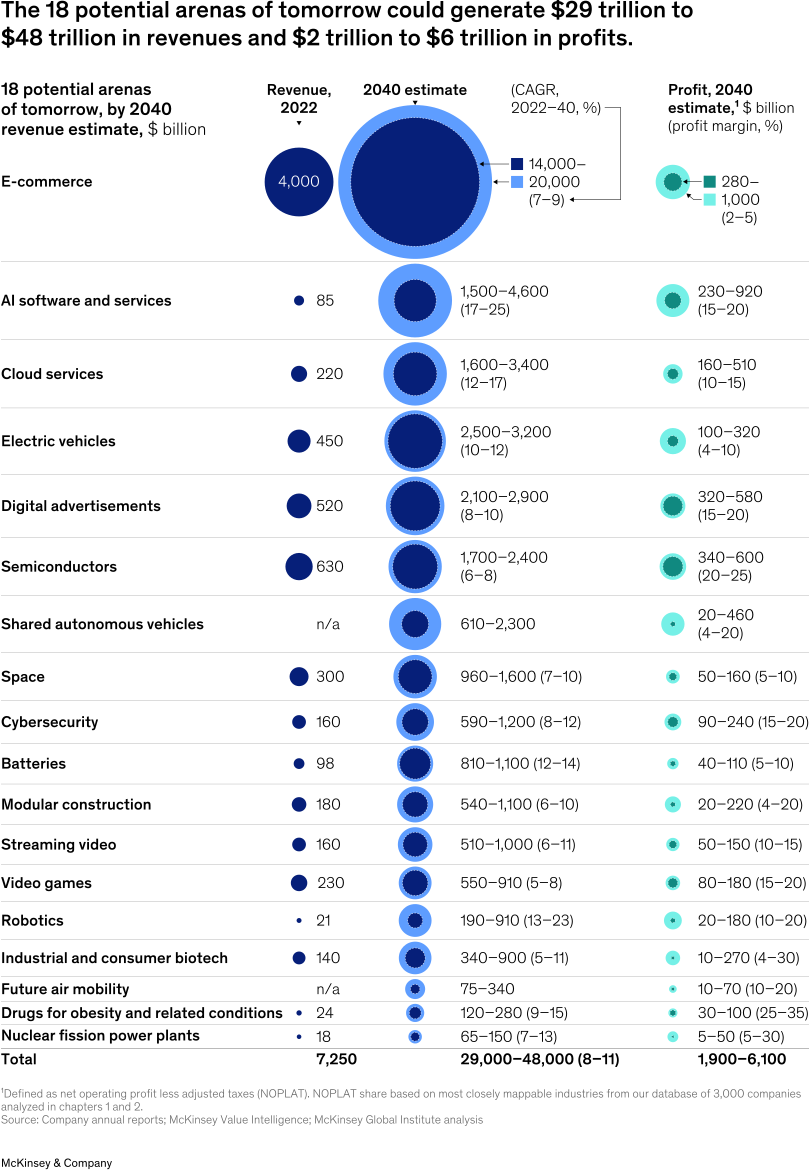
Given the growth and dynamism that arenas potentially represent—and contrasting them with the low-growth environment the industry currently faces—insurers have a compelling case to act. Insurance leaders are already addressing the emergence of these arenas, but for now, this is often piecemeal rather than strategic. As the arenas gain traction, leaders will need to consider how the phenomenon might play out more holistically—and how they should respond.
The following are a few questions for CEOs and other senior insurance leaders to consider as they set strategy.
- Which arenas will affect our P&L within five years?
- How much of our existing book, including premiums, pricing, and reserves, is exposed to arena-driven change, and how quickly?
- In terms of driving growth, can we underwrite new risks profitably with our capabilities today, and if not, how do we position ourselves to be able to do so in the future?
- How are we positioned to capture economic value as risk concentrates and placement models shift across distribution, underwriting, and capital provision?
- AI adoption, geopolitics, and green transition together amount to swing factors for the arenas. How is our organization scenario planning around them?
- Does the predominant role of AI in many of the arenas affecting insurance pose a concentration risk that we should consider?
- Does our balance sheet portfolio reflect the shifting growth and time horizons implied by the arenas?
- Where do we need capital and capacity we don’t have today, including through reinsurance, insurance-linked securities, partnerships, and M&A, and how do we fund it?
The answers will vary by organization, but the questions need to be addressed clearly and as early as possible, given both the value at stake for insurers, the disruption the arenas will bring to the industry, and the risks of being left behind. Carriers who are ahead of the curve in considering the next arenas and the impact on their business will be poised for more profitable growth.
Related Articles


The race takes off in the next big arenas of competition