Electrification is reshaping the global automotive industry, with electric vehicles (EVs) accounting for a rising share of new vehicle production.1 Yet original equipment manufacturers (OEMs) are facing high EV production costs.2 Incumbents still produce EVs at lower volumes than their hybrid or internal-combustion engine (ICE) fleets, making economies of scale harder to capture at the model level. Incentives are starting to recede, and early adopters are giving way to more price-sensitive mass-market buyers.
Demand, however, is not declining. In most major markets, EV sales continue to grow.3 The industry is moving from a phase defined by regulation and subsidies to one that requires EVs to compete on their own economic merits. Many OEMs now find themselves squeezed between rising input costs and intensifying price competition. Batteries still account for up to 35 percent of total vehicle cost.4 In addition, complex vehicle architectures, fragmented development processes, and legacy specifications continue to erode margins.
Earlier McKinsey research demonstrated that long-term EV success would depend on structurally improving margins, not simply scaling volume.5 Four years on, that imperative has become even more urgent. Our latest analysis of EVs across regions shows a 20 to 50 percent spread in cost of goods sold (COGS) between vehicle models (see sidebar “A note on methodology”). Roughly one-third of this spread stems from product material and design choices, another third from process efficiency, and the remainder from foundational levers such as subsidies and lower utility costs.
This article focuses on how OEMs can unlock 10 to 25 percent material-cost savings by designing profitability into EVs from the start (Exhibit 1). While material-cost optimization draws on both commercial and technical levers, we concentrate on the latter because most of the cost is locked in long before supplier negotiations or factory optimization begin. For EVs, profitability is determined upstream—through technology choices, requirements definition, architectural decisions, system‑integration logic, and development governance.
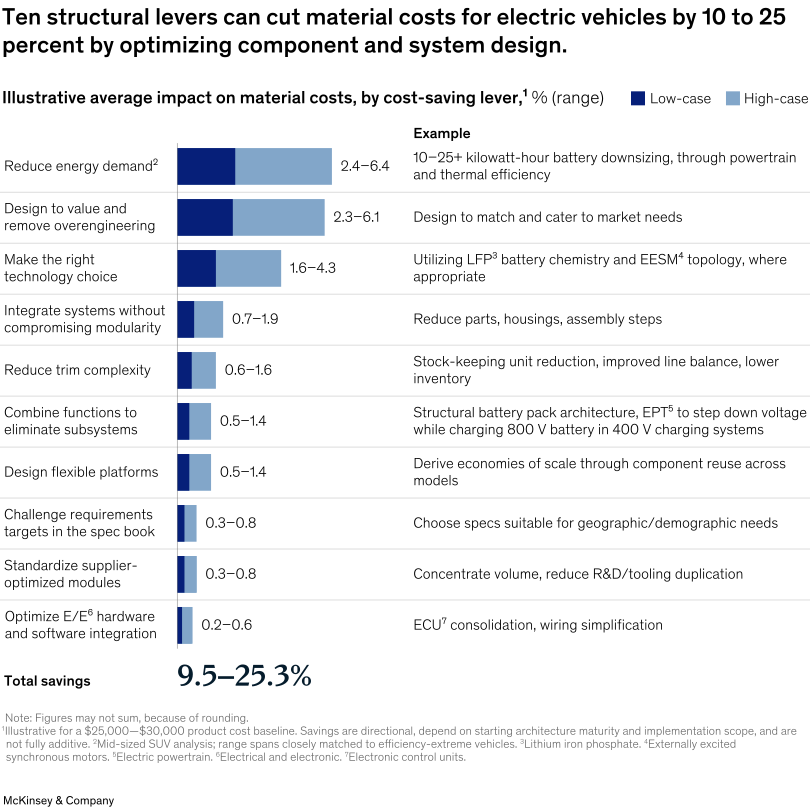
Profitable OEMs therefore need to approach EV design differently. Rather than optimizing components late in the process, they could systematically address structural cost levers, from choosing the right platform architecture to eliminating redundancy, integrating functions, standardizing supplier components, and enforcing development discipline. The following ten levers show how OEMs can embed profitability into EV programs from the ground up.
1. Reduce energy demand to minimize battery size
Battery cost remains the single largest barrier to EV affordability.6 One of the most effective ways to manage it is to require less battery in the first place, without affecting overall mileage.
OEMs can improve energy efficiency in a number of ways, such as reducing the coefficient of drag, lowering overall vehicle weight, decreasing rolling resistance, reducing low-voltage consumption through improved electrical and electronic (E/E) architecture, increasing e-drive unit efficiency, and improving thermal management.
The impact of each is consequential. A 10 percent reduction in aerodynamic drag, for example, can improve highway mileage by about 5 percent and city mileage by around 2 percent.7 Dual-topology powertrains—such as pairing induction motors with permanent-magnet motors for city driving—can further increase vehicle efficiency. Efficient heat-pump systems and intelligent waste-heat reuse enable smaller, cheaper battery packs without sacrificing range or reliability.
The cumulative impact of these measures is significant. One disruptor OEM applied them to a pickup truck, reducing battery size by 13 percent while increasing range by 4 percent relative to a competitor’s model. The resulting efficiency gains translated into approximately $2,000 in battery-cost savings per vehicle.
However, battery redesign does not stop at launch. Energy consumption and battery performance must be continuously monitored under real-world driving conditions to identify efficiency losses and inform future design decisions.
2. Design to increase value and eliminate waste
As EV margins tighten, design-to-value—engineering each component to deliver exactly what customers need, and no more—has become a meaningful source of cost reduction. This goes beyond simply removing features. OEMs are calibrating components to what customers actually value, eliminating engineering waste in overspecified parts, and validating every design decision against real-world usage and vehicle positioning.
In practice, this means simplifying geometry, reducing material use, consolidating variants, and continually checking designs against consumer needs. Gen AI-enabled design-to-value tools can link feature configurations to willingness-to-pay and usage patterns at a much finer level, helping teams quickly explore many design options. That allows engineers to focus effort on combinations that create the most value for customers at the lowest cost.
Features where perceived value exceeds costs are retained, while those where cost exceeds perceived value are eliminated or substituted. For example, one incumbent OEM applied this logic to car seats, removing ventilation and adjustable cushions and substituting premium leather with synthetic leather, capturing about $250 in per-unit cost savings without impacting customer satisfaction.
OEMs can also save costs by reducing engineering waste. For example, a bracket designed at 1.5-mm thickness with structural grooves can deliver the same stiffness and structural integrity as a 2.5-mm part of the same material, at a lower material cost.
3. Make the right technology choice
In EVs, technology decisions are not isolated component selections. They are structural commitments that lock in cost, supply exposure, and scalability for the entire lifespan of a platform. For example, battery chemistry, power-electronics materials, and motor topology collectively determine performance, raw-material dependency, capital intensity, and the vehicle’s ability to scale profitably across markets.
Battery chemistry illustrates the magnitude of these choices. Our analysis shows that moving from high-nickel chemistries, such as nickel manganese cobalt (NMC) or nickel cobalt aluminium (NCA), to lithium iron phosphate (LFP) can reduce pack cost by about $10 to $20 per kilowatt-hour (kWh)—equivalent to $750 to $1,500 in direct material savings on a 75-kWh vehicle. Beyond unit economics, LFP can reduce exposure to nickel and cobalt price volatility, thereby simplifying long-term sourcing strategy. Emerging chemistries such as lithium manganese iron phosphate (LMFP) offer higher energy density while limiting critical-material dependency at lower costs. Advances in pack design—including cell-to-chassis architecture—have narrowed the energy-density gap between LFP and NMC to the point where chemistry choice is increasingly a cost and sourcing decision, rather than a purely performance-driven one.
Power electronics presents another structural lever. Silicon insulated-gate bipolar transistors (IGBTs) remain the lowest-cost solution for 400-volt (V) architectures and are well suited to cost-focused platforms. Silicon carbide (SiC) devices carry a higher upfront cost but improve switching efficiency and enable 800-V battery packs, often allowing for battery downsizing and lighter cooling systems that partially offset the higher semiconductor cost. The economic outcome depends on vehicle positioning: in premium or long-range segments, SiC may deliver positive net value, but in mass-market applications, IGBT may remain the more rational choice until SiC costs stabilize.
Motor topology involves a similar balance between efficiency and supply-chain exposure. Permanent-magnet synchronous motors (PMSMs) offer best-in-class power density but increase reliance on rare-earth materials, which raises costs and geopolitical risk. Induction motors (IMs) and externally excited synchronous motors (EESMs) reduce or eliminate magnet dependency, with only modest trade-offs in efficiency and power density.
For a midsize SUV, the transition to an optimal power-module-battery chemistry-motor topology combination can deliver $400 to $1,000 in net per-vehicle savings, driven primarily by battery chemistry economics and partially offset by power electronics and motor trade-offs. OEMs therefore would do well to evaluate technology choices as a system rather than optimizing each component separately.
4. Integrate systems without compromising modularity
System integration is one of the most structurally powerful levers available to OEMs. Two integration opportunities stand out for their combined impact on cost and efficiency: consolidating powertrain and power electronics into integrated drive units, and combining thermal management functions across major vehicle systems.
Integrating the inverter, e-motor, and gearbox into “X-in-one” drive units has become a defining characteristic of the most profitable EV architectures. Shared submodules across vehicle lines reduce bill-of-materials (BoM) costs, while improving both efficiency and manufacturability. Three-in-one integration is rapidly becoming the norm, but higher degrees of integration, such as 12-in-one, are becoming increasingly attractive at scale. Several OEMs are already implementing these integrated e-drive architectures.8
Combining battery, cabin, electric drive, and power-electronic thermal loops into a single integrated thermal management system (TMS) can deliver cost savings, while improving energy efficiency. This holistic system eliminates the need for auxiliary heaters, allows for smaller radiators and compressors, and can enable battery downsizing by 1 to 1.5 kWh without compromising range.9
5. Reduce trim complexity
Reducing vehicle-level variant complexity is one of the most underestimated sources of cost improvement for traditional OEMs. Managing dozens of trim, seat, and feature configurations introduces unique part numbers, inventory buffers, and line-balancing inefficiencies. Every additional variant increases material handling complexity, supplier coordination effort, and the risk of production disruption.
By consolidating trims and embedding common hardware across all variants—while using software activation or post-assembly packages to enable feature differentiation—OEMs can dramatically simplify operations, shifting the complexity from hardware, where every variant carries a real cost, to software, where the marginal cost is near zero.
The financial impact of consolidating variants can be significant. A meaningful reduction in variant count can translate to $150 to $400 in savings per unit, driven by fewer stock-keeping units (SKUs), lower inventory-carrying costs, improved line efficiency, and reduced overhead from engineering change management. In an environment of compressed margins, reducing trim complexity remains one of the most straightforward and scalable structural cost levers available.
6. Combine functions to eliminate subsystems
Electrification creates a new class of cross-system integration opportunities that were structurally impossible in ICE vehicles (Exhibit 2). OEMs now have the design freedom to combine primary and auxiliary functions into single components, eliminating entire subsystems, reducing part count, and improving packaging efficiency.
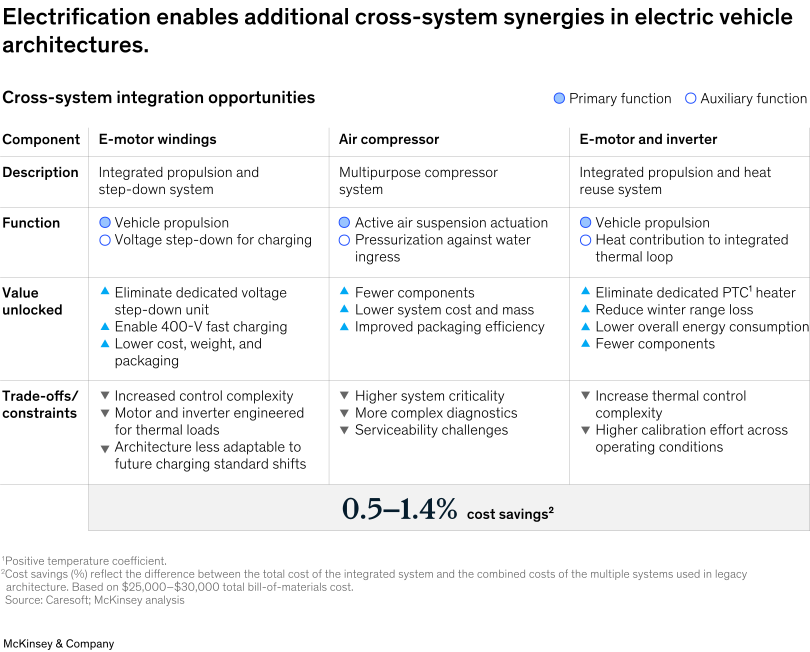
The opportunities are plentiful. Examples include integrating propulsion and voltage step-down functionality to remove the need for a dedicated converter unit; deploying multipurpose compressor systems that serve both battery pack pressurization during wade mode and suspension actuation; reusing motor waste heat for cabin conditioning, eliminating positive temperature coefficient (PTC) heaters entirely; integrating coolant channels directly into the battery housing floor; or combining rear brake callipers with electronic-parking and driveline-locking functions in a single unit.
Treating the battery pack and the body-in-white (BiW) as a single load-bearing structure is another powerful example. Structural battery packs can cut vehicle BiW weight by about 3 percent and significantly reduce press-shop tooling and weld operations. The result is lower capital intensity and improved torsional stiffness. In one case, a disruptor OEM reduced BiW weight between two model years by 11 kg by adopting a structural battery pack approach.
7. Design flexible platforms
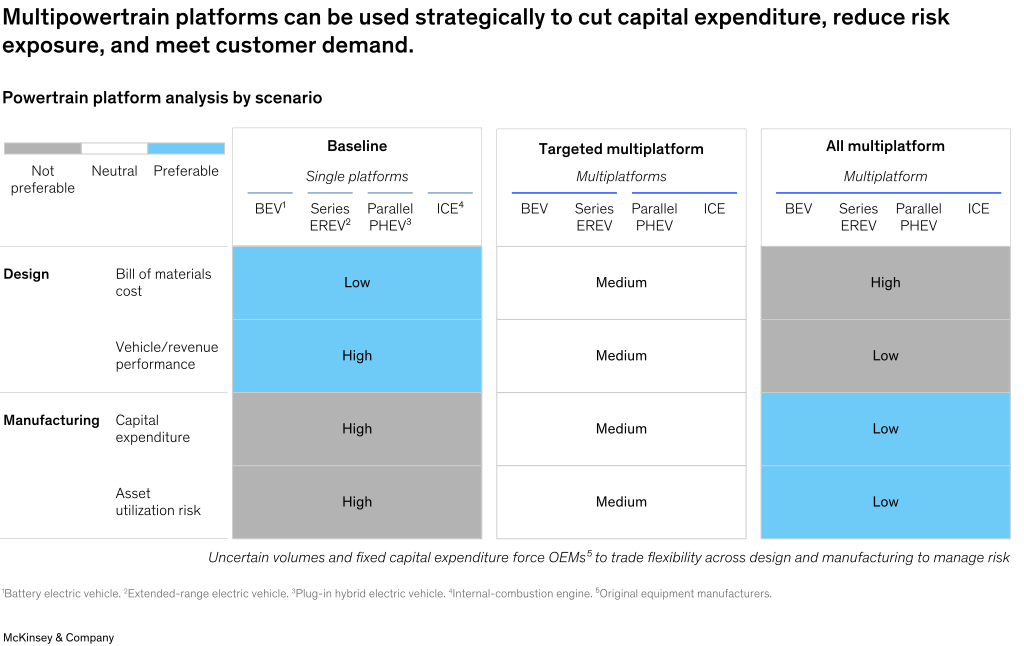
The next frontier in EV cost leadership is platform modularity—architectures capable of supporting multiple powertrains and vehicle types without duplicating engineering investment. Rather than maintaining separate platforms for ICE vehicles, plug-in hybrid electric vehicles (PHEVs), and battery electric vehicles (BEVs), some OEMs are returning to multi-energy platforms, this time with more shared components.
With powertrain take-rates still uncertain across markets, some OEMs are concentrating capital expenditure, R&D, and material costs on a smaller number of adaptable platforms (Exhibit 3). A recent example by a disruptor Chinese OEM illustrates how this can be executed in practice. The most successful configurations tend to have a common platform between BEV and extended-range electric vehicle (EREV) variants, and a separate standardized platform shared between ICE and PHEV models.
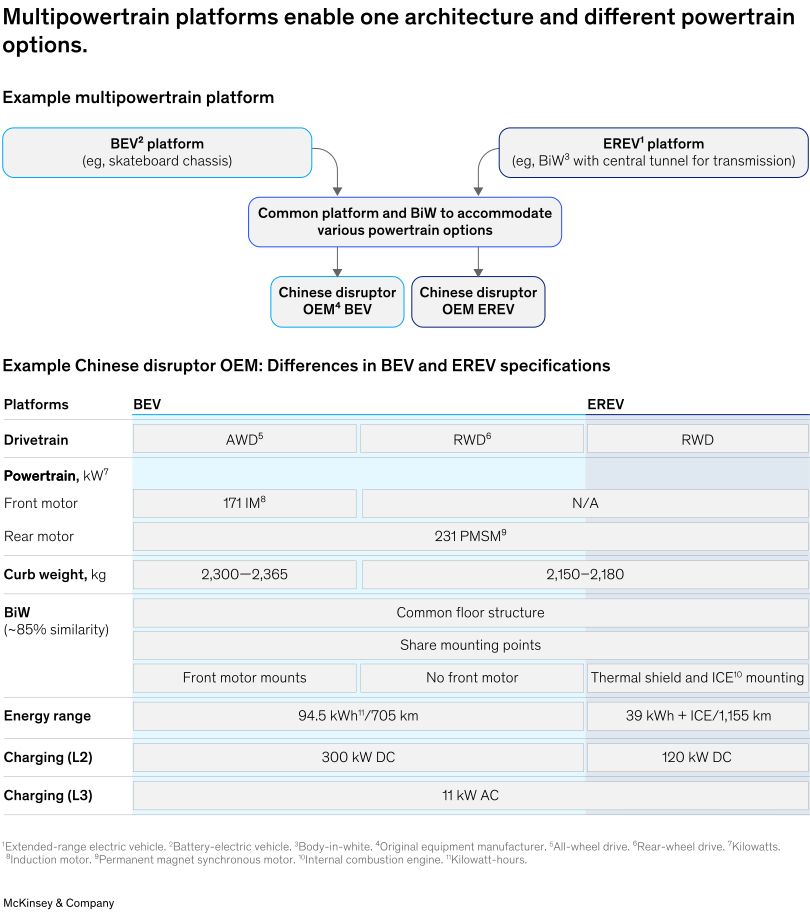
The strategic advantages are threefold (Exhibit 4). First, economies of scale: Shared tooling, components, and logistics reduce capital expenditure and simplify procurement and operations. Second, speed and flexibility: Once a platform is established, new derivatives can be developed in months rather than years. Third, technology agility: Modular “skateboard” designs allow upgrades in battery chemistry, motor configuration, or software architecture without full redesign, enabling OEMs to adjust the production mix as regulatory and consumer preferences shift.
8. Challenge requirements at the source
One of the most powerful yet underused cost levers is reassessing legacy performance specifications before they become embedded in hardware. Specifications that were rational in an ICE context are often carried forward into EV platforms, where they may no longer be relevant. Stripping out these overlaps can yield meaningful savings and simplify the architecture.
In electric drive systems, for example, strict operating-temperature assumptions require more heavy rare earth elements (HREEs) in permanent magnets, such as terbium and dysprosium. These materials improve high-temperature stability but carry significant cost and supply-chain risk. A rigorous reassessment of real-world duty cycles and thermal envelopes can reduce HREE content without compromising reliability, unlocking approximately $10 to $20 in savings per motor.
A similar pattern emerges in noise vibration harshness (NVH) protection. Dedicated NVH filters are sometimes specified as a precaution rather than a requirement, even when system-level shielding already manages interference, adding unnecessary cost. A disciplined review of real operating conditions can allow those discrete filters to be removed, saving about $5 per unit.
Individually, these adjustments may appear incremental, but in aggregate, particularly across high-volume components, they are not. Disciplined requirement management can remove $120 to $240 per vehicle before any redesign or supplier negotiation occurs, while also reducing raw material dependency, simplifying sourcing, and preventing overengineering from cascading into downstream subsystems.
9. Standardize around supplier-optimized components
As electrified powertrains proliferate, architectural complexity often grows faster than volume. Many OEMs continue to engineer bespoke inverter layouts, lamination geometries, cooling plates, and gate-drive designs for each vehicle program, fragmenting scale and duplicating tooling. Yet a large share of these components are either identical or very similar across platforms.
The opportunity lies in designing vehicles around supplier-optimized modules rather than tailoring modules to each vehicle. The rear drive unit in a Chinese disruptor OEM’s EV illustrates this principle. The inverter uses a modular mechanical architecture with standardized gate drives and power modules deployed across more than a hundred vehicle applications. Instead of program-specific printed circuit boards (PCBs) and housings, the design anchors around repeatable submodules that can scale across multiple torque ratings and vehicle lines. Western OEMs often develop powertrain solutions independently for each model, regardless of whether components are make or buy.
In the transition to electrification, cost advantage increasingly comes from disciplined reuse. The most competitive architectures are not those with the most unique parts but those that concentrate volume on fewer, optimized components.
10. Optimize E/E and software architecture
E/E architecture accounts for roughly 5 to 10 percent of total BoM costs and simplifying it is a prerequisite for profitable scale. Traditional vehicles rely on 70 to 100 electronic control units (ECUs) connected by kilometers of wiring. Some EV platforms are already replacing this with a few high-performance zonal controllers, each managing multiple vehicle domains. Zonal architectures can cut wiring and copper use by up to 30 percent, reduce assembly effort, and enable true software-hardware decoupling, allowing faster updates and functional upgrades.
Software integration can be treated as a platform design discipline rather than a post-validation exercise. Embedding these decisions early minimizes late-stage rework and allows over-the-air (OTA) calibration improvements. As vehicles become software-defined, this integration mindset will likely be as critical to cost management as it is to product differentiation.
How gen AI can accelerate EV cost design
Gen AI is changing how leading OEMs design and engineer EVs, particularly across the ten levers described in this article (Exhibit 5). It is most powerful when embedded in core product-development workflows—from understanding customer needs through to specification, design, validation, and launch.
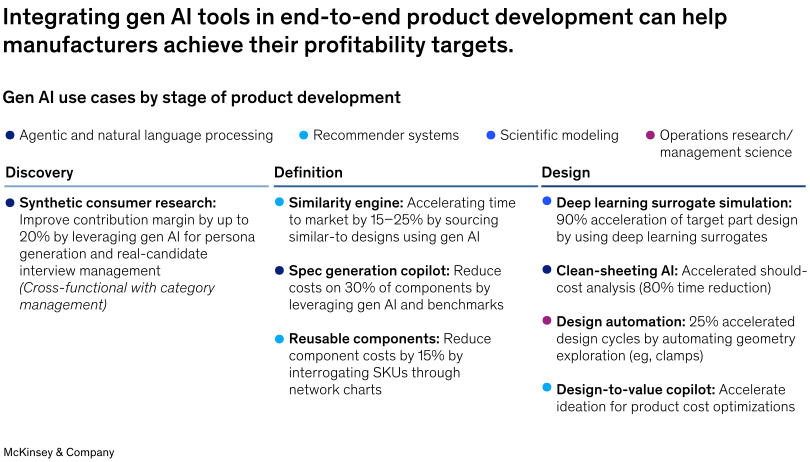
In the discovery and definition phases, gen AI tools can support synthetic consumer research by generating representative personas and structuring interviews, giving product teams a faster and more granular insight into what different customer segments value. Combined with benchmark data, specification copilots can draft and iterate technical requirements, flag reuse opportunities, and highlight legacy specifications that may be overengineered for EVs.
During design and validation, deep learning–based surrogate simulation models and design-automation tools allow engineers to explore more design options, understand cost and performance trade-offs, and provide on-demand technical guidance to resolve engineering challenges. Gen AI–enabled clean sheeting and design-to-value copilots can help systematically evaluate cost structures and identify optimization opportunities early in the cycle.
Used in this way, gen AI does not replace engineering judgement. Instead, it expands the design space teams can explore and compresses the time required to make structurally better cost decisions.
The world is transitioning to electric mobility, but the pace of adoption now depends on EV economics. Sales are still growing, but not fast enough to meet long-term climate and business targets if profitability remains constrained. To sustain momentum, the industry may need to move beyond reliance on early subsidies and instead focus on financial sustainability.
While the ten levers outlined in this article are critical, they are not exhaustive. Other important levers exist for OEMs, including a make-versus-buy strategy, robust platform strategy, and a strong procurement function. That said, optimizing product costs through intentional design will likely remain one of the most important and foundational ways to bring down costs, improve efficiency, and deliver affordable EVs at scale. Those that do may close the profitability gap with ICE vehicles, ensure healthier financials, and position themselves to lead in the next era of sustainable mobility.