The argument for business aviation is simple and clear: Fly where you want, when you want, with whom you want. Yet delivering on that promise is increasingly difficult. Demand for private aircraft is outstripping supply, while growing numbers of flights and passengers are putting pressure on infrastructure, airspace, and qualified personnel such as engineers and pilots.
Our inaugural article on the state of business aviation details an industry coping with growing demand driven by increasing consumer wealth, especially in the United States, and challenges including the supply of new aircraft, shifts in flight patterns to smaller airports, and the need to maintain momentum in consolidation, which propels greater professionalism and economies of scale.
The defining question is no longer who can provide an aircraft but who can secure and coordinate the capacity around it, from delivery slots, crews, hangars, and maintenance to a seamless passenger experience. Drawing on industry data and interviews with leaders across the sector, our article identifies where that scarcity is emerging, how it is reshaping business models and consolidation, and what stakeholders can do to build sustainable advantage.
Understanding business aviation today
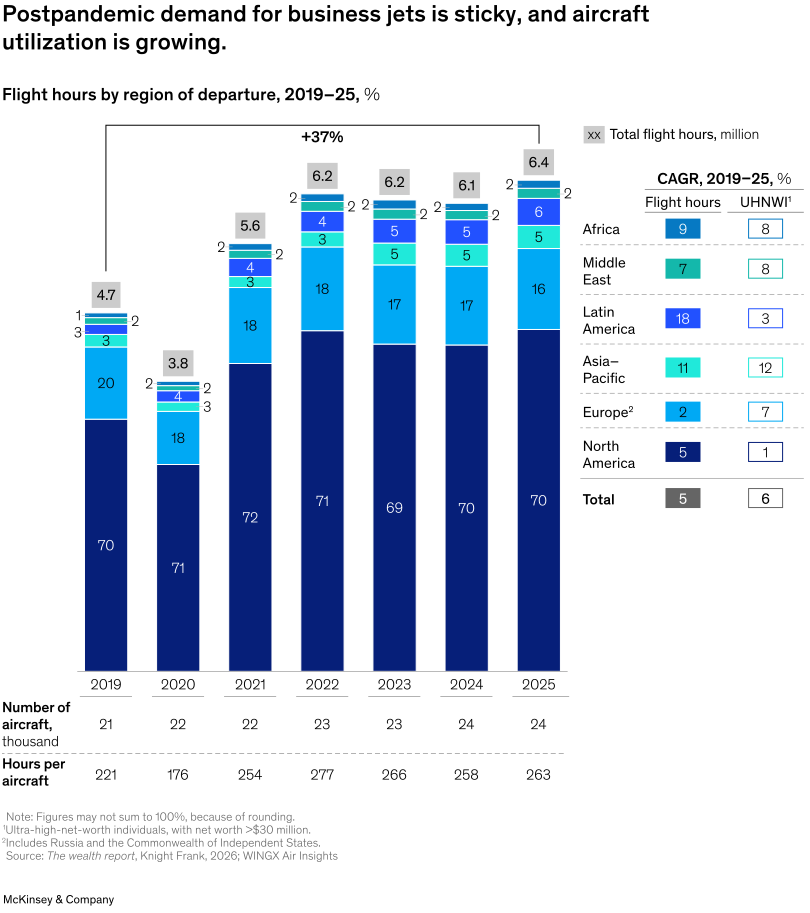
While the Lockheed JetStar1 introduced the world to private jets more than six decades ago, business aviation arguably truly came of age six years ago. When the COVID-19 pandemic shut down much of the world in early 2020, global business jet flight hours fell sharply. While global commercial airline traffic took almost four years to return to prepandemic levels,2 flight hours for business aviation did so by March 2021.3
It wasn’t just a one-time rebound. Business aviation departures have continued to grow, increasing by 4.9 percent annually since 2019 and hitting a record 3.9 million in 2025 despite easing from 2022 to 2024.4 The pandemic disrupted the sector, but the subsequent rebound has reset business aviation at a higher level, likely because of its advantages over commercial aviation.
North America dominates, although other markets are accelerating
North America is by far the largest regional market for business aviation, accounting for 70 percent of global business flight hours in 2025 (Exhibit 1).5 Yet that dominance masks significant changes underway in other markets. All regions experienced growth in flight hours between 2019 and 2025, with Latin America and Asia–Pacific gaining the most percentage. However, at current growth rates, the rest of the world would not reach volume parity with North America for decades: Today, North America registers about four times the flight hours of Europe and more than ten times those of every other region.
Growing individual wealth and future transfers are major demand drivers
Growing demand for business aviation is fueled in the near term by the increasing global population of ultra-high-net-worth individuals (UHNWIs). Defined as people with net worth of more than $30 million, the world’s UHNWI population rose by 5.6 percent annually from 2019 to 2025, almost double the rate of global GDP growth.6 North America’s share of global UHNWIs is expected to rise from 37.0 percent today to 43.0 percent by 2031, growing by a CAGR of 8.9 percent a year. During the same period, the Middle East is expected to grow by 5.7 percent and Asia–Pacific by 4.4 percent.7 As wealth passes to a new generation of owners, it could expand the pool of individuals with the means to use business aviation and create new demand for private travel. “The transfer of wealth we have been hearing about for years suggests that around $80 trillion to $100 trillion dollars will be transferred over the next 20 years,” said Patrick Gallagher, president of NetJets Aviation.
Shrinking commercial routes have helped business aviation
Gaps in premium commercial aviation are increasing the relative appeal of business aviation, and that trend may persist. First, commercial offerings are shrinking, especially for second-tier destinations. The number of nonstop commercial routes for flights of less than 1,000 kilometers fell 4.4 percent globally between 2019 and 2025,8 with Europe down 7.8 percent and Asia 3.9 percent. Roughly 1.9 percent of city pairs less than 1,000 kilometers apart carrying more than 50 passengers a day now have no direct service, while in Europe unique connections served have fallen 1.6 percent since 2019 and airports served dropped 3.2 percent.9 Second, commercial capacity can be withdrawn abruptly, especially during geopolitical disruption. Business aviation often absorbs that demand. And while commercial airlines are investing in their premium offerings, crowded airports, inconsistent service, and reduced on-time performance continue to make business aviation increasingly appealing.
Business aviation demand is shifting toward leisure
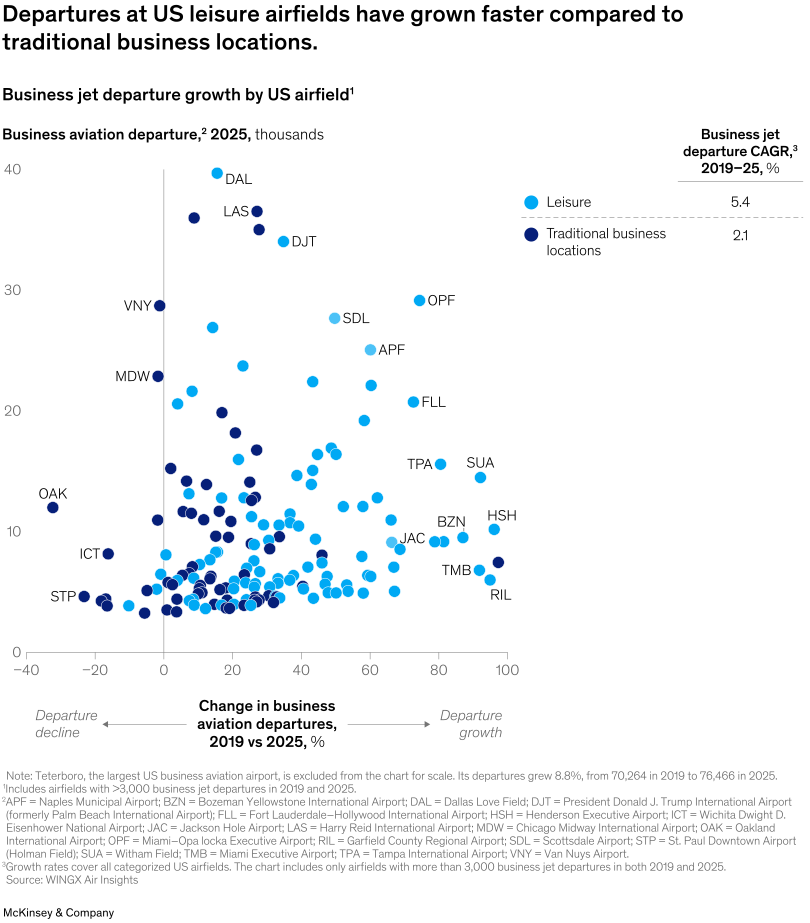
Demand for private aviation in the United States has shifted from corporate centers toward leisure and second-home destinations (Exhibit 2). While business jet departures have fallen at established centers including Chicago Midway, Oakland San Francisco Bay, and Van Nuys (Los Angeles), they have increased at Florida airports such as Fort Lauderdale-Hollywood International, Miami International, Witham Field (in Stuart, near West Palm Beach), and Tampa International, as well as at mountain destinations including Rifle Garfield County in Colorado. “Naples, Scottsdale, Jackson Hole, and Bozeman are becoming very busy year-round,” NetJets’ Gallagher said. “People who bought or built homes during the pandemic are now going there regularly.” This rapid growth at leisure destinations is putting pressure on hangar and parking space; maintenance, repair, and overhaul (MRO); and other business jet services tailored to private travelers.
Fleets are aging as demand increases for the smallest and largest aircraft
Buyers in the United States are increasingly interested in business jets at both ends of the size spectrum. From 2019 to 2025, the fleet of very light jets grew by 6.7 percent a year and long-range jets by 5.1 percent a year, while the midsize category increased by just 0.2 percent annually and large-cabin aircraft declined by 2.1 percent a year. The very light category comprised 42 aircraft in 2000 but grew to 2,160 by 2025, propelled by the availability of new aircraft such as the Cirrus Vision Jet. In addition, the category’s relatively low cost per hour makes it an appealing entry product for first-time flyers. At the top end of the market, the number of long-range aircraft increased from 432 in 2000 to 4,448 in 202510 as wealth boomed and demand moved toward ultra-long-range intercontinental products, led by the Bombardier Global 7500/8000 and the Gulfstream G650/700/800. Aircraft are also remaining in service for longer periods of time: The average age of the midsize fleet increased by 3.0 years to 21.2 during the period, while the average age of large-cabin aircraft rose by 4.0 years to 24.8 as the fleet shrank by 125 aircraft.11
Range goes unused as buyers prioritize space and luxury
In the United States, the largest aircraft travel just a fraction of the distance they are built to fly. Ultra-long-range jets can fly more than 7,000 nautical miles (NM), yet 65 percent of all ultra-long-range flights to and from the United States in 2025 were less than 1,000 NM, within the reach of a light jet, and 27 percent were less than 250 NM.12 Dan Drohan, chief executive of Solairus Aviation, said that while Solairus jets average 14 seats and about 14 hours of certified range, “the average flight time and occupation of our jets is two hours and two passengers.” Range and capacity are going unused as buyers prioritize speed, cabin space, ride quality, and cabin connectivity.
Demand is shifting toward flexible business aviation models
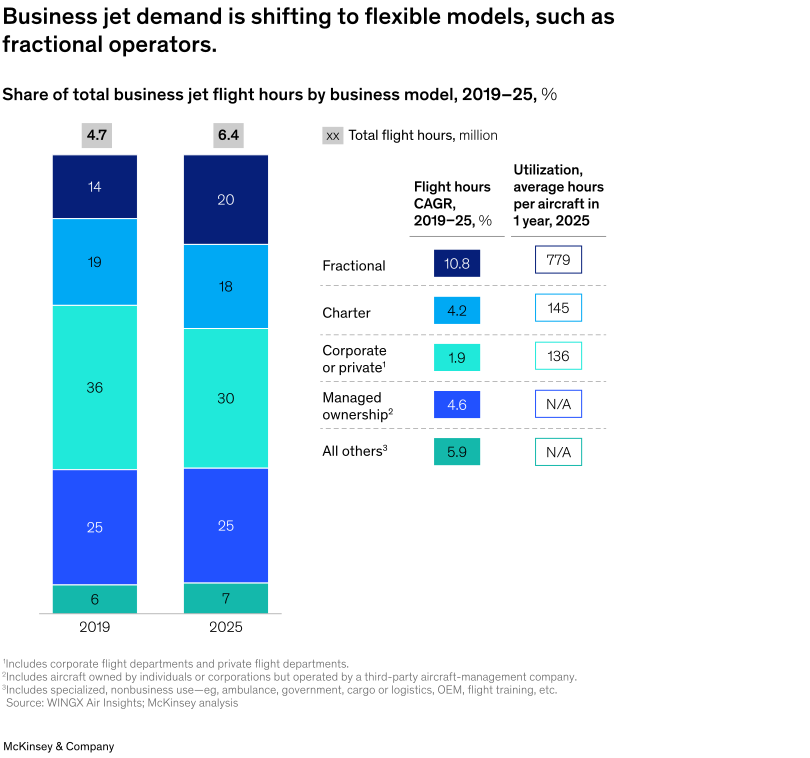
While managed and corporate/private ownership represent the largest segments of the global business aviation fleet and flight activity, demand is shifting toward more-flexible models (Exhibit 3), with fractional operators showing the fastest growth. Business models are evolving for each of the four fleet archetypes:
- Managed ownership. Third-party management of privately owned aircraft accounted for a steady 25 percent of total business aviation flight hours from 2019 to 2025. The all-in cost of ownership has risen sharply since the pandemic, driven by higher aircraft prices, rising fixed-base operator (FBO) and hangar costs, costly engine maintenance, and pilot shortages. Management companies help absorb the operational, maintenance, and regulatory burden, but direct ownership is increasingly concentrated among customers able to absorb the high fixed costs.
- Corporate and private. Corporate and private fleets added aircraft at a rate of 2 percent a year during the past ten years, the slowest growth of any model even as the global fleet kept expanding. Several large owners moved the other way and downsized outright. As a result, the share of corporate and private flight hours decreased by 6 percentage points from 2019 to 2025.13
- Charter. Twenty years ago, only one charter operator managed a fleet of more than 50 aircraft. Today, eight do. These include large branded charter companies such as VistaJet—which acquired XO Jet and Jet Edge and now offers access to more than 300 jets globally on a subscription model14—and flyExclusive, which has more than 100 aircraft on a prepaid membership model.15 Despite the emergence of scaled players, charter operators’ share of total flight hours stayed roughly flat from 2019 to 2025.16
- Fractional. The number of aircraft in fractional fleets increased from 990 (4.5 percent of the global fleet) in 2019 to 1,510 (6.1 percent) in 2025, growing by 7.3 percent annually.17 Fractional operators’ share of flight hours climbed from 14 percent to 20 percent, with the market dominated by NetJets and Flexjet, which fly 92 percent of fractional hours.18
Constraints industry leaders must overcome
The business aviation industry is maturing as it grows, with the fleet flying more hours, run by fewer and more professional operators. The average aircraft flew roughly 19 percent more hours in 2025 than in 2019,19 with higher utilization and more-professional operations. This increased use, paired with the rise of new business models, may put private jet travel within reach of more customers.
Yet the industry may be running out of the spare capacity it once took for granted. That makes scarcity a redistributing advantage, with three factors likely to separate leaders from laggards: limited aircraft supply, growing infrastructure constraints, and the difficulty of scaling.
1. Limited aircraft supply
Business aviation was structurally oversupplied for most of its history, but that has now ended. Deliveries of new aircraft reached 842 units in 2025, on par with 2006 and just 65 percent of the peak of 1,290 in 2008.20 While supply chain issues make it difficult to meet demand and have contributed to an impressive order backlog, the global business jet fleet has grown largely through not retiring aircraft. The fleet grew by 730 aircraft in 2025, up from about 500 in 2019, almost entirely because of owners retiring fewer jets rather than manufacturers building more (retirements fell from about 300 to around 110, while deliveries rose from around 810 to about 840).21 The result is an older fleet that requires more maintenance, increasing MRO demand structurally rather than cyclically at a time when overhaul capacity is already tight.
Recent growth in charter and privately owned flight activity has been supported in part by older aircraft returning to service after the pandemic, including Hawker 800s, Learjet 60s, Gulfstream IVs, and Challenger 605s. Many of these aircraft were previously held by low-utilization owners or corporate flight departments but were acquired at a premium by charter operators seeking immediate capacity during a postpandemic demand surge. They provide an important short-term supply buffer but are difficult, and increasingly costly, to maintain. Many of these aircraft are likely to be retired soon as they reach major maintenance milestones. With new-build rates limited and replacement aircraft carrying much higher price tags, there may a second wave of capacity constraints when these aircraft have major maintenance events.
As multiyear lead times prevent buyers from acquiring aircraft on short notice, these factors make aircraft ownership more challenging and accelerate the shift toward access models such as fractional shares, charters, and jet card products, which sell immediate availability rather than an asset. Small fleet operators increasingly run mixed models, while scaled operators, corporations, and fractionals are placing larger and longer-term orders for aircraft as competition for delivery slots intensifies. Service providers gain a tailwind as an aging fleet lifts demand for MRO, refurbishment, and management.
2. Growing infrastructure constraints
A growing business fleet and evolving demand for destinations have resulted in infrastructure constraints across everything from hangars and parking spaces to MROs and crew. Demand has not only grown but relocated: US business jet departures grew by 417,000 between 2019 and 2025, and airfields serving leisure destinations accounted for 78 percent of that increase (326,000). The 39 percent increase in departures from leisure airports from 2019 to 2025 was spread across 132 airports, including Witham Field (where departures rose 92 percent), Tampa International (81 percent), Miami-Opa Locka Executive (74 percent), Fort Lauderdale-Hollywood International (73 percent), Naples (60 percent), and Scottsdale (50 percent).22 Many airports were not built to handle such volume or to accommodate sharp seasonal peaks.
Growth at established economic centers is running well below that of leisure fields. Airspace congestion and capacity constraints on ramp space and runways are major growth-limiting factors, along with construction and noise rules. Landing fees and special event fees, while not affecting demand yet, are creating additional challenges for customers. Traffic is also shifting to secondary airports in major metropolitan areas, with departures at New York’s secondary fields growing far faster than at Teterboro, the primary field (departures rose 27 percent at Westchester County and 34 percent at Republic, compared with 9 percent at Teterboro).23 Saturation at traditional airfields and dispersion into facilities often not designed to handle such volumes are constraining the industry’s ambition.
“Infrastructure is by far the biggest challenge we contend with,” NetJets’ Gallagher said, citing airport congestion and air traffic control resources, while Solairus Aviation’s Drohan said hangar constraints were “something we deal with literally every day.” Ground capacity is not being added as quickly as traffic is growing. This is also true in the maintenance industry, where the average fleet age of 18.2 years24 is generating more shop visits and cabin upgrades in an environment that operators say is already historically tight. Demand for connectivity retrofits has outpaced the supply of hardware, leaving MROs with installation capacity but too few systems to install. Salaries are increasing, including for the maintenance supervisors who keep aircraft dispatchable day to day, and rising operating costs risk pricing out entry-level owners.
3. The difficulty of scaling
With new aircraft in short supply and infrastructure reaching capacity, the business aviation industry is consolidating and professionalizing. The top three operator groups—NetJets, VistaJet, and Flexjet (including subsidiaries)—flew about 20 percent of total business jet hours in 2025, up from around 15 percent in 2019. Scale is being pursued through M&A, aircraft acquisition programs, offers to private owners, higher utilization, fewer dead legs, faster aircraft-on-ground response, infrastructure investment, crew training, and higher IT and digital spend. Returns accrue to those able to fund more efficient networks, build new capacity, and deliver experiences that clearly exceed the commercial alternative.
FBO networks have consolidated on the same logic, with Signature Aviation roughly doubling to 200 locations from 100 over 15 years25 and Atlantic Aviation expanding to 100 locations from 66.26 “I think there will be more consolidation,” said Stephen Maiden, chief executive of West Star Aviation. “As the industry grows, tier-one providers and OEMs continue to invest in improved technology solutions and talent. There is pressure for other stakeholders to keep up.”
Capital is already moving to provide the capacity that scarcity has exposed. Signature has invested in Las Vegas, Palm Beach, Teterboro, and Vail27; Atlantic has invested in Austin, Denver Centennial, San Jose, and Scottsdale28; and West Star has added projects at Chattanooga and Grand Junction while taking further hangar space at St. Louis Regional Airport.29 “You need more capacity as airplanes get bigger,” Maiden said. “We are trying to keep up with what demand will be over the next five to ten years.”
Three major shifts
Three shifts are affecting every part of business aviation, from OEMs to MRO suppliers, operators, and infrastructure providers:
The planning horizon has lengthened
Today, every input should be secured years before it is needed, turning a capacity decision made in 2026 into a bet on 2032 traffic—with a wide range of plausible outcomes. Planning against multiple demand futures at once requires discipline, such as building the fleet and capacity plan against a small number of explicit scenarios rather than a point forecast, then finding the decisions common to all. Contracted capacity should be treated as a balance sheet position rather than an operating expense. A slot, ramp position, or shop visit secured ahead of the queue is worth more than the cash it costs. And triggers should be identified and set in advance so scenario changes are spotted early and adjustments made. The test of a plan is no longer whether a forecast was right but whether capacity was contracted in time.
Customer needs have evolved
The customer base for business aviation is now younger, more digital, and more geographically spread, and most of it has arrived through a fractional or charter product rather than ownership. These customers benchmark their experience against consumer technology rather than against other operators, seeking more personalized, frictionless travel30 that translates to a greater willingness to pay for speed and the quality of the time spent in the cabin rather than certified range.
Cabin connectivity is becoming an emerging expression of that evolution. It is no longer an amenity but rather a necessity that determines aircraft utilization and customer experience. Access and certainty are the products to sell, with the market segmented by behavior rather than net worth given that according to interviews with experts, younger clients lean toward shared assets, anonymity over display, and contemporary cabin experience.
AI and analytics are outpacing the industry
Today’s customers increasingly research decisions through AI rather than a broker, meaning the interface is moving and operators without an agentic front end may be disrupted on their own product.31 The near-term opportunity lies behind the interface in adopting technology for everything from crew and aircraft rostering to empty-leg reduction, parts and inventory management, predictive and preventive maintenance, and SG&A optimization, as well as pricing and product design using demand pattern data. AI use cases can be sequenced by economic impact and implementation feasibility, and then the data and IT backbone can be built.
Considerations for stakeholders
What do these three shifts mean for stakeholders? In short, driving economies of scale and the further maturing of the industry through consolidation is the competitiveness gap that OEMs, MRO suppliers, operators, and infrastructure providers should close. “Our industry is decades behind the commercial airline space,” West Star Aviation’s Maiden said. “It is so fragmented, with so many operators and owners. There used to be hundreds of mom-and-pop locations for maintenance. And there is a mentality of low expectations; that work will always take longer.”
This gap is evident in the lack of capacity utilization—the ability to derive roughly twice the output from comparable aircraft over comparable routes is a management issue, not an asset one. A professional operation would carry the fixed cost of scheduling systems, crew pipelines, maintenance planning, and data, which is why consolidation is the most likely forcing mechanism. Scale is not the objective in and of itself, but we believe it is what enables professional operations to be streamlined while offering a more consistent customer experience. Here are considerations for stakeholders:
OEMs: Produce the right number of aircraft while capturing opportunities across the aircraft ecosystem
For OEMs, increasing aircraft production should remain the priority given that a record backlog suggests a supply chain problem rather than one of demand. While program cycles run across a decade, data shows customers are favoring speed and cabin and interior retrofits over range, especially in the aging midsize and large cabin fleets doing most of the flying. The profit pool is also moving from final assembly toward major systems and the aftermarket, meaning an OEM that sells an aircraft but cedes major system content and the service relationship risks selling the lower margin half of its own product. Retrofit presents another opportunity through upgrading aircraft rather than replacing, keeping the manufacturer in the customer relationship between deliveries. OEMs also have to satisfy distinctly different customer groups and, as operators scale, will need to increasingly compete for fleet relationships, not only individual aircraft orders. Finally, production planning needs to account for these demand shifts. It’s important for OEMs to distinguish between growth driven by utilization, growth in the base of new installed aircraft, and replacement demand.
Operators: Evolve to meet market demand
Business models should adapt to meet customer needs, and many customers now want guaranteed access rather than ownership. Fractional operators’ share of hours flown increased from 14 percent in 2019 to 20 percent in 2025. Yet margin is not automatic. There remains a gap between current utilization and the capacity of aircraft, both in terms of seats and range, making it intuitively the first thing to fix—but it’s also the hardest to sustain through rapid fleet additions, especially without undermining the customer experience. Operators should optimize the positioning of aircraft and crews to minimize empty legs in free-floating fleets, deliver customized offering through agentic sales interfaces and explore digital marketing channels, and use AI to sharpen sales pipelines and spot emerging demand among private and corporate customers (for example, targeting scale-up companies after financing rounds, or creating network maps of UHNWIs). And because a delivery slot without a hangar and a crew is not capacity, scale matters. It can deliver slots, crew pipelines, and ground positions.
MRO suppliers: Capture efficiencies and stay ahead of the curve
The world’s business aviation fleet is aging, making maintenance, repair, and overhaul the most predictable demand line in the industry. But taking advantage of this trend requires MROs to unblock supply chain bottlenecks, especially for parts for older aircraft, while embracing the proven efficiency methods used by commercial aviation MRO. These include lean hangar flow, condition-based and predictive maintenance, digital work cards, parts pooling, and standardized turn processes. Lowering turn times is also critical, as every day an aircraft is in the shop is a day of lost use for operators whose aircraft have never been worth more per hour. Turn time is becoming a competitive differentiator rather than an operational metric. Finally, MROs need to be positioned for where the margin is going. The profit pool is shifting toward aftermarket and services, and it’s likely to settle with those holding the customer relationship and data on the installed base, not with those selling labor hours. MRO suppliers have an opportunity to move from being seen as a cost center to being the gatekeeper of fleet availability, with consolidation providing the capital required to deliver at scale.
FBOs and infrastructure providers: Adapt capacity for travel patterns while keeping focused on customer needs
Demand for business aviation continues to rise, but the industry is butting up against capacity constraints. FBOs and infrastructure providers must move on multiple fronts, including securing long-term positions at reliever and leisure fields, becoming more efficient in moving aircraft and catering, and meeting evolving customer needs. Industry experts tell us that passengers are increasingly judging the arrival, ground handling, and lounge experience against luxury hospitality rather than against other FBOs, making quality facilities and data-driven frictionless experiences all the more valuable. And growth is increasingly international, with departures growing fastest in Asia, Latin America, and Oceania, making network positions outside the United States critical.32 Yet those regions have nowhere near the maturity of the US business aviation market, and years of underinvestment mean that infrastructure is not prepared for accelerating demand.
Demand for business aviation reset at a higher level after the pandemic and has kept climbing. Yet supply did not follow, resulting in scarcity migrating from the aircraft to the ground, then into the shop, and now into the costs of those who keep aircraft flying. In such a period, advantage is likely to accrue to whoever secures capacity earliest, serves the newest customers best, and runs the tightest operation. In addition, the industry is likely to continue consolidating, meaning leaders will also need to plan on a longer horizon than the market rewards, meet evolving customer needs, and industrialize the back office without hurting the front one.



Related Articles


The state of aviation
