The commercial aerospace industry has operated with a kind of hard-won confidence since the pandemic. The demand was clear, and the industry needed to deliver. The production ramp became the defining challenge. That assumption is now being tested.
The third annual survey by McKinsey and Aviation Week polled more than 150 commercial aerospace leaders across the value chain—airlines; airframe and engine OEMs; suppliers; maintenance, repair, and overhaul providers; and lessors. The data reveals an industry at an inflection point.
The first McKinsey and Aviation Week survey, conducted in 2024, found surprising optimism about timing for a next-generation single-aisle (NGSA) aircraft: 84 percent of respondents expected the aircraft to enter service by 2035 or sooner.1 The 2025 survey told a different story. As the production ramp for current-generation aircraft slipped, confidence in that NGSA timeline eroded substantially, and the survey turned to a harder question: Did the economics of a next-generation aircraft work? The answer, in short, was that they did not.2
This year, the frame shifts again. The supply chain issues that defined the prior two surveys have not been resolved. Specifically, 94 percent of respondents expect the aircraft and engine shortage to persist for at least one more year, and 41 percent expect it to last three or more. But those familiar constraints are now layered over another question: what happens if the end market softens?
Global air passenger traffic is now forecast to grow just 2.1 percent in 2026, less than half the growth rate projected at the start of the year.3 By a wide margin, the industry expects growth to slow (exhibit). But many players are reluctant to label what they expect as a slowdown—perhaps because doing so would demand a response they are not yet prepared to make.
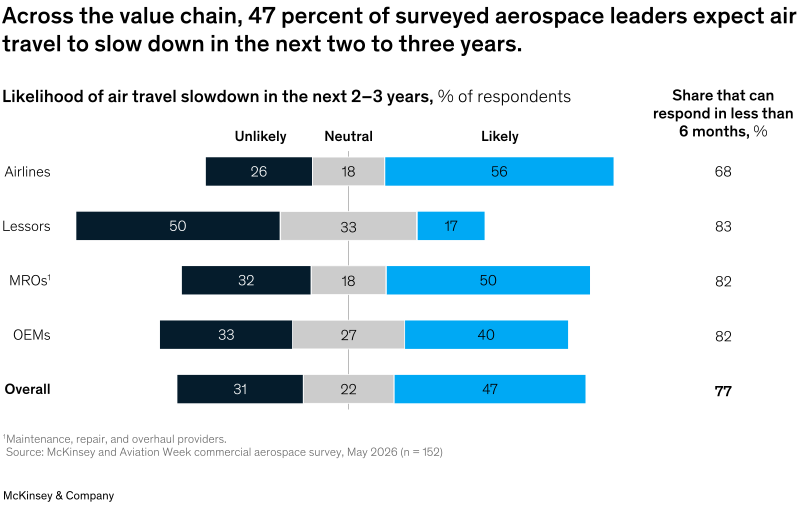
The most telling finding in this year’s survey is the divergence across segments. Airlines report the highest likelihood of a slowdown at 56 percent. Lessors report the lowest at 17 percent. That 39-point gap reflects something more consequential than differing opinions: It reflects an industry whose incentives are pointed in different directions, without consequence for those furthest from the pressure.
Seventy-seven percent of survey respondents said they could adjust their strategies within six months in response to a demand slowdown. The evidence from the past five years does not support that confidence. The pace at which the production ramp has unfolded, or failed to, reflects an industry for which rapid change is genuinely difficult to execute.
But the industry can adjust; it has done so before. The question is how to build the flexibility to respond with minimum exposure. The businesses positioned to weather variability are those that have engineered it in deliberately. In a value chain as interconnected as this one, preparation is the only early warning system that works.
For more details on the factors in play and what they mean for industry stakeholders, download the full article here.
Related Articles