How do travelers plan and book their trips? The answer has changed dramatically in less than a decade.
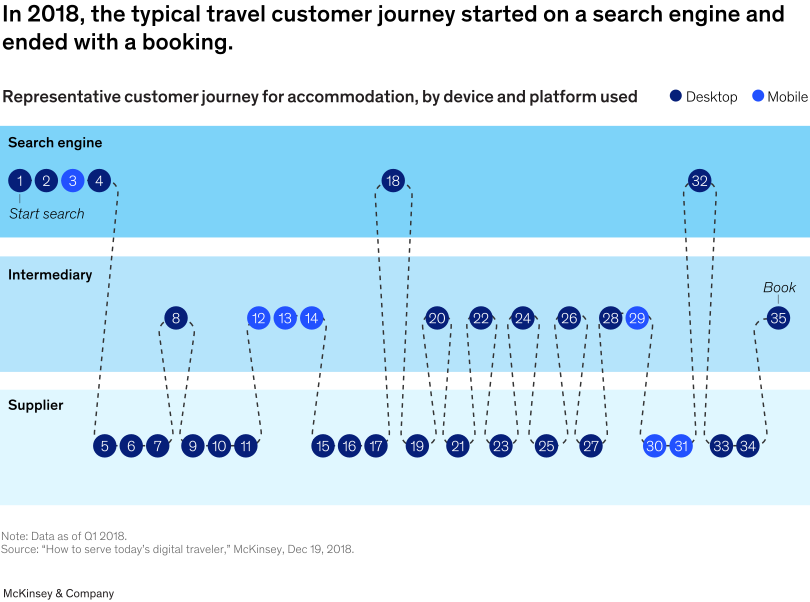
In 2018, when McKinsey conducted extensive research on the customer journeys of travel consumers, travelers tended to click among search engines, online travel agencies (OTAs), and supplier sites, often returning to the same channels repeatedly before transacting. The path varied in its specifics, but its underlying logic was consistent: develop an intent, narrow the options, secure a booking, and embark on the journey.
Today, the journey before the journey has changed shape. Inspiration is no longer a defined moment that marks the beginning of earnest travel planning. Travel inspiration has instead become part of everyday entertainment—delivered through social feeds, film and television, editorial content, reviews, and AI. Travelers encounter destination ideas continuously. Sometimes they research them. Sometimes they save them and move on. Sometimes they abandon one possible trip for another. Even when they advance all the way to booking, new content, recommendations, and prices can reopen the decision, leaving the itinerary feeling provisional long after the transaction has been confirmed.
The travel customer journey of today might be imagined less as a linear path and more as an orbit. At the inspiration stage, the traveler loosely orbits a vague travel idea—for example, some kind of trip to Japan. As they orbit closer to this idea, they become more specific in their intent (Kyoto, in April, with old college roommates, using credit card rewards points) and more tuned in to associated content (a TikTok post about cherry blossoms, an article about unagi). They might keep moving closer in orbit toward a booking, or they might fall further out of orbit and even leap into a different orbit—say, a vague notion of a trip to Eastern Europe.
In this new customer journey, continuous engagement is a positive signal. Travel is more accessible and more deeply embedded in consumers’ lives. But the expanding complexity and scope of travel planning have made the environment more competitive. Destinations, properties, and platforms are competing not only for a click but also for sustained attention as travelers explore and reconsider. Meanwhile, the consumer experience is increasingly fragmented. Travelers move among social platforms, search, AI tools, reviews, OTAs, supplier sites, devices, and conversations, but their context rarely moves with them. Every handoff adds friction: They repeat searches, reconstruct short lists, and revalidate decisions.
Drawing on a new survey of more than 1,000 US travelers—augmented by dozens of self-reported diaries from travelers researching and booking actual trips—this report examines four implications stemming from the new shape of travel planning:
- Always-on inspiration creates more entry points, but trust determines which ideas gain momentum (60 percent of travelers say social media inspires their trip ideas).
- Fragmented research creates a “restart tax,” underscoring why travel players should build for the return visit (half of travelers say their greatest frustration comes when attempting to compare trips across sources).
- AI is advancing faster than operator readiness (71 percent of travelers are comfortable using AI for inspiration today, and 86 percent say they would consider AI bookings in the future).
- Booking confirmation has become a waypoint instead of a finish line, creating openings for active postbooking relationships (half of travelers have changed booked accommodations after seeing a more attractive option).
Travel players do not need to win every touchpoint. But they do need to decide where they can credibly earn travelers’ attention, how they will maintain engagement, and which sources of friction they are best positioned to smooth over. The opportunity now is to create greater continuity and confidence for travelers—from the first spark of inspiration through booking and beyond.
From a bounded path to a looping orbit: The new travel customer journey
In 2018, McKinsey mapped the digital path to a hotel booking using cross-device clickstream data. On average, the journey lasted roughly 36 days and spanned about 45 touchpoints. Travelers bounced among search, intermediary, and supplier channels before buying. The chart did not show a straight line, but it did indicate a bounded path. The traveler entered with intent and moved, with some zigs and zags, toward a transaction. The chart ended at “Book” (Exhibit 1).
In 2026, the number of touchpoints has increased to 65, and the shape of the journey is difficult to capture using the same framework. It’s hard to pinpoint the exact start date of a booking journey when it begins with a scroll through social media instead of a search engine query. Similarly, clicking “buy” no longer represents the end point, as consumers increasingly change or cancel their booking before they travel. The 2026 journey can be better understood as a series of orbits, each formed around a possible trip.
Our analysis of travelers’ self-reported booking diaries supports this framing. Across 26 diary participants tracking 211 research and booking sessions, roughly one in three stage changes moved travelers outward in orbit rather than inward—say, from booking back out to research, or from research back out to inspiration. Half of multisession diarists made at least one such backward move over the course of their planning journey. The path is not just nonlinear; it is actively iterative (Exhibit 2).
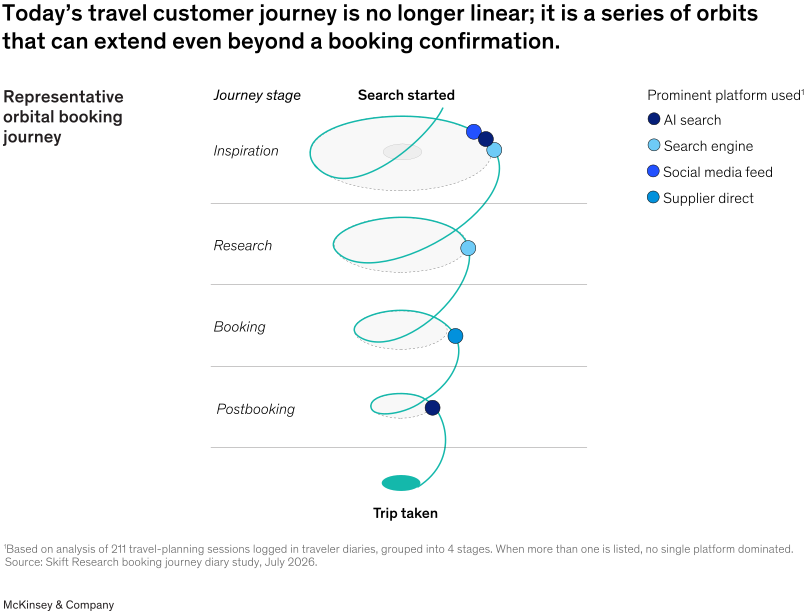
Inspiration happens in the outer orbit. A traveler may see a stylish hotel in a social feed, hear about a fun destination from a friend, watch a film set in a lush locale, or ask an AI tool to serve up exciting ideas. They may remain at the periphery of booking, simply enjoying the content without intending to buy. Or they may move into a closer orbit to research specifics such as prices, transportation, and availability. From there, the traveler might continue moving inward toward validation and booking, might retreat to the outer orbit again for further inspiration, or might exit the orbit entirely.
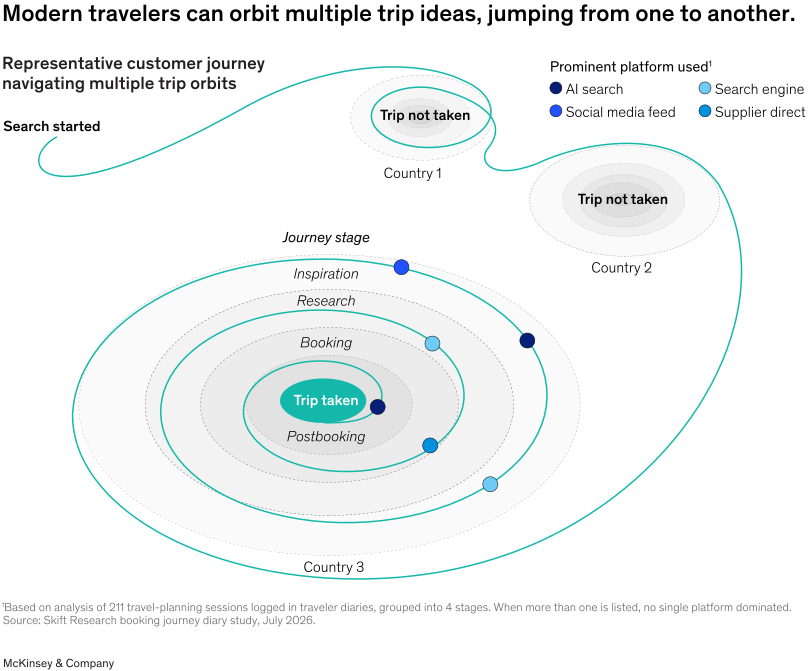
Unlike a linear travel customer journey, today’s journey can involve multiple orbits that remain active simultaneously (Exhibit 3). A traveler can save a Sicily tour video, research Seoul shopping, and discuss Portuguese cuisine with friends without treating any one idea as the definitive start of a journey. Even the orbit that actually produces a booking could remain active until after the trip is actually completed: Flexible change and cancellation policies, continuous price monitoring, and a never-ending stream of new recommendations mean that booking decisions aren’t as final as they may seem.
All that said, some constants remain. People still want to visit places they will enjoy, at prices they can afford, with experiences that make the whole travel group happy.
Inspiration becomes entertainment
Even consumers with no intent to plan a trip will still have travel content served to them. They encounter it while scrolling, streaming, reading, or chatting. A destination can enter consideration before a traveler has selected dates, set a budget, or even decided to travel at all.
Not every piece of inspiration turns into demand. Many ideas are liked, saved, discussed … and forgotten. Others are discarded and then picked up again as the traveler wavers on whether the idea is realistic or a good fit for them. A compelling image may attract attention, but a friend, a review, a credible creator, or another source with relevant experience often determines whether the traveler continues to orbit closer to a booking.
Faster answers, slower trust
AI adds speed to this system. A traveler can move from a vague idea to a detailed itinerary in seconds, ask follow-up questions that are instantly answered, and generate fully fleshed-out alternatives with a single click. AI is also a meta layer, drawing on reviews, articles, listings, social content, and supplier information, then recombining them in a new interface.
The technology evolves every day. But travelers’ confidence in it is not advancing at the same rate. An itinerary can look polished while leaving questions that actually matter unresolved. Is this place as great as it seems? Would someone I trust have picked it? Is this really the best price I can find? And is any of this actually still available? They then check reviews, consult friends, compare prices on OTAs, or visit the supplier directly. AI can narrow the field, but trust—with a human touch—still determines whether the traveler is willing to act.
The ‘restart tax’
More tools do not necessarily create a more coherent experience. Travelers can move from a saved post to search, from search to AI, from AI to reviews, and from reviews to a supplier or OTA. Each move can strip away part of the context they have already built.
The friction comes when travelers must reconstruct what they already know. They reopen closed tabs, reenter details and preferences, reconsider rejected options, and check the same facts again and again because one channel does not know what happened in another.
The challenge for travel players
The new shape of the customer journey creates both permission and pressure. Travel players have more touchpoints through which to inspire, reassure, serve, and sell. They also face a greater risk of losing travelers to another orbit. Capturing attention once is not enough. The goal is to help travelers maintain momentum even if they exit the orbit and then return.
That does not mean one company needs to own the whole journey. The opportunity is to make the experience feel more connected: Preserve what the traveler has already expressed, reduce unnecessary repetition, reconcile conflicting facts, and provide the proof and controls needed to move forward.
When inspiration never rests, trust becomes crucial
In 2018, inspiration often followed from intent. A traveler decided to take a trip, opened a search bar, and asked, “Where should I go?” The activity that followed was organized around that decision.
Today, travel ideas increasingly arrive before intent is formed. They surface while people scroll social feeds, stream a TV series, or read an article. Inspiration is no longer the formal beginning of a process. It is an ambient condition of the traveler’s life, delivered continuously and consumed as entertainment.
The result is a paradox. There are more opportunities than ever to put a destination, property, or experience into a traveler’s head. But travel ideas casually discovered can also be casually discarded. There is less commitment attached. As inspiration becomes more abundant, capturing attention is only a beginning. The harder task is earning credibility—building the gravitational pull that moves a traveler into a closer orbit.
Research tools are more powerful, but they come with a restart tax
Inspiration sits at the outer edge of a trip’s orbit. Research represents a traveler’s early attempts to move inward, and it is where they encounter the most friction.
The work of travel research is familiar: Travelers gather options, compare them, test which sources can be trusted, and hesitate before committing. That was true when the process involved a human travel agent and a brochure, and it remained true when the action moved to search engines and browser tabs.
What has changed is the volume of information, the number of tools and touchpoints involved, and the frequency with which travelers are prompted to reconsider their choices. Search, reviews, OTAs, supplier sites, social platforms, friends, forums, metasearch, and AI now converge during research. Each additional tool can make an individual task easier. Yet the final decision can become harder to reach. Faster answers create more opportunities to ask another question, open another tab, or reconsider an option that had already been rejected.
These tools also rarely share context. A saved social post does not know what the traveler compared on an OTA. An AI conversation may not reflect that one hotel was ruled out by a review site. Seventy-four percent of travelers revisit the same sites or apps multiple times before deciding, but they are left to carry the work across platforms and reconstruct the decision map each time they return.
AI is reshaping how travelers interact with operators faster than operators are ready for
By the time a traveler enters an orbit and moves inward to the research stage, two hurdles remain before the traveler proceeds to book with a given operator: The operator must enter the traveler’s consideration set, and the traveler must feel confident enough to complete the transaction. AI is reshaping the first step far faster than anyone is resolving the second.
For operators, this creates a new visibility challenge. Competitive rates, strong content, and a frictionless checkout could have little value if the product never appears in an AI answer. Incomplete or poorly distributed content can keep a strong offering outside the consideration set, without the provider ever knowing it was excluded. Strong search rankings and healthy review scores don’t confirm that a brand is appearing in AI answers, and the metrics that operators report on today may not show where—or how often—the brand is absent.
AI adoption is real. Sixty-two percent of travelers say AI tools have made planning easier, and more than half expect to use them more over the next 12 months. AI is used by 34 percent of travelers during research—more than at any other point in the journey. Willingness to delegate to AI, however, falls away as the stakes rise. Seventy-one percent of travelers are comfortable letting AI generate initial ideas, and 67 percent are comfortable letting it compare and narrow options—but only half will let it make a flight or hotel booking on their behalf or handle a disruption during the trip. Discomfort nearly doubles at the point where AI stops advising and starts acting, with three-quarters of travelers preferring to make the final booking themselves.
Asking an AI tool a question commits the traveler to nothing. Authorizing it to book commits money, dates, and itinerary choices. Forty-nine percent of respondents rank greater trust in a supplier’s website as their number one reason for booking direct—ahead of better prices or exclusive deals—and 87 percent place it in their top three. Trust is the key currency at the point of transaction.
Booking confirmation is just a pause, not the end
A traveler can enter an orbit, move inward through research and validation, commit at the center and hit “buy”—and still not be at the end of the journey. The expectation now is that a booking is provisional rather than final. Consider that four in ten travelers have changed booked accommodations after seeing a more attractive option.
“The postbooking phase is part of the validation loop,” says Naveen Manga of Marriott. “One reason it lingers is cancellation policy: Travelers may be able to cancel up to a certain point, so they revisit. As an industry, we allowed that. If we want to stay relevant and competitive for trips booked months in advance, we cannot treat booking as ‘set it and forget it.’”
Seventy-eight percent of travelers say they continue planning and researching after booking, and only 18 percent stop once the main reservations are made. The activity is substantive: 68 percent research restaurants, activities, and things to do in more depth; 64 percent continue browsing social content about the destination; and 48 percent share plans or ask friends and social networks for recommendations. Postbooking is a bundle of loops—plan, compare, share, reprice—that extends the pretrip window well past the purchase.
Underneath it is a single motive. Travelers are reassuring themselves that the trip they chose is still the right one, that they have not missed something better, and that they will know how to make the most of it when they arrive. Booking is no longer the finish line. It is the midpoint of a longer relationship.
What travel players can do next
The shifts described in this report do not require travel players to invest everywhere at once. But they do suggest a need for disciplined decision-making about where the organization can credibly influence the traveler, which sources of friction it is best positioned to remove, and how to keep the traveler moving forward through the customer journey.
Pair inspiration with proof and a clear next step
The objective is to determine where a priority traveler is most likely to encounter an idea, what will make that idea feel credible, and how the experience will encourage continued exploration.
Each inspiration initiative should be designed around three elements: the spark, the proof, and the next step. The spark is the distinctive experience, story, or point of view that earns attention. The proof is the evidence that makes it believable—such as reviews, social media imagery, creator testimony, or examples from people with similar needs or outlooks. The next step is to provide an owned or partner surface where the traveler can save, compare, explore, or ask questions without being forced immediately to checkout.
This involves a more disciplined decision-making process. Operators cannot be maximally present across every social platform, creator community, search surface, and media format. Each initiative should begin with a clear audience, the desired role in the customer journey, the expected traveler response, and a decision rule. Test on a limited basis, measure whether the idea helps travelers progress beyond attention, and then scale, adapt, or stop.
Reach, views, and clicks remain useful metrics, but they do not always show whether an idea gained momentum. Operators can also track saves, return visits, engagement with reviews, progression into planning, and eventual conversion. A campaign with modest reach but strong downstream movement may create more value than one that is widely seen and quickly forgotten.
Finally, the promise and the product are more powerful when they align. Marketing cannot manufacture inspiration if the underlying experience is generic, and the value of a strong idea is lost if the landing page ignores the story and proof that created the interest.
Design for the return, not only the first visit
The new customer journey requires platforms to assume that the traveler will leave, consult other sources, and then come back. Each return should begin from a more advanced decision state than the last.
Operators can begin by solving for the highest-friction handoffs rather than trying to connect the entire ecosystem at once. Repeated searches, abandoned comparisons, customer service contacts, and traveler diaries can reveal where people reenter information or revisit the same question. Those friction points should be the first priorities for the product.
Measurement can extend beyond first-session conversion. Useful indicators include the share of returning travelers whose prior state is restored, the time required to reach the next decision, repeated searches for the same information, and the rate at which unresolved questions are closed.
Seek today’s AI visibility—and prepare for tomorrow’s AI execution
Operators can look to ensure that AI will find, represent, and book their products accurately, while also giving travelers enough transparency and control to confidently authorize the result.
The machine-facing work can begin with recurring audits of how the brand is represented on AI portals. Operators can test high-value traveler prompts across major AI tools and assess whether their products appear, how they are described, which sources are cited, and whether rates, policies, and availability are current. Gaps may require richer structured content, stronger third-party listings, more current reviews, clearer policies, or better distribution across the sources models use.
Execution requires a separate foundation: reliable inventory, machine-readable terms, booking APIs, and processes that identify and correct failures. Appearing in the answer is not enough if the transaction cannot be completed accurately.
Treat postbooking as a time of risk and opportunity
Confirmation changes the operating mode but does not end customer engagement. Once a booking is made, the provider holding it has its richest information about the traveler, trip, price, timing, and cancellation terms. At the same time, the traveler remains reachable by competitors. Postbooking strategy can therefore address both retention and acquisition.
The first step is to segment travelers by exposure and opportunity. Relevant signals may include booking lead time, cancellation flexibility, trip composition, acquisition source, loyalty status, price sensitivity, and itinerary completeness. A flexible family booking made months in advance presents a different retention risk—and switching opportunity—from a nonrefundable business stay booked for the following week.
Price monitoring should not be left entirely to metasearch tools or AI agents. If a public rate falls during the cancellation window, the booking provider might offer a rebooking path, credit, complimentary amenity, loyalty benefit, or explanation of the value already included. A competitor might instead surface a clearly better alternative and make the trade-off and switching process easy to understand.
The same model applies to itinerary gaps and disruption. Missing dining or activity plans can trigger curated recommendations or partner offers, whether or not the provider holds the primary booking. Weather, schedule, or destination changes can prompt useful alerts and adjustment options. Digital tools can handle routine needs, with human support available for more complex cases.
Postbooking engagement works only when it is relevant to the traveler. It should not be an excuse to send generic messaging. Every intervention should resolve uncertainty, help protect or win the booking, or improve the trip.
The travel customer journey no longer resembles a path with a beginning, middle, and end. It is a set of overlapping orbits. Travelers move fluidly among social platforms, search engines, AI tools, reviews, and supplier sites, often pursuing several possible trips at once and revisiting decisions that might have seemed settled. Travel players that plan around the old linear model could find themselves a step behind where travelers actually are.
This shift rewards those who can earn credibility, reduces the restart tax travelers pay every time they switch channels, closes the gap between AI’s growing role in discovery and its still-limited role in booking, and keeps travelers engaged after booking confirmation rather than treating it as the end of the relationship. None of this requires any single company to control the entire journey. But it requires a clear view of where an organization can plausibly earn attention and trust, as well as the discipline to invest there rather than everywhere.
The travelers in this research are not saying they want more options, more content, or more tools. What they want is continuity: to be recognized when they return, to have their questions answered without redundant effort, and to feel confident that the choice in front of them is sound—and reversible if it is not. The operators, platforms, and destinations that deliver on that can earn an enduring place in the traveler’s orbit, wherever the next journey leads.
Related Articles