There’s been no shortage of attention on Europe’s competitiveness and investment gap.1 It has been the focus of influential reports by Mario Draghi and Enrico Letta2 and of ongoing European Commission efforts spanning dozens of initiatives, ranging from the building of at-scale AI gigafactories to exploring the creation of a 28th regulatory regime for innovative companies.3 At the same time, European nations are rapidly increasing defense and other spending,4 such as Germany establishing a €500 billion fund to support infrastructure and climate-neutral investment.5 The net result? The stage is set for Europe to revive its economic growth—if the continent can grasp the opportunity.
That’s where the private sector comes in. While the continued reform process and completion of the single market is critical, Europe’s leading companies could now play the central role in ushering in a new era of growth and prosperity. Investors are already identifying opportunities6: A record of about €300 billion was raised by European-focused private equity funds in the first nine months of 2025—or about a third of global commitments.7 That’s encouraging, given European corporations still invest about 40 percent less in capital expenditure and R&D than their peers in the United States.8
But more can be done. This article extends our analysis of the critical contribution companies can make to a European economic renaissance, including through a more strategic approach to collaborating with the public sector to shape the investment environment. Such an economic renaissance would benefit everyone. As the McKinsey Global Institute argues in its new book, A Century of Plenty, it is economic growth and rising incomes that enable many of the things Europeans care about: better health and education outcomes, better physical and social infrastructure, investments into climate change mitigation and adaptation, and investments into security and sovereignty.9 With growing consensus on what’s needed, now’s the time for both sides to accelerate.

World Economic Forum: A debrief of Davos 2026
January 28, 10:30 - 11:00 a.m. ET / 4:30 - 5:00 p.m. CET Join Senior Partners Becca Coggins and Shelley Stewart for a dynamic debrief on the conversations that stood out at Davos. They'll explore the themes rising to the top of the 2026 agenda—from agentic AI and the future of 21st-century leadership to geopolitics and new pathways to growth—and share practical takeaways every leader can put into action now.
The critical catalyst: Business investment
Measuring Europe’s investment gap
Since the global financial crisis, Europe’s prolonged slump in private investment has been especially pronounced in future-shaping industries.1 In the past five years, for example, US firms have invested €2 trillion more in digital technologies than their European peers.2 From January 2024 through September 2025, the annualized gap amounted to €580 billion for corporate investment and more than €300 billion for start-ups and scale-ups (Exhibit). And in traditional manufacturing industries, China is out-investing Europe at a rate of 3:1.3
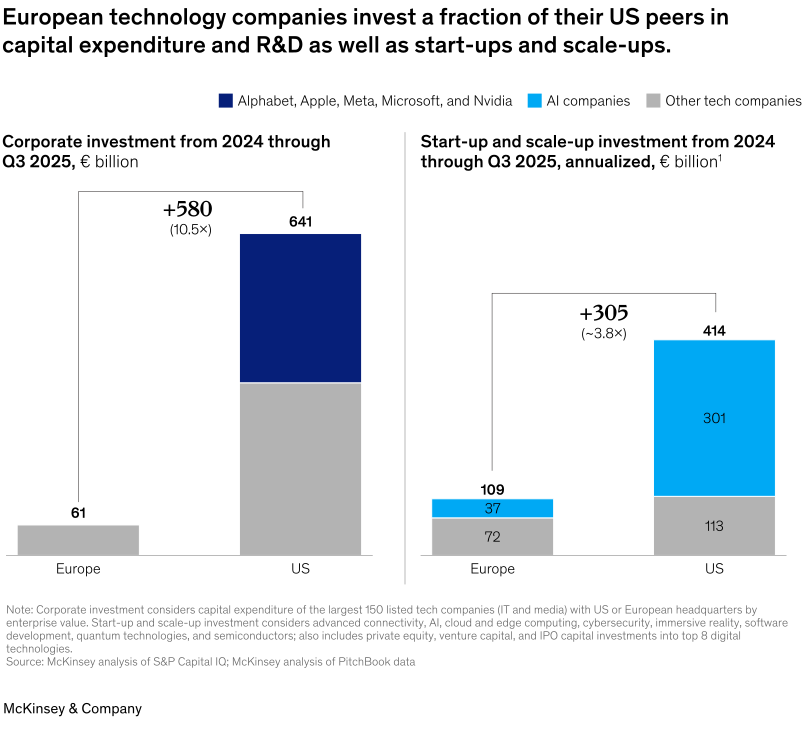
Competitiveness and growth are shaped by a multitude of factors, such as an efficient business environment, a robust innovation ecosystem, and a productive workforce. Business investment is a practical proxy for current competitiveness as well as a requirement for the invention, development, and adoption of new technologies that can shift Europe’s economic fabric in the future. In the past decade, Europe’s investment pulse has been low (see sidebar “Measuring Europe’s investment gap”).10
When the landmark Draghi report on European competitiveness was released in 2024, it estimated an additional €800 billion needed to be mobilized annually to start closing the continent’s competitiveness gap. According to recent estimates, that figure is now €1.2 trillion in private and public investment annually for the next five years, driven by increasing defense spending.11
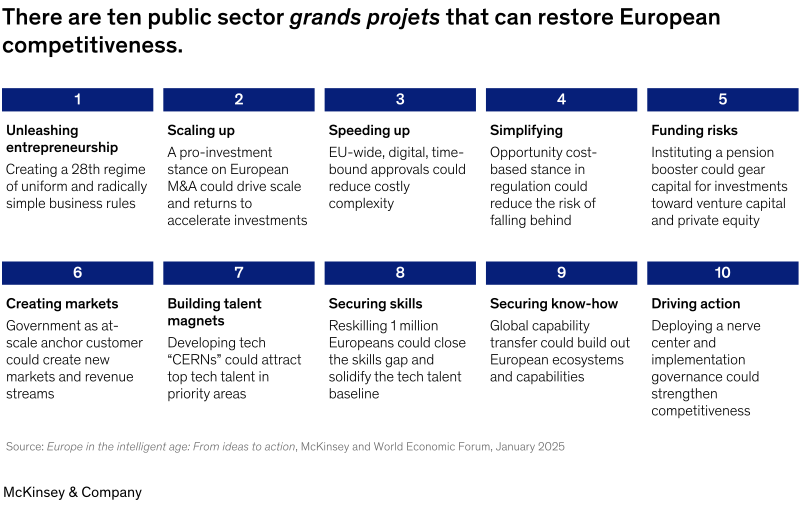
Reaching this level of ongoing business investment requires implementing numerous regulatory changes as well as other initiatives detailed in a study by McKinsey and the World Economic Forum that explores our ten public sector grands projets for restoring European competitiveness (Exhibit 1).12 But European companies cannot wait. An effective path forward would be twofold: advancing broad-scale regulatory reform while also accelerating specific private projects with, if needed, targeted support. While systemic reform is essential and transformative, it will take time. Focusing on unleashing ten to 20 multi-billion-dollar investments in strategic industries could start to close Europe’s investment gap and drive immediate, transformative impact.
What’s needed: Standout companies
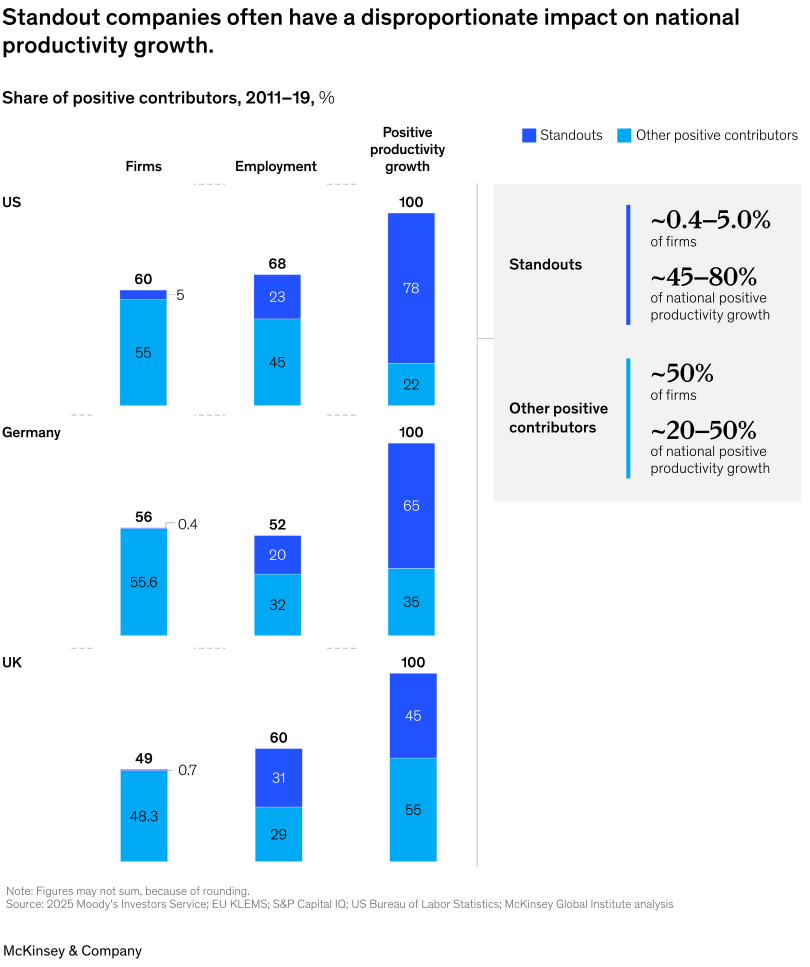
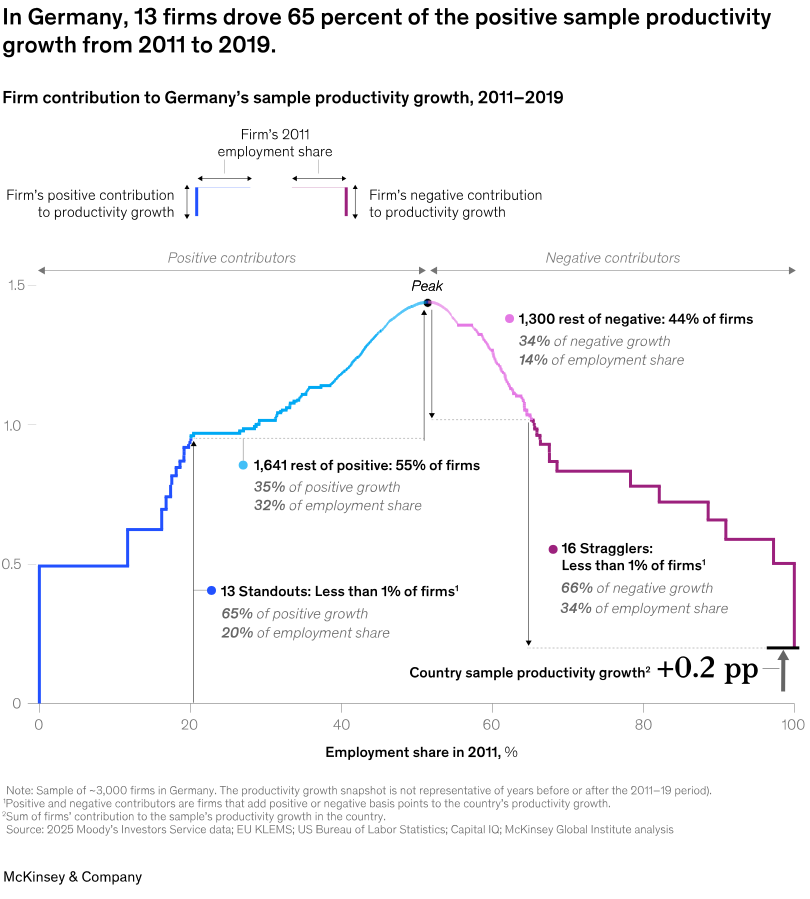
A handful of companies could make a material difference to Europe’s economic trajectory.13 McKinsey Global Institute research shows that national productivity growth is often propelled by a few ambitious firms making bold moves while many others advance incrementally.14 For instance, in examining a sample representing about 15 percent of US GDP, MGI found more than two-thirds of productivity growth was driven by 44 standout companies between 2011 and 2019, while as few as 13 standout companies drove two-thirds of the equivalent German sample’s productivity growth (Exhibits 2 and 3). The bottom line is that the incremental impact of leadership at a small number of firms is significant. Just a few hundred firms can materially shape an economy’s growth trajectory—whether by moving more firms into standout productivity performance, accelerating those that are already standouts, or turning around stragglers.
These standout companies drive productivity growth mostly through one or more of five bold strategic moves. Four of them are about growing value, and one involves reducing costs:
- scaling the most productive business models or technologies
- shifting portfolios toward the most productive and high-growth businesses
- reshaping customer value propositions through innovation leadership
- building scale and network effects
- transforming operations to raise labor efficiency and reduce external costs
And there are already examples both within Europe and overseas that provide inspiration for the kind of bold steps that can and should be replicated and scaled more widely.
While driving economic vitality requires Europe to become more dynamic in nurturing standout companies—which includes potential future standouts in the scale-up phase—it also requires more swiftly restructuring and turning around stragglers that can otherwise hold productivity back. In some cases, firms can grow or restructure alone, but in many cases, close collaboration with the public sector and other companies can help drive their success while also delivering secondary benefits for newer companies.
Finding inspiration: Bold examples of standout moves
Across countries and industries, there are examples of businesses and investors taking a mix of the five bold moves that can create productivity standouts. While it is too early to tell whether all of these will succeed, they may provide inspiration.
1. Scaling the most productive business models or technologies
ASML, a Dutch company at the core of the global semiconductor ecosystem, is Europe’s most valuable company by market capitalization at the time of writing. Its advanced (and globally unique) sub-nanometre lithography systems enable the chip miniaturization that powers AI, high-performance computing, and advanced memory. While ASML is taking action to scale its business globally, it has also committed to scale its footprint in Europe.
In 2024, ASML joined forces with the Dutch government and regional partners to launch Project Beethoven, a €2.5 billion public–private investment (which included significant investments in energy, transport, and housing infrastructure as well as talent development in the Eindhoven region) to enable expansion of the broader microchip cluster in ASML’s home region.15 Private ecosystem partnerships are also part of ASML’s growth story.
For instance, a decades-long partnership with Belgian nano-electronics research institute IMEC and a more recent partnership with France’s Mistral AI offer a new model of collaboration to scale advanced hardware and software in Europe. They allow IMEC to ramp up advanced pilot lines for pre-competitive R&D (such as sub-two-nanometer chips, supported also by the EU Chips Act, the Flemish government, and many global leaders in the semiconductor industry),16 provide Mistral with access to a complex industrial environment as a testing ground,17 and ensure ASML remains at the technological frontier.
2. Shifting portfolios toward the most productive and high-growth businesses
SAP and Siemens, Germany’s two most valuable companies, have made decisive portfolio shifts toward digital and AI in recent years. For instance, SAP is turning Business AI into its core product, embedding gen AI features at scale in its cloud applications, and making strategic acquisitions in AI and cloud management software.18 Siemens, meanwhile, is working to unite the physical and digital worlds. It has acquired software companies worth more than $15 billion over the past two years while also making substantial organic investments in AI. These include a €1 billion company-wide investment to scale industrial AI offerings across its businesses, a nine-figure commitment to the development of an Industrial Foundation Model, and strategic partnerships with companies such as Nvidia, Amazon, and Microsoft to create state-of-the-art industrial AI solutions for customers.19
In other layers of the technology stack, a range of European utilities have been converting former coal and gas power plant sites for hyperscale data centers, while others are co-developing or powering major new data center campuses with dedicated clean-energy and grid solutions.20 Another notable and recent example is Germany’s Schwarz group, Europe’s largest retailer, committing €11 billion—the largest single investment in the company’s history—to a 100,000 GPU sovereign AI gigafactory in eastern Germany, both for its own operations and STACKIT cloud customers.21
3. Reshaping customer value propositions through innovation leadership
European pharmaceutical company Novo Nordisk is reshaping customer value propositions by helping shape and scale the GLP-1 drug segment for obesity and cardiometabolic diseases. The company invested heavily in R&D—more than $8.2 billion in 2024 alone22—to develop breakthroughs such as the weight-loss drug Ozempic, expand access through an oral GLP-1 (Rybelsus), and launch a digital partner platform supporting patients through the weight-loss journey (in the process briefly becoming Europe’s most valuable company).23 Despite recent clinical trial setbacks and growing competition, Novo Nordisk’s story stands to show the impact of innovative companies. Other pharma companies are making similarly bold moves to accelerate the rate at which they develop new products, including using AI to develop digital twins of the human body and automating many steps of the drug discovery process.
European firms could also reshape customer value propositions by innovating and scaling novel technologies in other domains. Some of the most promising include next-generation semiconductors and nanoelectronics, quantum computing and quantum materials, advanced photonics and lithography, and nuclear fusion. Europe has strong expertise in all of these technologies but will need to ensure sufficient funding for the commercialization and scale-up as the technologies mature.
4. Building scale and network effects
Fragmentation is an issue in many European industries, including aerospace and defense, where around six times as many weapons systems compete against each other compared with the United States.24 In the past year, however, there have been signs of consolidation. M&A activity in the first half of 2025 rose 35 percent year over year,25 with one example being the preliminary agreement between three of Europe’s leading aerospace companies—Airbus, Leonardo, and Thales—to merge their space divisions into a single European space joint venture.26 The proposed merger will have annual revenue of around €6.5 billion and about 25,000 employees, and it is consolidating capabilities and strengthening strategic autonomy.27 Similar moves are happening in aircraft, drones, tanks, armor, and naval platforms, with several joint ventures and acquisitions among European players in each segment in 2025.28
Other examples of integration and network effects are found in regional ecosystems, such as the microchip cluster in Eindhoven or, as just one example, the Wallenberg ecosystem of companies in Sweden. Wallenberg Investments, who holds long-term stakes in some of Sweden’s biggest companies, launched an AI infrastructure company (Sferical AI) to boost the competitiveness of Swedish industry, together with Nvidia and its portfolio companies AstraZeneca, Ericsson, SAAB, and SEB. In parallel, the Wallenberg Foundation launched the Wallenberg AI, Autonomous Systems and Software Program (WASP) to train 600 PhDs and drive research in collaboration with major Swedish universities, helping to establish Sweden as a global digital ecosystem.
5. Transforming operations to raise labor efficiency and reduce external costs
MGI’s research on the economic potential of gen AI found its use alongside other automation technologies could add up to 3.4 percentage points annual global productivity growth through 2040.29 And many European businesses are adopting AI to drive efficiency. Europe’s largest bank by market value, Santander, reportedly achieved cost savings of €200 million in 2024 through its AI initiatives and has set a clear ambition to become a data and AI-first (AI native) bank, embedding AI into “every decision, process and interaction.”30 Similar early examples of AI adoption for efficiency gains are emerging across industries, including insurance, healthcare, technology, and telecommunications.31 While it is not yet clear whether the bold moves of today will lead to standout firms in the future—and many technology-related moves depend on how AI evolves—bold movers at least have a better shot at outperformance than those standing still.
Healthy competition: Countries and regions should vie for the best projects
Beyond pursuing broad reforms in line with the grands projets, the public sector (including regional and local governments) has a role in accelerating momentum through its own bold moves. These may include directly supporting important projects32 as well as creating regional “landing zones” to attract private sector investment.
Many European countries already host special economic zones and special territories offering tax breaks, customs benefits, and streamlined rules. Poland has the largest number of special economic zones (such as Katowice, focusing on automotive; Pomerania, focusing on electronics; and Krakow, focusing on IT). Other special industrial zones are found primarily across Eastern Europe and Southern Italy, special business zones in the Canary Islands (Spain) and Madeira (Portugal), and freeports in the United Kingdom.33 Alongside these mature platforms, there are more recent initiatives such as technological free zones and net-zero valleys, which are focused on deploying and testing advanced digital and clean technologies in real-world environments. Increasing competition at the regional level could allow bright spots to intensify and spread, unlocking more regions where investments are mobilized at scale and innovation flourishes.
Inspiration can also be found outside Europe, notably in Asia and the Middle East:
- Companies in China have emerged among the world’s fastest innovators, with the result that the country now leads research in 66 out of 74 new technologies34 and has created globally leading companies across many of what MGI calls “future arenas of competition.” Alongside the country’s huge pool of technical talent and its ability to direct resources to strategic industries (as identified in the “Made in China 2025” plans35), a culture of quick iteration and ambitious execution and scaling contributed to this success.36 For instance, Chinese OEMs go from concept to launch of new models in fewer than two years (compared with three to four years for leading European OEMs) while targeting cost reductions of 5 to 10 percent annually (compared with 1 to 2 percent among Western incumbents).37 European companies may not be able to or need to replicate the Chinese model wholesale. However, they could benefit from forming targeted partnerships with Chinese peers to absorb practices that accelerate innovation execution and achieve “China Speed.” Collaboration may help European firms build greater speed in early concept phases, adopt more-assertive cross-functional teaming, and strengthen cost–performance discipline while maintaining European strengths in quality, safety, and system integration. This blend offers a pragmatic path to close the execution gap and compete more effectively in global technology-intensive markets.
- Japan also offers inspiration. Japan and Europe share similar challenges, from aging populations to an industrial fabric challenged by disruptive innovation and Chinese competition, reliance on energy imports, and a long spell of comparatively weak economic growth. While Japan’s ultimate trajectory is still to be determined, recent policy has pivoted toward catalyzing growth through incentives for innovation. Among many initiatives, the Japanese government targeted the creation of 100,000 start-ups and 100 unicorns by 202738 and rewired its fiscal architecture to encourage greater risk-taking (such as providing corporations with a tax deduction for open innovation investments). In partnership with leading Japanese corporations, it backed the creation of leading-edge semiconductor manufacturer Rapidus.39 Of course, there are challenges: The government’s ambitions are not met by today’s pipeline of start-ups, and questions remain about whether the risk appetite of the private sector is truly shifting. Yet Japan’s experience underscores the potential power of clear targets, national-level funds, and clear incentives to mobilize private capital at speed.
Act now: Capitalizing on recent investment momentum
On its current trajectory, our research finds Europe risks another decade of “secular stagnation”: sluggish real GDP growth of around 1 percent annually as high savings and weak investment reduce aggregate demand and push interest rates back to near-zero.40 But that outcome is far from inevitable. If standout private sector leaders, supported by the public sector, can build on recent momentum in capital flows and roughly match their US counterparts in terms of investment and R&D spending, the continent could shift to a productivity acceleration pathway that would double its rate of economic growth and significantly expand household wealth—leading to a renaissance in European prosperity.
Green shoots in Europe’s investment environment
Foreign direct investment (FDI) provides a solid directional measure of global investment decisions. Our research finds that announced greenfield FDI into Europe has increased by 40 percent between the pre- and post-COVID-19 periods (exhibit).1 In the first nine months of 2025, a dozen large-scale projects each exceeding €2 billion were announced. FDI inflows from outside Europe have been driven by investments into data centers (such as a recent project in France backed by the United Arab Emirates and a project in Sweden backed by Canada) and advanced manufacturing (including electric vehicle and battery projects by Chinese companies in Eastern Europe and Iberia). Still, more investment is needed: The United States doubled FDI for the same period, and outflows from Europe (to the United States and other regions) exceed inflows by a factor of almost 2:1.
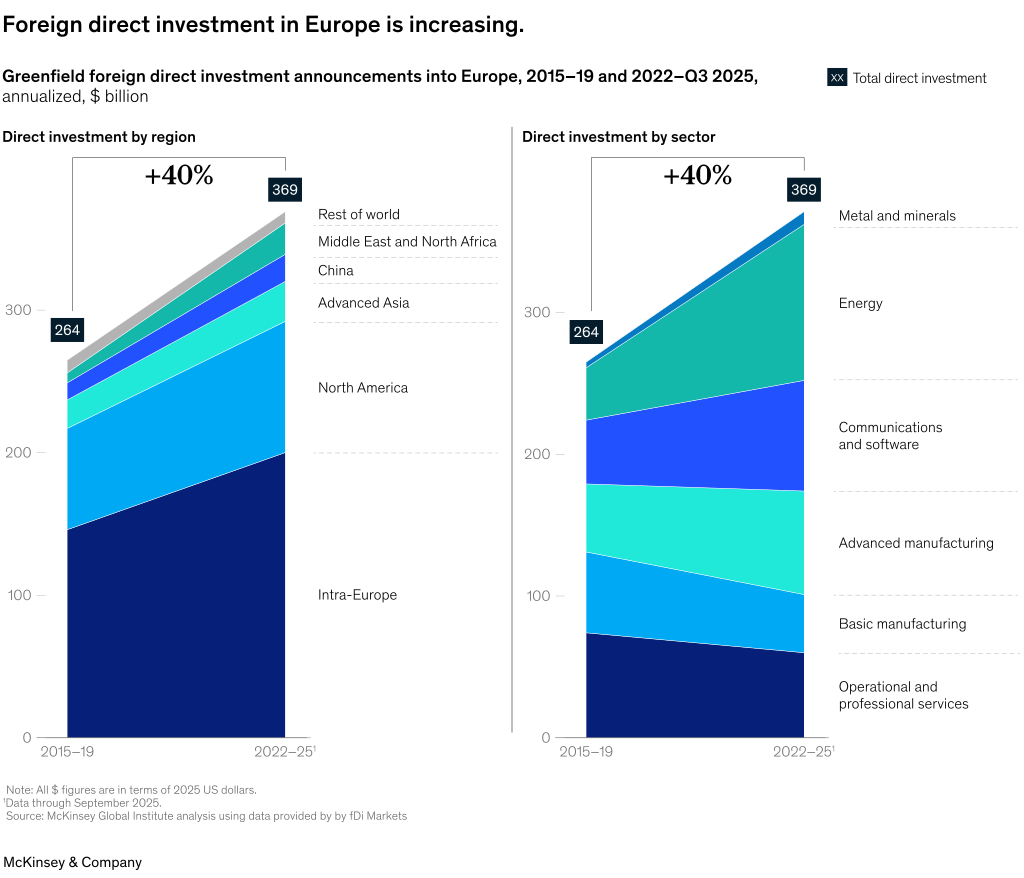
Private equity investments are another directional measure. From January to September 2025, Europe-focused funds raised $311 billion (around €300 billion) or 34 percent of the global total, compared with around 25 percent in previous years and six percentage points higher than the previous record of 28 percent in 2010.2 KKR deployed more than $20 billion in Europe in the first nine months of 2025,3 citing record levels of interest in Europe and the upside for the continent from channelling more finance—including from Europe’s large pension funds and asset managers—into the scale-up of innovative companies and ideas.4
In the past two years, planned FDI into Europe has increased by 40 percent compared with the pre-COVID-19 average (see sidebar “Green shoots in Europe’s investment environment?”),41 while private capital investors scaled European commitments to around €300 billion in the first nine months of 2025. For example, KKR deployed a record $20 billion in Europe in 2025 through September, highlighting digital infrastructure, energy transition, and defense42; Blackstone is planning up to $500 billion of European investment during the next decade, compared with $350 billion invested during the past 25 years43; EQT, Europe’s largest private equity fund, is doubling its commitments to $250 billion during the next five years44; and Apollo Global Management is targeting as much as $100 billion of investment in Germany alone.45 Of course, rising private equity activity may signal not only investment in scaling transformative businesses but also the purchase of value or distressed assets. For Europe, however, faster restructuring of distressed businesses may also be an important driver of productivity growth.
Competitiveness is critical to both Europe’s prosperity and its security and strategic autonomy. With growing consensus on what needs to be done, now is the time for leaders to take action at pace and at scale. But while public sector leaders can lay necessary foundations to accelerate investment and growth, private sector leaders can control their destiny by acting boldly to turn their companies into standout firms. Just a few hundred more standout firms would close Europe’s growth gap to the United States. It’s through this combination of public sector action and private sector boldness that Europe can move forward—with purpose and at pace.