Many business leaders now accept that quantum technology is coming sooner than they first expected, and they’re taking steps today to capture a competitive advantage. We have found that over 300 organizations worldwide are already working with quantum technology providers, with many more experimenting.1 What many leaders lack is a sense of how much to invest in which technologies, and over which timeline.
Faced with quantum technology’s rapid pace of development and the scale of its implications, leaders are now forced to reconsider their action plans. Across all three of its pillars—quantum computing, quantum communication, and quantum sensing—quantum technology is advancing rapidly. Quantum technology companies are hitting milestones more quickly than they initially predicted, and many have ambitious road maps that put the expected arrival of fault-tolerant quantum computing (FTQC) within the next few years. FTQC will enable reliable quantum computing at scale, opening new possibilities in everything from drug discovery to materials design to financial modeling. But FTQC is a double-edged sword; when fully scaled, it will also bring about Q-Day, the moment when quantum computers can break today’s public-key cryptography. As a result, even companies that don’t directly deploy quantum computing will need to update their security platforms to contend with it.
To help business leaders understand the road ahead, we mapped three horizons of quantum technology development (Exhibit 1). This article will also highlight the roadblocks that could slow the quantum timeline—and the emerging developments that could speed it up.
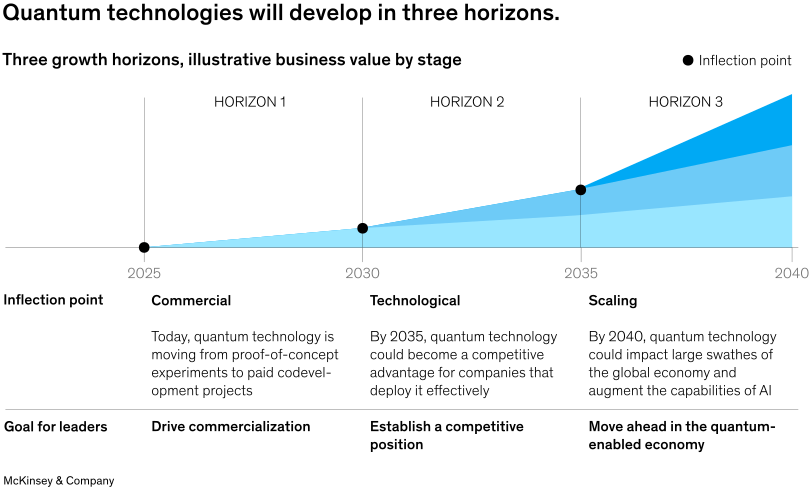
The financial stakes justify immediate action. Our latest Quantum Technology Monitor finds that quantum computing alone could create $1.3 trillion to $2.7 trillion of economic value worldwide by 2035. To capture as much of this value as possible, business leaders need to understand how quantum technology is developing across the three horizons and map their companies’ pathways through them. Waiting to invest is risky. Those that do could soon find that the partnerships, talent, and intellectual property needed to succeed with quantum technology were claimed years earlier by faster-moving competitors. They could also face severe security issues when Q-Day arrives.
The Rise of Quantum Computing
Accelerating technological breakthroughs, increasing investment flows, start-up proliferation, and promises of capable quantum systems by 2030 signal it’s time for business leaders to begin planning their quantum-computing strategies.
Horizon 1: Early commercialization
The clearest signal that quantum technology has crossed from research into commercial deployment is that the sector now has an exit market. In 2026, companies such as Horizon Quantum, Infleqtion, Pasqal, Quantinuum, and Xanadu went public.2 Meanwhile, IonQ acquired SkyWater Technology in a deal that pairs SkyWater’s chip manufacturing with IonQ’s quantum hardware and software.3 Governments are also supplying a stream of development capital, including, for example, recent commitments of $2 billion in the United States and more than €1 billion in France.4 Many of these investments are aimed at increasing manufacturing capacity rather than just research output, and they show that governments see economic opportunity in quantum technology.
The demand side has changed just as much. Proof-of-concept projects are shifting to paid codevelopment. Our research finds that companies including Airbus, Boehringer Ingelheim, E.ON, JPMorgan Chase, and Liberty Mutual are actively developing applications in collaboration with quantum technology players. Cloud access and quantum-as-a-service models are also lowering the barrier to entry, turning what was once a large capital project into a strategic partnership decision. Companies are showing a strong interest in quantum. Our recent Technology Trends Outlook 2026 report shows that searches on quantum-related keywords and the number of research publications on quantum technology rose steadily between 2022 and 2025, while equity investment surged from $2.5 billion in 2024 to $13.3 billion in 2025.
None of this means that quantum computers are ready today, but the market around them is clearly forming. Supplier relationships and intellectual property are being cemented, internal skills are being built, and companies are making investment decisions even with imperfect information about when reliable fault-tolerant hardware will arrive.
The three quantum pillars are commercializing at different speeds. Quantum computing is currently the largest market of the three pillars. It draws its advantage from the quantum principles of superposition and entanglement, which allow a processor to evaluate an enormous number of possible states simultaneously. The unit doing that work is the qubit, the quantum equivalent of a classical bit. But while a classical bit must be either zero or one, a qubit can hold both values at once and behave as a single system.
Our research shows that quantum computing companies surpassed $1 billion in combined revenue in 2025—and that revenue could grow to as much as $4.4 billion by 2028.5 Near-term deployment of quantum computing is overwhelmingly hybrid, with quantum processors attached to existing high-performance computing environments rather than replacing them. Several such systems are already operating. The US Department of Energy’s Oak Ridge National Laboratory has connected IQM’s Pathfinder system with its Frontier supercomputer; Europe’s 54-qubit Euro-Q-Exa went live at the Leibniz Supercomputing Centre in early 2026; and Aramco and Pasqal operate a 200-qubit neutral-atom machine as the Middle East’s first commercial quantum-computing-as-a-service platform.6
Quantum communication is driven by the looming Q-Day deadline. To address upcoming security risks at the physical layer, quantum key distribution (QKD) uses quantum mechanics to make interception detectable in real time on protected links, and it’s starting to move out of the laboratory. Meanwhile, postquantum cryptography (PQC)—new algorithms designed to resist quantum attacks while running on existing hardware—is here now and will be critical for companies migrating their cryptography systems. We expect the overall quantum communication market to reach $11 billion to $15 billion worldwide by 2035.
Quantum sensing is the most mature of the three pillars. It uses the same quantum properties that make qubits work but applies them to measurement rather than computation. Q-CTRL’s quantum sensors, which navigate by reading Earth’s magnetic field rather than satellite signals, have completed safety-of-flight testing, for example.7 Atomic clocks, gravimeters, and magnetometers that leverage quantum sensing are also finding commercial traction in sectors such as navigation, medical diagnostics, and mineral exploration. We expect this market to reach $7 billion to $10 billion worldwide by 2035.
For business leaders, positioning their companies as front-runners in Horizon 1 is about building the foundations of success. This requires securing talent, intellectual property, and partnerships today. Those that wait risk entering the next phase dependent on technologies and ecosystems shaped by their faster-moving competitors.
Horizon 2: Establishing a competitive position
Hardware road maps from leading quantum computing companies are converging on the possibility of delivering a fault-tolerant quantum computer within five years. IBM has published a potential path to large-scale fault tolerance by 2029, while IonQ is targeting two million physical qubits by 2030—enough to yield up to 80,000 logical qubits, the error-corrected units of computation that fault tolerance depends on.8
Fault tolerance will bring a step change for quantum computing: machines that can sustain long computations reliably enough to be embedded into production workflows. If quantum technology companies achieve their development road maps, we expect the quantum computing market alone to capture between $43 billion and $71 billion of the worldwide “internal quantum market” by 2035. (The internal quantum market represents the total global spending expected by companies on quantum hardware, software, and services, and we estimate this market will reach $60 billion to $100 billion in 2035.)
But fault tolerance at scale is also a trigger for Q-Day, which could invoke a whole slew of new security challenges. For many large enterprises, getting ready for Q-Day is a multiyear, multibillion-dollar transformation—but one that’s necessary. Without PQC systems in place, companies’ virtual private networks, public-key infrastructure, connected devices, and identity systems could all become exposed on Q-Day. Plus, sensitive data is already exposed to “harvest now, decrypt later” attacks, in which encrypted traffic is collected by hackers today so it can be read by quantum computers on Q-Day. That means acting today is imperative to avoid severe security flaws in the near future.
However, the FTQC timeline faces several roadblocks. The case for fault tolerance by the early 2030s rests on road maps, and every technology developer—and buyer—knows that road maps often slip. Three key constraints deserve attention from leaders who are building their quantum investment plans around these dates.
The first is that scaling is now largely a manufacturing problem. Quantum technology is advancing quickly, but building quantum machines with millions of physical qubits requires lasers, cryogenic infrastructure, control electronics, and manufacturing processes that don’t yet exist in the capacity needed for true scaling.
The second is that talent is scarce. The pool of researchers and engineers who can design and program quantum computers remains limited. To scale quantum computing, companies also need software developers and solution architects to translate quantum capabilities into business applications, as well as technicians to build manufacturing systems.
The third is that there is no consensus on which quantum computing hardware modality—superconducting, trapped ion, neutral atom, photonic, spin, topological, or an entirely new one—will scale most effectively. A company choosing a single quantum technology provider is making a future-looking bet, not merely a procurement decision.
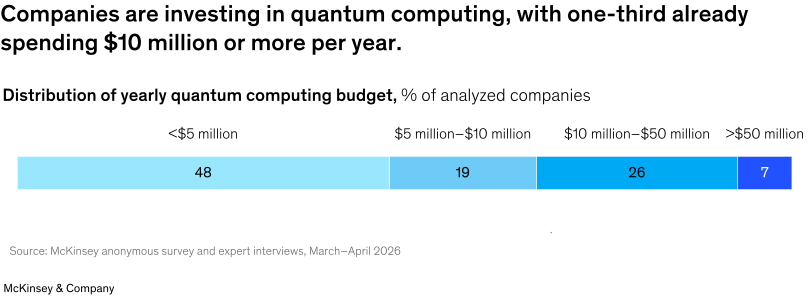
Despite these uncertainties, many companies are pushing ahead with plans for quantum technology adoption; they can’t afford to be laggards. When we interviewed business leaders already working with quantum technology providers, one-third said their companies spent $10 million or more on quantum computing in 2025, with 7 percent of those companies spending $50 million or more (Exhibit 2). These are capability-building budgets rather than experimental ones, set by buyers that have determined that today’s road maps, while not set in stone, are reliable enough to plan against.
Horizon 2 is when companies lock in their quantum strategies—and real value starts to accrue. Fault-tolerant machines will be scarce and expensive when they first arrive, so the customers that worked with providers on earlier pilots and partnerships in Horizon 1 could get first dibs on this compute capacity. Thus, during Horizon 2, the most competitive companies will be those that continue to codevelop the quantum applications they started before the hardware even existed.
Horizon 3: Leading the quantum-enabled economy
In Horizon 3, entire economic arenas could reorganize around the future capabilities that quantum technology will make possible. The McKinsey Global Institute (MGI) has identified 18 future arenas of competition that will shape the global economy over the next 15 years, collectively generating $29 trillion to $48 trillion in revenues by 2040. Quantum technology intersects with several of these arenas. This means that some of the most competitive companies in Horizon 3 will be those that redesign their operating models around quantum technology.
Quantum technology could create outsize value in four of the arenas:
-
Cybersecurity. Quantum technology could soon upend the public-key cryptography that underpins most enterprise security systems. Business leaders need to act now to build the PQC systems that will ensure their data remains safe after Q-Day. This is a multiyear program, not a patch cycle. We expect PQC to emerge as one of the largest quantum communication verticals, representing a $2.4 billion to $3.4 billion global market by 2035.9
But quantum technology could also help companies design new, more robust security systems—which is especially crucial in an era when AI has dramatically sped up attacks. QKD is a hardware-based security approach that uses physics to distribute keys and offers a level of protection that classical cryptography cannot. QKD is distance limited and cannot provide authentication or signatures on its own, so it remains a complement to PQC rather than a substitute in the near term. But we predict that by 2040, QKD could be a standard networking option. Financial exchanges, power grids, hospital systems, and government networks could at that point run over shared, QKD-protected corridors as the default. By 2035, we expect the QKD market to be worth $2 billion to $2.8 billion worldwide.
-
Drugs for obesity and related conditions. Quantum computing could lead to a new world of personalized medicine, especially for chronic conditions. The body’s biological systems are far too complex for classical computers to model, so medical research is done on simplified subsets of data. In the near term, quantum computing could sharpen molecular simulation enough to design therapies for narrow patient subgroups rather than broad populations. For example, it could enable pharmaceutical companies to develop more effective therapeutics for obesity and its related chronic diseases. By 2035, we predict that quantum computing could deliver up to $400 billion in value to the pharmaceutical industry.
Further out, quantum computing could support patient-level digital twins: computational replicas of an individual, detailed enough to simulate how a disease could progress and how a treatment would work. By 2040, diagnosis and treatment could be optimized continuously for one person at a time rather than for a population they resemble.
-
Industrial and consumer biotechnology. Quantum technology could transform the discovery of biomaterials and biochemicals. We estimate that quantum computing could unlock up to $800 billion in value in the chemicals industry alone by 2035. A material’s useful properties are a result of how its electrons interact. Those interactions are quantum mechanical, and the possible configurations multiply so fast that classical computers cannot always calculate them directly. Thus, researchers often fall back on trial and error: synthesize a candidate, test it, adjust, repeat.
Quantum processors don’t rely on approximation, because they represent electron behavior using the same physics that governs it. In May 2026, Q-CTRL demonstrated a 3,000-fold speedup in modeling how materials behave, running on 120 qubits.10 That capability points toward designing materials that don’t yet exist, such as superconductors that move electricity without loss and alloys that survive inside next-generation reactors.
-
Robotics. Our analysis shows that the global market for general-purpose robots could reach $370 billion by 2040.11 Quantum computing could have a big impact on the development of general-purpose robots, including humanoid, quadruped, and other form factors, because to operate effectively in the real world, these robots must continuously process information from cameras, microphones, sensors, and other inputs. They must assess their surroundings to move safely through unpredictable environments and coordinate with cloud infrastructure, enterprise software, and fleets of other robots. In other words, general-purpose robots require huge amounts of sensing, communication, and computational processing power—all of which quantum technology could provide.
General-purpose robots that harness quantum computing from near-bot and cloud-computing platforms will come first, with quantum networking and sensing later becoming on-bot quantum enhancements. We estimate that qubots, or robots that use quantum technology in at least some capacity, could represent up to a $67 billion global industry by 2040, with humanoid qubots alone representing up to $55 billion of that total.12
By 2040, quantum computing could become ordinary in many high-innovation sectors. Most organizations will likely access quantum computing through quantum-as-a-service providers. Quantum communication could feasibly scale from a handful of connections to a network layer. Quantum sensing could become embedded in common industry tools: magnetometers that read brain activity, gravimeters that map what lies underground for mineral exploration, and navigation systems that track positions without satellite signals.
Horizon 3 is not just about adopting quantum technology for its own sake. If quantum becomes as foundational as AI is today, the question facing business leaders will not be whether to use quantum technology at all, but how to do so in ways that materially change their operating models. Every leader also needs to consider how quantum technology and AI will intersect—and the value that intersection could create for their businesses, the economy, and society.
MGI’s latest research on the AI economy describes an interconnected system moving at mismatched speeds: Model capabilities are expanding exponentially, while the physical inputs they run on, such as chips, power, and data centers, are growing linearly and take years to build. Quantum computing could help unblock that bottleneck, dramatically expanding compute capacity to accelerate AI capabilities. And the AI–quantum relationship is symbiotic. AI is speeding up quantum algorithm design and error correction in ways that could hasten the arrival of FTQC. As MGI notes, changes in even one part of the AI ecosystem can ripple through the other parts to cause change to the whole system. The combination of AI and quantum computing is an example of such an interconnected shift, and together they could accelerate the arrival of Horizon 3. This would leave leaders less time to prepare for its implications.
A way forward
Over the next 15 years, quantum computing will drive deep structural shifts in how companies do business. As fault-tolerant systems scale, first movers could gain access to computational capabilities that deliver hundreds of billions of dollars in value. Preparing for this future requires action today. To do so, leaders need to understand how quantum will develop across the three horizons.
To ensure their organizations take leading positions during each horizon, leaders can focus on four strategic priorities: secure ecosystem partnerships and access to frontier systems; pilot applications ahead of commercial readiness; build organizational familiarity through talent and IP; and explore how quantum technology could ultimately alleviate compute and energy bottlenecks in AI scaling. Quantum technology will not wait for organizations to feel ready—and the window to build a leading position will narrow with each horizon that passes.
Related Articles


Quantum is almost here: Are you and your systems ready?