When it comes to quantum computing, innovation-driven companies can no longer afford to wait and see. Over 300 organizations including Airbus, Boehringer Ingelheim, E.ON, JPMorgan Chase, and Liberty Mutual are actively collaborating with quantum technology companies to solve business challenges. First movers are transitioning from pilots to applications that are embedded in end-to-end workflows. That’s a key finding from McKinsey’s fifth annual Quantum Technology Monitor.
Companies that act now to begin testing and implementing quantum computing stand to gain a competitive edge and define future industry standards. By creating the teams and capabilities to succeed with quantum now, first movers can capture an early advantage. They can also secure intellectual property to build defensible ownership of key quantum computing applications.
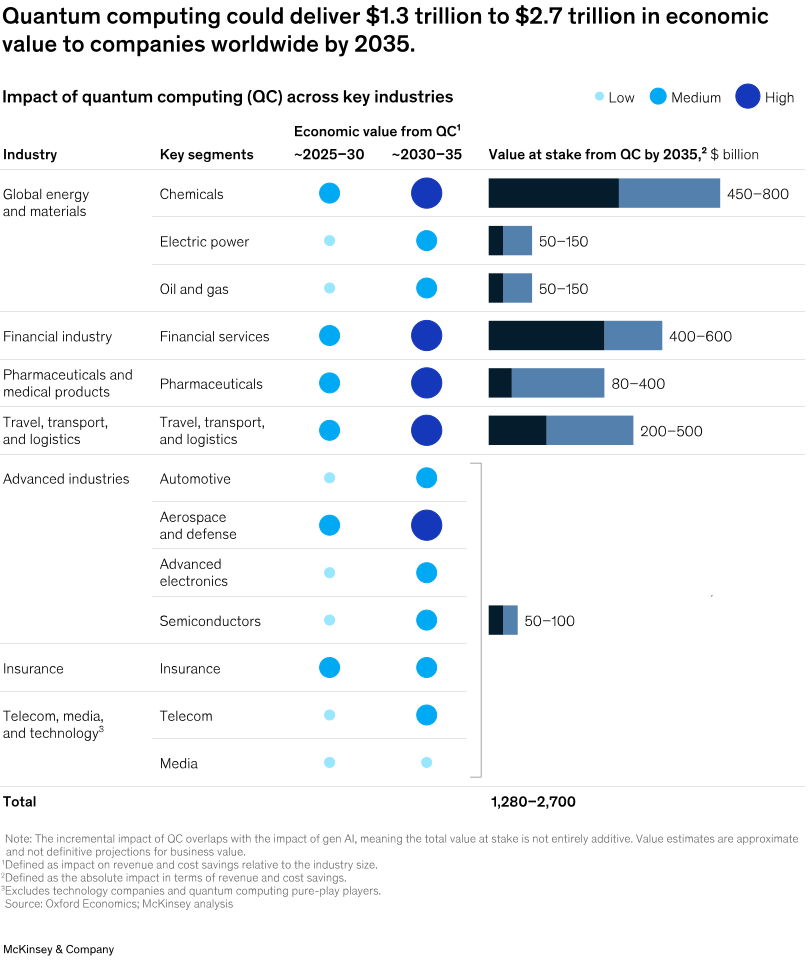
Business leaders are waking up to the potential of quantum computing. Quantum computing could create up to $2.7 trillion of economic value worldwide by 2035 as it enhances current industry use cases and unlocks new ones, according to our updated analysis (Exhibit 1). We also find that companies are actively investing in the technology, filling the coffers of quantum computing companies. According to our research, quantum computing companies generated more than $1 billion in revenue worldwide in 2025—and that could grow to as much as $4.4 billion by 2028.
Companies aren’t just investing in quantum applications, but also in the capabilities required to deploy quantum in practice. Our analysis shows they are building internal teams, developing algorithms, and upgrading their tech stacks to get ready for a near-term shift to quantum computing (see sidebar “About the report”).
Commercialization
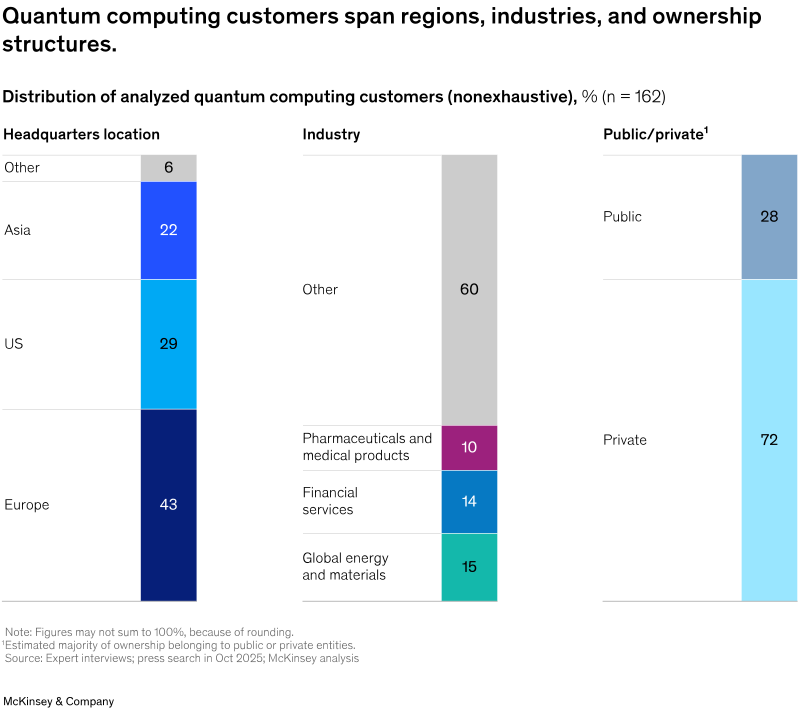
Our research shows that quantum computing has reached a commercial tipping point. Early movers are beginning to map clear paths to generating real enterprise value from their quantum computing efforts. Of the over 300 companies engaging with quantum computing worldwide today, we analyzed 162 of them in detail to get a clearer understanding of industry adoption levels and current use cases. We find that European companies are leading when it comes to advancing quantum computing and that 72 percent of quantum computing use is at companies that are majority-owned by private entities—a shift from just a few years ago when public-sector organizations such as research labs were front-runners in advancing quantum computing projects (Exhibit 2).
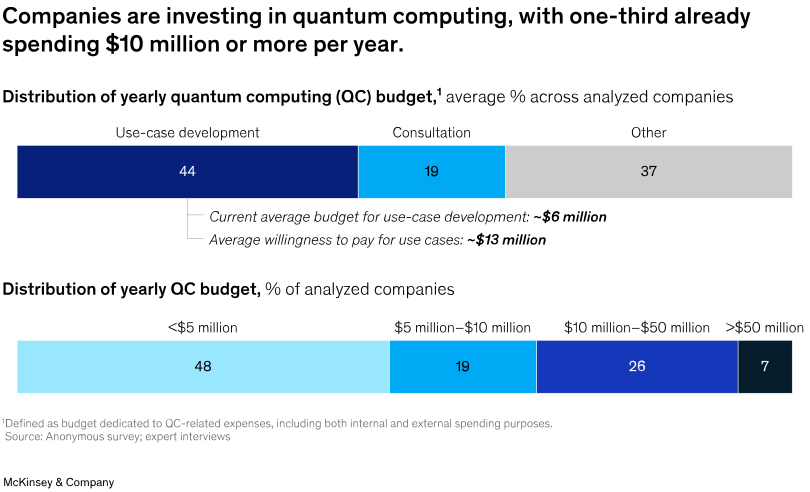
We also analyzed a selection of large global companies to assess their spending on quantum computing. We found that one-third of companies allocated more than $10 million to quantum computing initiatives in 2025, with 7 percent allocating more than $50 million (Exhibit 3). These budgets flowed mostly to use-case and application development, integration with existing tech stacks, and internal capability building—with spending on hardware and operating system development far less prevalent. We find that private companies are more apt to access hosted quantum computing applications through cloud providers, whereas public entities are more apt to purchase on-premise hardware, showing a strong growth trajectory for the quantum-as-a-service market.
Our analysis finds that companies making the fastest progress with quantum computing are those that pair technical experimentation with clear economic hypotheses and defined delivery road maps. JPMorgan Chase, for example, has an internal team of scientists building quantum algorithms and applications to address business use cases in AI, portfolio optimization, and cryptography.1
We also find that quantum computing is taking off in a few key industries:
Chemicals and life sciences: Companies in these innovation-driven sectors are using quantum computing to run vast numbers of simulations at the material and molecular levels. Unlike classical methods, which often rely on testing assumptions, quantum approaches could allow researchers to more directly simulate the underlying physics of molecular interactions. Early efforts are focused on improving how companies screen and prioritize candidates—whether drug compounds or advanced materials—so that experimentation is faster, more targeted, and less costly.
Travel, transport, and logistics: Companies in these essential sectors are adopting quantum computing to optimize processes and supply chains, using combinatorial calculations to find new ways to boost efficiency. The most traction is emerging in hybrid setups, where quantum algorithms are used to tackle the hardest subproblems—such as routing constraints or scheduling conflicts—within larger classical systems. Even incremental improvements in these areas could translate into meaningful cost savings or capacity gains, which is why organizations are using quantum computing to optimize high-friction decision points.
Financial services: Companies in this highly secure and regulated sector are using quantum computing to test risk scenarios and strengthen security across established decision flows. Institutions are experimenting with quantum-enhanced models to better capture edge-case risks and to model complex correlations that are difficult to simulate using classical computing techniques alone. In parallel, the looming Q-Day—when quantum computers succeed in factoring exceptionally large numbers to undermine the math that public-key cryptography depends on—is pushing financial firms to reassess their security architectures. In this sector, quantum computing could be both a tool for improved analytics and a catalyst for broader risk transformation.
Investment
Business leaders are not the only ones waking up to the commercial promise of quantum computing; investors are, too. Our research shows that investment in quantum technology start-ups reached $12.6 billion in 2025, 6.3 times higher than in 2024 (Exhibit 4). A full 90 percent of this investment went to quantum computing start-ups—with the remaining 10 percent flowing to the two other quantum technology subsectors: quantum sensing and quantum communication (see sidebar “What is quantum technology?”). In addition, 2025 also saw several profitable exits for quantum computing start-ups, including IonQ’s $1.1 billion acquisition of Oxford Ionics and Xanadu’s announcement of a public listing via a special purpose acquisition company (SPAC).2 These deals illustrate the growing maturity of the market.
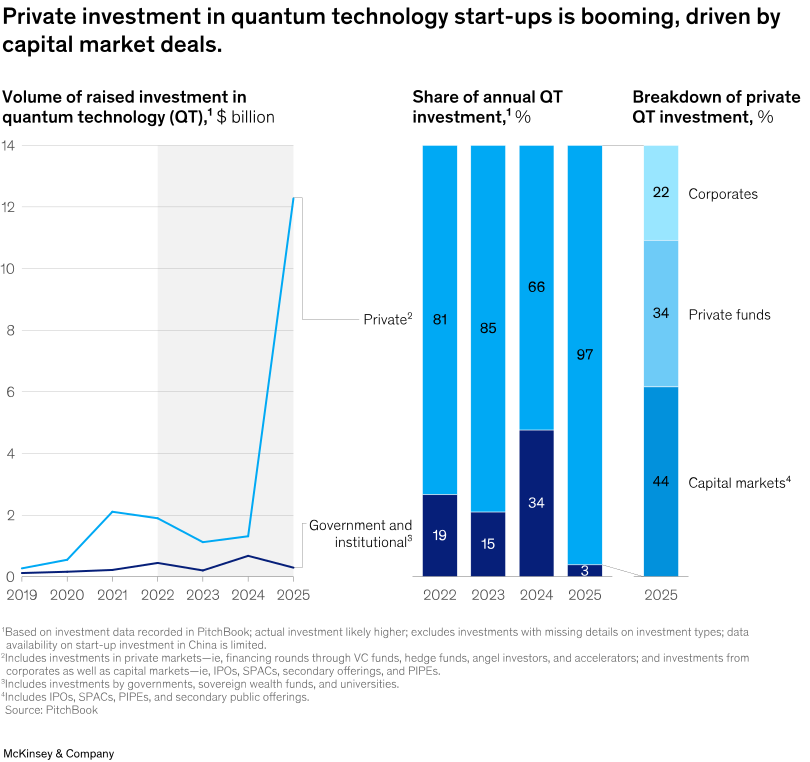
A marked change from 2025 is the shift from public to private investment. In 2024, one-third of investment in quantum technology start-ups came from public sources—governments, sovereign wealth funds, and universities. In 2025, just 3 percent did.
Our research shows that much of the investment capital flowed into a few top companies, with roughly 60 percent of the total 2025 investment concentrated in the top ten deals. These megadeals show that, for investors, the cost of investing in new or scaling quantum start-ups is rising. Valuations are climbing; talent and progress are concentrating among a few highly capitalized leaders; and the hardware and infrastructure required to build new quantum products are increasingly harder and more expensive to secure.
Mergers and acquisition activity also accelerated in 2025, with several high-profile quantum technology deals illustrating clear signs that the market is maturing and consolidating. Publicly listed quantum computing company IonQ, which builds trapped-ion quantum hardware and provides access to its systems via cloud platforms, went on an acquisition spree, for example. In 2025, IonQ acquired Capella Space, Lightsynq, Oxford Ionics, Qubitekk, and Vector Atomic, while also securing a majority stake in ID Quantique. And its proposed acquisition of SkyWater Technology is expected to close in 2026.3

The Rise of Quantum Computing
Quantum technology market
The quantum technology market is beginning to evolve from a research ecosystem into something closer to a scalable technology stack. One way to see that shift is through what we call the “internal quantum market”—that is, the market for the technology itself, including hardware, software, and services—distinct from the much larger economic value quantum could create across industries. On that basis, the internal market is projected to reach $60 billion to $100 billion worldwide by 2035, with quantum computing accounting for $43 billion to $71 billion. (Last year, we predicted that quantum computing would account for $28 billion to $72 billion of the internal quantum market by 2035, but we have revised the lower estimate upwards after seeing a big shift in companies willing to spend on quantum computing.)
The more important change, however, is not the size of the internal quantum market but how its structure is maturing. A few years ago, most commercial activity in quantum computing consisted of bespoke pilots, research collaborations, and one-off demonstrations. Today, the market is starting to organize into products that can be built, sold, and scaled. Hardware providers such as IBM, IonQ, and Quantinuum are increasingly offering access to their systems through cloud platforms rather than only through direct partnerships. Software companies including Classiq and Zapata Quantum are developing compilers, orchestration tools, and vertical applications that make quantum systems usable within existing enterprise environments. And leading quantum service providers such as Amazon Web Services and Microsoft Azure are beginning to package these capabilities into cloud-based offerings that can be deployed repeatedly rather than rebuilt from scratch each time. Together, these developments are creating a viable quantum-as-a-service market, where companies can test and run applications without owning costly hardware or software.
As the stack becomes more standardized, companies can begin to embed quantum into real workflows—typically as part of a broader computing environment rather than a stand-alone system. We are also seeing a strong move toward repeatability; once a company deploys one quantum computing application, it can more easily adapt and redeploy the application across similar problem sets.
In 2025, quantum technology companies made notable technical progress. Road maps from leading providers are becoming more detailed and more aligned, giving customers a clearer sense of when products may become available that could solve their particular use cases. For example, IBM has outlined a path to fault tolerance by the end of the decade, while companies such as IonQ, IQM, and QuEra have published similarly ambitious timelines.4 These road maps should be taken at face value, but they are changing how companies approach early quantum computing use cases. They are shifting conversations from whether quantum computing will work, to when and how it can be integrated into existing systems.
Technology maturity
Quantum computing is maturing in ways that are starting to enable commercialization. For much of the past decade, the key question was whether quantum systems could perform meaningful computations outside of controlled experiments. Our research shows that the main question is now more of a practical one: Can these systems be scaled, integrated, and operated reliably enough to deliver value in real-world settings?
At the same time, the nature of the technical challenge is changing. The limiting factors are no longer only about qubit availability or performance, as most large players have road maps showing huge upcoming expansion in qubit capacity. Increasingly, they are about the broader systems required to scale quantum machines: lasers, cryogenic infrastructure, control electronics, and manufacturing processes. These are the kinds of constraints that typically emerge as a technology moves from the lab to industry. They are also harder to solve quickly, because they depend on supply chains, engineering, and capital investment rather than purely scientific breakthroughs.
Against the backdrop of these scaling bottlenecks, there is also a lack of visibility from quantum computing companies on the surety of their road maps. Projections from leading quantum computing companies span a wide range—from hundreds to hundreds of thousands of logical qubits within the next several years. Timelines for achieving fault tolerance also remain uncertain and subject to change. As a result, the near- to medium-term return on investment for quantum computing remains difficult to quantify, with most applications still in experimental or hybrid phases. Even so, the early use cases, technical progress, and ecosystem investment we have covered in this article reinforce the long-term promise of quantum computing.
The most credible path to near-term value remains hybrid. Rather than replacing classical computing, quantum systems are being integrated into existing high-performance computing and AI environments. In this model, classical systems handle the bulk of computation; AI supports learning and orchestration; and quantum is applied selectively to the most complex parts of a problem. The hybrid approach is already being tested in operational settings and could provide a practical bridge between today’s limited quantum systems and future, more powerful machines (Exhibit 5).
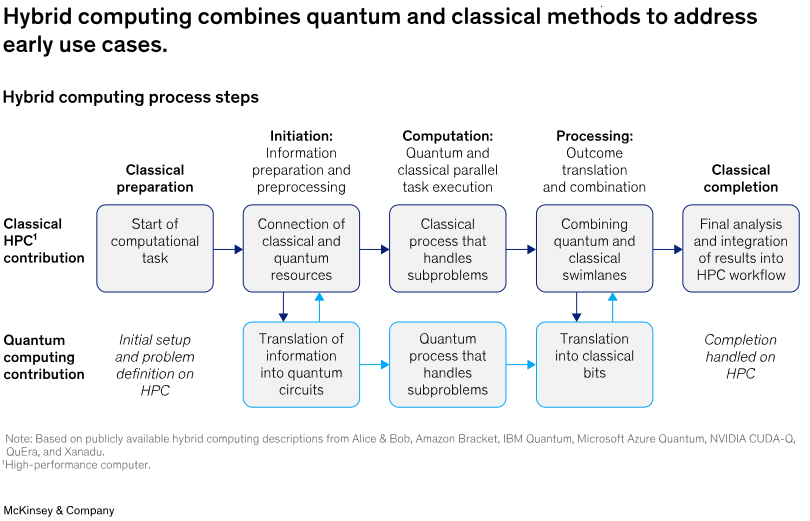
Hybrid solutions will require a wide talent base that spans classical and quantum computing. That means demand is growing not just for physicists but for engineers, software developers, and business experts who can translate quantum capabilities into business applications.
Governments are responding to the demand by launching education and workforce programs. In India, for example, more than 55,000 university students have enrolled in a quantum computing course as part of a broader push to build national capability.5 That kind of investment reflects a broader shift: Commercialization will depend as much on people and systems as on the underlying technology itself.
Next steps for business leaders
Quantum computing is still an emerging technology. But it is no longer one that business leaders can afford to ignore. The risk of not acting now to begin piloting quantum computing projects is significant. With rapid advances in performance, quantum computing is at a tipping point where it could soon outperform classical systems by orders of magnitude—making pilots today critical for companies that don’t want to fall behind.
The companies making the most progress today are treating quantum as a capability to be built, not a breakthrough to wait for. They are prioritizing use cases where quantum can deliver incremental value today—particularly hybrid applications in areas such as simulation, optimization, and risk—rather than focusing solely on long-term, noncommercial research efforts. Getting in early could enable first movers to shape the industry, capture intellectual property, and set critical standards. But moving fast must be accompanied by a clear strategy: assessing exposure to quantum-related risks, identifying use cases where quantum could create near- to medium-term value, and building a road map tied to both.
Execution matters. Companies will need to move beyond pilots and build production-grade pathways that include data readiness, integration with existing systems, governance, and partnerships with technology providers. The goal is not to scale immediately but to ensure that early experiments can be translated into repeatable deployments as the technology matures.
There is also a timing element. As capital concentrates, technical road maps advance and the ecosystem begins to consolidate. That means the cost of inaction is likely to rise. Companies that delay their adoption of quantum computing may find themselves competing for scarce talent, limited partnerships, and maturing platforms—often at a higher cost of entry.
Business leaders may thus want to shift from early exploration toward scaled value capture within key domains. For instance, they could opt for co-development with leading quantum computing players or adopt early applications through quantum-as-a-service offerings. Experimenting now will not only create early value but also enable companies to build internal capabilities, creating a backbone for future growth. Developing talent, infrastructure, and know-how can provide a long-term competitive advantage.
The quantum computing market remains nascent. But companies that move now to build capabilities and test real use cases could define the industry’s future. These first movers will also be well positioned to access the up to $2.7 trillion in economic value that could emerge across industries in the next decade.
For the complete set of insights and data, download the full 2026 Quantum Technology Monitor.