


The accelerating drumbeat of headlines heralding advances in AI is increasingly accompanied by a look at the broader impact of technology, particularly on the environment. For example, the data centers at the heart of the AI revolution require a steady supply of power along with millions of gallons of water a day to cool servers. Multiply that by the dramatic expansion of data centers planned over the next several years, and the massive challenge that lies ahead starts to come into view.
Ironically, the same digital technologies that could increase resource demand also have the potential to reduce energy consumption. Used alongside existing classical infrastructure, quantum technologies could make certain simulations and optimizations far more efficient, although their overall impact on power use will depend on how and where they are deployed.
With the timeline for quantum hardware continuing to accelerate—recently published road maps suggest early, application-relevant systems emerging as soon as 20281—quantum players, enterprise end users, and investors should ensure they consider its impact on energy consumption. Here’s what they need to know.
Tech is a major contributor to climbing electricity usage
A look at trends over the past 15 years highlights the sharp, accelerating uptick in usage that is fueling electricity consumption. Since 2010, the number of internet users around the world has more than doubled, and global internet traffic, especially from mobile broadband, continues to rise rapidly; mobile broadband traffic alone crossed the one-zettabyte threshold in 2023.2 Thanks to this increase, energy consumption by digital technologies rose by about 30 percent from 2007 to 2020 (Exhibit 1). This jump occurred despite major efficiency improvements in chips and data centers—a rebound effect known as Jevons paradox, in which cheaper and more capable computing spurs higher overall demand and energy use.
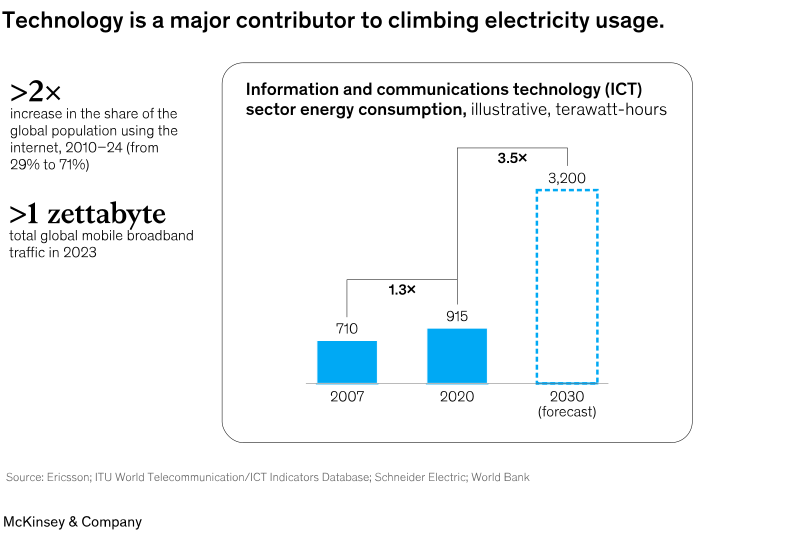
The coming years could see the electricity consumption of information and communications technology triple, fueled by data-heavy traffic, AI, cryptocurrencies, data warehouses, and the continued adoption of cloud services. The electricity demand from data centers alone could double by 2030, and power generation will have trouble keeping up.3 Indeed, 40 percent of existing AI data centers could be energy-constrained by 2027.4
The rise of quantum technologies
Interest and investment in quantum technologies continue to rise—for instance, governments have committed a cumulative $42 billion to quantum projects as of 2024. Advancements in quantum infrastructure and hardware continue to accelerate, which will fuel rising energy consumption. The high energy needs for quantum hardware and software are continuous in daily operations and stem from several sources:
- GPUs that handle parallel processing are crucial for training AI and machine learning applications.
- Extensive cooling in data centers maintains constant and optimal hardware temperatures.
- High-performance servers run complex applications and process large volumes of data.
- Robust networking equipment manages vast amounts of transferred data.
Yet even with these electricity requirements, at the level of a single high-performance system, a large-scale quantum computer could draw far less power than an equivalent classical supercomputer for the same class of problem (Exhibit 2).
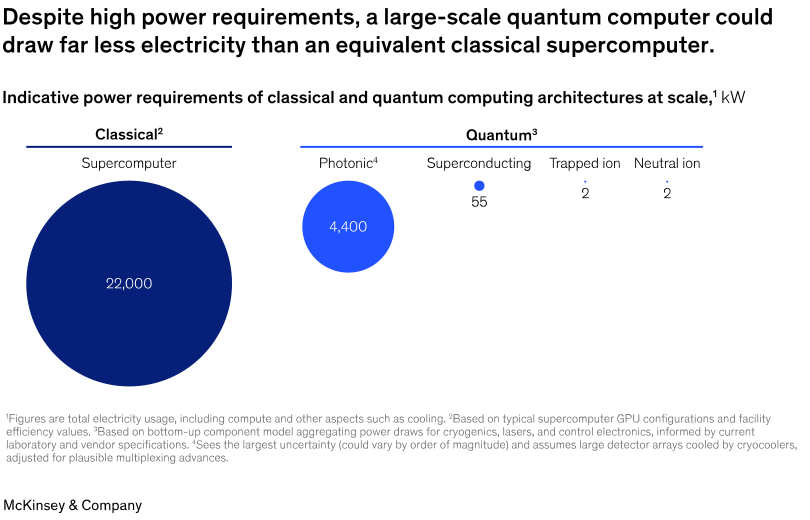
In many architectures, particularly superconducting ones, the bulk of electricity consumption comes not from the quantum processors but from the infrastructure supporting them. These systems operate at millikelvin temperatures, maintained by dilution refrigerators that consume five to ten kilowatts (kW) each, with control and readout electronics adding several more kilowatts to total demand.5 However, alternative approaches show promise to substantially lower electricity consumption. Neutral-atom platforms rely on optical traps and room-temperature environments. A 1,000-qubit system of this kind can reportedly be operated with a total power draw of about ten kW.6
Given the rapid pace of hardware innovation and supporting systems, the energy use of quantum technologies will depend on not only the quantum processors but also the cooling, control electronics, and error correction required. Advances in hardware efficiency, error correction, and algorithms now under active development could enable quantum computing to deliver significant performance gains with a much smaller environmental footprint.7 As quantum systems scale, locating them near abundant, reliable low-carbon electricity with sufficient grid capacity to support round-the-clock operation will become as critical as the hardware itself, mirroring the emerging infrastructure patterns seen with AI data centers.
How quantum technologies could shape electricity demand
Quantum technologies could be a key enabler in tackling climate change. While they will not be a magic bullet, they could make AI far more energy efficient per unit of useful computation—even as overall demand for AI continues to grow—and support the development of solutions in other areas.
Quantum computing
Once deployed at scale, quantum computers could speed up certain computations while using less energy than classical hardware for those workloads, potentially reducing the energy required per AI task even if the total volume of compute continues to rise. For perspective, Meta aimed to operate about 1.3 million GPUs by the end of 2025, highlighting just how concentrated and resource-intensive today’s AI workloads have become.8 Theoretically, a fully fault-tolerant quantum chip could one day rival the output of billions of classical GPUs on certain highly specialized problems such as simulating molecular quantum systems, which classical machines struggle to scale efficiently. In practical terms, that would mean plugging quantum processors into existing facilities as specialized accelerators that take over the most computationally intensive steps in selected AI and simulation workflows.
Quantum computing could also offer use cases for sustainability that were previously out of reach.
- Quantum molecular simulation could significantly improve the accuracy of modeling complex chemical reactions, such as those involved in carbon capture, battery chemistry, and hydrogen catalysis, enabling faster discovery and optimization of such techniques and their side effects. For example, more accurate modeling of the nitrogenase enzyme’s structure and activity could be deployed to develop a green, scalable alternative for ammonia production.
- Combinatorial optimization involves finding solutions to more-complex problems (for example, load balancing in electrical grids for efficient integration of renewables), complementing the physical build-out of batteries and shiftable loads and flexible generation to make better use of available resources.
- Quantum machine learning could enable faster and more scalable analysis of large environmental data sets to improve climate and weather predictions, including hazardous events. This capability would enable earlier and more accurate interventions, reducing associated damage.
Many current superconducting systems require extreme cooling to be operational, which is highly energy inefficient.9 For quantum computers to operate with a minimal carbon footprint, they will require energy-efficient algorithms, optimized data centers (such as advanced cooling and dynamic power management), and low-carbon electricity supply.
Recent progress in quantum computing has been encouraging. Still, advancements in the next several years would be needed to achieve the performance and ease of implementation to support the widespread application of quantum computing and capture these ecological benefits.
Quantum sensing
Quantum sensors have the potential to offer more accurate, scalable environmental monitoring, far surpassing the limits of current technologies. These sensors could provide a number of advantages, such as greater accuracy, higher sensitivity, and the ability to measure new territory (for example, within biological cells or in geographic regions without GPS).
The good news is that organizations are already exploring the deployment of quantum sensors in a range of climate tech use cases. For instance, they can rapidly detect hydrogen gas leaks, preventing potential hazards. BP led the HYDRI consortium, which developed quantum-based hydrogen sensors to enhance the safety of hydrogen gas.10 Similarly, the University of Birmingham and the British Geological Survey have explored the use of quantum sensors to monitor groundwater levels, aquifer health, and peatland regeneration.11 The European Space Agency has used cold-atom quantum gravimeters to infer ice sheet dynamics over Iceland from ultraprecise gravity measurements.12
In addition, the deployment of quantum gravity sensors to monitor CO₂ movement in carbon capture and storage sites is being explored. A UK-led study used cold-atom gradiometers to model near-surface plumes, showing promise for detecting leaks with high sensitivity and low drift.13
These examples are emblematic of the promising developments in quantum sensors that could pave the way for broader, enduring impact.
Quantum communications
Cryptocurrency is energy-intensive, but its growing popularity has caused its adoption and activity to soar in recent years. Consider that Bitcoin’s total trading volume reached $9.1 trillion in March 2024, and its total annualized energy consumption is forecast to be 183 terawatt-hours.14
Quantum cryptography could drastically reduce the electricity demand associated with cryptocurrency mining, which requires extensive parallel hardware and high energy input. By using superposition to probe multiple states simultaneously, quantum systems offer computational shortcuts that consume far less electricity.
This year, researchers demonstrated a prototype blockchain that uses a new approach, “proof of quantum work.”15 Instead of relying on large numbers of conventional mining machines, which consume substantial amounts of electricity, this method employs quantum processors to complete the computational steps needed to validate transactions. If scaled, it offers a pathway to reduce the environmental impact of digital asset infrastructure while maintaining security standards. In addition, Toshiba Europe successfully transmitted quantum-secure communications over 250 kilometers of live telecom fiber using components that operate at room temperature.16 This approach eliminates the need for energy-intensive cooling, making it easier and more efficient to deploy quantum-secure networks on existing infrastructure.
As noted, the coming years could see progress on a number of related fronts. Investments in AI and data centers are forecast to significantly increase electricity use, which is already raising concerns about supply and connectivity capacity. At the same time, advances could make quantum technologies less energy-intensive, with even high-demand superconducting systems projected to require less power than classical supercomputers. And quantum applications could directly enhance sustainability across sectors.
The intersection of these parallel tracks has the potential to bend the energy consumption curve. Notably, quantum technologies won’t solve climate challenges on their own, but they could help reduce the energy use of digital technologies while unlocking new climate solutions. Their impact will hinge on design (such as advances in cooling and error correction) and siting (the potential of renewable energy sources to power data centers).
So, what actions can stakeholders take now? Given the accelerated development timeline for quantum technologies, companies could integrate future quantum energy demands into procurement and infrastructure plans. The projected growth of quantum technologies—$97 billion in global revenues by 2035—means investors would do well to incorporate this lens into portfolio company road maps. And because the cloud will be the primary access point for quantum technologies in the long term for most industry players, security and data sovereignty issues will become a higher priority.
Companies could get ahead of these issues by assessing the location of providers and their controls and governance related to data.17 Careful consideration of potential implications can ensure that all players are well prepared to fully harness quantum technologies.
Henning Soller is a partner in McKinsey’s Frankfurt office, Jess Fleming is a data scientist in the London office, and Martina Gschwendtner is a consultant in the Munich office.
The authors wish to thank Duc Nam Nguyen, Victor Kermans, and Waldemar Svejstrup for their contributions to this blog post.
1 Sophia Chen, “IBM aims to build the world’s first large-scale, error-corrected quantum computer by 2028,” MIT Technology Review, June 10, 2025; Miranda Davis, Daniela Sirtori, and Isabella Ward, “Chicago’s $1 billion quantum computer set to go live in 2028,” Bloomberg, July 21, 2025.
2 “Two-thirds of the world’s population uses the Internet, but 2.7 billion people remain offline,” ITU, 2022.
3 “AI is set to drive surging electricity demand from data centres while offering the potential to transform how the energy sector works,” IEA, April 10, 2025.
4 “Gartner predicts power shortages will restrict 40% of AI data centers by 2027,” Gartner, November 12, 2025.
5 “Dilution refrigerator: Everything you need to know [2025],” SpinQ, May 30, 2025.
6 “Quantum computing to greener calculation,” Pasqal, October 5, 2023.
7 Marco Fellous-Asiani et al., “Optimizing resource efficiencies for scalable full-stack quantum computers,” arXiv, updated October 16, 2023.
8 Jaspreet Singh, “Meta to spend up to $65 billion this year to power AI goals, Zuckerberg says,” Reuters, January 24, 2025.
9 Q Blog, “Could quantum computing help curb AI’s carbon footprint?,” blog entry by Gabriella Skoff, Project Q University of Sydney, June 21, 2019.
10 “HYDRI-HYDrogen sensor for Industry,” UK Research and Innovation, updated on January 8, 2026.
11 “Researchers awarded funding to use quantum sensor technology for environmental applications,” University of Birmingham, March 20, 2023.
12 “New campaign dataset for Airborne Quantum Gravimetry,” European Space Agency, July 16, 2024.
13 “Feasibility study into quantum technology-based gravity sensing for carbon dioxide capture and storage,” UKCCSRC, March 2022.
14 As of February 17, 2026. Nasdaq and CoinDesk data; Ibrahim Ajibade, “Crypto market Q1 2024 round-up: Trading volume hits $9.1 trillion as despite market dip,” Nasdaq, April 5, 2024; “Bitcoin network power demand,” Cambridge Electricity Consumption Index, accessed February 17, 2026.
15 Mohammad H. Amin et al., “Blockchain with proof of quantum work,” arXiv, updated on February 9, 2026.
16 “Toshiba breakthrough brings quantum communications to existing national-scale telecommunications infrastructure,” Toshiba, April 24, 2025.
17 Justin Coupel and Tasnuva Farheen, “Security vulnerability in quantum cloud systems: A survey on emerging threats,” arXiv, April 27, 2025.