



A humanoid robot walks the aisles of a grocery store, filling a basket with a variety of items. As a personal shopper, it chooses products based on a buyer’s preferences and makes on-the-fly purchase decisions if items are out of stock or on sale. It deftly navigates, avoiding people and carts. All the while, it communicates in real time with the buyer and collaboratively learns from hundreds of similar robots shopping in stores across the city.
This robot does not yet exist. But over the next decade, advances in robotics, AI, and quantum technologies could bring something like this remarkably close to reality.
Much of the excitement surrounding AI has focused on digital systems that can write, code, analyze, and converse. The next frontier is physical AI—machines capable of perceiving, reasoning, and acting in the real world. Yet the path to truly autonomous multipurpose robots remains constrained by computational limitations, a lack of high-performance sensory input methods, and safety concerns. Quantum technology could help alleviate these bottlenecks, creating a new category of machine: quantum-enabled robots, or qubots. These are robots enhanced by at least one quantum technology to become more capable than robots today.
How exactly might quantum technology enhance robotics? The three underlying quantum sectors—quantum sensing, quantum communication, and quantum computing—could help robots overcome limitations in perception, navigation, and decision-making. In the near term, quantum sensing is likely to have the greatest impact by improving navigation and calibration, while quantum communications could improve secure data transfers between robots and interconnected systems. Quantum computing could eventually enhance robot learning through increased computing capacity and synthetic data. On-bot quantum computer integration will not happen in the foreseeable future, but advances could come from near-bot or cloud-based quantum solutions that accelerate the simulation-training-deployment loop.
The next frontier of AI is physical
For decades, advances in computing expanded the problems that software could solve, and now AI is transforming how knowledge work is performed. But AI’s advances have so far largely been confined to the digital world. Physical AI represents a different ambition. Rather than generating text or analyzing data, physical AI seeks to create smart robots that can understand and interact with the physical environment. Physical AI requires intelligence that operates under real-world constraints.
Among the many possibilities for physical AI, humanoids, a class of multipurpose robots that move like people, have emerged as a promising potential form factor. Warehouses, hospitals, retail stores, offices, staircases, tools, and vehicles were all built around human movements. Machines capable of operating in those environments could create immense value—and quantum technology could make this happen more quickly.
For instance, quantum computing could improve the simulation-training-deployment loop. That’s because, unlike classical computing chips that process information in a linear way, quantum chips leverage the principles of quantum mechanics to explore many potential solutions in parallel to solve complex tasks faster than even the most powerful supercomputers. This potential is why we predict that quantum computing alone could create up to $2.7 trillion of economic value worldwide by 2035. Qubots, while still in development, could deliver billions of this value.
Improving computational capacity is only part of the equation. To operate effectively in the real world, a robot must continuously process information from cameras, microphones, sensors, and other inputs. It must interpret that information and make decisions in real time. It must continually assess its surroundings to move safely through unpredictable environments. It must coordinate with cloud infrastructure, enterprise software, and fleets of other robots. It must interpret AI outputs and be trained on vast quantities of synthetic and real data. In other words, next-generation robots will require huge amounts of sensing, communication, and computational processing power—which quantum technology could provide.
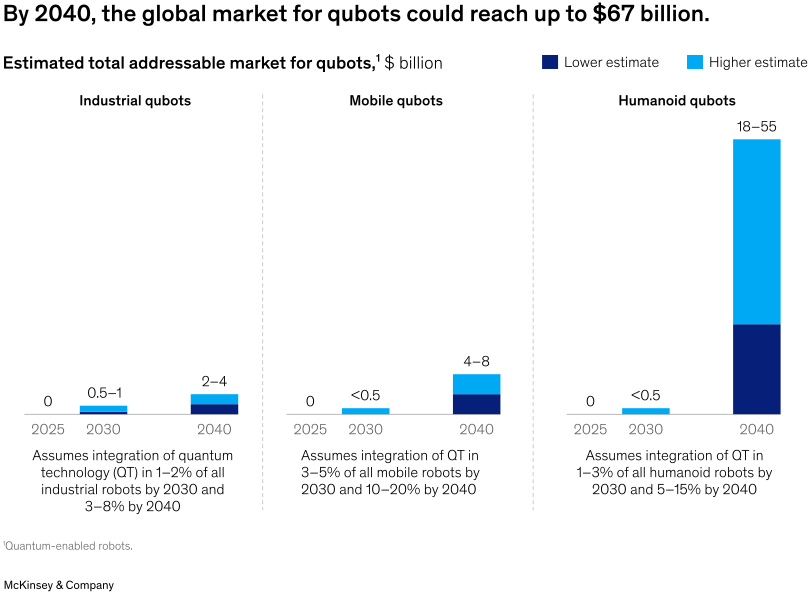
Qubots remain a long-term prospect, but our analysis finds that they could represent a $24 billion to $67 billion global industry by 2040. Qubots that harness quantum computing primarily from near-bot and cloud computing platforms will come first, while qubots with on-bot quantum networking and sensing will arrive several years later. Humanoid qubots are still in the piloting stages, but we predict that humanoids integrating at least one quantum technology solution will represent between 5 and 15 percent of all humanoid robots by 2040 (Exhibit 1).
Quantum sensing: Enhancing perception and dexterity
Among the three quantum technology domains, quantum sensing may have the most near-term impact on multipurpose robot development. Physical AI depends on the ability of machines to accurately perceive and interpret the surrounding environment. Improvements in sensing could therefore have a disproportionate impact on robot performance (Exhibit 2).
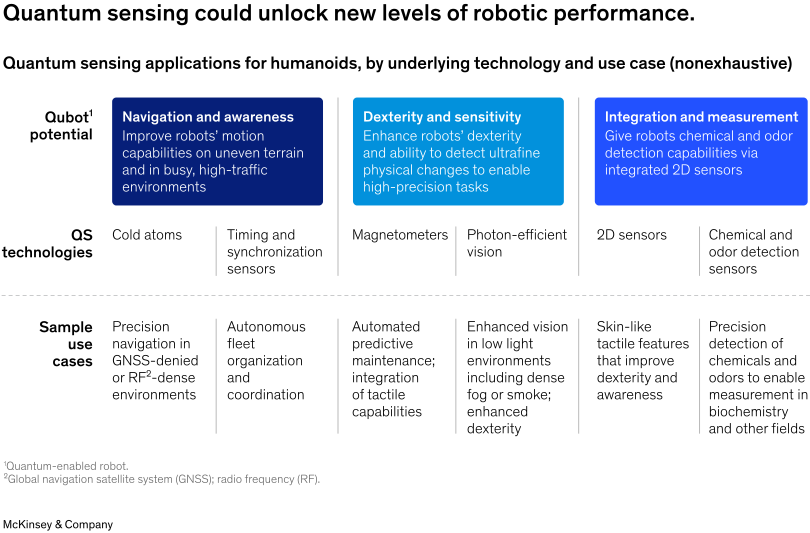
Several quantum sensing technologies have the potential to accelerate qubot development. Cold-atom systems, which use atoms cooled to extremely low temperatures for precision sensing, could enable highly accurate navigation—even in environments where GPS is not available, such as mines, tunnels, and underground facilities. Quantum timing technologies may improve synchronization across robotic fleets and strengthen navigation capabilities. Diamond-based quantum magnetometers, which are ultrasensitive quantum sensors that measure extremely small magnetic fields with high precision, could be used to support predictive maintenance and advanced tactile sensing. Meanwhile, photon-efficient quantum imaging systems may improve robot performance in low-light, foggy, or smoky environments. Further afield, emerging sensor architectures based on advanced materials could eventually enable robotic skin capable of detecting pressure, texture, temperature, and chemical compositions.
Quantum communication: Enabling trusted robotic ecosystems
Physical AI systems are unlikely to operate as isolated devices. Instead, they will form part of larger ecosystems that include cloud infrastructure, enterprise software, autonomous vehicles, sensors, and other robotic systems. In such environments, the ability to exchange information securely and reliably becomes a prerequisite for effective operation, making quantum communication critical.
Quantum communication has the potential to strengthen both robotic security and coordination. Near-term approaches such as postquantum cryptography—which uses algorithms to ward off attacks from both classical and quantum computers—could help protect robotic systems against cyberthreats. Meanwhile, quantum key distribution, which uses the principles of quantum mechanics to detect any eavesdropping attempt during key exchange, could soon provide additional safeguards for highly sensitive communications. The longer-term opportunity extends beyond cybersecurity to authenticating robot identities and synchronizing robot fleets.
Quantum computing: Powering the physical AI intelligence layer
The most transformative impact of quantum technology on robotics may emerge not from improving individual robot capabilities but from accelerating the life cycle through which physical AI systems learn and improve. Unlike traditional software, physical AI depends on a continuous cycle of simulation, training, deployment, observation, and refinement. Developers first generate synthetic environments and training data, then build and train AI models capable of operating within those environments. Those models are deployed into robots—in this case, qubots—that perform real-world tasks and generate new operational data. Insights from those experiences are then incorporated into future model development, creating a continuous learning loop (Exhibit 3).
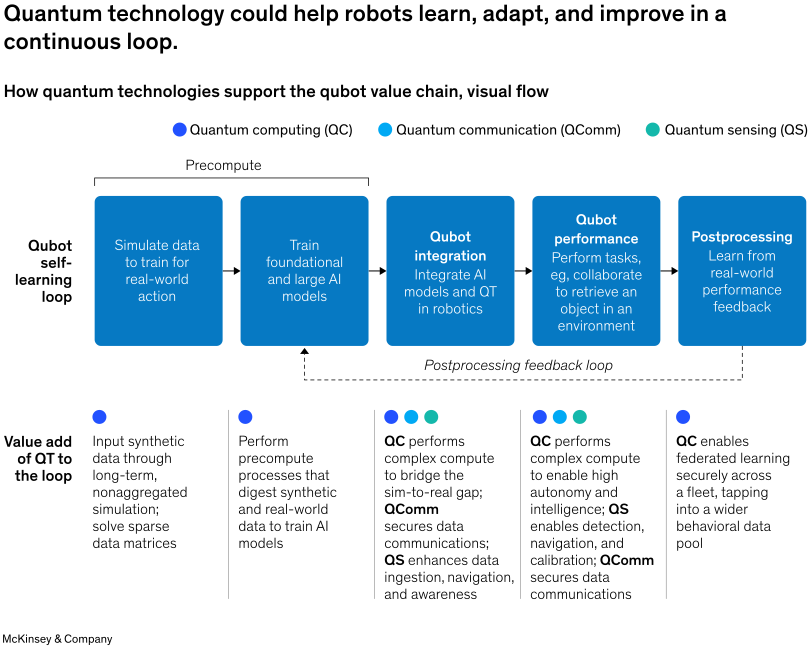
Quantum technology has the potential to contribute to multiple stages of this process. Quantum computing may improve simulation fidelity and speed up synthetic data generation. Quantum sensing may increase the quality of robots’ real-world observations through better navigation, calibration, and spatial awareness. Quantum communication may enable secure sharing of information across fleets, supporting collaborative learning and federated AI architectures.
Viewed together, these technologies create the possibility of a self-reinforcing feedback loop in which robots learn faster, adapt more effectively, and continuously improve their performance. The long-term significance of qubots may therefore lie in how quantum technologies accelerate learning in AI systems.
The qubot timeline
Over the next three years, the robotics industry is likely to remain focused on producing multipurpose robots, with few of these robots available commercially at scale. During this same period, quantum technology is expected to continue maturing, with hybrid quantum-classical approaches expected to advance significantly within the next three years.
Within five years, improvements in battery technology, dexterity, and AI capabilities could make humanoids increasingly viable for select use cases. At the same time, quantum sensing technologies and early quantum computing use cases are expected to become more commercially available. This is when we may see some of the first qubots come to market.
Looking ten years out and beyond, qubot humanoids could become commercially viable across a broad range of applications. Beyond that horizon, the convergence of AI and quantum computing could support increasingly sophisticated forms of embodied intelligence, with tomorrow’s multipurpose robots exhibiting far greater autonomy, reasoning capabilities, and environmental awareness than today’s systems. In other words, physical AI could become the norm.
For business leaders, the immediate priority is identifying where advances in physical AI could create future competitive advantage. Organizations should begin evaluating workflows that remain difficult to automate, assessing where a robot with keen perception and autonomy could unlock value. They can build familiarity with emerging robotics capabilities through targeted pilots and proofs of concept.
For robotics leaders, the challenge is rethinking hardware. The next generation of performance improvements will come from AI, sensing, and computational infrastructure, rather than mechanical engineering and software alone. Companies can evaluate where quantum technologies could address existing bottlenecks in simulation, training, navigation, calibration, perception, or security. More important, they can begin building partnerships with quantum computing providers—both hardware makers and quantum-as-a-service companies.
For quantum technology providers, robotics represents a potentially valuable future market. Early collaboration with robotics companies can help identify practical applications, guide research priorities, and establish positions in what remains a largely open competitive landscape.
For investors, the convergence of robotics and quantum technologies offers exposure to two high-growth markets simultaneously while creating opportunities at their intersection.
Although a mature qubot market may remain more than a decade away, the decisions that shape the industry are being made now. Leaders in many sectors—from manufacturing and logistics to healthcare, insurance, defense, energy, construction, agriculture, and retail—should start thinking today about where qubots could create competitive advantage tomorrow.
Ani Kelkar is a partner in McKinsey’s Boston office, Henning Soller is a partner in the Frankfurt office, Martina Gschwendtner is an associate partner in the Munich office, and Victor Kermans is a consultant in the Brussels office.
The authors wish to thank Ahsan Saeed and Christian Jansen for their contributions to this blog post.