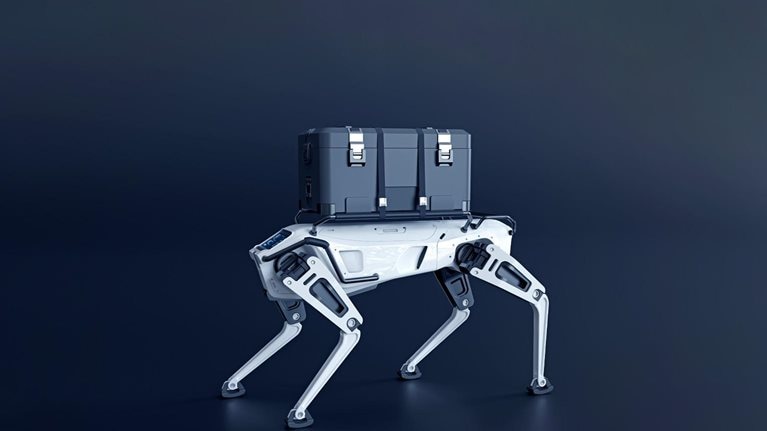
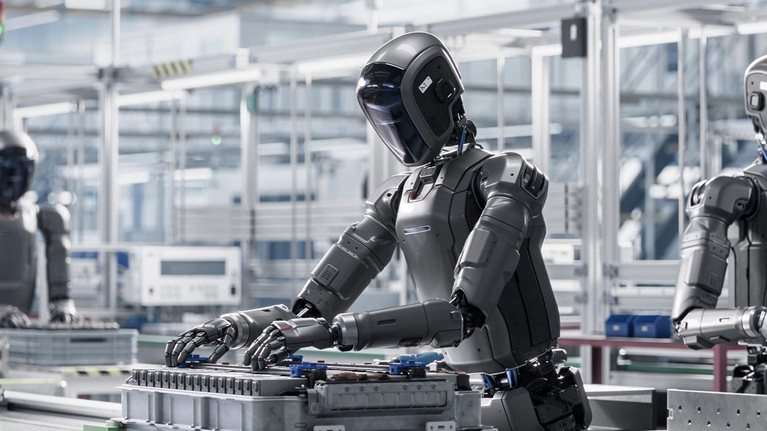
As robots become more capable of perceiving, learning, and adapting, they could become as commonplace in daily life as software is today. In five videos, McKinsey partners explore the technological advances, economic forces, and workforce shifts that are transforming robots from tools to teammates. The following is an edited transcript of the conversations.
When robots start thinking
Ani Kelkar: Between now and 2040, I certainly expect robotics and physical AI to create at least a trillion dollars in economic value, most of that in manufacturing and logistics. That will happen not through worker replacement and productivity but through our ability to innovate what products we make, how we make them, and what tasks humans perform versus which ones are automated, elevating the nature of work for humans to more problem-solving and to sort of a catcher role, rather than just relying on our physical dexterity.
Zina Cole: The big difference between what we looked at 40 years ago and what we will look at in 2040 is the ability of a robot to think and make decisions in very unstructured and unpredictable environments.
Christian Jansen: Let me paint an optimistic view of 2040 and the role of robotics in the workplace. By 2040, robotics will have evolved from task-specific automation solutions to task-agnostic ones. We will see robots with the ability to change tasks within hours by merely watching others doing it, seeing it more as team sport. The robot will watch the human worker doing the task and adapt in real time.
Ani Kelkar: The more time I’ve spent in robotics, the more I’ve come to appreciate how skillful and cool humans are. We do things that are extremely hard to describe. There are edge cases that we problem-solve on the fly. There aren’t necessarily job instructions for every single thing we do. I think one of the key things that has shaped my view of robotics is having a system that can adapt to the context that it’s deployed in. You’re never going to perfectly predict what happens in the environment, or what the robot needs to do. So how can the robot have enough perception and cognitive capability to adapt to that context?
Zina Cole: My dream is that in 2040, or somewhere around that, I’ll be able to call a company and say, “Look, I want a machine that does A, B, C, D, E, F, G for me. I want it to look like this, and I want it to cost more or less like that,” and then I will get that machine [sent] back to me. I don’t think it will happen by 2040, to be honest, because that’s a bit of a stretch. But my dream is that we will have sort of a LEGO system where you can combine the tasks, cost point, and form factor you like.
The robotics cost curve
Zina Cole: Where we can get stuck is this point: “Can I afford a robot that is safe and intelligent enough to be helpful?” I think this is the point to focus on when we’re investing in innovation. A robot has to be helpful for a scalable use case or a task platform for it to be good enough.
Christian Jansen: Humanoid robots currently cost six figures in terms of bills of materials. This needs to come down tremendously—by at least five times the current level, probably ten times, to see broad scale adoption.
Ani Kelkar: When we were looking at large transformation projects, for every dollar that was spent in buying a robot, five dollars were spent in designing the safety systems and the infrastructure around them. That equation is changing now through AI, better programmability, and the better semantic understanding that robots now have. These factors make the economics around adoption a lot better.
Zina Cole: Industrial settings actually have much more potential for automation than households, where the work would involve, for example, folding laundry or other home tasks. Why? It’s very simple. If you look at the scale and number of the warehousing facilities and manufacturing plants, and you compare that with the number of people who would be happy to see machinery doing laundry or folding it at the right cost point, and who could actually afford that, it is significantly lower than the industrial opportunity.
Christian Jansen: We will see completely new value creation models. Today, robotics are bought as a capital expenditure investment. You install robotics in a plant; you produce with robots in a plant; and you depreciate them. Maybe there will be future with as-a-service models, where robots will be leased, and you will essentially pay a robotic wage. There might even be a whole new asset class of companies that will own robots and put them in your company for you.
Zina Cole: We need to think of the optimal compute architecture that would be helpful in allowing a task to be performed while also providing cost efficiency. This is an expensive piece of intelligence; it could be on a robot, or somewhere in the building, or on the cloud. How do I distribute those workloads so that it’s optimal for both the task itself and for the cost point? All those things have to come together so that you can perform a task at a cost level that makes sense.
Humans and robots at work
Ani Kelkar: I think robotics and automation will reduce the number of dull, dirty, and dangerous jobs and spur additional economic growth. In 2040, I would imagine across the world a lot more manufacturing and logistics sites adopting robots, all form factors, and it could even pervade into service industries, such as retail and hospitality, and then other fields, such as mining and energy, which have limited automation today.
Christian Jansen: We will see safe collaboration between humans and robots. We will see fenceless operations. Technologies, regulatory standards, and standardization need to be in place to make that happen.
Zina Cole: I think there will be selected deployments where a human and a robot can coexist. We are seeing a lot of advances in the ability of a robot to make correct decisions and safe decisions at the same time. However, it will be a long while until we see actual scale. We believe that most growth will occur between 2035 and 2040, and that it will be disproportionate to what we are seeing today.
Ani Kelkar: Think about technology that feels ubiquitous today, such as Excel. You don’t need to have a computer science or a math PhD to use Excel. It is now a very general tool that everyone uses. I think robotics is going to see a similar shift, from being a specialized domain of experts in mechatronics, AI, and computer vision to being a domain where workers will have a framework to think about what the robot can do and can come up with clever ways of using that robot as a tool or a team member.
The future of robotics: Intelligent, adaptable, and on your team
The emerging robotics ecosystem
Zina Cole: I do believe that at some point there will be machines present at home, which will have families of tasks that they are capable of executing, but they will not necessarily look like a human and ask you, “How are you?” while making you coffee and then going to do your laundry. However, I do believe that there will be more consumer applications, which would be helpful.
Ani Kelkar: I think we will see robots in homes and hospitals, but not in the way that is being imagined today. I don’t expect us to see truly general-purpose butler robots from the Jetson era in homes. I do expect to see robots that are more capable than the robots we have in the home today, which emerged to do a set of narrow tasks, such as vacuuming. But the current robots will pave the path to a longer-term future, where you will see many more general-purpose robots in homes.
Christian Jansen: I think that this will be an industry that develops to a scale similar to automotive—by 2040, an industry size, in dollars, in the triple-digit billions. Automotive, as a reference, is in the single-digit trillions of dollars. Robotics is probably still ten times away, but with a growth rate that’s clearly outperforming. In such an ecosystem, we’re unlikely to see a winner-take-all dynamic but rather a broader set of players will succeed, depending on customer proximity and domain understanding—it really involves cracking these different areas where robotics will see a large uptake.
Ani Kelkar: One other interesting aspect that transforms the industry is that these robots become more capable over time by learning. You have a product whose value creation increases over time. We’ve typically not had that. Almost everything you buy starts depreciating the moment you buy it, whereas the robot just gets better and better and performs more things.
Robotics in the real world
Christian Jansen: Today, we see general purpose robots with uptimes of around two hours. To move from pilots to productive use cases, we will need uptimes around eight to 12 hours—so a typical worker shift. This is enabled by a multitude of potential advances in battery technology, architecture redesigns with swappable batteries, smarter management of energy, and so on. This will be the table stakes for at-scale deployment.
Zina Cole: The debate we have is this: When will robotics be ready? I think views differ on the market. Some of the more provocative views would say that by 2030 all of the warehouses will be full of humanoids doing everything independently. I don’t think so. I think it’s going to take more time for general-purpose robotics to flourish because we need to make sure that all the capabilities are at a level that is safe, helpful, and performed at the right cost.
Ani Kelkar: When you bring robots in that are no longer deterministic and programmed to do the same exact thing but instead are capable of sensing their environment, they will have their own decision-making policies or foundation models that drive decision-making, and then they act in the real world. You must think through: What safety use cases do you want to test that robot with? How do you identify the edge cases? How do you understand the implications when the context changes? How would the robot behave? How would the robot interact with humans that might be in its environment? Those become really key questions for an end user, and they provide a framework for thinking about adopting robotics.
Christian Jansen: Today, robots can perform in a very impressive way, as we all know from the YouTube videos out there, for specifically trained tasks. But to reach dexterity on a level of a human, where they are able to manipulate tools, drawers, pull carts, or whatever is required of them, there’s still a long way to go, and this will require a tech stack evolution.
Zina Cole: If you see hundreds of robots doing backflips or very sophisticated dance moves, it’s very impressive, right? Because if you think of the machinery and dexterity it has, and all the movements, they are really, really exciting. However, then you must think, “Okay, how will I use it?” We’re at the point where we are trying to take all of this technological excitement for both software and the hardware layer and create a learning loop to broaden a number of tasks which a robot can perform, and then apply [those tasks] to something useful.
Ani Kelkar: I think in the future, you’re likely to see robots perform complex assembly tasks, potentially in automotive, or even in creating the servers needed for data centers. You’ll also see use cases in inspection and surveillance that require the robots to locomote in complex unstructured environments. Those would serve as the building blocks that allow us to see robotics create the trillion dollars in economic value that we’re all excited about.