Most business leaders can see that the geopolitical environment is only getting more complicated—and yet many still aren’t fully prepared to weather prolonged shocks. A recent McKinsey geopolitical risk survey of more than 200 senior leaders across industries and geographies bears that out1: Only 15 percent of respondents report having a dedicated geopolitical intelligence unit; roughly one in three say they never use scenario-based analysis to stress-test their readiness; and roughly half of them rarely, if ever, discuss geopolitical risk with their executive boards.
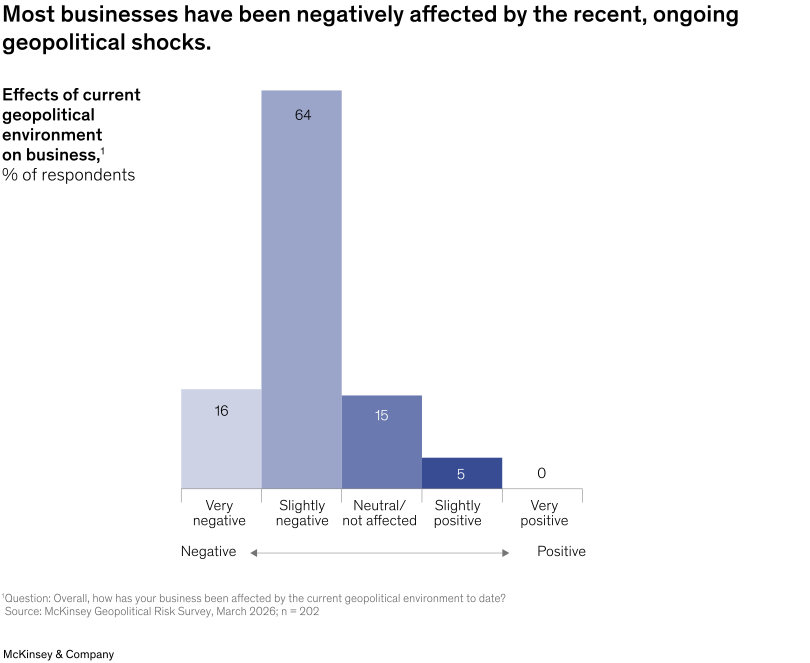
Leaders are under no illusion about the implications of mismanaging geopolitical risks. Eight in ten survey respondents say the current geopolitical environment has had a negative effect on their business (Exhibit 1). Even before geopolitical tensions in the Middle East escalated sharply in late February,2 executives worldwide were already citing geopolitical instability as the top risk to global economic growth. That sentiment spiked further after the escalation, along with heightened anxiety over energy prices and supply chain volatility.
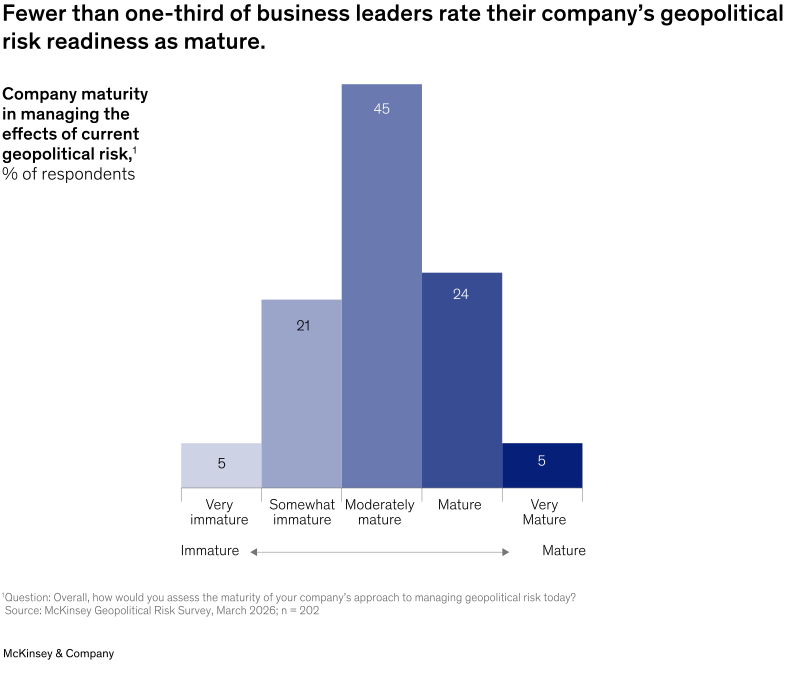
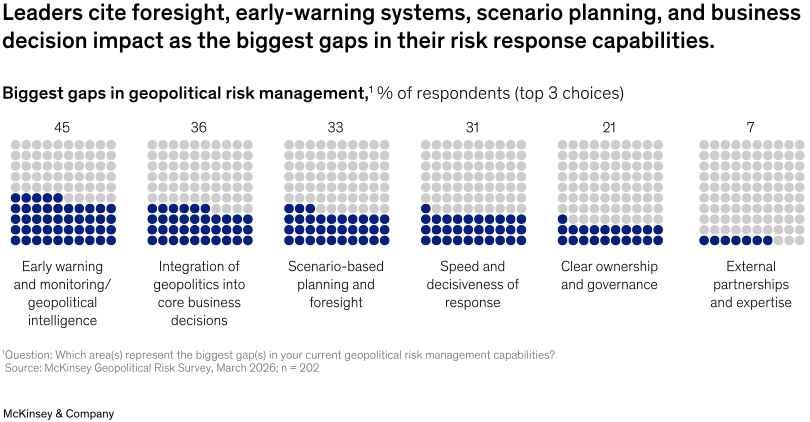
Despite this, risk readiness remains low. Fewer than one-third of respondents consider their geopolitical risk management capabilities mature (Exhibit 2), and just 28 percent rate them as effective at supporting decision-making. Among the most cited capability gaps were the lack of early warning systems and insufficient geopolitical intelligence gathering. Notably, few leaders view their existing risk response capabilities as either “ineffective” or “very effective,” suggesting that few companies are positioned to anticipate shocks or seize the opportunities that may emerge during geopolitical disruptions.
The current moment calls for a different approach—one where CEOs and risk and strategy leaders build the capabilities required to anticipate geopolitical shocks, not just absorb them, and where leaders can seize growth opportunities, not just mitigate against margin loss. Some survey respondents have made this shift, actively positioning geopolitics as a source of competitive advantage while still mitigating risk. Indeed, some companies have redesigned their supply chains to serve new, high-growth trade hubs. Some are evaluating M&A targets that offer a foothold in less volatile markets, and others are actively pursuing industrial subsidies for clean energy and advanced manufacturing.
In this article, we review the findings from our survey and propose five actions that risk strategists and operations leaders can take to retool their operating models and respond more effectively to an increasingly volatile global business environment.
Mounting risks—and lagging preparedness
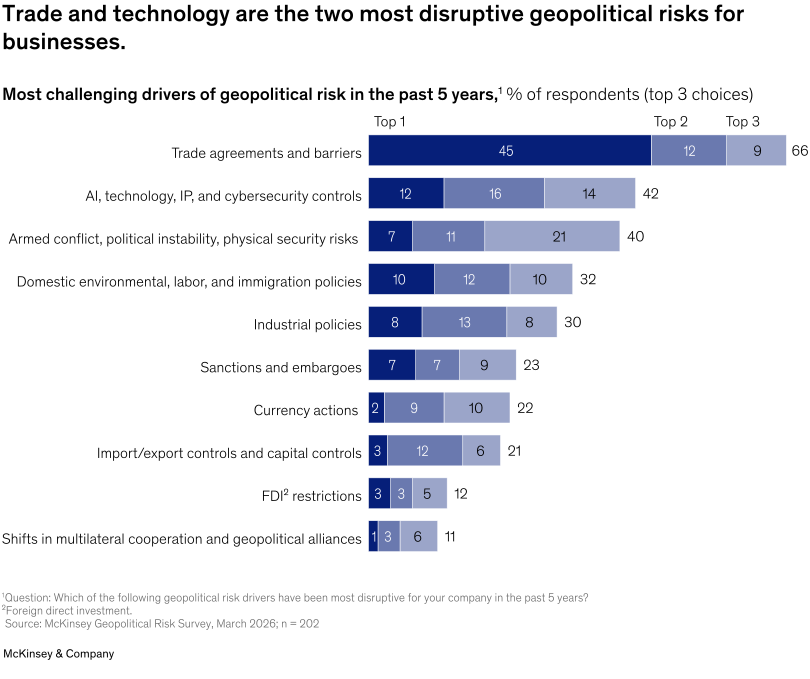
The survey examined ten risk drivers—from trade barriers and industrial policy to AI and cybersecurity controls, sanctions, and armed conflict—drawing on responses from senior leaders in decision-making and decision-influencing roles across a range of industries. Respondents cited trade barriers as the most disruptive force of the past five years, with technology controls rising fast behind (Exhibit 3). Earnings and margins primarily have been affected by these risks, prompting many organizations to begin diversifying their supply chains and reconfiguring their footprints. These actions could pay off in the long term but would not improve a company’s responsiveness to near-term disruptions.
Several insights stand out:
- Trade barriers are directly affecting earnings. Seventy-seven percent of companies most exposed to trade barriers expect current tariff developments to lead to a negative EBITDA, with 17 percent anticipating declines exceeding 11 percent. For most, the hit is moderate—but the impact may linger as tariffs and evolving trade policies become more frequent, variable, and interdependent.3
- Technology controls are rewriting digital strategy. AI, technology, intellectual property, and cybersecurity controls rank second overall as a disruptive force. The risk has broad exposure: 95 percent of affected companies report at least some redirection of technology investment as a result of technology controls. Those actions reflect a broader shift toward segmenting or localizing technology stacks and data architecture in geopolitically sensitive markets.4
- Currency and capital flows are under sustained pressure. Ninety-five percent of respondents report some level of financial exchange impact from currency volatility, and one in four face annualized sovereign and finance exchange risk costs above 2 percent of EBITDA. Separately, 70 percent say government subsidies, tax incentives, or local content requirements have materially redirected planned capital expenditure.
- Sanctions and foreign direct investment restrictions are narrowing market access. Seventy-six percent of respondents report moderate to high impact from foreign investment restrictions and screening regimes, while 80 percent of companies exposed to sanctions report impacts on revenue or assets over the past five years—with one-third affected across 10 to 25 percent of their revenue or asset base.
Awareness of geopolitical exposure has not translated into preparedness for most companies. Few organizations report advanced capabilities and practices for managing geopolitical risk. Governance remains fragmented across functions. Issues are inconsistently elevated to the board, particularly for more complex or fast-moving risks. And many companies lack early-warning systems, scenario-based planning, and other forward-looking capabilities that would help them anticipate and act on geopolitical developments (Exhibit 4).
Five actions that can strengthen risk responsiveness
The data suggests that leaders know they need to actively manage geopolitical risk; the question is, where to start? Our research suggests that closing the gap between risk assessment and responsiveness does not require a complete overhaul but instead requires focused action in five areas.
Acquire geopolitical foresight and early-warning capabilities
Without timely intelligence, risk and strategy leaders can’t make informed decisions that could counter geopolitical disruptions—or capture the opportunities they may create. The companies that are best at geopolitical risk responsiveness pair a structured scenario framework with a small, dedicated team—a “nerve center”— that monitors early signals against those scenarios. They also use a range of foresight-development tools5 to track regulatory filings, sanctions listings, and policy developments in near real time. These include horizon scanning, structured scenario planning, contingency playbooks, simulations, and tabletop exercises. Risk and strategy teams use these tools regularly rather than in one‑off workshops.
In this way, teams can defend their operations effectively but also identify potential opportunities from geopolitical shifts.
A global dairy organization, for instance, used scenario planning to assess how emerging geopolitical trends would affect its various markets and manufacturing facilities. This exercise led its leaders to divest one business unit and reinvest the proceeds in a region that showed strong growth potential across most scenarios, a move that contributed to a 10 percent increase in the company’s share price the following fiscal year. Similarly, DHL established a proprietary “Global Connectedness Tracker” to continually monitor shifting trade policies, sanctions, and broader global developments. The tracker functions as an early-warning system and maps potential exposures for the company.
What scenario planning looks like
Strategic foresight helps leaders make better decisions in uncertain and complex environments by systematically exploring potential future developments and their implications. Organizations commonly employ five foresight instruments—horizon scanning, scenario planning, contingency planning, simulations, and tabletop exercises—to identify risks, test assumptions, and strengthen preparedness.1 The case study below illustrates how scenario planning can be used to help organizations assess geopolitical uncertainty, evaluate potential impacts, and improve decision-making and resilience.
Case study: Strengthening a global infrastructure company’s geopolitical muscle
A global transport and infrastructure operator with an extensive international footprint faced rising exposure to geopolitical dynamics, including supply chain disruptions, energy security, and regulatory fragmentation. Recent global tensions and regional instabilities had heightened the need for timely and actionable insight, and as a critical infrastructure player, the company also needed to strengthen its resilience posture. McKinsey supported the company’s efforts to stand up a dedicated geopolitical risk unit that could give the organization a single, structured view of the landscape and a faster path from signal to decision.
The work was organized around the risk unit’s three core activities and deliverables:
- a daily geopolitical update for internal use, with a defined scope for monitoring priority developments across energy, raw materials, and AI, and a standardized format highlighting key events and business implications
- a biweekly analytical update for external audiences, piloted as a deep dive on the most relevant developments and translated into implications for the transport and infrastructure sector
- a set of geopolitical scenarios to support annual strategic planning, built on a structured approach for identifying prioritized risk drivers
Framing geopolitical scenarios from best to worst case
To address the third activity, we created a structured scenario tool: a matrix designed to analyze the impact of four prioritized risk drivers—armed conflict, technology competition, industrial policy, and tariffs—and frame geopolitical scenarios across degree of disruption and duration of disruption (exhibit). Each scenario is paired with a defined set of early-warning indicators and a corresponding set of business actions, so that movement in indicators translates into a known posture rather than a fresh debate.
The risk unit is now operational, and the client has been able to build internal geopolitical muscle and create a group-level view on the most relevant trends and developments, produce daily geopolitical updates that are read by over 200 internal stakeholders, and use four prioritized risk drivers to develop geopolitical scenarios that directly inform the annual strategic plan.
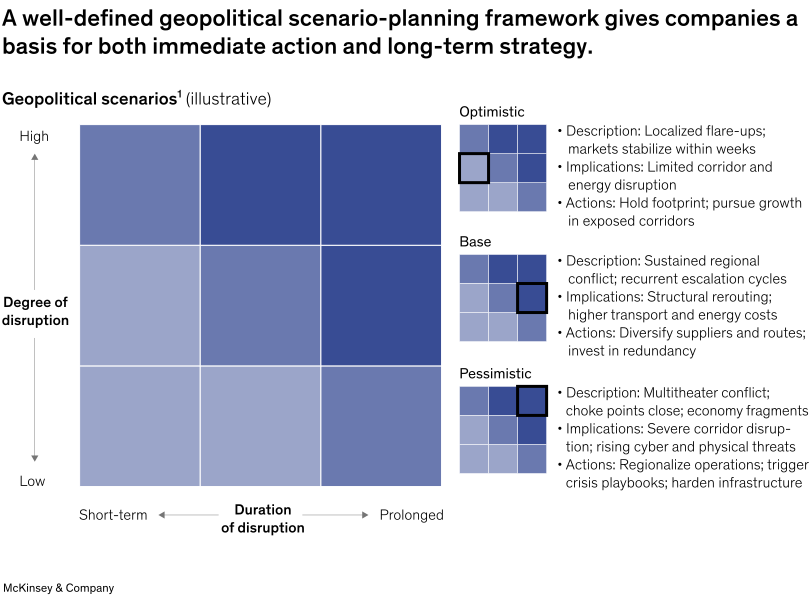
The most useful scenarios map the widest possible range of plausible futures and identify the indicators that would signal movement toward each (see sidebar, “What scenario planning looks like”). Shell, for example, has long maintained a dedicated scenarios team that combines energy transition and trade flow modeling to generate long-range views on geopolitical and macroeconomic shifts. The company shares these insights with leaders in corporate affairs, enterprise planning, and M&A and with other leaders to inform their most critical decisions.
Build organizational agility to decide and act with speed
When ownership of geopolitical risk is dispersed across strategy, risk, legal, public affairs, and regional leadership, decisions slow down, and the organization’s ability to pivot quickly is compromised. Such fragmented governance may reflect the complexity of the risk landscape, but it creates gaps at the boundaries between teams and functions. The most prepared companies move beyond checking the box on governance to building true decision-making agility.
Organizations with strong geopolitical governance typically do three things to help establish that agility: Assign clear ownership by risk category rather than leaving it to whichever department or function seems closest; establish a regular board cadence—quarterly at minimum, with escalation protocols for fast-moving developments; and finally, build outside-in intelligence by partnering with industry associations, government channels, and research institutions to supplement what internal teams can see.
Reconfigure operations and footprints for resilience—and optionality
Supply chains and operations remain among the most exposed surfaces to geopolitical shocks. That’s especially true for companies that depend heavily on a narrow set of suppliers, manufacturing sites, data flows, or end markets. But these shifts also create an opportunity to reconfigure operations for optionality, not just resilience. The best-prepared companies can mobilize quickly when a crisis hits or an opportunity opens, pairing on-the-ground capabilities with strong links to headquarters. To strengthen resilience, they selectively regionalize production, diversify suppliers, renegotiate contracts, and localize technology while preserving global optionality. That was the approach taken by a medical-products multinational corporation (MNC) that had begun shifting toward regional manufacturing and market-for-market strategies in 2023, including China-only operations through joint ventures, ahead of the subsequent US tariff measures.
Craft a flexible strategy for making trade decisions
The McKinsey Global Institute (MGI) reported that global trade continued to grow in 2025 despite higher tariffs and geopolitical disruption. Behind that growth, however, is this fact: Goods are traveling longer geographic distances while flowing increasingly among geopolitically aligned partners. As a result, corridor strategy needs to account for geopolitical distance—the degree of alignment between trading partners—alongside market growth, cost, and proximity. For example, although US trade between China and the United States fell by about $130 billion from 2024 to 2025, US-based MNCs replaced about two-thirds of that gap with alternative suppliers, including India, Vietnam, Thailand, and other economies.
By rebalancing their activity among trade corridors, leaders can position their companies for growth amid disruption. MGI estimates that 31 percent of projected global trade in 2035—about $14 trillion—could be at stake across corridors. The best-prepared companies prioritize corridors by resilience across trade scenarios—from safe bets, such as India-linked corridors, to uncertain ones, such as China- or Russia-linked corridors—then use scenario planning to guide investment while preserving flexibility to reroute supply, shift sourcing, adjust pricing, and rebalance capital as conditions change.
Ensure investments are sustained through volatile periods
Leaders’ instinct to retrench during periods of geopolitical uncertainty is understandable, though often counterproductive. Companies that continue to invest through volatility tend to outperform those that pull back. They are better positioned, for instance, to find opportunities in industrial policy incentives that are reshaping the geography of investment (in semiconductors, clean energy, and advanced manufacturing). Companies that move early to qualify for those incentives or build in regions that benefit from shifting trade flows are capturing advantages that late movers will pay more to access. In this environment, leaders in risk strategy and operations will need to distinguish between investments that are genuinely exposed to geopolitical risk and those that are not, rather than applying blanket caution.
The leaders we surveyed expect geopolitical pressures to remain elevated for the foreseeable future. For companies without robust risk capabilities, that gap in preparedness will only become more consequential. The practices that distinguish more prepared companies—structured foresight, clear governance, resilient operations, and the discipline to keep investing through volatility—form the basis for moving from a protective posture to strategic readiness.