During a recent discussion about developing strategy amid rising geopolitical volatility, the CEO of a global fintech company posed a blunt question: “Is scenario planning broken? We keep missing big things.”
Large companies and governments have long monitored flashpoints and modeled scenarios to anticipate and prepare for disruptions. Yet some of the defining shocks of this century—from the COVID-19 pandemic to Russia’s invasion of Ukraine to the biggest global energy crisis in history, caused by the conflict in Iran1—have caught many off guard and left them unprepared to react. Moreover, the scope and velocity of such disruptions seem to be on the rise. While “black swans” (unpredictable events with high impact)2 and “gray rhinos” (probable events with high impact)3 used to occur sporadically, today several alight or stampede simultaneously. All of which begs the question: Can organizations do more to anticipate and plan their responses to external shocks?
The question is germane given that, in recent years, geopolitics has evolved from a risk and public policy issue into a core aspect of corporate strategy and board-level consideration for many organizations. Numerous companies have adjusted their operating models, geographic footprints, and capital allocation in response to rising trade tensions, industrial-policy interventions, and export controls. In many cases, however, these actions may not fully reflect the intensity of the risks—or the size of potential opportunities.
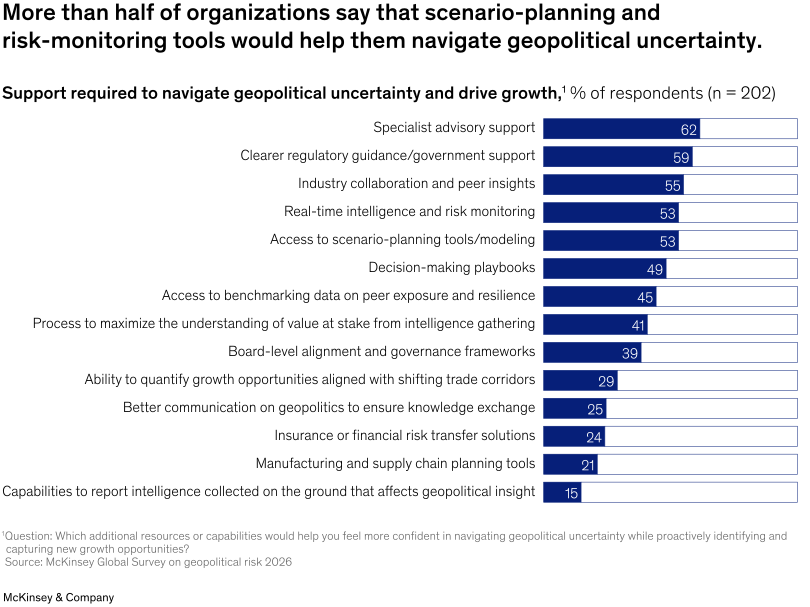
In a recent McKinsey survey,4 fewer than one-third of respondents deem their organizations’ management of geopolitical risk “mature.” And while 53 percent say that scenario planning, real-time intelligence modeling, and other strategic foresight methods would significantly strengthen their organizations’ geopolitical resilience, fewer than 30 percent report using such tools to guide decision-making (Exhibit 1). What’s more, only 5 percent say their organizations have conducted simulations to understand their exposure to geopolitical risks and prepare their responses.
To be sure, structured thinking about the future is not a crystal ball. However, our experience leading policy planning for a multilateral defense institution, steering strategic foresight at a global energy company, and helping multinational corporations strengthen their geopolitical capabilities and strategic planning under uncertainty has demonstrated the value of strategic foresight in verifying assumptions, future-proofing organizational policies, and providing senior leadership with situational awareness. In this article, we offer a playbook for developing geopolitical foresight, covering the science, art, and technology of the long view.
The science of geopolitical foresight
Strategic foresight is not an academic exercise. Its purpose is to help leaders make better decisions in highly uncertain and complex environments. Once leaders have defined their objectives, they can choose from a tool kit of foresight development instruments. Below, we outline five that organizations frequently employ:
- Horizon scanning: gathering internal and external perspectives to create a baseline understanding of the geopolitical context
- Scenario planning: developing a range of possible event-driven scenarios, their outcomes, and implications for critical strategic and tactical decisions
- Contingency planning: creating playbooks for crisis response that help leaders weigh numerous factors and determine actions
- Simulations: role-playing scenarios that test leadership teams under pressure to make decisions in real time
- Tabletop exercises: role-playing scenarios with adversarial red and blue teams to challenge leaders’ assumptions
Horizon scanning: Identifying near-term risks and opportunities
The objective of horizon scanning is to understand risks and opportunities emanating from geopolitical volatility over the coming year or two. In the past, annual risk snapshots and geopolitical updates for boards or leadership teams highlighting the main issues in the year ahead were typical examples of horizon-scanning outputs. Today, leading companies are using AI-assisted, dynamically updated dashboards to monitor rapidly changing events (see sidebar, “Using AI to improve strategic foresight”).
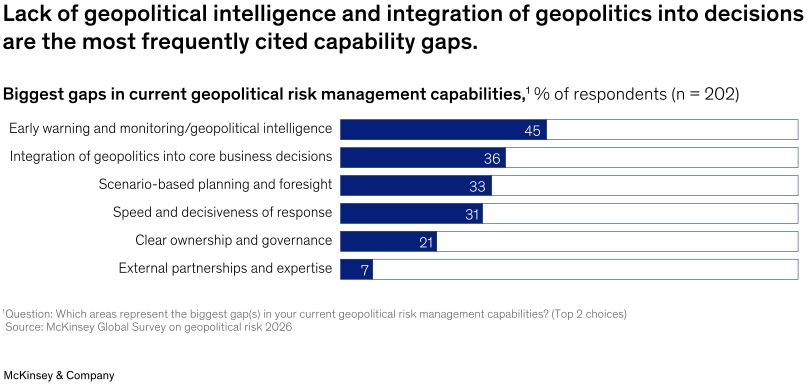
In McKinsey’s survey, geopolitical intelligence that provides early warning of material developments emerged as the biggest capability gap, cited by 45 percent of respondents (Exhibit 2). This suggests that many organizations aren’t systematically anticipating or addressing geopolitical risks.
Horizon scans should leverage a broad mix of internal and external perspectives. Country leadership teams, along with public affairs, legal, risk, and security functions, are typical internal sources for horizon-scanning exercises. External perspectives can come from political-risk advisory groups; publications such as the World Economic Forum’s Global Risks Report; and experts from academic, policy, media, and not-for-profit arenas.
One way to structure the horizon-scanning effort is to categorize potential events as black swans, gray rhinos, or silver linings (that is, opportunities stemming from geopolitical developments, such as industrial-policy incentives or new defense and security arrangements). Another category this framework could include is “black jellyfish,”5 which covers events for which the triggers are known but the ripple effects are poorly understood and can escalate rapidly.
Scenario planning: Setting strategies based on multiple potential futures
In contrast to the near-term monitoring that horizon scanning entails, scenario planning is about imagining multiple potential futures over the short, medium, and long term and identifying the strategic decisions that leaders would make differently in each one. The exercise forces leaders to think critically about the forces shaping the world economy and their industry and to quantify their implications for the company’s performance and even its existence.
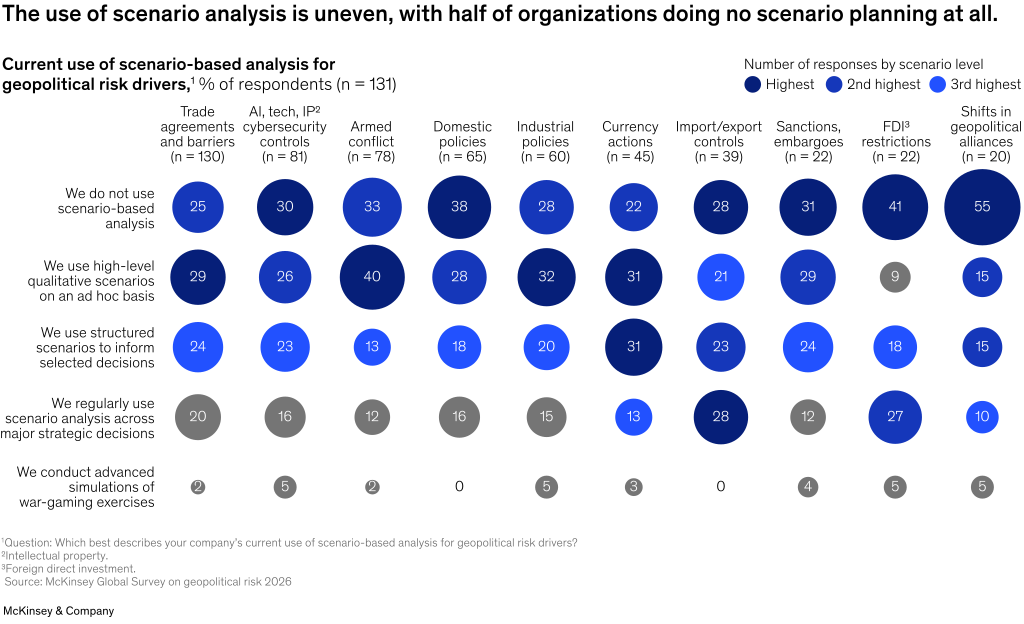
Yet organizations make surprisingly little use of scenario planning across most risk types, McKinsey’s survey shows. In fact, a third of respondents say their organizations don’t run scenario analyses at all. Depending on risk type, between 9 and 40 percent of respondents report using qualitative scenarios on an ad hoc basis, and 13 to 31 percent say their organizations apply structured scenarios for select decisions. The use of scenario analysis for strategic decisions is low across most risk types and advanced simulations or war-gaming exercises hardly used at all (Exhibit 3).
Effective scenario planning entails developing a range of plausible future narratives, along with their key drivers and watch points, and then quantifying the implications in a way that enables executives to challenge their existing strategy and the implementation plans used to carry it out. Scenarios could explore different paradigms of global trade or China–US relations, various outcomes of conflicts in Europe and the Middle East, or how macro drivers such as geopolitics, energy, and technology might collide to affect a company’s industry or strategic and operational realities. Sometimes, it’s effective for scenario exercises to take the form of “premortems.” For example, Netflix Chair Reed Hastings used to pose this challenge to his team: “It’s ten years out, and Netflix is a failed firm. What are the different causes?” As Hastings notes, “Sometimes the discussion turned to what we can do about some of these risks, but many times, just defining what risks we faced prompted people to adjust behavior in smart ways that made us more resilient.”6
McKinsey’s work with clients during the COVID-19 pandemic and the geopolitical volatility that followed produced several principles around scenario planning:
- Assume most of the business will continue as usual. Plants will operate, deliveries will continue, and stores and service centers will remain open across scenarios. Scenario planning should focus on the decisions about elements that would change.
- Adopt a broad range of scenarios. The scenarios must be sufficiently differentiated to challenge the strategic posture and tactical plans. Narrow scenarios leave companies unprepared for meaningful shifts.
- Focus on a few consequential decisions. The exercise should lead to a limited number of decisions with material business implications or build confidence that the current approach is appropriate across scenarios. It should also quantify the implications to clarify priorities.
- Focus on risk appetite, not probabilities. Business leaders should not spend time assigning probabilities to specific scenarios; future outcomes are difficult to predict. The focus should instead be on the risks and opportunities tied to consequential decisions. Some require action today. Others warrant monitoring or mitigation.
- Capitalize on uncertainty. Competitive advantage shifts during periods of disruption. Resilient companies pursue growth opportunities and build investment optionality with the same intensity they use to manage downside risks. 7
Scenario planning isn’t simply an analytical exercise. Its aim is to develop capabilities and test leadership. The process helps leaders align on governance frameworks for crisis response, establish cross-functional teams or dedicated risk and geopolitics units, and define the trigger points, dashboards, and monitoring processes required to refresh scenarios as conditions evolve. It also helps leaders develop credible narratives that connect the scenarios to operational and strategic decisions and build resilience across the organization in a rapidly changing business environment.
Contingency planning: Developing crisis response playbooks
Contingency planning is another area where strategic foresight can become operational. Scenario planning asks, “What could happen and what business decisions would we need to make?”; contingency planning asks, “What would we do if we find ourselves in a crisis?”
At its best, contingency planning provides a framework for weighing various geopolitical factors, determining responses, and creating a common understanding across the leadership team. For example, one company wanted to develop contingency plans for evacuating staff from a high-risk region in the event of a conflict. When designing the playbook, the executives asked themselves a series of questions: What would constitute a trigger for an evacuation? Would we relocate all or some of our staff? On what basis would we choose the individuals to evacuate and the evacuation method? What would be the relocation site? Which stakeholders and vendors would we engage to support the evacuation? Which leaders in the organization would make decisions about the action plan? How can we codify the contingency-planning principles for future leaders?
With a shared understanding of contingency playbooks and a governance framework in place, executives can react quickly rather than improvise under pressure. This not only bolsters their ability to keep people safe during crises but can also help them preserve enterprise value.
Simulations: Testing responses under pressure
Simulations take contingency planning a step further by placing leadership teams inside crisis situations and requiring them to make decisions on the spot. When executives are tested under pressure in simulations of black swan events, such as climate-related catastrophes, or gray rhino events, such as trade conflicts, they learn how to respond effectively to ambiguity and evolving information. “Even if you run drills, you are never going to anticipate the black swan,” says Chevron CEO Michael Wirth. “But … you start to build muscle memory for asking the right questions and for thinking about the collateral impacts that are very difficult to identify in the heat of the moment.”8
Despite these benefits, simulations appear to be underused. Fewer than 5 percent of respondents to McKinsey’s survey report that their organizations run simulations—the lowest share among all the foresight methods.
A simulation typically involves role-playing a scenario in which an external individual acts as chair. A new face or an unexpected personality can inject an element of surprise and focus the discussion. Individuals with experiences or ways of thinking different from those of simulation participants—such as science fiction writers, behavioral scientists, or professional gamers—can help challenge entrenched assumptions and imagine novel possibilities. As the simulation progresses, the chair injects new pieces of information to test the leadership team’s responses and alignment. Ultimately, the session can help clarify roles that various leaders would play in an actual crisis and reveal weaknesses in the organization’s operations, policies, or strategies that might otherwise remain hidden.
Simulations shouldn’t be “one and done” exercises, points out Michèle Flournoy, the cofounder and managing partner of strategic advisory firm WestExec Advisors. “The best companies we work with do this on an iterative basis,” she says. “Every time you do [such an exercise], you come away with a to-do list … and then these takeaways become a work plan.”9
Simulations that involve participants from both the public and private sectors can generate unique insights for both groups while demonstrating the value of collaboration. For example, a government simulation of the response to a major disruption of critical infrastructure, such as the severing of undersea power or communications cables, can benefit from the involvement of commercial operators and infrastructure maintenance firms. Meanwhile, corporate executives who sponsor or participate in such exercises can gain a better understanding of the geopolitical dynamics that may affect their operations. Business leaders who have participated in simulations held by the Development, Concepts and Doctrine Centre at the UK Ministry of Defence, for instance, experienced firsthand how policymakers respond in high-stakes situations.
Tabletop exercises: Understanding the policy tool kit
Tabletop exercises are similar to simulations, but they divide participants into “red teams” and “blue teams” that play the roles of adversaries or competitors. Participating in or observing sessions conducted by government agencies can help leadership teams understand the policies and tools governments may employ during crises, from sanctions and investment controls to exit bans.
Some companies sponsor tabletop exercises to explore the implications of potential government actions during crises and how business leaders might respond. One global private equity firm, for example, ran such an exercise for its portfolio companies focused on a potential conflict in the Taiwan Strait.
Together, the five methods for generating geopolitical foresight constitute a tool kit leaders can use to guide their strategies amid geopolitical uncertainty: Horizon scanning builds awareness of potential near-term developments, scenario planning captures multiple futures to guide strategy, contingency planning bolsters internal alignment and operational readiness, simulations stress-test resilience and response capabilities, and tabletop exercises reveal actions that governments may take that could shape the business environment in a crisis. These instruments help fuse foresight with action.
The art of taking the long view
In his book, The Art of the Long View, Peter Schwartz reminds us that foresight is not only a discipline but also a craft. It requires creativity, imagination, and comfort with uncertainty, among other elements. The science of foresight gives executives the tools; the art hones their intuition and judgment in framing and applying those tools. Our experience suggests that three elements of the art of geopolitical foresight particularly matter: language, stakeholder engagement, and leadership buy-in.
Language: Fine-tune the message
In a world fragmented by geopolitics, where identity and belief systems shape the actions of individuals, organizations, and nations, the well-worn phrase “know your audience” has never been more important. Persuasive, colorful language can inspire stakeholders while challenging their assumptions. Framing scenarios in words that resonate with a CEO, government official, or regulator—each of whom may have their own vocabulary—can help secure their trust and openness to your perspective, rather than miring the discussion in differing interpretations of terminology and evidence.
Memorable phrases can make a big difference. “Unless scenarios become a living part of an organization, they are useless,” writes Charles Roxburgh, chair of Lloyd’s of London and a former McKinsey senior partner, in a classic article on scenarios.10 He recommends using no more than four words and playing on film titles or historical events. “Avoid long, descriptive titles,” he adds. “No one will remember ‘Restrengthening world economy at a lower level of overall growth.’”
Stakeholder engagement: Seek a diversity of views
In developing strategic foresight, organizations should consult a wide range of stakeholders, including external voices—such as nongovernmental organizations, government officials, and industry and academic experts—who can interrogate management’s assumptions about geopolitical trends and identify institutional blind spots. “Invariably, somebody’s going to figure out some way to introduce some risk that you’ve never experienced before,” says Robert F. Smith, chair of Vista Equity Partners, “and you need a diversity of thought and capabilities to render judgments on this data and information.”11
Internal participation in foresight projects is equally important. Here, mindset matters more than hierarchy. When strategists, corporate officers, and regional teams all learn to identify signals of change and leaders develop policies to adapt accordingly, the entire organization becomes more resilient.
In our experience, effective foresight development sessions include several participant archetypes: project owner or sponsor (to ensure that the process has leadership endorsement), project implementers (who would adapt the project based on insights from the foresight process), potential opponents (who might reject the process findings), provocateurs (who raise opposing perspectives), and truth tellers (who are willing to pose uncomfortable questions to senior leadership).
Foresight findings resonate when people can see themselves in situations the process presents or when the implications apply to their areas of interest. Showing how a trend or series of events may affect a specific department or role can materially enhance an organization’s ability to act.
Leadership buy-in: Demonstrate the enterprise value
Senior executives facing time constraints and potential internal skepticism about the value of foresight capabilities need to know what the insights could mean for them today, next year, and a decade from now. For this reason, securing their sponsorship early is essential. To demonstrate the value of foresight in decision-making, teams should quantify the impact on company performance in a way that addresses leaders’ priorities—for example, if a given executive is focused on the short term, give them actionable near‑term options while continuing to develop longer-term insights. Furthermore, showcasing past successes can help raise awareness of—and cultivate trust in—foresight capabilities, which in turn strengthens the mandate to develop those skills.
Foresight teams also need to consider future sponsorship by engaging new executives early. Through training, tailored projects, and dedicated exploration time, future leaders can experience the value of foresight before taking charge.
“Plans are useless, but planning is indispensable,” said former US President Dwight Eisenhower. We agree—partly. Plans are worthwhile, but only to a point. Planning, however, is everything. Identifying an objective, choosing the right foresight method to achieve it, and building the capabilities to spot risks and opportunities requires the recognition that there is no crystal ball—only disciplined preparation.
The methods that comprise the science of foresight—horizon scanning, scenario planning, contingency planning, simulations, and tabletop exercises—can help decision‑makers navigate uncertainty with well‑thought‑out plans, while the art of foresight—including nuanced language, stakeholder engagement, and leadership buy‑in—can ensure that the resulting insights translate into impact. Will business leaders continue to be surprised by big events? Inevitably so, but by developing capabilities to respond, they can minimize the downside and be in a stronger position to seize opportunities.