The Gulf Cooperation Council (GCC) countries do not lack AI ambition, and they are backing up those ambitions with large-scale investments. In Saudi Arabia, for example, the AI company HUMAIN targets 6.6GW of capacity by 2034. In the United Arab Emirates, G42 is leading a consortium with US tech partners to build the 5GW UAE-US AI Campus in Abu Dhabi. In Qatar, Qai and Brookfield have formed a $20 billion strategic investment partnership focused on AI infrastructure in Qatar and select international markets.
But are these investments simply going to establish the region as a token exporter? Or will the region become known for leading the value creation story for enterprises and citizens through the successful adoption of these tokens? To shed light on these important questions, we surveyed senior leaders in the public and private sectors across the region (see sidebar “About the research”).
In the first part of this article, we highlight survey results showing that AI adoption in the GCC is widespread and growing in line with global benchmarks. Among organizations that have adopted AI, most are now moving from pilots toward redesigning workflows, an action that enables a step change in value creation. At the aggregate level, however, only a fraction of the value at stake has been realized. Just 16 percent of respondents across the public and private sectors can be classified as front-runner adopters. This mirrors the global picture, where most organizations have yet to scale AI across the enterprise.
In the second part of this article, our focus is on the public sector: Governments play a significant role in the GCC economy, which makes the deployment of AI by and within public institutions especially important in determining the success of the region’s AI transformation.
GCC countries have many advantages as we enter the era of transformative AI, including capital, low-cost energy, and rapidly expanding data center capacity. But building a truly rewired government will mean closing capability gaps, particularly those involving organization-wide adoption, and paying close attention to AI sovereignty issues. The value at stake is enormous. If the GCC builds these delivery muscles, it can unlock tremendous gains in productivity and growth, as well as the ability to provide world-leading services for citizens and residents.
The state of AI
Survey results point to four core insights into AI adoption and value creation in the GCC.
1. AI adoption in the GCC is widespread and growing in line with global benchmarks
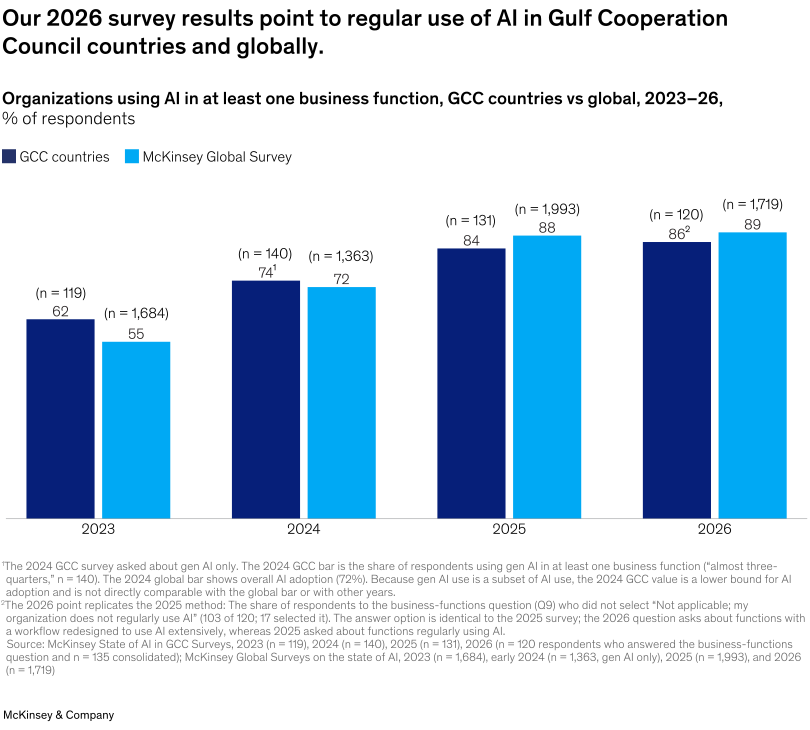
Eighty-six percent of GCC respondents said their organizations have adopted AI in at least one business function in 2026, up from 62 percent in our 2023 survey (Exhibit 1). This is in line with the global picture. The question now is whether organizations are realizing real value.
2. Organizations are moving from pilots toward redesigned workflows
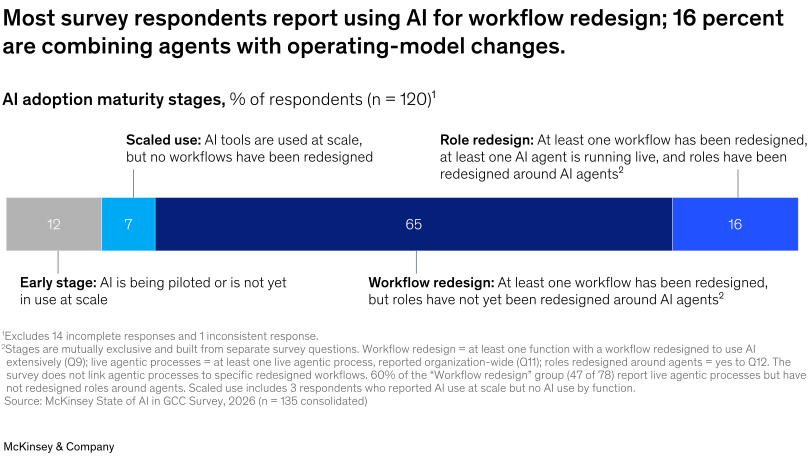
We define four AI adoption maturity levels:
- Early stage: AI is being piloted or is not yet in use at scale.
- Scaled use: AI tools are used at scale, but no workflows have been redesigned.
- Workflow redesign: At least one workflow has been redesigned, but roles have not yet been redesigned around AI agents.
- Role redesign: At least one workflow has been redesigned, at least one AI agent is running live, and roles have been redesigned around AI agents. These organizations are at the highest level of maturity, and we refer to them as front-runner adopters.
We treat these levels as a proxy for value creation: Workflow redesign, especially redesigning roles around AI agents, represents a step change in value over simply layering AI, even at scale, onto existing structures. As one private sector CFO put it, “I rarely approve stand-alone pilots anymore. I ensure my teams bring plans that encompass full workflows. That is where we’ve found value.”
In the 2026 survey, 81 percent of respondents reported that their organizations had redesigned at least one workflow (Exhibit 2). Only 16 percent had also redesigned roles around AI agents.
3. Workflow redesign remains concentrated in a few functions
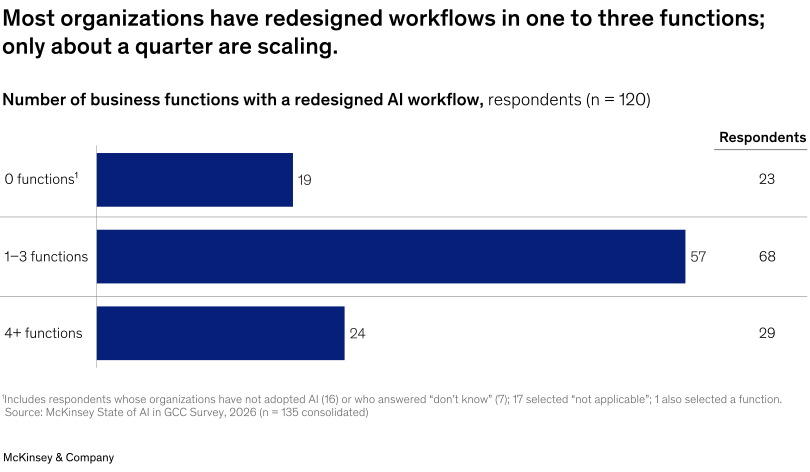
Workflow redesign can be difficult and disruptive. Most organizations are focusing their current investments on a few functions, seeking measurable impact to help fund continued transformation. For example, 57 percent of respondents said their organizations have extensively redesigned workflows in one to three business functions, while only 24 percent said they were scaling—that is, redesigning workflows in four or more of the nine functions (Exhibit 3).
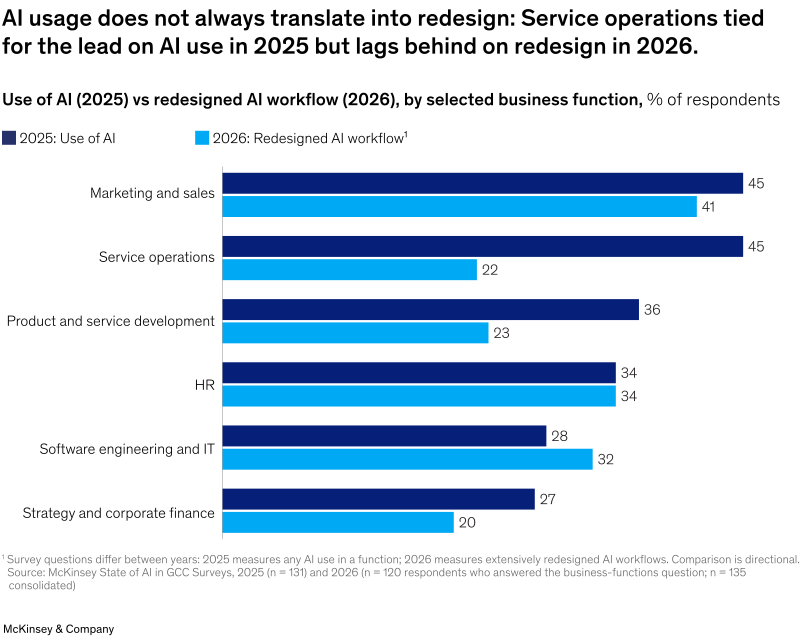
The functions in which workflow redesign is most common largely mirror those reporting AI usage in 2025 (Exhibit 4). One exception is service operations, which primarily involves customer-facing activities. Despite high AI use, the function has lagged behind on workflow redesign, likely because its processes are high-volume, interdependent, and full of exceptions that call for human judgment, making it harder to rework without risking service quality. Strategy faces a similar challenge, while functions such as marketing and sales, human resources, and IT appear more amenable to redesign.
4. Front-runner adopters remain rare across sectors but report stronger value
As we have seen, fewer than one in five survey respondents reported that their organizations had reached the highest level of AI maturity and become front-runner adopters (Exhibit 2). This proportion is similar across both public and private sectors.
Surveyed front-runner adopters were more likely to report productivity gains and continued momentum in their AI transformation (Exhibit 5).
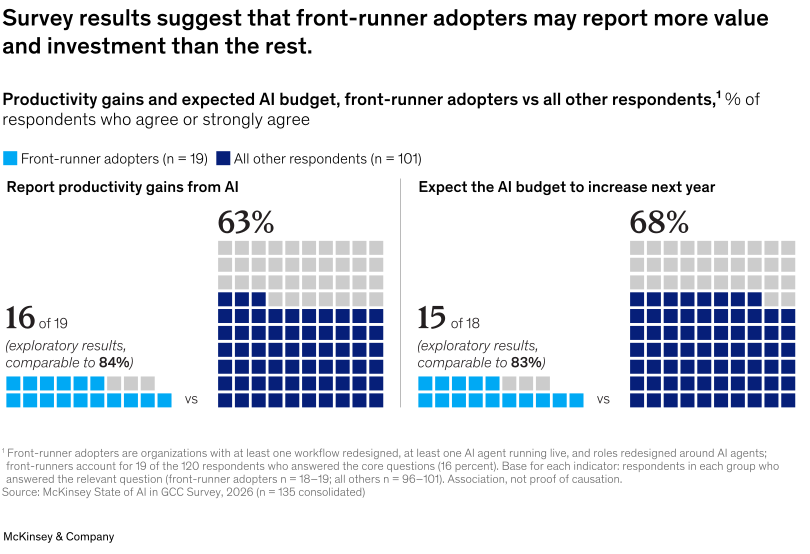
Organizations with less AI maturity are not short of conviction or investment: They too reported productivity gains and expect budgets to grow. But there is a gap between perceived and realized value, since most have layered AI onto existing workflows rather than redesigning them. Closing that gap depends less on deploying more AI than on redesigning work around it.

Rewiring government: Understanding the capabilities needed to deliver on the GCC’s ambition
The state’s role in the GCC economy extends beyond government budgets through public employment, state-owned enterprises, and sovereign investment. For example, Saudi Arabia’s Public Investment Fund (PIF) accounted for 11 percent of non-oil GDP in 2025, compared with 10 percent in 2024.
This reach makes the deployment of AI by and within public institutions critical to the success of the region’s AI transformation, and GCC countries have set ambitious plans to do so. For example, Abu Dhabi is implementing its AED 13 billion digital strategy, which includes more than 200 AI use cases. The Qatari government has signed a multiyear partnership with Scale AI to deploy AI, including agentic automation, across government services.
But our survey suggests that ambition has so far outpaced delivery capability. Just five out of 29 public sector respondents in our sample represent entities that can be described as front-runner adopters. What explains this gap? Our work with hundreds of organizations across multiple industries and sectors points to six core building blocks that are critical for successful AI transformations: strategy, talent, operating model, technology, data, and adoption and scaling (Exhibit 6). Together, these building blocks make up the components of McKinsey’s Rewired framework.
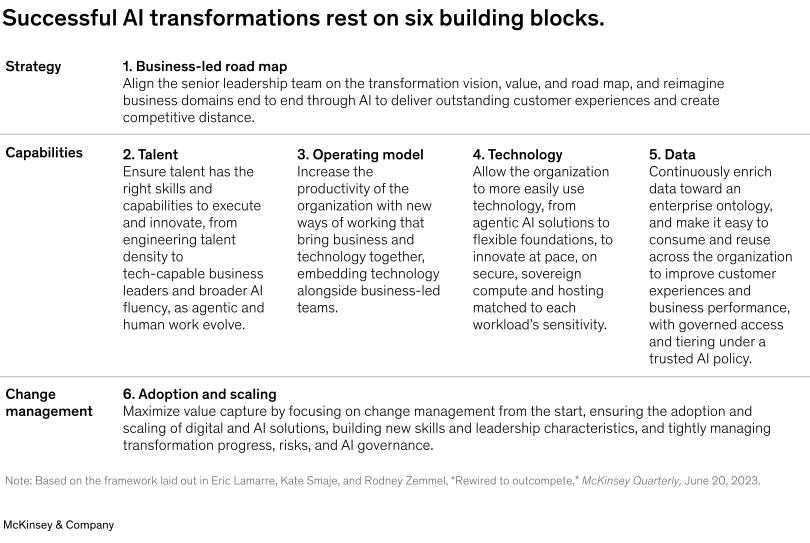
Rewired governments have built these critical capabilities: They go beyond deploying tools to design services around citizen and policy outcomes. As one public sector leader in the region observed, “We’re not dealing with commodities; we’re touching people’s lives. That means we have to be innovative and sensitive at the same time.”
Governments shape policy, safeguard society, and serve citizens, so the stakes of getting AI right are uniquely high. Rewired government can be effortless and personalized for citizens, frictionless for businesses, and focused on judgment rather than paperwork for civil servants.
Capability gaps and what leaders can do to address them
When asked about the maturity of core capabilities, most GCC public sector respondents reported that their organizations possess a strategic road map, appropriate talent and in-house capabilities, and the necessary technologies (Exhibit 7). Organization-wide adoption is the area in which the fewest public sector organizations reported strong progress, followed by data readiness.
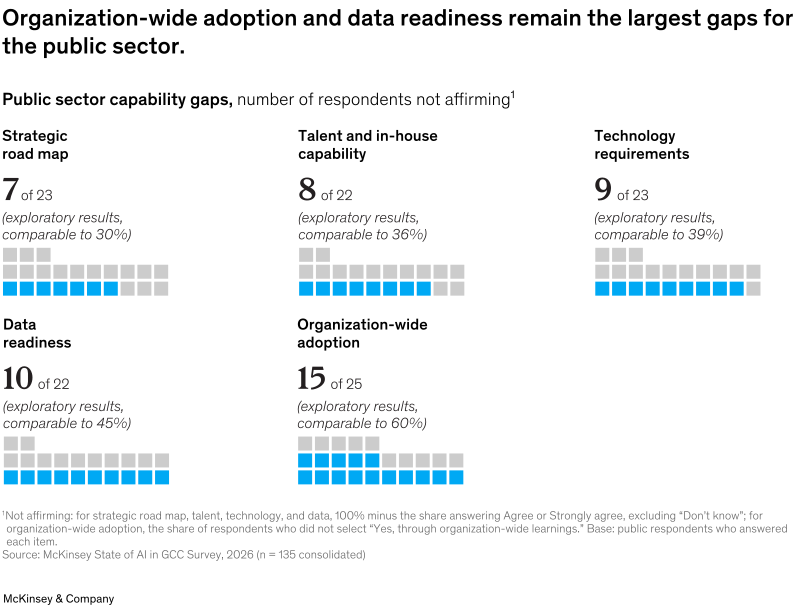
Developing these capabilities is challenging for any organization. Doing so in the public sector may be even more so because, as our previous work has noted, public sector institutions are operating under the hardest version of the AI problem.
Below, we outline the core challenges and priority actions for leaders.
1. Strategy
Clarity about the responsible use of AI (including rules related to permissions, deployment, and telemetry) is core to any successful government rollout of AI capabilities at scale, and a clear responsible AI policy can unblock IT and risk approvals. Leaders increasingly view ownership of AI capabilities as a national security issue, so AI strategy should address sovereignty in full, defining at a government or institution level which data can be processed on which compute, and under what permissions (see sidebar “Sovereign AI is now a strategic imperative”).
Funding can also be an issue. While 16 of 23 public sector respondents said they had a clear, well-funded road map, sustaining funding remains hard, as in many other countries. As one public sector leader put it, “I feel like we do a strategy refresh every year … but rarely do we reach the stage where these road maps are funded well enough to implement against them.”
Priority action for leaders: Institute domain-based prioritization. Fully funding two or three high-value domains, each with a clear owner, over multiple budget cycles may add more value than a broader, shallower approach, with further funding tied to results. Governments can reimagine entire end-to-end service journeys, such as relocating to a new city, with agents coordinating across the multiple entities involved.
2. Talent
Specialist skills, from data science to workflow architecture and risk, remain scarce and hard to recruit on constrained budgets. The bigger opportunity lies in upskilling the existing workforce, since most of the value from AI will be captured by the civil servants already in place.
Priority action for leaders: Roll out enterprise-wide, hands-on upskilling programs. Programs work best when tailored to roles and experience levels and focused on using AI in daily work. Governments can also lead the wider societal workforce transition: As major employers and architects of national skills policies, they can set the direction for reskilling, partner with universities and employers, and use their own programs as a model for the broader economy.
3. Operating model
Implementing a new operating model can be particularly difficult in government: Roles are set by civil service rules, services cut across multiple agencies, frontline capacity cannot simply be reduced, and public services must continue to serve everyone. Yet redesigning roles around AI agents is what most distinguishes front-runner adopters.
Priority action for leaders: Redesign roles and teams around end-to-end workflows. Cross-functional teams that are accountable for outcomes in each priority domain, such as permits and licensing, can then redesign roles in phases so services continue uninterrupted as agents take on more work.
Governance is an often overlooked part of the operating model. Based on the survey, only 13 percent of respondents reported no significant governance challenges. The most common gaps were the lack of a clear AI strategy or governance framework (nearly one in four respondents) and limited AI knowledge among leadership (16 percent).
The answer is not more committees but clear accountability for AI-enabled decisions, covering oversight, human judgment, and escalation.
4. Technology
Access to AI compute and inference is expanding quickly across the GCC, but the underlying technology infrastructure within many public institutions has not always kept pace. As one Saudi public sector technology leader put it, “There is real inertia around refreshing our technology infrastructure, especially when nontechnical leaders feel that a technology upgrade completed several years ago should still be sufficient.”
Priority action for leaders: Develop platforms that work on flexible compute and hosting capacity. Bolting AI onto legacy architecture restricts speed and traps data in silos, so core infrastructure must handle AI’s elastic compute demands by establishing a strong cloud foundation. Technology is best managed as an ongoing, modular platform that lets teams deploy AI at scale, not through periodic upgrades. AI-specific cybersecurity will need to be built in since frontier AI is rewriting traditional software security rules, introducing elevated cyber risks tied to how AI models ingest and process vast amounts of sensitive data.
5. Data
Research across the public and private sectors indicates that data issues are one of the leading causes of AI project failure. Public sector entities typically face additional constraints versus the private sector; in Dubai, for example, Dubai Electronic Security Center (DESC) data classification determines what can run in the cloud. Data quality and protection are therefore core to public trust.
Priority action for leaders: Put in place clear data management and governance principles and capabilities. For each domain, leaders should identify their highest-value data assets, such as population registers, licensing records, and health data, and set clear rules for access, permissions, key ownership, and data tiering. Semantic layers and knowledge graphs should be built for specific public service use cases, not as stand-alone data programs.
6. Adoption and scaling
Adoption starts with bringing people along. For civil servants, that means leaders modeling AI use, a clear case for change tied to citizen outcomes, hands-on skill building, and performance goals that reward new ways of working. A top executive from a large GCC-based logistics provider put it plainly: “AI transformation is not a technology challenge; it is a leadership challenge: Defining the value, breaking organizational silos, and moving decisively from ambition to execution.” Measurement is also a challenge: Most entities track licenses issued and log-ins, which reveal little about whether work has changed.
Priority action for leaders: Put in place mechanisms to measure the value AI creates and translate it into bottom-line impact. Decide before deployment what will be measured—for example, depth of use, speed (such as time to decision), quality (such as error and override rates), and citizen service outcomes. These indicators should then guide the next round of investment and workflow redesign. Leaders should also plan in advance how freed capacity will be used, whether redeploying staff to higher-value services, redesigning roles, or reflecting savings in budgets. Without such a plan, efficiency gains rarely show up as bottom-line impact.
The GCC has the ambition, capital, energy and compute infrastructure, and public sector reach necessary to scale AI. The region now needs to turn these advantages into impact. Execution, rather than access to resources, is now the main constraint. Building the right capabilities can unlock tremendous gains in productivity and growth, as well as a significant improvement in citizen-facing services.