A $22 trillion construction wave is coming, and the current capital-project delivery model is not built to absorb it. Global construction spending is projected to rise from $13 trillion in 2023 to $22 trillion by 2040. Outside China, meeting that demand would require the industry to roughly double its historical growth rate, from 1.3 percent to 2.7 percent a year. For capital-intensive companies, this is no longer only a question of deploying more capital. It is a question of converting capital into productive capacity faster, with higher delivery throughput, shorter backlogs, and greater certainty.
The current delivery model is not scaling at the same pace. Over the long term, construction productivity has improved by only 10 percent since 2000, compared with 50 percent for the broader economy and 90 percent for manufacturing. More recently, cost pressure has intensified: Construction has become 1 to 3 percent more expensive each year globally on top of general inflation, with construction costs up 50 percent in Europe and nonresidential construction prices up 65 percent in the United States between 2015 and May 2026 (Exhibit 1). Upstream supply-chain volatility is adding another layer of uncertainty, as long-lead equipment, supplier capacity, logistics constraints, and commodity exposure increasingly shape whether projects stay on plan.
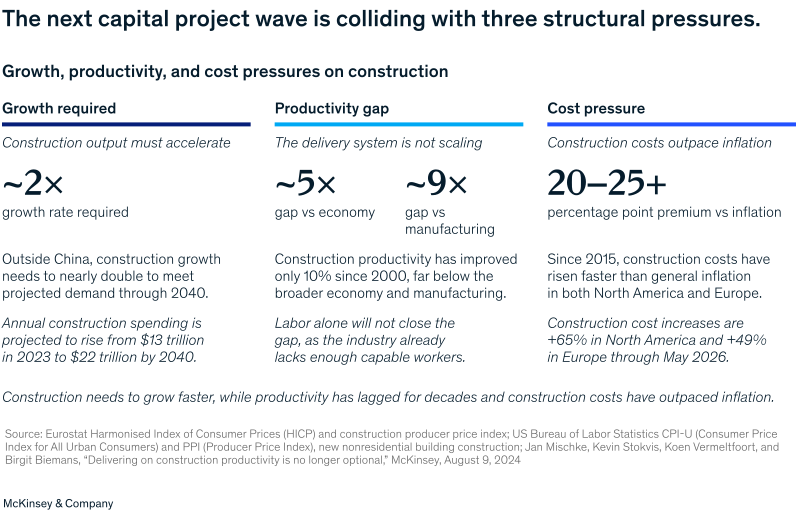
Together, these pressures create a challenging equation: more capital to deploy, faster time to market to achieve, fewer experienced people, more volatile supply chains, rising costs, and a delivery model still built around bespoke designs, fragmented contractor interfaces, periodic reporting, and late signals.
Encouragingly, recent advances in digital and AI are beginning to change that trajectory. The opportunity doesn’t lie in dashboards or plug-in solutions; it lies in redesigning how capital projects are planned and delivered by connecting signals from all key stages (strategy, engineering, procurement, construction) and acting on them to make faster, evidence-based decisions (Exhibit 2).
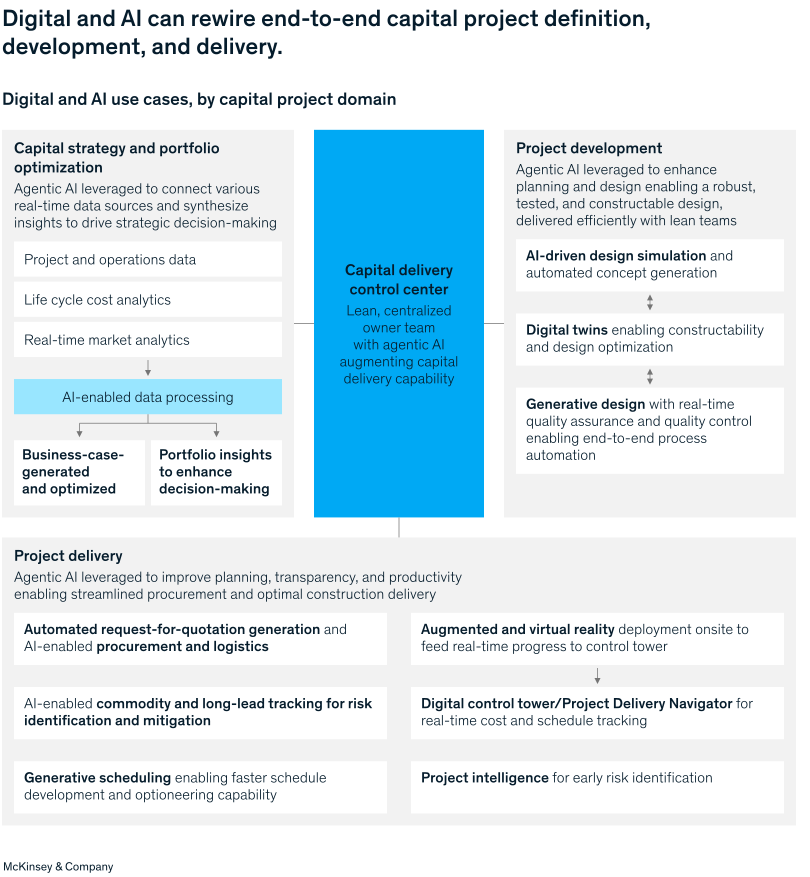
Leading companies are deploying digital and AI capabilities across the capital-project life cycle, from targeted solutions, such as generative scheduling and generative design, to end-to-end transformation programs that fundamentally rewire how projects are developed and delivered. Those organizations are positioning themselves to deliver the coming wave of capital investment with greater certainty, improve productivity despite growing labor constraints, and offset rising cost pressure. The most successful organizations will be those that combine deep capital-domain expertise with digital and AI capabilities, while redesigning workflows, decision rights, and adoption at scale.
The delivery model needs an upgrade
The current delivery model for capital projects is built around stage gates, baseline control, and periodic reporting. These mechanisms remain important, but they were not designed for environments where project conditions change faster than the governance cadence.
The result is latency. Business cases become snapshots of outdated assumptions. Engineering trade-offs are made before procurement constraints are fully understood. Schedules are created while supply-chain and field constraints are still evolving. The information often exists, but teams are too slow to connect, interpret, and act on it.
Traditional project controls can reinforce the problem. Comparing actuals against an approved baseline is necessary, but contractor-reported data often lags reality by one to two months. By the time issues surface in formal reporting, constraints may already be forming in a drawing register, supplier update, workface plan, or turnover log.
A dynamic delivery model asks a better question: Given what the team knows now, is the current plan still the highest-value path? That shift moves project management from retrospective reporting to forward steering.
Focus on high-value domains
The temptation to solve these issues is to start with the easiest use case: a visible tool, a contained pilot, a simple ROI calculation. That can create momentum, but it rarely changes project outcomes. A scheduling engine can produce better scenarios, but value is captured only if the broader delivery system can act on them. A design tool can create more options, but value is captured only if teams use those options to challenge scope, constructability, and procurement constraints earlier. The ambition should be to fully transform—from end to end, connecting several solutions—the way capital projects are performed.
The best place to start is where better decisions create the most value. That value is not just lower project cost. For many owners, it means bringing assets online sooner, delivering more projects with the same resources, reducing project backlogs, and getting earlier returns from capital investments. Leaders should identify one or two parts of the project life cycle were faster decisions, greater certainty, or shorter schedules would have the biggest impact. Then they should redesign those workflows around the decisions that matter most.
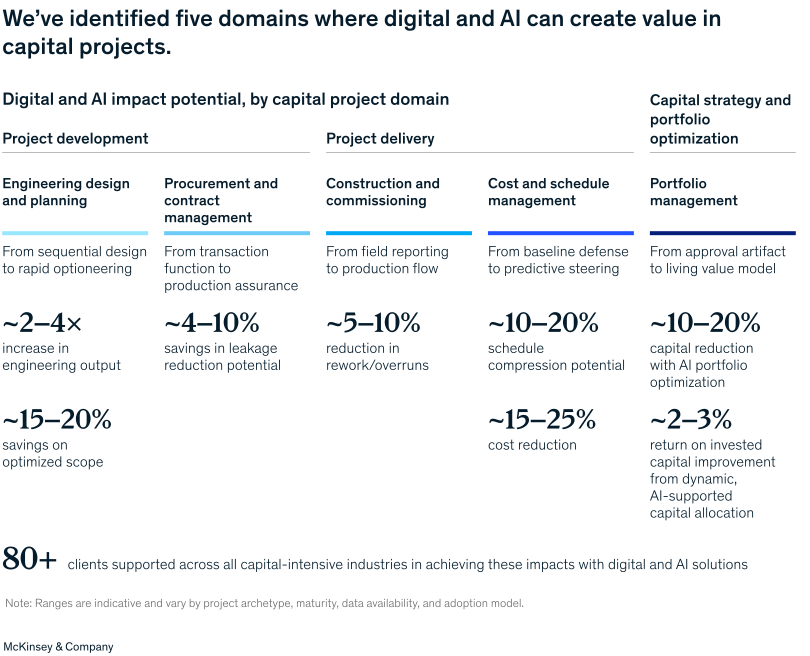
Within capital projects, we have identified five domains that typically carry the largest opportunity: engineering design and planning; procurement and contract management; construction and commissioning; cost and schedule management; and portfolio management (Exhibit 3).
1. Engineering design and planning: From sequential design to rapid option generation
Engineering will move from sequential design to continuous generation and evaluation of design options. Instead of weeks-long, sequential steps to mature a concept, teams will be able to generate, test, and compare thousands of technically viable options against total cost of ownership (TCO), constructability, procurement feasibility, and schedule confidence before choices are locked in.
This makes engineering one of the highest-impact starting points for AI-enabled capital delivery. Much engineering work is rules-based, documented, and repeatable, making it well suited to codified standards, automated quality checks, and rapid comparison of alternatives.
A redesigned engineering workflow changes the traditional project cycle: from further stages/areas of the project waiting for engineering to deliver designs, to AI agents and generative design engines that create design options, draft deliverables, check standards, compare quantities, estimate cost and schedule implications, and surface constructability risks—accelerating the traditional process. Humans remain accountable for project-critical decisions, but they spend more time evaluating trade-offs and less time on low-value coordination work.
A European transmission system operator used AI technology to build a parametric solution for the rapid design of insulator strings, targeting a key engineering and partner-capacity bottleneck. The new tool required up to 88 percent fewer design and procurement hours, cutting lead time in half. The company estimated that extending the same approach across its portfolio could generate savings of €175 million.
Value-improvement cases show a second pathway. A $100 billion-plus market cap semiconductor manufacturer used value engineering assisted by agentic AI on a $500 million mechanical, electrical, and plumbing part of a factory buildout. The approach evaluated more than 500 specifications and delivered 15 to 20 percent in savings versus the initial baseline, equivalent to approximately $50 million to $100 million in project cost savings.
2. Procurement and contract management: From transaction function to value assurance
Procurement is often treated as a back-office transaction engine. In capital projects, it is one of the biggest determinants of whether the schedule survives contact with reality. Long-lead items, supplier capacity, contract terms, commodity exposure, logistics constraints, and invoice leakage can determine whether a project stays on the critical path or loses months.
A more dynamic procurement workflow starts earlier and stays live. If a long-lead item is at risk, the control team should automatically see its implication in the schedule. If supplier capacity is constrained, engineering should know whether redesign creates a better path. If invoice lines do not match contracted terms, value-preservation routines should intervene before leakage becomes normalized. In a rewired model, procurement becomes a live production-assurance function, not just a purchasing process.
AI-enabled category, sourcing, and contract tools can monitor supply-market conditions, automate commercial analysis, benchmark supplier options, and surface risks early enough for project teams to act. Procurement analytics can connect supplier capacity, long-lead items, commercial exposure, and design choices before they become delays.
The evidence for the impact of these approaches is strongest in adjacent procurement settings. A leading North American utility company deployed a set of contract management intelligence agents at scale to automate invoice-to-contract compliance across hundreds of contracts and more than a million invoices. The agents prevented contract leakage in real time, equivalent to over 1% of in-scope spend on a run-rate basis, and identified a further set of contract-optimization opportunities. A beverage player applied a similar approach to evaluate more than 190 contracts across 75 suppliers in four languages, identifying 4 to 10 percent savings with 96 percent accuracy.
3. Construction and commissioning: From field reporting to production flow
Construction is where the plan meets reality and where small disconnects become expensive. Crews lose productive time when workfronts are not ready. Installed work can drift from design intent. Materials arrive out of sequence. Turnover packages reach commissioning incomplete. When these issues are discovered late, teams are forced into costly recovery mode.
A rewired approach to field work starts with a simple principle: Work should begin only when the workfront is genuinely ready. Live evidence from site capture, schedules, requests for information (RFIs), materials, quality records, and turnover systems can continuously update the execution plan. Field management teams can then distinguish reported progress from executed reality, adjust sequencing, remove constraints earlier, and protect the path to first production. This shifts field management from reporting progress to actively managing production flow. Instead of asking only whether an activity is complete, teams can ask whether the next activity can start safely, productively, and without creating downstream rework. AI-enabled field workflows can help identify workface constraints, flag deviations from design intent, prioritize quality risks, and recommend the next best action for construction teams.
Commissioning also moves upstream. Rather than discovering readiness gaps near the end of construction, teams can build a system-level view progressively as evidence becomes available. AI can help identify missing documentation, incomplete systems, quality risks, and activities most likely to delay start-up, allowing human teams to focus on the interventions that matter most.
McKinsey’s proprietary Project Delivery Navigator shows how this shift can work in practice. A leading European oil and gas exploration company embarking on a roughly $20 billion capital program lacked standardized reporting, reliable data, and an integrated view of performance across its project portfolio. Within five months, the company implemented the Project Delivery Navigator using a user-centric, minimum viable product (MVP)–based approach. The solution integrated more than 10,000 data points across over 20 KPIs and provided nine tailored views of cost, schedule, procurement, and delivery performance. More than 30 active users, including teams from two engineering, procurement, and construction (EPC) contractors, gained access to a common performance platform covering approximately $2.2 billion in purchase-order value. Combined with a capital-excellence academy and capability-building sessions, the effort improved portfolio transparency, reduced dependence on manual reporting, and enabled earlier management intervention on emerging delivery risks.
4. Cost and schedule management: From baseline defense to predictive steering
Project controls will move from explaining variance to steering outcomes. Baseline control remains essential, but the next frontier is giving leaders a better view of where the project is heading and what they can still do about it.
In a more dynamic model, cost and schedule management becomes a forward-looking steering function. Tools such as generative scheduling can create production-grade schedules, test alternative execution paths, and show how changing field conditions could affect the critical path before the impact is locked in. Instead of waiting for variance to appear in the next report, leaders can see the likely consequence of a constraint and compare practical recovery options.
The value comes when insight changes action. A schedule-risk signal should prompt a management intervention. A cost forecast should inform commercial and capital decisions. A productivity signal should change how work is organized in the field. Controls become less about defending a baseline and more about helping teams choose the highest-value path from the options still available.
A $300 million elevated transit guideway project used generative scheduling to recover schedule delays by running hundreds of optimization and risk scenarios. That work achieved a 13-month schedule reduction (20 percent schedule compression) and saved more than $80 million (about a 25 percent cost reduction). For a semiconductor manufacturer on a $1 billion semiconductor fab construction buildout, the same generative scheduling approach identified three months of schedule compression across civil, structural, and architectural activities, helping the company reach key schedule requirements required for federal funding. A leading international data center company used generative scheduling to develop a “golden schedule” for its base-build model, identifying 13 schedule optimization opportunities and reducing the baseline schedule by approximately 40 percent, with plans to roll out the methodology across future projects globally.
5. Portfolio management: From approval artifact to living value model
Capital allocation will become a living model, not an annual artifact. Instead of relying on static approval documents that age quickly, leaders will be able to update portfolio economics, project alternatives, risk exposure, and investment trade-offs as conditions change.
Capital portfolios are often managed through periodic planning cycles, static baselines, and approval artifacts. These mechanisms create discipline, but they can also lock capital into decisions based on yesterday’s assumptions. Market conditions move, demand forecasts shift, scope matures, design choices create new execution trade-offs, and procurement constraints become clearer. Yet capital may remain tied to a portfolio mix that no longer reflects the latest view of value, risk, deliverability, and strategic fit.
AI enables a shift from periodic portfolio reviews to continuously refreshed capital allocation. It can compile and reconcile updated project performance, actual cost and schedule data, supplier behavior, external market signals, historical project outcomes, and macroeconomic trends into a current view of portfolio value. Rather than relying on manual analysis, gut-feel decisions, or a limited set of scenarios, leaders can rapidly evaluate alternative investment strategies, test changing assumptions, and identify value drivers or risks that may previously have gone unnoticed.
The benefit is faster and better capital decision-making. Leaders can move from concept to decision more quickly while reducing the uncertainty embedded in early estimates. Instead of relying on rough assumptions until later stage gates, teams can test more scenarios earlier, compare risk-adjusted options, and improve the confidence of initial estimates before capital is committed. Better portfolio management, with dynamic allocation of capital toward the highest-return opportunities, could drive a 2 to 3 percent uplift in ROIC.
How companies can scale value capture
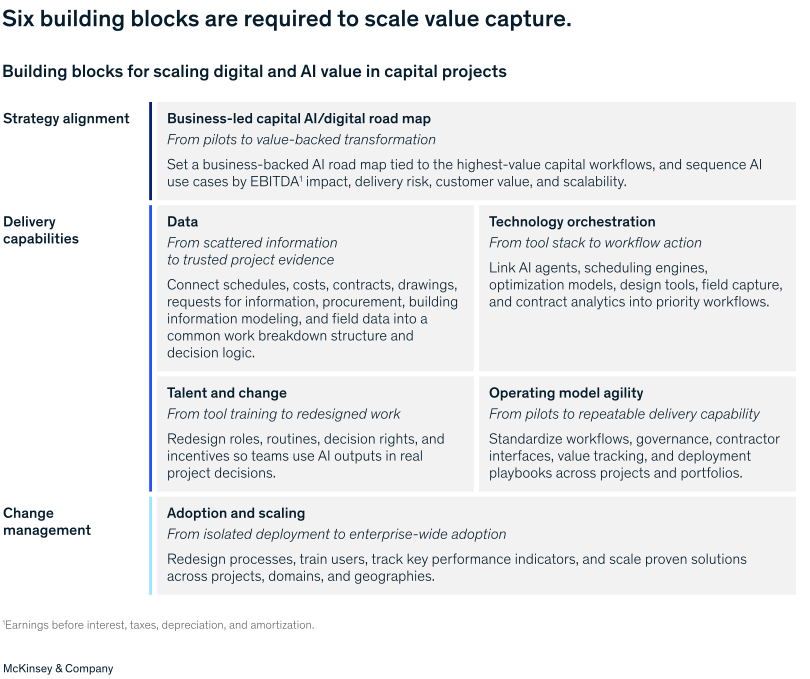
The companies that capture value are not the ones with the longest list of AI pilots. They are the ones that make digital and AI-enabled delivery repeatable, with clear business ownership and a value prize tied to project outcomes. Scaling requires visible CEO and C-suite accountability, a funded transformation road map, domain-level workflow redesign, production-grade data and technology, new AI-enabled project skills, an operating model that can deliver repeatedly, and an adoption engine that tracks value from launch to scaled impact.
These key ingredients can be translated into six reinforcing building blocks: a business-led road map, data, technology orchestration, talent and change, operating model agility, and adoption and scaling. Together, these determine whether a promising use case becomes a portfolio-wide delivery advantage (Exhibit 4).
1. Business-led capital AI/digital road map: From pilots to value-backed transformation
Leaders will start with the economic leverage points where better decisions can most improve capital efficiency, schedule certainty, and delivery resilience.
Many organizations begin their digital and AI journeys with visible point solutions. These can create value, but they rarely transform capital delivery if they remain disconnected from the decisions that determine project outcomes. A business-led road map starts from the opposite end. It asks where the company’s capital system leaks the most value: early scope definition, design optimization, long-lead procurement, field productivity, commissioning readiness, portfolio allocation, or cost and schedule steering. The goal is not to build a long list of digital and AI use cases, but to identify the one to three areas where better, faster, and more connected decisions would materially improve time to production, capital efficiency, risk-adjusted net present value (NPV), or forecast confidence.
That road map should be set by the C-suite and funded and owned by the business, not by the technology function alone. Capital leaders need to align on the future delivery system they want to build, the workflows to reimagine first, the value at stake, and the sequence for scaling. In practical terms, this means defining which workflows deserve deeper redesign, what decisions each workflow should improve, what data and technology are needed to support those decisions, and what operating-model changes are required to make adoption stick.
The test of a good capital AI/digital road map is whether it changes the capital conversation. Instead of asking, “Which tools should we deploy?” leaders ask, “Which delivery outcomes must improve, which decisions drive those outcomes, and what systems do we need so teams can make those decisions earlier and with better evidence?” That shift is what turns digital and AI from experimentation into a value-backed transformation agenda.
2. Data: From fragmented records to decision-grade context
AI agents will process and tag messy project information against a common work breakdown structure (WBS) and decision ontology so teams can retrieve the right evidence without waiting weeks or months for clean data.
Capital-project data is scattered across schedules, cost systems, contracts, drawings, RFIs, daily reports, procurement systems, field tools, building information models, and spreadsheets. Teams often spend more time reconciling information than making decisions. But leaders should not interpret that fragmentation as a reason to pause until every data problem is fixed.
Gen AI can process unstructured information more effectively than traditional analytics, but its value depends on how well agents are instructed, trained, and quality-controlled for each workflow. The practical task is to connect the most important project information to the breakdown structure, add enough metadata to make it useful in priority workflows, and define how agents should classify, escalate, and summarize issues. High-risk decisions will still require integrity checks, deterministic models, and human oversight—especially in safety, technical compliance, and commercial exposure.
The objective is not perfect data everywhere. It is decision-grade context where it matters most.
3. Technology orchestration: From tool stack to workflow action
Modular technology layers will route signals from design, procurement, controls, and the field into the decisions that change project outcomes.
Many capital organizations already have dashboards, planning tools, building information models, enterprise-resource-planning (ERP) software, contract systems, document-control platforms, AI tools, and site-capture technologies. Yet these tools often operate in silos. A schedule risk may sit in one system, a design issue in another, a supplier constraint in a third, and field evidence somewhere else. Teams still need to manually connect the dots.
Technology orchestration creates a connectivity layer across the existing technology estate. Instead of replacing full platforms, organizations connect systems, data sources, AI agents, and deterministic engines through standard interfaces and reusable capabilities. A practical architecture combines large language models (LLMs) for synthesis, reviews, and optioneering; deterministic engines for scheduling, optimization, calculations, and generative design; site capture and augmented reality for field evidence; contract analytics for commercial control; and workflow interfaces to guide human decisions.
Leaders can start with a few critical workflows, such as schedule-risk detection, design-change impact assessment, or construction-progress validation. But they need to set up foundations that can scale: a clear data architecture, standard interfaces, an agent platform that coexists with existing applications, model-evaluation routines, cybersecurity and access controls, and deployment playbooks reusable across projects. The objective is not to add another tool. It is to make the existing technology estate work as one delivery system.
4. Talent and change: From AI tool use to hybrid project teams
Hybrid human–AI project teams will shift scarce expert capacity away from routine coordination and toward the decisions that most affect project outcomes.
Capital-project organizations already operate with limited specialist capacity while managing increasing project complexity. AI can relieve much of the routine work that consumes expert time today, including searching for information, preparing first drafts, reconciling documents, updating reports, and turning raw project data into decision-ready insights. As AI agents and digital workflows take on more of these activities, engineers and project managers can spend more time evaluating trade-offs, managing risk, aligning stakeholders, and intervening where their judgment creates the greatest value.
This shift also raises the bar for human capability. Teams will need stronger critical thinking to interpret AI-generated recommendations, challenge assumptions, identify errors, and decide when outputs are reliable enough to act on and when deeper technical review is required. Organizations will also need new capabilities, including data and AI specialists to develop and validate agents, domain experts to train and improve AI models, and frontline leaders who can embed human–AI ways of working into everyday project delivery. Across the project life cycle, AI increasingly performs synthesis, monitoring, and routine analysis, while people focus on judgment, accountability, and action (Exhibit 5).
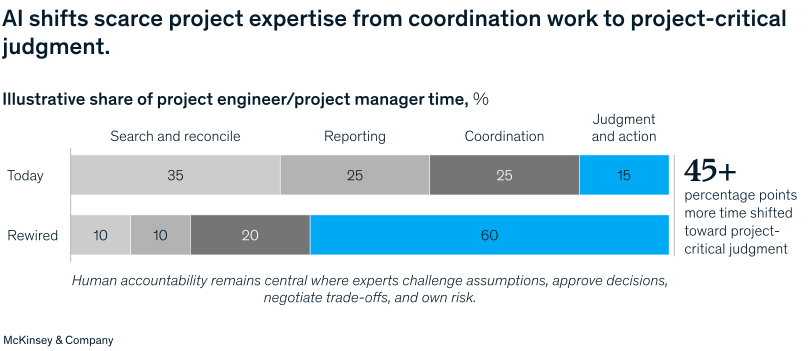
The change agenda therefore extends well beyond deploying AI tools or training people to use them. Most value comes from redesigning how work is performed. Leaders need to rethink project routines, decision rights, incentives, team structures, and governance so that human and AI capabilities work together as part of the standard delivery model. While human–AI operating models suggest that 20 to 50 percent of project work hours could be automated, capturing that value depends on fundamentally redesigning how work is allocated between people and AI, not simply adding new technology to existing processes.
5. Operating model agility: From disconnected initiatives to institutional capability
Leading owners will make AI-enabled delivery repeatable across their capital portfolios by changing the way projects are governed, staffed, and learned from.
Many capital organizations still run projects through a management system built for baseline control. That system creates discipline, but it also explains why point solutions often fail to scale. Current systems tend to reinforce silos between functions, project areas, contractors, and decision forums. Data is captured in different formats and at different levels of granularity. Decisions are often made through sequential handoffs rather than integrated workflows. As a result, a tool may improve one part of the process, but the value is diluted when planning, cost, procurement, engineering, construction, and commissioning continue to operate with different assumptions, incentives, and sources of truth.
A rewired delivery operating model makes the new way of working institutional. It defines how workflows are standardized, how AI-enabled recommendations are governed, how contractors participate, where humans retain decision rights, and how value is measured. Generative scheduling illustrates the point by testing better execution scenarios, but full value comes only when planners, project teams, contractors, and central experts adopt a common way of building, challenging, and updating the schedule.
Another key element in a rewired delivery model is benchmarking and best-practice transfer. When cost, schedule, productivity, design, procurement, and field-performance data are captured consistently across projects, teams can compare like-for-like performance, identify outliers, transfer proven practices, and set fact-based targets for the next project. Over time, every project becomes a source of learning for the portfolio, rather than a one-off execution effort. Today, digital and AI significantly facilitate processing and value capture from past performance.
The operating model should make repeatability explicit. Leaders need standard workflows, governance routines, contractor interfaces, value-tracking mechanisms, and deployment playbooks that can be reused across projects and portfolios. Otherwise, each project starts over, and the organization never compounds its learning.
6. Adoption and scaling: From isolated deployment to enterprise-wide adoption
AI-enabled delivery only creates value when new workflows become part of how projects are governed, managed, and repeated across the portfolio.
Adoption is the point where most digital transformations are either compounded or stall. A tool may produce better schedule scenarios, identify contract leakage, flag field deviations, or generate design options, but value is only captured when project teams use those outputs in real decisions. That requires more than training users on a new interface. Leaders need to redesign the routines around the tool: what meetings use the output, who reviews it, what decisions it informs, when escalation happens, how value is tracked, and where human judgment remains accountable. Without those changes, AI insights risk becoming another layer of reporting rather than a new way of running the project.
Scaling also requires discipline from day one. Each deployment should create reusable assets: a validated workflow, a data model, a set of decision rules, a governance cadence, role-based training, value-tracking logic, and a playbook that can be applied to the next project. In capital projects, this is particularly important because projects are long, fragmented, and executed through changing teams of owners, EPC providers, suppliers, and contractors. Adoption must therefore be leadership-driven and embedded into core routines, with clear expectations, reinforced behaviors, and a mechanism to prevent teams from reverting to old ways of working under pressure.
The most effective organizations treat adoption and scaling as a change management system, not a rollout activity. They build capability in the teams that will use the technology, create incentives for cross-functional collaboration, track whether the new workflow is changing decisions, and expand only when the first deployments prove value and repeatability. Over time, this turns local successes into institutional capability enabling the organization to learn faster with every project it delivers.
What leaders should do now
When we speak with capital-intensive companies, for many executives, the hardest question is where to start. The answer is to begin with value: Identify the few domains where better decisions would materially improve time to production, capital efficiency, forecast confidence, or resilience, then redesign the work around those decisions (Exhibit 6).
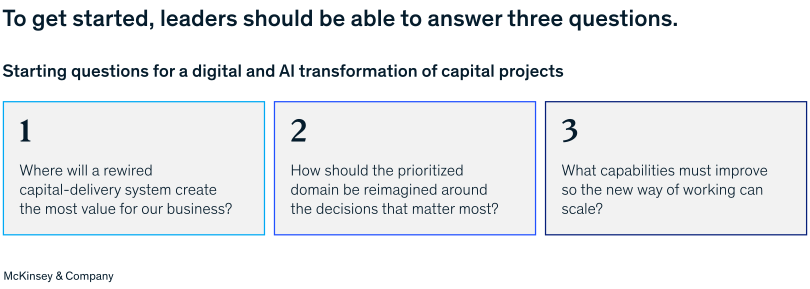
1. Where will a rewired capital-delivery system create the most value for our business?
Leaders should begin by defining the future system through the lens of value, not technology. The answer should reflect the company’s asset base, delivery model, capital portfolio, and strategic priorities. One owner may find the greatest opportunity in faster front-end engineering. Another may find it in procurement assurance for long-lead equipment, schedule resilience, field productivity, commissioning readiness, or portfolio allocation.
The goal is to identify the one to three economic leverage points where better decisions could most improve time to production, capital efficiency, forecast confidence, or resilience. This creates a clear business-backed road map and avoids spreading resources across disconnected pilots.
2. How should the prioritized domain be reimagined around the decisions that matter most?
Once leaders identify the highest-value domain, they should reimagine it around the moments where better decisions can change outcomes. A rewired process is not the old workflow with an AI interface on top.
In scheduling, that may mean building production-rate logic, contractor input, supply constraints, and recovery scenarios into the management cadence. In engineering, it may mean connecting requirements, standards, constructability, procurement feasibility, and cost impact in the same decision loop. In procurement, it may mean connecting long-lead risk to schedule and design alternatives before delays materialize. The test is whether technology improves the decisions that move value—not whether it merely automates tasks around them.
3. What capabilities must improve so the new way of working can scale?
To scale the new way of working, organizations need the capabilities that make AI-enabled delivery repeatable, trusted, and embedded in project domains. This requires stronger data products, technology orchestration, governance, value tracking, redesigned roles, and adoption routines. It also requires teams that combine project expertise, digital and analytics skills, change leadership, and the critical thinking needed to interpret outputs and spot issues.
A six- to 12-week value-backed diagnostic can help leaders identify the highest-value domains, map the decisions that drive outcomes, assess data and technology readiness, define the human–AI operating model, and build a deployment path from first workflow to portfolio scale. The objective is to define what needs to be set up: the priority workflow, the decisions it should improve, the data and context required, the adoption routines, and the deployment path that can scale across adjacent workflows and projects.
The next era of capital delivery will not be defined by companies that use AI to make today’s work slightly more efficient. It will be defined by those that use AI to redesign the work itself. Owners who start now can turn capital delivery into a source of competitive advantage: faster projects, better capital allocation, stronger owner control, and delivery systems that improve with every project. Those who wait may find that the investment wave has arrived before their delivery model is ready.