Big capital projects are plagued by low productivity. It’s a decades-old problem that has stubbornly resisted industry-wide efforts to fix. In 2017, our colleagues at the McKinsey Global Institute calculated that low productivity in the construction sector was costing the global economy $1.6 trillion in lost value every year. When we last revisited the topic, we found that little progress had been made.
The construction industry is not only struggling to lift its productivity but also lacking insight into the root causes of current production levels. As a result, companies are delivering projects behind schedule and over budget.
Companies can improve projects by basing their planning and execution management on a clear understanding of the rate at which work on the project is done. Rate-based planning, also called production rate planning, has long been applied in manufacturing contexts but is rarely applied to capital projects. By adopting this approach, companies can dramatically improve schedule compliance, optimize resource allocation, and put themselves on a path to sustained productivity improvements.
Planning to fail
For a skilled craftsperson, accurate planning is part of the job. Individuals working on small projects can accurately calculate the time required for each task based upon experience. That helps them price their work effectively, manage their calendar, and keep their clients happy.
In big projects with hundreds of craftspeople and thousands of interconnected tasks, this dynamic, expertise-based scheduling model doesn’t work. Although planners have access to sophisticated scheduling software to help them sequence tasks and manage interactions and dependencies, the basic components of these plans—the time and resources required for each activity—are usually estimates based on the planner’s (instead of the workers’) experience or copied from an old plan.
Those estimates are often wrong. In recent years, we have benchmarked dozens of tasks across the construction value chain, from the production of engineering drawings to the pouring of concrete and installation of pipework. Time and again, we find a disconnect between the time allowed in the project plan and the production rates that construction teams achieve on the ground. Around 80 percent of the project plans we have reviewed make unrealistically optimistic assumptions about the speed at which tasks will be completed (Exhibit 1). As a result, projects are doomed to fall behind.
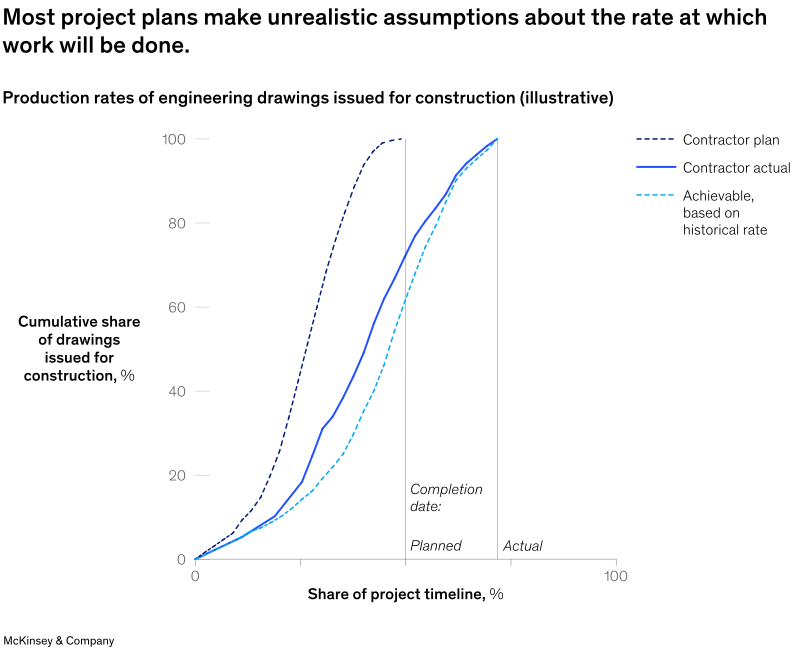
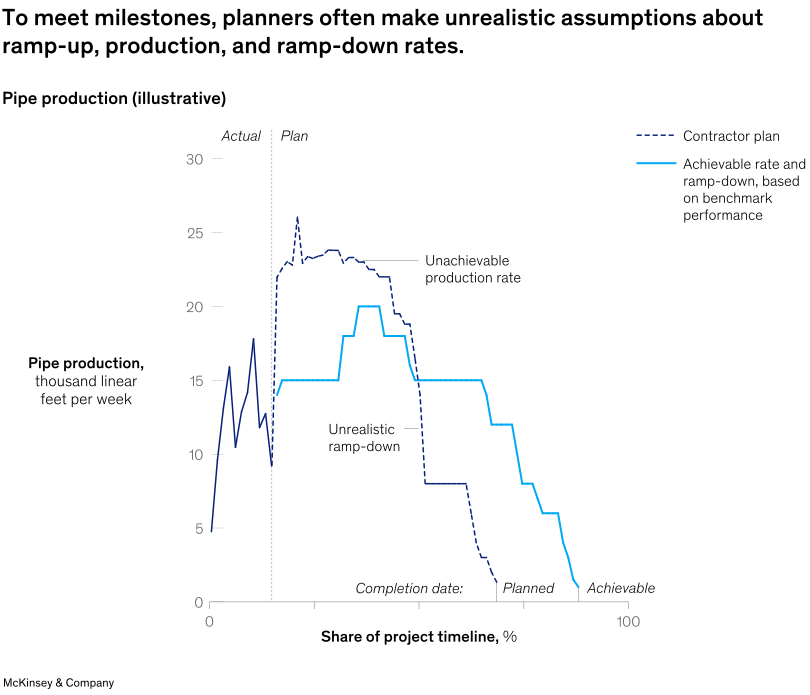
That basic flaw in schedule design is compounded by the way companies measure and report progress during execution. The usual measures of progress are earned value or milestone adherence. The former approach attempts to estimate the proportion of each project activity completed as a percentage of the total work hours. The latter compares the actual completion date for various project phases with the planned completion date. Neither method provides an effective mechanism to control execution performance across the full scope of the project. For example, earned value estimates don’t tell planners enough about which specific activities are putting schedules at risk, and apparent progress can be manipulated in the detailed earned value calculations. Meanwhile, the milestone adherence approach encourages front line planners to work from the milestone back. Sometimes they throw extra people at a task to accelerate progress as each milestone approaches, thus making unrealistic assumptions about achievable ramp up, production, and ramp-down rates, and therefore to unachievable resourcing plans (Exhibit 2).
Planning based on physical realities
We believe there is a better way to build project schedules. Instead of earned value or milestone adherence, planners should base their schedules on the actual work required. We call this approach rate-based planning. It involves building plans based upon more granular rates, like drawings produced per week or physical installation rates such as cubic meters of concrete per day, tons of steel per day, or feet of cable per day. When project teams focus on what must be produced to advance execution, they can build a forward-looking view of the production rates required to meet the scheduled completion date.
With that forward-looking view in place, the project team can design a production system to deliver the rates they need. A well-designed production system ensures the availability of sufficient resources, such as crews, equipment, material delivery capacity, or engineering and supervisory support. The team can also consider including allowances for weather delays, mobilization to different parts of the site, or holidays, all of which help ensure that the expected production rates represent project conditions.
Rate-based planning in every stage of the project
Leading companies are taking rate-based planning beyond single activities or trades, applying the approach across multiple disciplines, project phases, and delivery partners. Planning based on achievable rates is not just for construction; it can be applied to every project stage. Early on, this approach can apply to engineering and procurement. A metals company had a greenfield capital project where final engineering and construction were occurring simultaneously. The team was constantly under pressure to deliver specific Issue for Construction drawings and open logical work fronts for the construction teams. To avoid delays, the engineering team needed to replan how the work was completed, based on the time required to perform each unit of work and the total number of drawings required. By moving to rate-based planning, the team could adjust resources and workloads to meet the requirements and issue drawings on time.
To go beyond the typical “firefighting” we see on many capital projects, it is possible to apply rate-based planning on a project currently in the execution phase. One complex infrastructure megaproject was facing significant cost and schedule pressure at its 60 percent completion point. To stop things from slipping further, the project management team introduced a rigorous closed-loop performance management cadence connecting the front line to executive leadership, allowing all levels to better understand and improve on drivers of variance. For example, the team took daily trips to the field to identify needs and enable performance improvements. Where the issue was significant, the owner added booster teams to increase field productivity with tactical initiatives on underperforming work fronts such as improvements to construction planning, production readiness, or execution management. The project team ultimately deployed around 750 such initiatives, which increased the productivity of critical activities by 30 to 40 percent and reduced costs by around $1.5 billion, or 15 percent of the remaining project spend.
When construction winds down, production rate planning can make a difference in commissioning and start-up. A technology company had historically faced performance challenges in maintaining consistent durations during the commissioning of new data centers. The owner’s team developed a predictive production rate tool for commissioning activities, which it used to pressure test the schedule before starting and to manage daily and weekly commissioning performance.
In a sector that relies heavily on meeting specific demand signals, this rate-based commissioning planning helped the data center team improve both necessary resource allocation and predictability in reaching late-stage milestones.
Overcoming barriers to superior project execution
Organizations that want to start using production rates typically need to overcome two key barriers. First, they may lack key data and analytical capabilities to make effective decisions based on that data. Second, complex relationships between project stakeholders can interfere, delaying or preventing the translation of planning decisions into execution reality. Dismantling each of these barriers requires a systematic approach.
Investments in data and analytical capabilities
Companies that have spent decades managing projects with milestone schedules are not used to defining, capturing, and reporting project production rate data. Project teams frequently spend hours chasing down data to answer even simple queries about project progress and outcomes. As a result, those teams often resist the introduction of new processes that would lead to better data, because they believe tracking and reporting are onerous, rather than the key to better project execution.
Each project may face a different data availability challenge. In some cases, data may already be tracked in detail by the contractor or subcontractor, and the project team just needs access to existing data. In others, data is tracked informally or inconsistently, requiring efforts to standardize the data to make it usable. Sometimes data isn’t tracked at all, and the team can get a foundation of data by starting with simple approaches like manual counting by crews or hiring a quantity surveyor. Finally, teams wanting a technology option can evaluate the new solutions that scan real progress against a 3D model.
Ultimately, gathering the production rate data will allow project teams to compare their own production rates against global and regional benchmarks by craft to identify opportunities for productivity improvement. Production rate steering also creates the transparency that executives crave—especially data that can lead to better forward indicators, like daily production progress by craft. When rates are transparent, project teams spend less time putting out fires, because they can spot problems and intervene sooner.
Healthy contractor dynamics
Capital projects have long been plagued by complicated relationships between owners, contractors, and subcontractors. Our earlier work on contracting finds mismatched incentives, drawbacks to various contract structures, and struggles to create a healthy culture—but also potential solutions, including collaborative contracting, project delivery hubs, and pre-construction collaboration.
To succeed in rate-based planning, the full team needs a healthy dynamic, working together to drive results and performance. At first, increasing the transparency of project plans through the exchange of rate-based data can increase friction between stakeholders. When one organization reviewed a contractor schedule that met its proposed completion date, it found that the proposed rates would be impossible to deliver. Uncovering nothing but rate issues left both sides feeling frustrated by the increased transparency. Nevertheless, they designed a collaborative way of working, where the field work was informed by the contractor using rates to design a realistic schedule, and then transparent performance data unlocked more opportunity.
Data sharing and transparency should be reinforced using contract clauses that allow the owner to capture the data it needs to understand production rates. Owners with a grasp on production rates can then collaborate with contractors and subcontractors to remove roadblocks hampering productivity and capture opportunity across multiple areas of the project.
Start slow to go fast
Companies sometimes fear that the transition to a production-rate-based approach to project planning will be long, painful, and disruptive. While rate-based planning does require more time and investment of expert capacity up-front, this is a classic case of “start slow to go fast.”
That was the case for a chemical company where a project director decided to do things differently after many years of experience with traditional planning. He started by staffing the owner’s team with members committed to using production rates to solve for project success. That team worked with the project’s engineering, procurement, and construction management (EPCM) partners and its major contractors to create a construction plan with achievable rates based on historical project performance. The company used its new plan to direct day-to-day execution, sharing daily goals with frontline team leaders. The project used a skilled workforce and proven construction practices to deliver results that significantly exceeded expectations. Planning 80,000 welds with realistic rates led to significant improvement in pipe installation productivity. The welding teams achieved top-quartile welding performance, completed the project three months earlier than planned, and saved approximately $60 million compared with the original plan.
Paving the way for gen AI
Capturing detailed production rate data also enables the transformative power of generative AI on projects. Production rates distill the complexity of huge projects into digestible, repeatable tasks, and tracking them creates the data necessary for project teams to deploy generative AI. Companies already have created value by using production rates in generative scheduling, and over the longer term, we foresee the potential to unlock major value through a new agentic planning approach that can increase the granularity of planning and make execution more rigorous. All of this impact must begin from the foundation of production rates.
Companies that work with their delivery partners to address the productivity challenge through rate-based planning see benefits that far outweigh the investment required to change their working methods. This approach enables the planning function to use different thinking, including more predictable “construction recipes,” a closer-to-real-time picture of execution progress, and rapid identification of opportunities to streamline and accelerate delivery. This type of investment unlocks predictability, enables better risk management and early intervention, and sets the stage for the next wave of improvements, where data is captured automatically in the tech-enabled capital projects of the future.