Around the world, businesses report feeling squeezed by disruption. The response? A combination of the evergreen and the new. The evergreen: supplier changes, cost cutting, and restructuring. The new: adoption of digital solutions and AI.
But will either option work?
The track record of traditional cost-focused transformation isn’t encouraging. Decades of research shows that only a minority of such efforts sustain improvement. For AI, the jury is still out: Almost 90 percent of organizations say they’re at least experimenting with AI, but only 7 percent report scaling it across the enterprise. AI’s most advanced forms—especially agentic AI—show even lower penetration, with at most one-quarter of organizations even experimenting with AI agents in any function.
To see how companies can better respond to disruption, we surveyed 1,000 senior and midlevel executives worldwide (see sidebar “Our research”). First, encouraging AI news: Companies that are advanced in applying AI see significantly higher productivity and profitability than their peers. Second, the fundamental elements of operational excellence—robust management and technical systems, a strong corporate purpose, and well-defined operating principles and behaviors—matter as well. These elements become visible through everyday practices such as setting clear KPIs, reallocating resources based on real-time data, and continuously incorporating customer feedback. In the survey, companies that do these consistently show markedly higher profitability.
The greatest results come from combining the two. Companies that have built advanced technology into their operational excellence achieve higher productivity increases than companies relying mainly on manual or analog systems. Perhaps even more important, companies scoring higher on operational excellence are further along in deploying AI–reinforcing earlier research showing that high performers innovate faster and optimize their operations more successfully.
Mastering both is difficult, however. Across sectors, AI adoption rates correlate closely with revenues, underscoring the impact of scale and access to resources. Midsize companies appear pinched: their level of operational excellence tends to lag behind both larger and smaller organizations, and their AI implementation lacks the scale advantages that the largest businesses have.
Companies that are behind in AI adoption face hard choices but can learn from the sectors that are pulling ahead—particularly tech-centric industries like pharmaceuticals and semiconductors. These sectors also account for many of the sites recognized for their advanced-manufacturing capabilities by the Global Lighthouse Network (a project of the World Economic Forum and cofounded with McKinsey), offering additional lessons on combining operational excellence with thoughtful AI implementation.
This article outlines how leading companies build a performance loop deliberately—using operational excellence to turn AI ambition into sustained performance gains.
AI and operational excellence increase productivity and returns
Survey results show a distinct performance advantage for companies that move beyond isolated AI use and deploy it across the enterprise. Even amid widespread disruption—reported by nearly all respondents—companies with AI embedded across multiple functions generate nearly double the profit margins of peers using AI in only a few departments (Exhibit 1). The difference is even more pronounced in capital returns: Three-year ROIC is more than five times higher, indicating that enterprise-wide AI adoption helps companies allocate capital more effectively and convert innovation into sustained financial value.
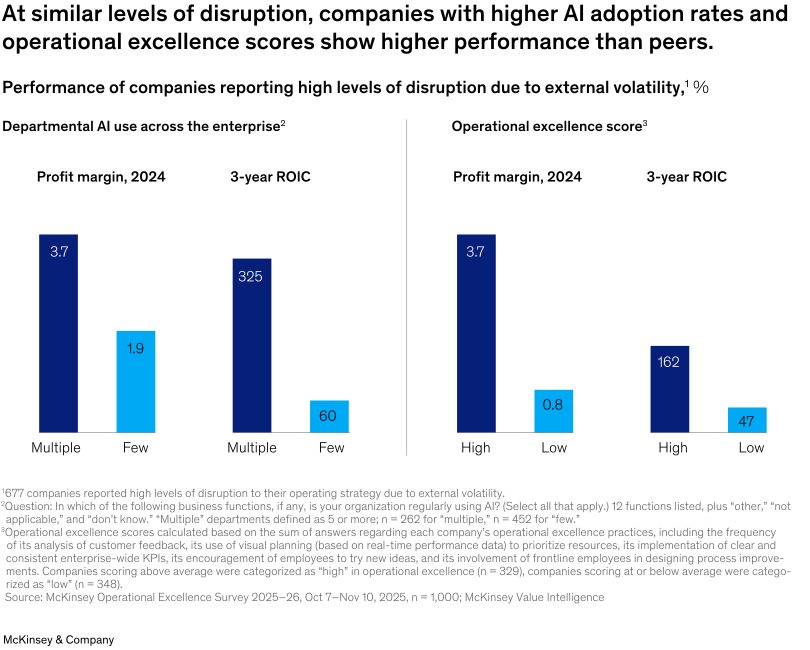
While the survey identifies correlations rather than causal relationships, the consistency of the patterns—linking AI deployment, operational practices, productivity, and financial performance—suggests that companies with stronger operating systems are better able to translate AI investment into measurable results.
Operational excellence delivers similarly strong benefits. Companies with high operational-excellence maturity outperform less-mature peers by a wide margin, achieving comparable profit margins and more than triple the three-year ROIC. The parallel uplift from AI scale and operational excellence underscores a critical point: Technology alone does not drive performance. Instead, strong operating disciplines—clear KPIs, disciplined resource allocation, and continuous performance management—create the conditions in which AI can deliver outsize returns. Together, these forces form a reinforcing performance loop. Operational excellence enables AI to scale, and scaled AI further strengthens operational performance—particularly in periods of disruption. As AI becomes embedded in daily workflows—optimizing planning, improving quality feedback, and accelerating operational decisions—it strengthens the very performance routines and data transparency that enabled its adoption in the first place.
Productivity is the link to results
Productivity emerges as the primary mechanism behind the profit and capital-return advantages. As operational-excellence maturity increases, productivity gains rise steadily, with high-maturity companies concentrated in the highest improvement bands and low-maturity peers lagging far behind (Exhibit 2). These sustained gains help explain why operationally mature companies outperform on margins under disruption: higher throughput, lower variability, and more efficient use of assets translate directly into stronger operating performance.
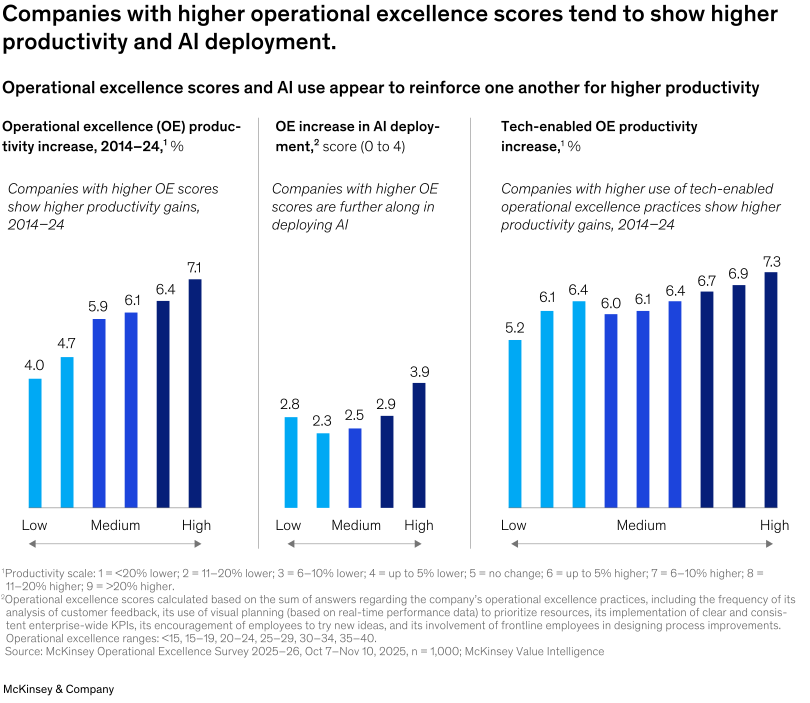
Technology-enabled operational excellence amplifies this effect. Companies that embed real-time data, digital workflows, and advanced analytics into their operating models achieve the largest productivity improvements. Likewise, organizations with higher operational-excellence maturity are further along in deploying AI, reinforcing a virtuous cycle: Productivity gains free up capacity and capital for faster AI deployment, while scaled AI sharpens operational performance further. For example, one of the world’s largest producers of lithium has built on more than a decade of operational-excellence investment to create AI systems that use data gathered from drones and embedded sensors to reduce water use while raising output and product quality. The company is now designing agents to handle complex maintenance and process-improvement tasks, which are increasingly critical as mining sites age and ore becomes more difficult to extract.
AI delivers productivity gains only when it moves beyond pilots
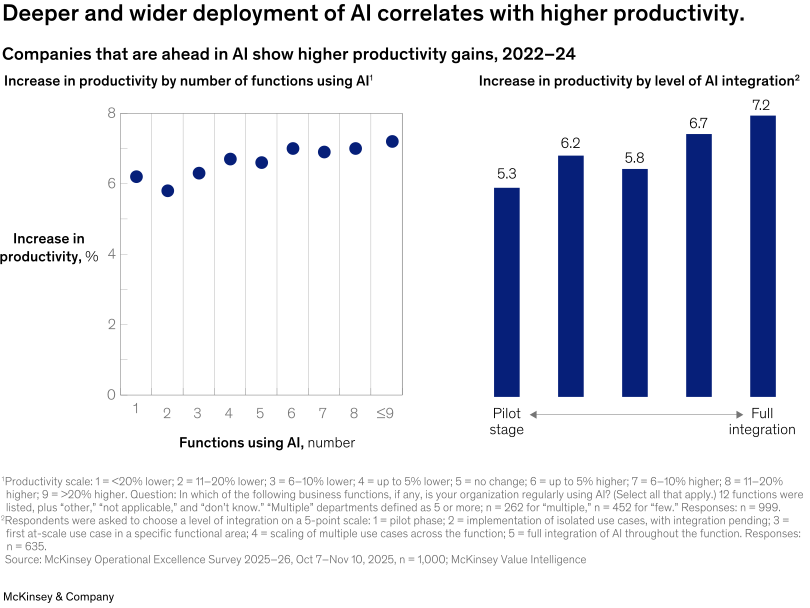
The survey shows a clear relationship between the scale of AI deployment and productivity improvement (Exhibit 3). Companies that embed AI across more functions report steadily higher productivity gains, while those limiting AI to a small set of use cases see far more modest results. The pattern suggests that AI’s impact comes not from experimentation alone but from integration into core operational processes.
A global automotive manufacturer illustrates the point. Facing stagnant financial performance, the company undertook a broad redesign of its operating model, starting from a detailed understanding of what customers actually wanted. The review revealed extensive technical debt and highly manual internal processes that slowed decision-making and frustrated customers. Leadership therefore focused first on simplifying processes and redesigning workflows, while committing to rapid iteration and the thoughtful deployment of AI capabilities.
Careful mapping of processes from end to end revealed needless complexity and delay. Gen AI—and AI agents with autonomous decision-making capabilities—dramatically shortened processing times. Software development productivity rose by up to 44 percent, while AI-supported sales tools helped create tailored customer profiles and contributed to a roughly 40 percent increase in incoming orders. The organization ultimately identified long-term efficiency potential of about 20 to 25 percent as AI adoption spread across the business.
What it means to be operationally excellent today
The survey results reinforce that operational excellence results from the coherence of a company’s operating system, building on longstanding disciplines to achieve far more from technologies such as AI. Companies with higher profit margins consistently share a small set of practices: clear and consistent KPIs that cascade from leadership to the front line, enterprise-wide performance measures tied to purpose, and the disciplined use of real-time data to prioritize resources and decisions (Exhibit 4). These elements enable alignment at scale, allowing organizations to move faster and with greater confidence—especially under disruption.
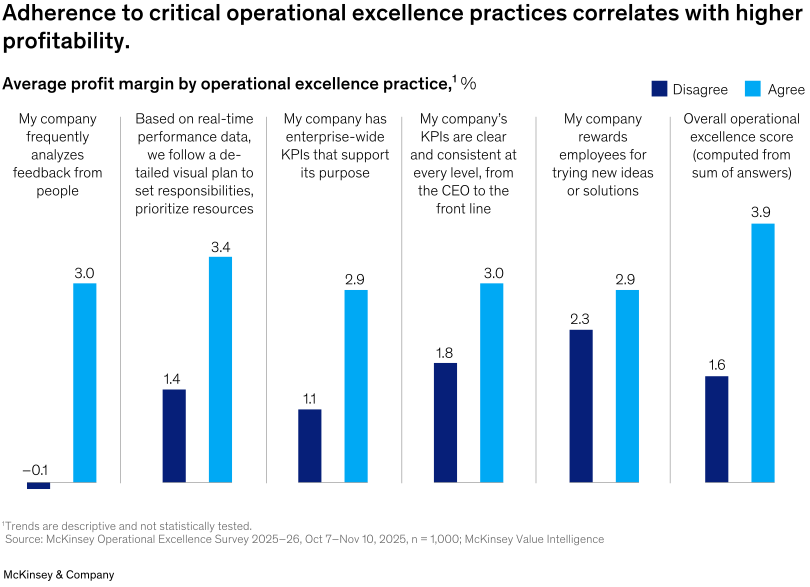
This definition of operational excellence reflects how leading companies have evolved their operating models over time. No longer relying solely on standardized processes or periodic improvement programs, they treat operational excellence as a living system that combines execution discipline with digital enablement and continual learning. Performance management becomes faster and more transparent, decision rights are clearer, and data flows enable teams to adapt in real time. Incentives and leadership behaviors reinforce this system, encouraging experimentation and problem solving while maintaining accountability for results.
Companies that invest in operational excellence as an enterprise-wide capability are better able to absorb disruption, redeploy resources, and integrate new technologies without fragmenting their operations. These foundations make it easier to scale AI and sustain productivity gains, reducing friction when speed, coordination, and judgment matter most. They are not reserved for the largest organizations; midsize organizations (with 500 to 5,000 employees), which have often faced particular challenges (see sidebar “Squeezed in the middle”).
Differences across sectors are instructive. Service-oriented industries such as finance, technology, and pharmaceuticals score highest on operational-excellence maturity, reflecting their long-standing emphasis on performance transparency, standardized decision processes, and disciplined execution at scale. Many advanced-manufacturing sectors—such as automotive and semiconductors—also perform strongly, drawing on deep operational playbooks refined over decades. Other sectors lag modestly, often reflecting greater asset intensity, variability, or fragmentation.
These differences highlight where operational excellence has become a repeatable organizational capability. Industries that score higher tend to pair robust performance management with strong execution routines, creating operating environments better prepared to absorb disruption and scale new technologies.
Siemens Nanjing: Making digital twins work by strengthening the operating backbone
At Siemens’ Nanjing site, high product variability and small batch sizes put constant pressure on throughput and delivery reliability. Frequent changeovers disrupted flow, while line balancing required continuous manual adjustment. As demand volatility increased, cycle times swung and lead times stretched.
The leadership team explored digital twins but resisted scaling them prematurely. A digital twin does more than simulate; it exchanges data with live production systems and can influence real equipment. Without strong governance, that bidirectional flow raises cybersecurity risks, creates latency concerns, and undermines operator trust. Teams questioned whether models could safely inform production decisions in a high-mix environment.
The site responded by tightening its operating backbone before expanding the technology. It integrated a manufacturing operations management system that governed data flows between virtual models and physical assets. Teams validated simulations through structured plan–do–check–act routines before implementing changes. Clear decision rights defined when human confirmation was required. Leaders treated IT/OT integration and data standards as core operational disciplines.
With those controls in place, digital twins became a daily management tool. Engineers used 3D layout planning and real-time simulation to rebalance lines, test cycle-time scenarios, and optimize labor and machine utilization. Units per hour increased 50 percent. Delivery lead time dropped 83 percent. Cycle time fell 12 percent.
Qatar Shell: Strengthening asset reliability before scaling AI
Qatar Shell’s gas-to-liquids facility in Ras Laffan operates one of the world’s largest energy production systems, converting natural gas into liquid fuels and other products at industrial scale. As operations expanded, the site faced challenges due to siloed systems and fragmented data. Access to specialized technical capabilities was constrained, while asset-integrity risks required careful management. Maintenance and inspection processes were largely reactive.
The site concentrated on one high-value intervention: improving asset reliability through real-time monitoring and predictive analytics. Site leaders deployed physics-based models combined with live operational data to assess structural integrity and predict corrosion in critical equipment. These systems now generate continuous insights on asset condition, allowing teams to prioritize repairs and align maintenance with planned shutdowns.
The same discipline guided operations. AI-enabled optimization systems now adjust production parameters in real time, replacing manual interventions and improving responsiveness to system disruptions. Integrated models simulate flow conditions and recommend optimal settings, enabling faster, more stable operations.
These changes translated into measurable performance gains. Engineering costs fell by 90 percent, and response time to system upsets dropped by 98 percent. At the same time, more targeted maintenance extended the lifetime of critical equipment by six years and reduced capital expenditures by 64 percent—demonstrating how stronger operational foundations can improve both reliability and cost efficiency at scale.
What it takes to turn AI into results
Among companies that already use AI at scale, profit margin differences are striking. The strongest performance comes from honing a small set of organizational capabilities: well-defined processes for defining AI business cases, the ability to deploy AI across multiple functions, access to sufficient resources—people, data, and systems—to build high-value applications, and an agreed road map for adoption (Exhibit 5).
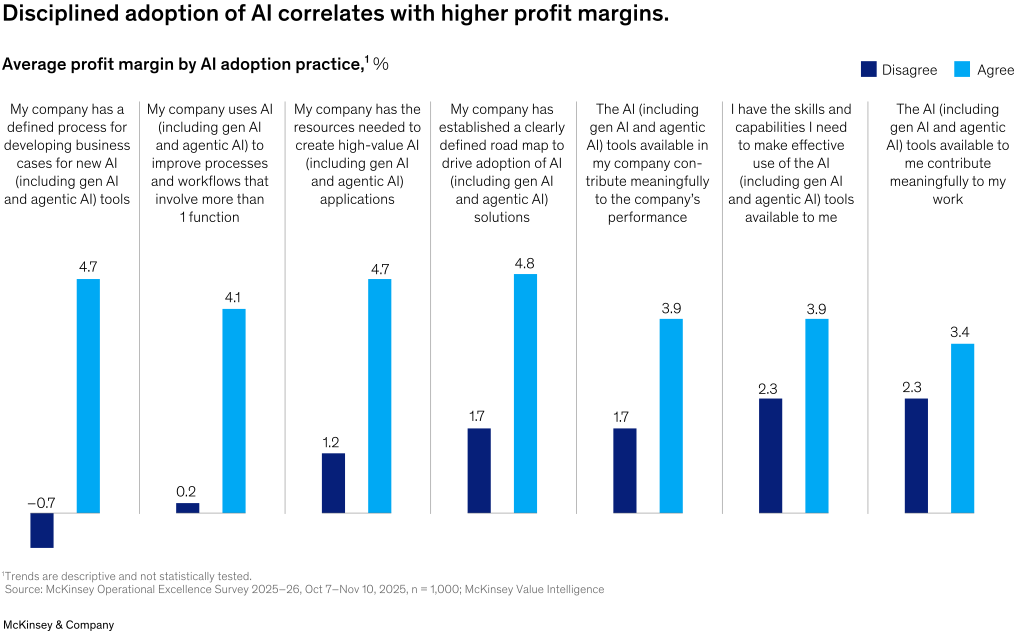
Leading companies increasingly move beyond experiments to embed AI in core workflows and link use cases directly to operational and financial outcomes. They also invest in the capabilities required to scale, including stronger data foundations, processes redesigned around AI-enabled decisions, and talent models that combine technical expertise with operational context. Where these elements come together, AI becomes a repeatable performance lever; where they do not, gains remain uneven.
As with operational excellence, sector patterns reinforce the point. Industries such as technology, financial services, pharmaceuticals, and parts of advanced manufacturing are more consistent in deploying AI across functions, reflecting years of investment in data, analytics, and execution discipline. Their experience suggests that success with AI is less about adopting the latest tools and more about building the operating muscle to use them well. For leaders elsewhere, the implication is pragmatic: Getting good at AI means focusing first on clarity, integration, and capability building—so that when AI is deployed, it can meaningfully contribute to performance rather than remain confined to pilots.
Midea: Closing the quality loop with AI-enabled complaint resolution
Before its transformation, Midea’s Si Racha (Thailand) site struggled to keep pace with a growing volume of customer complaints across more than ten countries and 800 service centers. The plant logged over 1,000 quality issues each year. Engineers investigated them manually, often piecing together information from multiple systems. Resolution cycles stretched beyond 60 days. With limited experience across the team, root-cause analysis varied in speed and consistency.
Midea redesigned the entire complaint-resolution process and built AI directly into it. Customer feedback now flows into a central platform linked to the plant’s quality system. The system reads and categorizes complaints, matches them to similar past cases, and identifies which product, line, or shift is most likely responsible. It then suggests likely causes and recommends actions, which engineers review and confirm. Each step—from complaint intake to corrective action—follows a defined sequence, supported by shared data.
The result is a tightly integrated loop between customers and the factory floor. The time from quality issue to action plan was reduced to one day. Defect rates declined 43 percent, and customer complaint rates dropped 32 percent.
CITIC Dicastal Morocco: Accelerating engineering and production with AI
CITIC Dicastal’s Morocco site produces highly engineered aluminum automotive components. Each product must meet tight tolerances while adapting to rising customization and sustainability requirements. As volumes grew, process variability increased. Quality control became more complex, and manual inspection and adjustment slowed performance.
The site concentrated on one high-value intervention: stabilizing and automating core production processes. It deployed machine learning models to optimize casting and machining parameters, improving weight accuracy and reducing variability. AI-enabled vision systems inspect complex parts at high speed, improving detection of critical defects. Engineers review and refine outputs before implementation.
The same discipline guided operations. Faced with variability in energy inputs, the site introduced advanced process controls to stabilize furnace performance and reduce consumption. Predictive maintenance based on knowledge graphs extended equipment life and reduced downtime. These systems were embedded in daily workflows and supported by a structured effort to build local technical capability.
Defect rates fell by more than 30 percent. Overall equipment effectiveness increased by 17 percent. Labor productivity rose by 27 percent. Direct energy-related emissions fell by more than 50 percent.
How leaders build the loop deliberately
Companies that succeed with AI rarely begin with technology alone. Instead, they build the organizational conditions that allow new tools to translate into operational and financial results. Schneider Electric’s Evreux (France) distribution center offers a useful example. Facing rising demand for circular products and tighter environmental requirements, the site redesigned its operating model so returned products could be refurbished and reenter the supply chain at scale. The transformation illustrates how leaders deliberately build the performance loop, using operational disciplines to anchor and scale AI in day-to-day execution:
- Start with a small number of operational priorities. Leading companies anchor AI efforts in a few high-value operational outcomes—such as throughput, yield, service levels, or asset utilization—grounding technology investment in core performance metrics instead of spreading investment across dozens of pilots. At the Evreux distribution center, leaders began with a focused operational problem: how to handle returned products not as exceptions but as part of normal operations. That meant prioritizing a few core capabilities—reverse logistics, refurbishment, and inventory valuation—before expanding the circular product portfolio.
- Design for scale from the first use cases. Early initiatives are chosen not only for impact, but for their ability to cut across functions and integrate into core workflows, reinforcing an end-to-end process perspective and aligning data, ownership, and decision rights. At Evreux, the redesign linked logistics, finance, and warehouse management so circular products could move through the same systems and processes as new ones. In procurement, agentic AI is already beginning to automate complex sourcing tasks. One energy company deployed an AI negotiation platform to engage more than 2,000 tail-spend suppliers simultaneously, delivering about 2.5 percent savings across the addressed spend base in two months.
- Build the operating backbone alongside the technology. Leaders treat data foundations, performance management, and governance as central operational disciplines, so technology outputs translate into consistent actions. Schneider Electric redesigned financial logic so returned products could reenter inventory with transparent valuation, while integrating two SAP systems to manage both linear and circular product flows within a single warehouse platform.
- Embed capability where decisions are made. Technical expertise is placed alongside operators and business leaders, ensuring new tools reflect how work actually happens and that accountability remains clear down to the front line. At Evreux, a dedicated team coordinated reverse logistics, refurbishment, and redeployment, linking operational decisions with the data systems supporting them.
- Sequence ambition with absorption capacity. The strongest performers balance operational stability with capacity for change, avoiding both extremes: waiting for perfect conditions or scaling faster than the organization can absorb. Operational discipline provides stability; technology provides acceleration. Schneider introduced governance routines that tracked circular inventory, demand, and product status in real time before expanding the circular range across the facility.
- Use operational excellence as the stabilizer—and technology as the accelerant. When the two advance together, productivity gains compound, capital is used more effectively, and performance becomes more resilient over time. Within two years, circular products accounted for 38 percent of the product range at Evreux while Scope 3 emissions fell 43 percent—demonstrating how operating-model redesign can enable both operational and sustainability gains.
Disruption is unlikely to ease. Companies that combine operational discipline with the ability to scale new technologies are best positioned to pull ahead. Built together, operational excellence and AI form a durable performance loop.
This article was originally distributed in May 2026.