Tariff tumult. Shifting geopolitical alliances. AI acceleration. Structural shifts are reshaping global trade. On this episode of The McKinsey Podcast, McKinsey Senior Partner Shubham Singhal and McKinsey Partner Jeongmin Seong speak with Global Editorial Director Lucia Rahilly about how to adapt to the current phase of global trade reconfiguration—from where to manufacture to supply chain decisions—and how best to invest.
In the second half of this episode, McKinsey Senior Partner Kate Smaje joins Lucia to answer some audience questions from a recent McKinsey Live webinar, based on the second edition of the book Rewired, about how to transform your organization in the age of digital and AI.
The McKinsey Podcast is cohosted by Lucia Rahilly and Roberta Fusaro.
This episode has been adapted from our McKinsey Live webinar series.
The following transcript has been edited for clarity and length.
The new logic of global trade
Lucia Rahilly: 2025 delivered a massive shock to trade. We saw the highest US tariffs in generations, changing up trade dynamics and, perhaps most visibly, pushing something like $165 billion in trade away from the US–China corridor. And now, in 2026, the disruptions have continued, including acute instability, let’s say, in the Strait of Hormuz, which is, of course, a critical choke point for more than a fifth of the world’s seaborne oil and gas trade. Nevertheless, I was super surprised to learn that trade continued to grow in 2026, despite what looked like a really turbulent year. Shubham, talk to us. What did the MGI [McKinsey Global Institute] research reveal about the status of global trade?
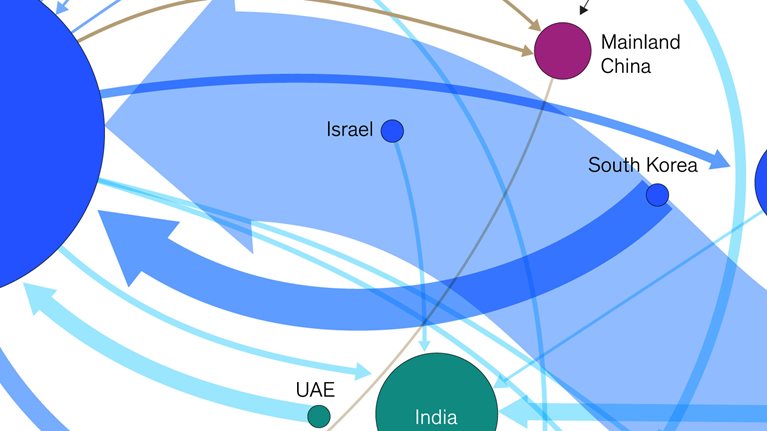
Shubham Singhal: We have to remember that countries trade because every country needs something another country has, even if we change a few policies. Some people say, “Oh, it’s fragmenting. It’ll regionalize or localize.” In fact, trade is traveling over longer geographic distances. It isn’t localizing or regionalizing. It’s rewiring toward shorter geopolitical distances—that is, the alignment between countries and their foreign policies.
And we are seeing this alignment happen, with more geopolitically aligned countries trading more with one another. The biggest example, of course, being, as you said, US–China direct trade. Also, some people paint with one broad brushstroke when talking about trade. But at MGI, we looked at three different views.
One is whether the trade or category is in a critical area. We talk about critical minerals as one of those, or semiconductors. Second, is it concentrated production? In other words, is the production of those, or the source of those, concentrated in one area? And then lastly, are you receiving that from geostrategically unaligned countries?
If you were to take US imports and apply all three of those factors, 5 percent of US imports would fall into the category of being very critical, probably national-security sensitive, concentrated, and coming from a geostrategically unaligned country.
So the rewiring is much more surgical than saying 100 percent of trade has to be rewired to, in this case and for those purposes, 5 percent. The world is seeking balance. Just take the US and China, for example. The US probably consumes far more and produces far less today than it used to.
China, on the other hand, produces a lot, while domestic consumption still hasn’t quite caught up. And in all of the discussions over the last year, the focus was on goods. But we should understand that trade in services, data, and intellectual property [IP] is also quite significant. And we see those continuing to grow and reconfigure in terms of where they happen.
Lucia Rahilly: At a high level, could you say something about the other primary challenges and risks leaders are confronting in the throes of all this geopolitical flux?
Shubham Singhal: We see the interplay with domestic environmental, labor, and immigration policies. On one hand, there’s the desire to solve some of the climate change and other issues we face. On the other hand, energy security matters. So how do we think about that as balancing forces? We see a lot of import and export and capital controls playing out, particularly in those concentrated arenas.
We’ve seen the semiconductor debates. We’ve seen currency movements. How those are managed clearly affects trade. Now, with Russia’s invasion of Ukraine and the conflict in the Middle East, the security environment fully and completely plays a role.
Countries are increasingly focused on the resilience of their national security and defense capabilities, which is leading to a lot of foreign investment restrictions, sanctions, embargoes, and the like. You also see this playing out in AI and the debate on technology transfer.
How should you think about IP diffusion? The importance of cybersecurity? And then, as you said, you see those dynamics impacting choke points, including economic and critical choke points. But there’s also a lot of multilateral cooperation, and alliances come about as part of this.
Because as conflicts happen, the alliances also shift around. And with them shifts the movement not just of defense technology, but also of trade and other arenas of cooperation among major economies.
How shifting trade corridors are reshaping growth
Lucia Rahilly: Jeongmin, let’s zero back in on trade specifically. Walk us through the forces that are doing the most, in your view, to reconfigure the trade landscape.
Jeongmin Seong: Three really stand out: AI, China, and the rise of connecting economies. Let me talk through these one by one. The overall size of AI-related trade is relatively moderate. But it accounted for about one-third of global trade growth in 2025. And that growth was even more pronounced in the United States.
That’s because the US accounted for roughly half of global new data center construction last year. And this trend is continuing into 2026, creating a massive ripple effect globally. For example, many Koreans are quite happy these days because the stock market rose by more than 70 percent, largely driven by two semiconductor companies.
People in Taiwan are also happy because its GDP grew at around 14 percent in quarter one, again, driven largely by the AI-related value chain. So AI is the first big factor. The second factor is China. But in the new China story, it’s not just about “Made in China”; it’s also about “China inside.” That is because China is becoming the factory to the factories. So last year, despite very high tariffs, China actually had a record-high trade surplus.
But if you break it down, China’s exports of final consumption goods actually declined. But exports of intermediate goods—which are basically inputs into additional production processes—grew by around 9 percent.
And close to half of China’s trade is with so-called Global South economies, or emerging economies. China is enabling these economies to become the factories of the world. And this trend is, again, continuing into 2026.
The third factor is the rise of the connecting economies, most notably ASEAN [the Association of Southeast Asian Nations] economies. They are basically playing the role of matchmaker for the global supply chain, keeping it from breaking up. In 2025, ASEAN exports grew by about 14 percent. Imports also grew by about 11 percent. But what was interesting was where this growth was coming from.
On the export side, the United States contributed about one-third of export growth. On the import side, China represented about half of total import growth. So the big question for these connecting economies is how far this can go, and whether they can add meaningful local value.
Business leaders will need to constantly reassess how trade corridors are shifting and reposition their global footprint accordingly.
Want to subscribe to The McKinsey Podcast?
Lucia Rahilly: There’s a view that China’s export growth, which you just broke down, is driven largely by price cuts. What’s really going on there?
Jeongmin Seong: There’s some truth to that narrative. It’s often said that China’s domestic competition is very fierce, squeezing margins and pushing companies to export more aggressively. But that is only part of the story.
If you look at the data, prices for final consumption goods have fallen by about 8 percent. But if you look upstream at intermediate and capital goods, price on average stayed relatively stable—and in some cases even increased further. So the answer is that it’s partly true, partly not true.
Lucia Rahilly: Let’s move on to foreign direct investment [FDI]. Jeongmin, how should leaders be reading the FDI signals right now? And is capital flowing in ways that reinforce these trade shifts, or cut against them?
Jeongmin Seong: I don’t make predictions, because predictions would be wrong. But I can offer some helpful leading indicators to monitor.
In my view, that is FDI. Money moves faster than physical networks. We analyzed about 200,000 FDI announcements and found that the reconfiguration along the geopolitical lines we spoke about is happening faster than trade.
In fact, it’s growing twice as fast as trade. There are two main drivers behind this. One is sector reconfiguration. About 75 percent of FDI is now going into what we call “future-shaping sectors”—for example, AI infrastructure, advanced manufacturing, and the resources that power them.
The second is geographic reconfiguration. The US became a magnet for FDI. On the other hand, FDI into China declined by about two-thirds. However, China still maintains its level of outbound investment and therefore remains a major outbound investor. The implication for business leaders is clear: FDI can be a very credible, forward-looking indicator. Therefore, use it to anticipate potential changes early and inform decisions on manufacturing footprints and supply chains.
Adaptability is a competitive advantage
Lucia Rahilly: That’s a nice segue into implications for readers and how they can use this information. It can feel challenging to predict how the structural shifts will play out in the near and long term. Practically speaking, what counsel would you offer executives here? Shubham, this one’s for you.
Shubham Singhal: We just did a round of CEO interviews over the last few months and really sought to understand the characteristics of companies navigating this.
Five things emerged. The first was on managing the image of disruption to earnings. What we found interesting about the leading companies was that they went beyond the defensive, asking, “How do I actually drive the productivity, given I now have this signal? I have to look into it. What else can I question and improve?”
They went one step further and asked, “If I improve my economics, there will be others in the industry who won’t keep pace. Could those companies become available to be acquired, or could we take share away from them?”
The second example was that these folks were thinking about capital deployment. They asked themselves, “Where across the different scenarios would we be making a fairly good bet? Where is the bet not clear in terms of if these scenarios come out against us?”
Now, the operations point is obvious. Everyone’s thought about this and about how to manage it. Global operations are more resilient. I’ll give you an example. When the US and Canada got into that tit for tat on tariffs, Canada put tariffs on chocolates.
One global company started shipping chocolates from Europe to Canada and took their US production and shipped it elsewhere. That’s a very simple, trite example. But we’ve seen this across industries, with folks saying, “Do I have a global footprint? I have global markets, therefore I have global production.”
This idea of adaptability of your production network—and the agility within it—has become very important. But global production has been much more resilient. Growth is the other one. Jeongmin talked about the sheer shifts we are seeing in growth rates of different trade corridors.
When we say trade corridors, not only do we mean the trade between two countries, but also trade at the category level. Aligning with those growing corridors literally puts you in that double-digit growth, which is very important. Of course, on the flip side, you could be in things that are declining quite significantly as well.
And then there are sectors. Defense is a growing sector—we know that. Some of the sectors that Jeongmin talked about are forward leaning, like advanced manufacturing, energy, and infrastructure. We’re seeing folks lean into all the services that go into that and align themselves with those growth sectors.
The final point is that the faster your organization can move, the better off you are. Enter markets, exit markets, redeploy capital, move production, move different markets, and move people. When a crisis erupts, be able to respond quickly. When an opportunity opens up, be able to go after it quickly. This idea of speed within an organization is becoming a real basis for competitive advantage in this era of volatility.
Lucia Rahilly: Shubham, you gave the chocolate example. Could you give one more example of a company that has responded proactively to these challenges?
Shubham Singhal: I think there are a number of companies that are doing a good job. Last year, as Liberation Day happened, a global consumer company had the challenge of everyone looking at their situation and saying, “This is a pretty meaningful hit to our earnings. How should we think about it?” They stepped back and said, “We need to plan around this. We need to understand the scenarios. What events actually change my decision? How do I think about that decision at that point in time? When that happens, what plans do I have in place to move?”
They rewired their strategic planning to be much more event and scenario based, and much more adaptable.
Lucia Rahilly: Shubham and Jeongmin, thank you for joining us today.
Kate Smaje answers questions you submitted about AI and digital transformation
Lucia Rahilly: Kate Smaje, congratulations again on the second edition of Rewired, our McKinsey playbook for winning with technology and AI. We featured you and one of your coauthors, Rob Levin, on a recent episode of The McKinsey Podcast, and we received a veritable deluge of questions as a result—well over a thousand audience questions—which was amazing.
Kate Smaje: Awesome.
Lucia Rahilly: It’s a huge testament to the situation: executives are looking for counsel as they navigate this incredibly fast-changing AI era and try to realize more meaningful ROI. Obviously, we can’t tackle a thousand questions here, but many of these questions converge around similar themes, so we distilled several of them into a selection that we’ll cover here.
Kate Smaje: Wonderful.
Lucia Rahilly: AI is evolving and learning faster than many of us. How should leaders be thinking about organizing around what AI is capable of now, versus what it might be capable of in the future? How can we manage that old problem of building and flying the plane at the same time?
Kate Smaje: The advice I would give is that you’ve got to be in it for a genuinely dynamic, constant learning cycle. You must ask yourself, “How can I be the fastest learner here?” I think that is key to winning in AI.
How do you make that not just an individual effort, but a collective effort? What are the insights and diverse thinking that we’re going to get from outside, and how are we going to serve that up to people without having to wait for a formal training course or to actually embrace the viral peer-to-peer elements of that?
We’ve got to relearn how we learn. But I come back to this point about unlearning as well, because I think it’s not talked about enough in this space. With agentic in particular, one of the superpowers of executives right now is, “Can I almost release the paradigms, the orthodoxies of how I understand my business and ask, ‘What if? What if that really were different? What if that end-to-end process had half the steps it has today? What if agentic allowed me to break what I thought was fair market share and do something really outsize or seismic, in terms of the level of change?’” That’s what allows you to reimagine.
Lucia Rahilly: That is a nice segue to a question we got from a number of folks who were either CIOs or CIO equivalents in their organization. What’s something that CIOs should consider when they’re confronted with CEOs who are erring on the side of caution, who maybe are less prone to adopt this “what if” unlearning attitude and who want to take their time vis-à-vis AI transformation?
Kate Smaje: In some ways, you could argue that speed without trust will destroy value, right? Additionally, trust without speed destroys relevance. In all the research we’ve done across hundreds of transformations, we have not found a singular highly successful transformation that did not have not only the buy-in, but also the real, genuine, hands-on leadership of the CEO.
There may be lots of business leaders in an organization, but if you’ve got a reluctant CEO, AI adoption is going to be really tough. In that situation, I think it becomes important to help them understand why and how this is going to help drive business value.
The second thing I would say is that, for the broader kind of leadership cohorts, you must speak their language, which is, “How is this going to drive my business performance?” You need to ask yourselves whether that means getting to a structurally different unit cost, getting to outsize market share or revenue share gains, driving EBITDA uplift, or maybe even improving operational outcomes. Speaking their language of, “This is what I want to help you to accomplish. We’re going to use technology to do that, but really it’s about business change.”
Lucia Rahilly: From your point of view, are we overestimating AI’s ability to drive EBITDA in certain sectors?
Kate Smaje: There are enough proof points now to say the money is absolutely there. In the latest edition of the book, we looked at a cohort of the 20 most economically successful companies using AI, and the average EBITDA uplift in that group—not the top performer, but the average—was 20 percent from their AI initiatives.
And importantly, for every dollar they put in, in terms of investment in AI, they’re getting back, on average, $3 in EBITDA. But for many, the dissonance is still too great between the promise of AI and the reality of how far that has driven real, true, tangible bottom-line performance.
It’s less of an industry-specific problem. It’s much more the heart of your question: “Are we overestimating AI’s ability to drive this?” Possibly. Because it isn’t the technology. AI transformation is, at its heart, a people transformation to get to differential outcomes.
Lucia Rahilly: What are the top three KPIs for measuring the impact of AI in the current moment that leaders should be looking at more closely?
Kate Smaje: I always come back to the question, “What are you trying to get out of AI?” That’s why you must go back to this domain-level change and identify what outcomes you’re trying to drive. For some organizations, the key metric will be an EBITDA metric—for example, a financial metric.
For others, it might be yield or throughput. If you’re in heavy industry or agriculture, for example, it’s about, “How much yield can I actually produce?” In other cases, it might be customers. You might say, “I want to raise my NPS [net promoter score] here. I’m trying to get to a differential customer outcome, and I’m using AI to engage more deeply and more systematically with my customers, and therefore my metric is NPS,” for example.
I think one of the mistakes a lot of companies make is thinking there is one uber metric and that metric is the same no matter what they’re trying to do, as opposed to really thinking hard about the outcomes and key results they’re trying to drive for a particular reason.
Another metric that gets a lot of heat is adoption. But adoption can’t be the only metric. Even if I have everybody adopting a tool, that still doesn’t mean I’ve created value from it. I think you must be careful with a bunch of these metrics. Make sure it’s anchored in something that is going to drive genuine outcomes.
Lucia Rahilly: We had several questions about where you see leaders looking to AI to drive benefits beyond growth and productivity. Do you have any suggestions beyond these kinds of efficiency benefits?
Kate Smaje: A lot of what I’m seeing with super users comes down to AI being used for human “outperformance” to reshape the way work is done. They will use it so that their work is done better—not just faster and cheaper. That is quite an important way of thinking about AI integration.
Related Articles