As headlines with big claims about AI dominate the news, leaders are trying to realize the promise of these technologies. A set of outperforming companies prove that a specific constellation of behaviors—including focus, strong underlying capabilities, and the right approach to change—can help leaders translate new technologies into real, meaningful value.
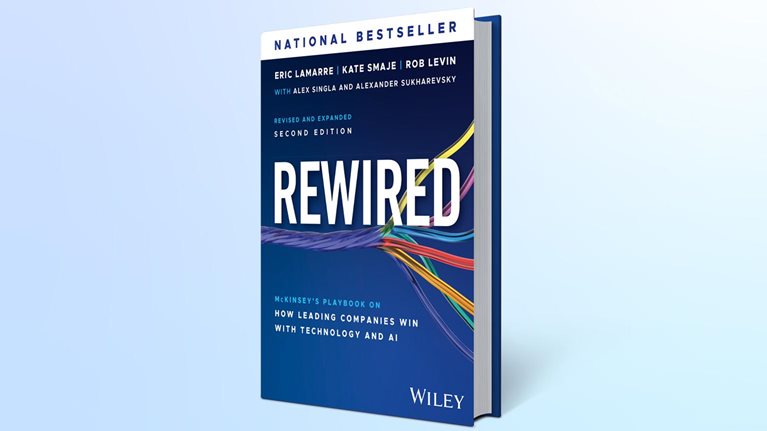
McKinsey Senior Partners Rob Levin and Kate Smaje are two of the authors of Rewired: The McKinsey Playbook on How Leading Companies Win with Technology and AI (Wiley, April 2026), a revised and expanded version of the best-selling first edition of Rewired. In this McKinsey Live webinar with Global Editorial Director Lucia Rahilly, Levin and Smaje explored what has changed since the release of the first edition, and dove into what successful companies are doing differently and how to start delivering value from artificial intelligence.
You can watch the replay of the full discussion above, including the Q&A, or explore the following transcript, which has been edited for clarity and length.
What’s changed and what’s at stake
Lucia Rahilly: The first edition of Rewired offered leaders a framework for how companies can empower themselves with tech and AI. What prompted this revision?
Rob Levin: I think at some level, the world didn’t give us a choice on whether to write a second version. Most of the world saw ChatGPT for the first time three and a half years ago, and since then, technology has changed further. AI has moved from machine learning into agentic AI, this new capability to automate end-to-end workflows. We really wanted to look back at the framework we established three years ago and say, “Does this recipe for established companies to organize, align, build, adopt, and scale AI still work?”
We kept coming back to this quote by the Greek poet Archilochus: “We don’t rise to the level of our expectations; we fall to the level of our training.” That still feels pretty true to both this moment in AI and to the core thesis of Rewired, which is that any given company is aligned on the “what” of AI in its industry—where the value is, what domains can be transformed, and the big business cases—but companies will only perform at the level of their capabilities.
That’s what we wrote about in Rewired and what we wanted to check this time around. As generative and agentic AI have become increasingly important, do companies with these capabilities continue to do well? That was probably the core learning for us in writing this edition: The companies that have built these capabilities in AI 1.0 have succeeded far more as we’ve gotten into AI 2.0 than companies that haven’t.
Freeport-McMoRan is a great example of this. In the first book, we had a story about Freeport building a digital twin of its entire copper concentrator, creating end-to-end efficiencies across the process of taking copper from the rock. They were incredibly successful in driving value. They then turned their attention to generative AI and approached another area of the business, leaching, which is the final chemical process to get the ore out of the rock, and created a whole bunch of additional value. That was a good example of how, once the company had these rewired capabilities, they continued to serve them incredibly well, even as AI has shifted toward gen AI and agentic AI.
Lucia Rahilly: Kate, talk to us about what’s at stake here if we accept that AI-enabled transformation is a must. What’s the scale of the change that needs to happen, and is it worth it?
Kate Smaje: Change is hard, and it does take a big lift. You can’t shy away from that. But one of the things I was excited about with the second edition was just getting a lot more nitty-gritty about what the value capture is. Because we hear so often, “I’ve got AI everywhere in my organization except for the bottom line.” What we wanted to do was get granular about where we see impact.
I want to share three numbers about this, specifically looking at a cohort within our research set of 20 companies that are doing this well and have really applied the framework, soup to nuts.
Number one is that those 20 companies have an average EBITDA uplift of 20 percent.
Number two: On average, it takes one to two years to become cash accretive. You can do this quickly. What’s interesting is that two-thirds of the cohort were able to do this with three or fewer focus areas for their transformations. So again, they’re not papering AI everywhere across the organization. They’re being incredibly focused on where they point their resources.
And then, the last number I’ll give you is, for every dollar that they are spending of investment, they’re getting three dollars back on average. In the grand scheme of returns that you can get, that’s not too shabby.
So, to your point, do we see the value is there? Yes, we absolutely do. But that’s within the cohort of the 20 companies really applying this in a rewired way, versus others trying different elements of it, not quite building that muscle, and therefore falling short of these numbers.
Successfully rewiring, then and now
Lucia Rahilly: What separates the companies that get there from the ones that fall short? Is there anything new in today’s agentic context that’s made a difference?
Rob Levin: One timeless core belief we have is that the differentiating capability is not the “what” of a transformation. Peers in a given industry usually share a similar view on how to create value through AI. The differentiation is the “how engine,” your ability to predictably, consistently turn your attention to the important capabilities and know that you’ll be able to build, adopt, and scale them to value.
Three categories of capabilities make a difference. One, align on a business-led road map that moves the needle by focusing on a few domains, versus spreading use cases across the board like peanut butter. Two, build a set of enabling capabilities around talent, the operating model and ways of working, the tech stack, and data—which is of course the lifeblood of AI. And three, maintain a focus on adoption and scaling.
In a few areas, the emphasis has shifted because of gen AI. In strategy, the new emphasis is end-to-end workflows. The value of thinking about broader change versus individual use cases has become incredibly clear with agentic AI and its ability to automate most tasks in an end-to-end workflow. In our latest State of AI research, among about 2,000 respondents, one of the practices with the highest correlations to value was reimagining workflows end to end, not just dropping AI tools into existing workflows.
On the talent side, we talked a lot in the first edition about the challenge of getting the right density of scarce technology talent. We need to think through that broad workforce transition, the skills we want in our employees, and what roles remain after agentic AI runs its course.
In technology, there is this 20 times software development productivity, this incredible fundamental disruption of code writing. It’s really collapsing this model of the “two-pizza team” of around eight people, to two people: a product owner who knows the definition of what good looks like, and a full-stack engineer who can work with code writing systems, debug it, and work it into the architecture. That’s a huge change.
It’s also never been more complex to solution technology than at this moment. Every vendor at every layer of the stack is making a claim to be the center of your AI gravity, and many of these vendors come with a high level of ongoing operating expenditures. It’s easy to think about point solutions or agents and core platforms for every function of the business, but when you step back, that’s a brittle architecture. It’s maybe inefficient architecture, maybe a less secure architecture, and so thinking about that becomes important.
Lastly, if you take a workflow and reinvent it, that means taking a clean sheet of paper, reimagining the process, breaking down all the roles into tasks, reconstructing them into new roles, and training everybody. It’s an incredible transformation, and I think if most companies looked in the mirror, they would say, “We haven’t fully transformed or reinvented an end-to-end workflow in a long time, if ever. We’ve continuously improved.” And so, we would say, this needs to be done over the next several years, and a change adoption tool kit is critically important.
Lucia Rahilly: Kate, give us a little color on companies that have rewired successfully and what they’re doing.
Kate Smaje: For me, one of the biggest differentiators is they’re able to operate at a different metabolic rate. Their latency from insight to decision, and from decision to action starts to look different. This isn’t digital transformation for transformation’s sake or AI transformation for its own sake. It’s about outcompeting, and to outcompete you’ve got to deploy capabilities and move faster than the peer next to you.
One example we revisit in this edition is DBS. For three or four years, it made hard foundational investments, so when generative and agentic AI came around, it was able to move really fast. They saw around a billion Singaporean dollars of tangible, verifiable benefits from AI. It’s only because the foundational capabilities were there that, as the technologies changed, they were able to move faster. So, for companies that are rewired, it’s both the speed of operations that feels genuinely different and the compounding value of these capabilities over time.
The key to getting started
Lucia Rahilly: For leaders who want to get started, what’s the most practical approach to next steps in your view?
Kate Smaje: When you step back from all of this, think: What are those signature moves, those things that would really make a difference here? And how do I get started against those? I use this approach in my day-to-day life to say, “Look, am I really doing these things?” It allows you to pause and take stock. If you’re doing these things and really can hold the mirror up against yourself, then you’re on the right path.
I think very few of us now are starting from day one. It’s much more of, “I’m in the mix, I’m in the arena. How do I make sure that I’m spending my money in the right way, that I’m pointing my very precious resources at the right things, and that I’m on a path to value?”
I’ll pull out a couple of personal favorite points from the shortlist. The first is making sure you are aiming your resources at the points of greatest economic leverage and are solving business problems that matter and will move the needle for you. It is striking to me how many companies I spend time with who think they did that at the start, but when it really comes down to it, they spread resources like peanut butter because everybody had their own version of the strategy. So, think in end-to-end domains, not use cases, and really point at three or fewer that move the needle for your company. If I’m in retail, that’s probably forecasting and planning. If I’m in insurance, that’s probably claims processing. If I’m in heavy manufacturing, that might be yield or throughput.
Every AI transformation at its heart is a people transformation. That is truer today than it has ever been. The talent density on your teams matters, particularly the technical talent density. At the same time, as agents take over more coordination, routine, execution, and decision-making, the human role shifts up the value stack as well. Start to think about what having both carbon and silicon employees together in one organization works and the level of people change needed. If you’re not thinking about your AI transformation as a set of people changes, then you’re probably off track somewhere.
Rob Levin: I think that speed as a defining organizational advantage is interesting. You mentioned DBS, and I think the $1 billion realized value is impressive. The other north star metric I love about DBS is that when they started with AI, it took them 18 months to get their first model into production. Now, they put a model into production every two months. That speed is the differentiated capability that allows them to keep doing more and go faster.
I’m also a fan of agentic engineering. I think this is the fundamental disruption that we’re only beginning to see the potential of. A great example is LATAM Airlines, which is probably a year ahead of most companies in terms of adopting and embedding agentic engineering, not just for coding, but for the entire software development life cycle, and they’re going so fast as a result.
And related to your point, AI has changed the talent mix. We need great engineers, but we need those who have retooled themselves with agentic software.
Who should lead the change, and how?
Lucia Rahilly: These points converge on a single unavoidable question: Who owns this transformation? Where does accountability sit?
Kate Smaje: It’s both top-down and distributed. In all the hundreds of transformations that we’ve studied, there isn’t one that is successful that does not have the transformation as a number one, number two priority for the CEO. At the same time, the ownership of how to do it has to be distributed across the full leadership team.
I describe it as a corporate team sport. One of my telltale signs when walking into a management team is when someone asks a question, you watch everybody in the room turn and face the one person that’s got it in their job title, that’s when you know that this is not going to work. You need your CHRO [chief human resources officer] to wake up in the morning and say, “What is an agentic organization going to look like?” Your CFO [chief financial officer] needs to rewire the funding mechanisms to allow you to reinvest in this over time. Your business owners, the domain owners, the real heart of the transformation, need to own this, too. So it is top-down and distributed as well.
Long gone are the days when you could delegate this to the technology function and hope for a good outcome. It’s just not enough anymore.
Lucia Rahilly: What are the gaps most businesses miss in their AI maturity journeys?
Rob Levin: One of the first things businesses miss is that these AI transformations need to be entirely business led. We need to think about technology, but the more important thought is, if we take an end-to-end workflow, that’s a core operational aspect of the business, and we’re going to entirely reinvent that with AI. We need to be incredibly thoughtful about how we do it. One of the first missteps is the mindset that the job of an ELT [executive leadership team] is to listen to proposals on AI, resource them, and then turn to the CDIO [chief digital and information officer] to get them done. And we would say, no. I think folks fall back on an old paradigm of working with IT, and that just doesn’t work currently.
I think another obstacle we see is a lack of preparation for adoption in at least three ways. One is, very often we resource things to MVPs [minimum viable products], but have we thought about the fact that when the MVP works, we need to get it to production, rinse and repeat, and scale it across our business? Have we thought about adoption that is not technical? For example, a major automotive company in the book fully reinvented its supply chain, but, as hard as that was, they then had to work with hundreds of suppliers to get them to operate the way the supply chain’s digital twin said they should. These aspects of adoption are often an afterthought and therefore become stumbling blocks.
Lucia Rahilly: What does it take to build AI conviction, both for yourself as a leader and across your organization?
Kate Smaje: First, the best way to build conviction is to focus on the value. Follow where the money is and solve real business problems. That’s the heart of it.
And then second, cut yourself a little bit of slack. This stuff is hard, and one of the benefits of agentic AI is that the cost of iteration has come down. It’s easier to make a wrong turn and pivot. It’s becoming less about coming up with the perfect answer and much more about stress-testing it, owning it, building conviction around it, and building the right to deliver that change. I think there’s beauty in the messiness of the process sometimes, and what ends up on the cutting room floor—and why—may be where the real value sits.