At a glance
- A new early-life asset-building program could generate substantial long-term assets. Under modeled scenarios, broad participation and additional contributions to 530A accounts, also known as “Trump accounts,” could generate between approximately $80 billion and more than $900 billion in long-term asset accumulation for lower-wealth households over the next decade.
- Expanding access does not guarantee broadly shared gains. While 530A accounts could meaningfully increase asset accumulation for lower-wealth households, uneven participation and contribution patterns may allow higher-wealth households to capture a disproportionate share of the tax benefit.
- Participation may matter as much as access. Evidence from other early-life asset-building programs suggests that participation, contribution patterns, and sustained engagement are key drivers of long-term outcomes.
- Small differences can compound into large gaps. Under modeled scenarios, a child receiving only the $1,000 federal seed contribution accumulates roughly $5,000 by age 18, compared with roughly $61,000 with a one-time $10,000 philanthropic contribution and more than $250,000 with sustained annual contributions from families or other contributors.
- Stakeholders can influence outcomes. Government, community organizations, philanthropies, employers, and financial institutions could help broaden participation, direct additional capital toward lower-wealth households, and support sustained engagement over time.
Early-life asset-building programs are designed to help families begin accumulating wealth earlier in a child’s life. These approaches—including child savings accounts, baby bonds, and education savings plans—aim to provide children with financial assets that can grow over time and support future economic mobility. While these policies are not new, their results have been uneven. Many programs have increased savings participation and asset ownership, but have not consistently reached the lowest-wealth families. Research suggests that long-term aggregate outcomes depend not only on access but also on who participates, contribution behavior, and program design.1
In the United States, a new type of investment account is available to families starting in July 2026. Known as Trump accounts and established under Section 530A of the Internal Revenue Code, these federally authorized, tax-advantaged investment accounts are designed to help parents and relatives save for a child’s future from an early age while advancing a broader asset-building approach.2 Eligible newborns can receive a $1,000 government-funded seed investment, subject to enrollment or activation, that is intended to compound over time in low-cost diversified portfolios (see sidebar, “What is a 530A account?”).3
While much of the discussion around 530A accounts has focused on account access and eligibility, the McKinsey Institute for Economic Mobility analysis in this report explores a broader question: What determines whether early-life asset-building programs translate into meaningful asset accumulation over time? Evidence from prior programs suggests that participation, contribution patterns, and sustained engagement may be as important as access itself in shaping long-term outcomes.
Economic mobility is often associated with education, employment, and income growth, but it is also shaped by asset ownership and the ability of families to accumulate wealth over time. An estimated 40 to 50 percent of American children are born into low-income or economically vulnerable households, depending on the definition used.4 At the same time, intergenerational income mobility has declined. Roughly 90 percent of Americans born in 1940 earned more than their parents, compared with 50 percent of those born in the 1980s.5 Mobility outcomes are also uneven across populations. Black Americans, in particular, experience significantly lower rates of upward mobility and larger intergenerational earnings gaps than White Americans across generations.6
Wealth disparities in the United States remain similarly stark. The bottom 25 percent of households hold very little wealth, with a median net worth of approximately $3,500 and limited ownership of financial assets. By contrast, households in the 75th to 89.9th percentile of the wealth distribution hold more than $1 million in median net worth. As a result, households in these segments are separated by a wealth gap approaching 300-fold.7 The gap is substantially larger when households in the top 10 percent of the wealth distribution are included, reflecting the concentration of wealth at the very top. These disparities reflect unequal access to assets that accumulate and compound over time.8
Against this backdrop, the long-term effects of early-life asset-building programs are likely to depend as much on participation and contributions as on account access itself. If participation and contributions remain uneven and concentrated among higher-wealth households, asset accumulation may disproportionately benefit households already positioned to contribute consistently and more likely to have access to the information, financial tools, and support networks that reinforce long-term investing. If participation is broader and more balanced, however, these programs could contribute to more widely distributed wealth accumulation over time.
The role and potential of early-life asset strategies
Consistent with the Urban Institute’s Upward Mobility Framework, we recognize that economic mobility encompasses three interconnected components: economic success, dignity and belonging, and power and autonomy.9 Among these dimensions, economic success is closely linked to a household’s ability to accumulate assets and build long-term financial security. Research from the McKinsey Institute for Economic Mobility suggests that wealth building depends on long-term assets that accumulate and compound over time, near-term financial reserves that support day-to-day stability, and broader supports that help families preserve and use assets effectively.
Existing US asset-building tools provide partial pathways into wealth-building systems, but each operates with different incentives and constraints:
- Baby bonds are publicly funded accounts that provide children with an initial endowment to support long-term asset accumulation. Depending on the program design, contributions may be universal or targeted based on household income or wealth.
- 529 accounts are tax-advantaged savings accounts designed for education expenses. Participation and balances tend to be higher among higher-income households.10
- Custodial accounts, such as the Uniform Gifts to Minors Act and Uniform Transfers to Minors Act, allow assets to be transferred to a minor under a custodian. Both enable early ownership but do not include tax advantages or structured mechanisms to support broad participation.
- Custodial Roth IRAs are tax-advantaged retirement accounts that enable long-term compounding but require earned income, effectively excluding most children during early childhood.
For many lower-wealth households, participation in long-term asset-building vehicles can be constrained by more immediate financial priorities such as housing, food, transportation, and emergency expenses. As a result, participation often reflects competing demands on household resources rather than differences in interest in saving or investing for the future. Program design can therefore play an important role in determining who can participate and accumulate assets over time.
Evidence from Child Development Accounts (CDAs, asset-building accounts established for children early in life) and related programs suggests that program design can meaningfully influence participation, savings accumulation, and long-term wealth outcomes. The SEED for Oklahoma Kids (SEED OK) experiment—the first large-scale randomized trial in the United States to automatically open and seed-fund 529 savings accounts for newborns—found that automatic enrollment and seed funding produced near-universal account ownership and about $1,000 more in savings per child. A 2024 Urban Institute simulation projected that baby bonds could more than double median wealth for young adults from low-income families. Together, these findings suggest that long-term distributional outcomes depend not only on account access but also on who participates, contribution structures, and sustained engagement over time.
Within this landscape, Trump accounts represent a new mechanism for expanding access to long-term asset accumulation at scale. The combination of birth-based eligibility, child ownership, and $1,000 in public seed capital for eligible children expands access to long-term asset accumulation earlier in life than many existing tools, which typically require individual or family contributions to establish an account.
More broadly, these accounts can serve as entry points for stacking multiple forms of long-term asset-building alongside near-term support and broader services that help families sustain participation, preserve assets, and translate account ownership into long-term economic mobility outcomes.
Structural factors that could determine impact
The long-term impact of 530A accounts will largely depend on how participation, contributions, and delivery systems shape outcomes over time. Three structural factors may ultimately determine whether asset accumulation is broadly distributed or reinforces existing disparities.
Wealth inequality and distributional outcomes
The potential impact of asset-building systems depends not only on account access but also on who participates, who contributes, and how assets compound over time. Early-life asset-building programs such as 530A create an opportunity for lower-wealth households to accumulate long-term assets, but differences in participation, contribution capacity, and sustained engagement may shape how broadly those gains are distributed. In practice, households with greater financial resources are likely to contribute consistently and remain invested over time, while broader participation and targeted contributions could enable lower-wealth households to accumulate meaningful long-term assets and narrow relative wealth disparities.
Evidence from existing asset-building programs points to similar patterns. In 529 plans, for example, higher-income households contribute more frequently and at higher levels, resulting in disproportionately larger balances. In addition to having greater financial capacity, these households often have greater access to financial advice, investment knowledge, employer-sponsored savings opportunities, and social networks that reinforce long-term investing behaviors. Across programs, uneven participation and contribution patterns tend to produce widening differences in outcomes.
Several reinforcing dynamics contribute to this divergence:
- Contribution asymmetry: Higher-income households contribute more consistently and at higher levels.
- Tax-advantaged asymmetry: Higher-income households receive greater tax benefits from contributions and tax-deferred growth, increasing the effective return on each dollar invested.
- Return asymmetry: Households with greater financial flexibility may be better positioned to maintain diversified investments and remain invested through periods of market volatility, increasing the returns earned over time.
- Compounding duration: Lower-income households are more likely to interrupt contributions or withdraw funds, often because of acute financial needs, such as emergency medical expenses.
Participation itself may be the first gating factor shaping long-term outcomes under the 530A program. Access to accounts does not guarantee account awareness, activation, or sustained engagement over time, and evidence from programs such as 529 plans and CalKIDS (California’s statewide children’s savings account program that automatically provides seed-funded 529 college savings accounts to eligible students) suggests that participation rates may vary significantly across households.
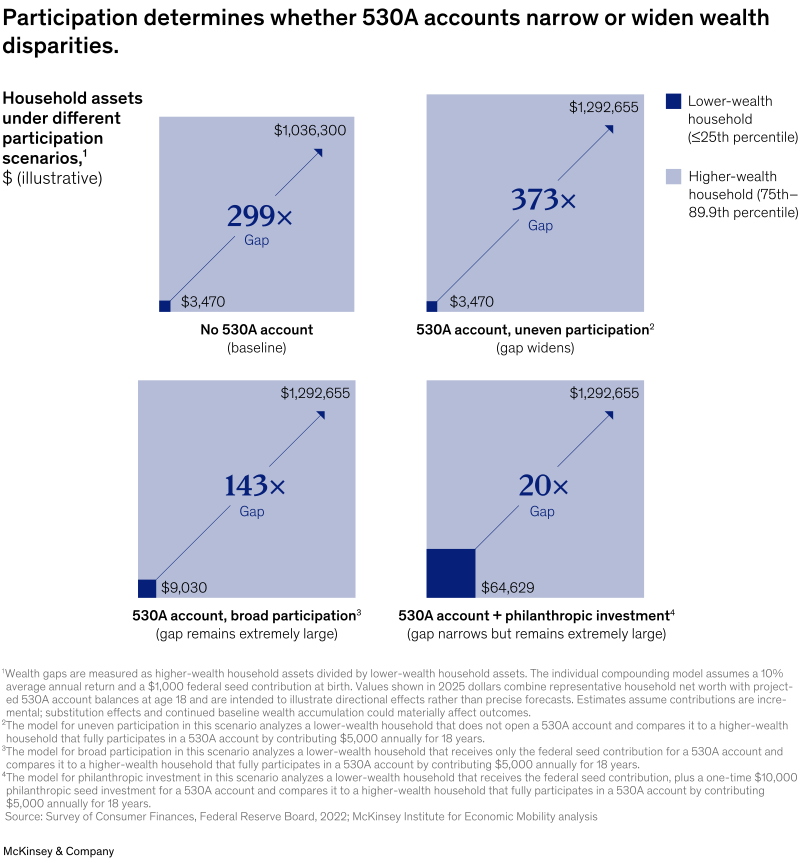
The interactive below illustrates how differences in participation and contribution patterns may shape long-term asset accumulation. Under modeled assumptions, Child A receives a one-time $10,000 philanthropic contribution plus a $1,000 one-time federal seed at birth, resulting in roughly $61,000 by age 18. Child B receives sustained annual contributions of $5,000 (the current combined annual contribution limit from households and employers) plus the $1,000 federal seed, and could accumulate more than $250,000 by age 18. Child C receives only the $1,000 federal seed contribution, and could accumulate roughly $5,600 by age 18. Explore the interactive to see how these account balances diverge over time.11
The distributional impact of 530A accounts over time will depend heavily on who participates and who contributes. Households with greater financial resources are more likely to contribute consistently, remain invested, and benefit from compounding. In practice, higher-contribution scenarios would also likely reflect a combination of household, employer, philanthropic, and other third-party contributions rather than household resources alone. Lower-wealth households, by contrast, may rely primarily on the federal seed contribution unless additional capital, outreach, or contribution supports are provided.
This suggests that Trump accounts could increase long-term asset accumulation for lower-wealth households, while still producing uneven gains across the wealth distribution. In scenarios where participation remains concentrated among higher-wealth households, the modeled relative wealth gap could widen from roughly 299 times to 368 times. By contrast, broader participation among lower-wealth households narrows the modeled relative wealth gap to roughly 143 times, while additional philanthropic contributions could reduce it further to approximately 20 times. Even in scenarios where the relative wealth gap narrows, the absolute gap may widen from approximately $1.0 million to $1.3 million (Exhibit 1).
Quantifying the opportunity
If participation is broad and contributions are more widely distributed, Trump accounts could generate hundreds of billions of dollars in long-term asset accumulation for lower-income children over the next decade. These estimates assume that contributions represent net new donations, rather than reallocated assets from existing vehicles. Explore the interactive below to compare how different child savings and investment accounts—and different contribution levels—may shape long-term asset accumulation over time.
The interactive above illustrates outcomes at the individual account level. To estimate the potential population-level impact, we scale those modeled per-child outcomes across an estimated 1.5 million lower-income children in each annual and extend the analysis across ten annual birth cohorts. Under these illustrative scenarios, Trump accounts could generate approximately $80 billion to more than $900 billion in long-term asset accumulation for lower-wealth households, depending on participation rates, contribution levels, investment assumptions, and continued federal seed funding beyond the initial four-year eligibility period (Exhibit 2).
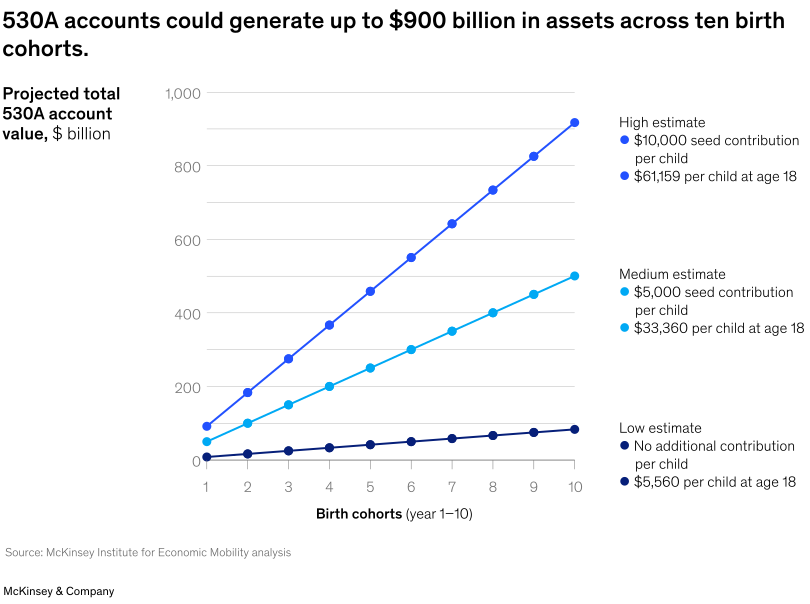
However, these outcomes are not guaranteed. If participation and contributions remain uneven, particularly if higher-income households are more likely to contribute consistently, a disproportionate share of asset growth could accrue to families that already hold a significant share of US wealth.
Participation and sustained engagement
Account creation does not guarantee sustained participation. Participation in 530A accounts depends on a series of actions by families, employers, financial institutions, and donors, including account activation, ongoing contributions, and continued engagement over time. Any potential complexity around enrollment, contributions, and account use could reduce participation, particularly among households with fewer resources.
Evidence from similar programs highlights this challenge. The UK Child Trust Fund—a British savings program that automatically established investment accounts for nearly all children born between 2002 and 2011—achieved near-universal account ownership. Yet many accounts remained inactive or unclaimed, demonstrating that access alone does not ensure sustained engagement.12 More broadly, while automatic enrollment can increase account ownership, contribution rates, and sustained participation vary widely across households.
Structural factors shaping participation and distributional outcomes
The central question is not whether higher-income households will participate and benefit—they likely will. The key question is whether lower-wealth households participate broadly enough to meaningfully expand wealth accumulation across a wider share of families. Evidence from asset-building programs suggests that three factors are particularly important in shaping how gains are distributed over time: contribution patterns, participation design, and system delivery.
Contribution patterns
Evidence from baby bonds and related programs suggests that more targeted contribution structures may produce more balanced outcomes, particularly when starting asset levels are low. How additional funding is distributed therefore is as important as how much is distributed. Broad contributions may increase overall asset accumulation for households already positioned to participate, while targeted approaches are more likely to reach children with fewer existing assets and influence how gains are distributed across households. Philanthropy, employers, and other private-sector actors can influence these patterns through seed funding, matching structures, and contribution incentives. Because disadvantage is unevenly distributed geographically, where capital is directed may be as important as how much is invested (Exhibit 3).
Organizations seeking to contribute to early-life wealth-building assets may see greater impact in areas with higher poverty levels.
1Total annual investment required if philanthropies (or state or local governments) invest $10,000 for each child born in high or extreme poverty.

Participation design
Participation depends not only on access but also on how easy it is for families to enroll, contribute, and remain engaged over time. Automatic enrollment is one of the strongest predictors of participation. Programs such as Maine’s My Alfond Grant, a statewide children’s savings account program that provides a $500 grant for every newborn, demonstrate that shifting from opt-in to automatic enrollment can increase participation from partial uptake to near universality.13 By contrast, more complex processes tend to produce lower and more uneven participation, especially among households with fewer resources.
Initial enrollment, however, does not guarantee sustained engagement. Evidence from CDA programs suggests that participation is higher when accounts are easy to access, simple to understand, and integrated into existing financial behaviors.14 Families may be more likely to contribute when accounts are linked to payroll systems, recurring transfers, or other familiar savings mechanisms. Employers and financial institutions could influence these dynamics through enrollment processes, contribution defaults, account design, and usability, while social-sector organizations support awareness and sustained engagement.
System delivery
The systems used to administer accounts can influence participation, accessibility, and trust over time. Evidence from savings and investment programs suggests that systems that are simple to navigate, easy to access, and integrated into existing financial behaviors are associated with higher participation and sustained engagement. Programs such as OregonSaves, Oregon’s state-sponsored automatic IRA program, use centralized administration and payroll-linked contributions to reduce friction for workers without employer-sponsored retirement plans.15
Financial institutions and platform providers influence system delivery through design, fees, and interfaces, while public and community-based intermediaries can shape access points, coordination, and trust.
How stakeholders could shape the scale and impact of 530A accounts
While 530A accounts are established through federal policy, participation and distributional outcomes will likely be shaped by a broader set of stakeholders. Government institutions can shape implementation through enrollment, activation, administration, and public awareness. Community organizations can support awareness, trust, and sustained engagement over time. Philanthropic organizations can influence how additional capital is distributed across households. And private-sector institutions can help integrate Trump accounts into existing financial and employment systems.
Together, these stakeholders influence different parts of the participation journey—from account access and activation to contributions, engagement, and long-term asset accumulation.
The public sector: Enabling participation and implementation
Government institutions can shape several factors that may influence participation in Trump accounts, including enrollment and activation, program administration, system integration, awareness, and accountability. By simplifying enrollment, reducing administrative complexity, connecting accounts to existing public systems such as schools and benefits programs, and increasing awareness of account eligibility and benefits, governments can help eligible families participate.
Evidence from child savings and asset-building programs suggests that these implementation choices can affect outcomes. For example, the SEED OK experiment found that automatically opening and funding accounts produced near-universal account ownership, while Maine’s My Alfond Grant demonstrated that shifting from opt-in to automatic enrollment could substantially increase participation. Likewise, experiences from CalKIDS and the UK Child Trust Fund suggest that account ownership alone does not guarantee activation or sustained engagement, highlighting the importance of ongoing communication, account visibility, and ease of use.16
Taken together, these examples suggest that the effectiveness of asset-building programs depends not only on the accounts themselves but also on the systems through which families access and engage with them. Governments can further support participation by analyzing enrollment, activation, and contribution patterns to identify and address gaps in engagement over time.
Community organizations: Driving engagement and trust
Community organizations, schools, nonprofits, and local intermediaries often influence whether families activate accounts and remain engaged over time. For example, the SEED OK experiment suggests that pairing accounts with outreach and engagement support can increase both account ownership and savings.17
For social-sector organizations, this creates several opportunities—especially when aided by philanthropic capital—to support participation in 530A accounts. These include increasing awareness, supporting account activation, providing ongoing engagement through communication and financial guidance, and integrating accounts into existing touchpoints such as schools, community programs, or benefits systems. Because these organizations tend to be better positioned than financial institutions to reach underserved families, they can play an important role in building trust, reinforcing the value of long-term participation, and helping families remain engaged over time. Where trusted intermediaries are involved, participation and contribution behavior tend to be more consistent. Without this support, engagement may decline over time, particularly among households facing competing financial priorities.
Philanthropy and catalytic capital: Expanding asset accumulation
Philanthropic organizations, foundations, and impact investors play a critical role in determining how capital is distributed, particularly for households with limited ability to contribute. For example, evidence from 529 plans suggests that higher-income families are far more likely to contribute and to receive state tax benefits, resulting in larger average balances compared with lower-income households.18 Likewise, philanthropic matching programs, such as those offering 2:1 or 3:1 matches on savings, often see the highest uptake among families already positioned to save unless targeted outreach is implemented.19
As a result, how capital is distributed matters as much as how much is deployed. Broad contributions may increase overall asset accumulation, while targeted contributions could influence how gains are distributed across households over time.
Recent place-based efforts illustrate this approach. In Atlanta, Harlem Children Zone’s Youth Opportunity Fund provides participating kindergarten students with access to $10,000 in future asset-building capital through a centrally managed fund structure. Unlike tradiational savings or investment accounts, assets are held and managed within the fund rather than through individually owned accounts. The model is intended to support future uses such as education, homeownership, or entrepreneurship.20
Direct, targeted seed investments address a central risk of 530A accounts: that children who receive only the federal seed may not accumulate meaningful assets if ongoing contributions are limited. Front-loaded capital can create a meaningful asset floor without relying on sustained household contributions.
For philanthropic organizations, this creates several opportunities to shape outcomes. These may include providing direct, targeted seed investments for lower-income children, funding progressive or targeted matching structures, supporting place-based or population-specific initiatives that direct capital to families with greater need, and designing programs that reduce barriers to participation. Philanthropy can also pilot simple, behaviorally effective incentives that encourage families to activate Trump accounts and contribute over time. When deployed strategically, philanthropic capital could help offset differences in household contribution capacity and influence how gains are distributed over time.
The private sector: Embedding participation into existing systems
Financial institutions, employers, payroll providers, and asset managers can help shape how accessible, simple, and integrated Trump accounts become within existing financial behaviors. Evidence from retirement savings programs shows that automatic enrollment, payroll-linked contributions, and simplified account design can substantially increase participation. For example, automatic enrollment implemented by large employers in 401(k) plans has increased participation rates from roughly 60 percent to over 90 percent, particularly among lower-income workers who were previously less likely to opt in.21
Taken together, these findings suggest that convenience matters. Systems that reduce friction and connect to existing financial activity are more likely to elicit broad participation over time.
For private-sector organizations, this creates several opportunities to make it easier for households to build assets consistently over time. Employers could encourage participation through seed investments, matching contributions, or incentives tied to employee participation. Payroll providers could embed contributions into existing payroll systems. And financial institutions could simplify account design, reduce fees, standardize default investment options, and enable automated contributions from multiple sources (such as from employers, family members, or philanthropy) within a single interface.
Together, these actions could help embed 530A accounts within existing financial and employment systems, reduce barriers to participation, and increase the likelihood that families benefit from long-term compounding.
The potential of 530A accounts to scale economic mobility
Early-life asset-building programs—including child savings accounts, baby bonds, education savings plans, and Trump accounts—represent a growing set of approaches designed to expand asset ownership and long-term wealth building. As the first nationally available account of its kind with a federal seed contribution, the 530A program provides a new opportunity to examine how these approaches may operate at scale. If participation is broad and contributions reach lower-wealth households, the program could help millions of children accumulate meaningful assets and generate hundreds of billions of dollars in assets over time.
But account access alone will not determine the outcome. Evidence from early-life asset-building programs suggests that participation, contribution patterns, and sustained engagement ultimately shape who benefits from long-term compounding and who does not.
One of the most important findings from this analysis is the potential to leverage early capital. Under modeled scenarios, targeted philanthropic or catalytic contributions made at birth can compound into substantially larger balances by adulthood, suggesting that investments made early in life may have outsize long-term effects for lower-wealth households.
530A accounts can provide a vehicle for exploring these dynamics, but its long-term impact will depend on how government, philanthropies, community organizations, employers, financial institutions, and other stakeholders support participation over time. The question is not whether these systems can create assets, but whether those assets become broadly shared pathways to economic mobility or reinforce existing wealth gaps.
Related Articles

The Great Ownership Transfer: A new era of business stewardship