At a glance
- A once-in-a-generation wave of ownership transitions is imminent. By 2035, about six million small and medium-size businesses (SMBs) will face ownership transitions as baby boomers retire. More than one million firms are viable candidates for sale, representing up to $5 trillion in enterprise value.
- SMBs are a cornerstone of the US economy. Ninety-nine percent of all companies in the United States are small businesses. They employ more than 60 million workers—nearly half of the US workforce—and generate 35 percent of business revenue. Failed transitions could erase jobs and locally rooted pathways to economic mobility.
- Ownership transition risk is distributed unevenly across geographies. Rural areas are particularly exposed. In some sparsely populated states, small businesses account for more than half of total employment, so failed transitions can stall economic mobility across entire communities.
- Participation gaps represent both a risk and a major wealth-building opportunity. Under current patterns, only 28 percent of transferring value would accrue to women and Black and Latino individuals combined. Closing participation gaps could unlock up to $3 trillion in new household wealth, making ownership transfers one of the most powerful near-term levers to narrow geographic, gender, and race-based disparities in wealth accumulation.
- A better-functioning ownership transition market could preserve jobs and local prosperity at scale. Effective transitions could keep up to 12 million jobs in place and protect about $250 billion in annual local spending power.
As millions of baby boomer business owners approach retirement over the next decade, the country faces the largest wave of small-business ownership transitions in modern history. Millions of firms employing tens of millions of workers will either shut down or change hands, with direct consequences for jobs, wealth creation, and economic mobility in communities across the United States. The outcomes of this “Great Ownership Transfer” are not inevitable. Whether businesses survive or disappear depends on the existence of a functioning market to transfer ownership at scale.
This moment is not merely a generational milestone—it is a structural test of the nation’s capacity to preserve local employment, sustain productive businesses, and support economic mobility. How this transition is managed will determine both the business landscape and the future of economic mobility for workers, aspiring business owners, and entire communities.
Economic mobility in the United States depends on more than education, skills, or individual efforts. It also depends on whether people can access stable jobs and participate in wealth creation over time. For more than 60 million Americans, small and medium-size businesses (SMBs) provide that foundation. Ninety-nine percent of all companies in the United States are small businesses. When those businesses disappear, so do the pathways they support. Failed ownership transitions don’t simply result in closures; they erode jobs, dismantle wage ladders for frontline and skilled workers, and eliminate locally rooted wealth-building opportunities. In many communities—especially outside major metropolitan areas—ownership continuity can be a lifeline for economic mobility.
Yet the systems for transferring business ownership in the United States are fragmented and underdeveloped. Today, most exits end in closure rather than transfer, not because the businesses lack value, but because pathways to succession are limited, opaque, or costly. Moreover, starting a business can be more straightforward than acquiring one. The result is a consequential lost opportunity: Firms shut down, jobs disappear, and hard-won mobility gains dissipate—not through disruption, but through inaction.
To better understand what’s at stake, the McKinsey Institute for Economic Mobility (IEM) has conducted new research on the future of small-business succession in the United States. By 2035, we estimate that about six million SMBs will be on the market as their owners retire. More than one million of these firms are viable candidates for sale or employee ownership, representing $5 trillion in enterprise value that could remain productive if ownership transfer becomes routine rather than exceptional (see sidebar, “About the research”).
Whoever captures this value will shape economic mobility for decades. Today, business ownership remains highly concentrated. In rural communities—where small businesses anchor employment, services, and tax bases—failed ownership transitions risk hollowing out local economies altogether. Under current participation patterns, only about 28 percent of this transferring value would accrue to women and Black and Latino individuals combined. Expanding access to capital, buyer preparation, and inclusive ownership models could turn the Great Ownership Transfer into one of the most powerful near-term levers for preserving jobs, expanding ownership, and narrowing geographic, gender, and race-based disparities in wealth accumulation.
Whether this transition reinforces existing disparities or becomes a catalyst for a broader ownership economy hinges on a fundamental question: Can buyers and sellers operate in a system that enables ownership transfer at scale? Rather than creating new businesses, new owners can step into existing, productive firms. When ownership transfer succeeds, businesses continue to generate jobs, wages, and local wealth. When it fails, economic mobility stalls—even where demand and talent remain.
In this report, we examine the barriers that prevent viable firms from changing hands, the economic opportunity embedded in overcoming them, and the market infrastructure required to turn a looming demographic shift into a durable source of growth, resilience, and shared prosperity. At stake is not only whether firms survive, but who gets to participate in the economy as owners, workers, and wealth builders in the decade ahead and beyond.
The coming wave of ownership transitions
To understand the challenges and opportunities presented by the coming wave of business transitions, we explore the demographic shifts that are ahead and their potential impact on small businesses and future economic capacity.
An unprecedented shift
The United States is entering a period of pronounced demographic transition. Even while Americans are living and working longer as they age, the baby boomer cohort is moving decisively into retirement. The share of Americans aged 65 and older is rising rapidly, while the growth rate of the working-age population continues to slow. After decades of driving labor force growth and economic expansion, boomers are now exiting the workforce in significant numbers, with many already retired and millions more expected to follow (Exhibit 1).
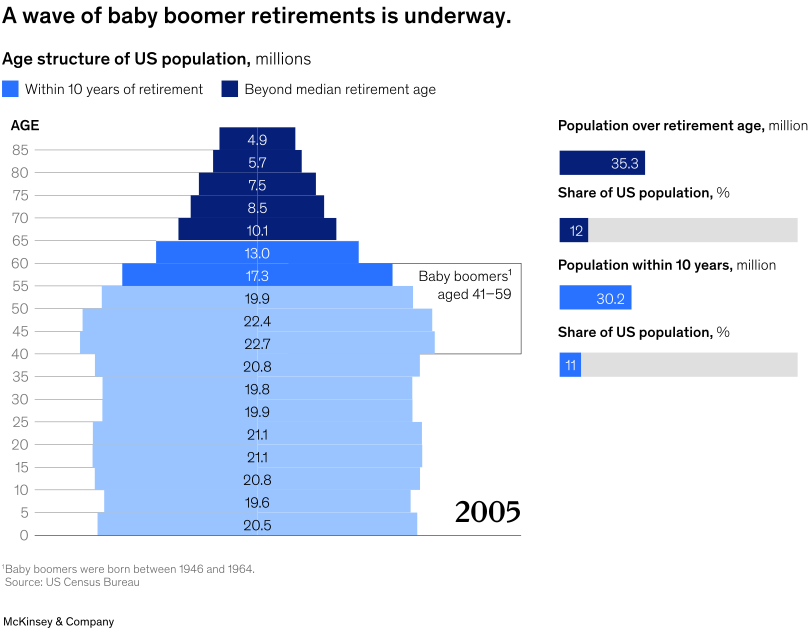
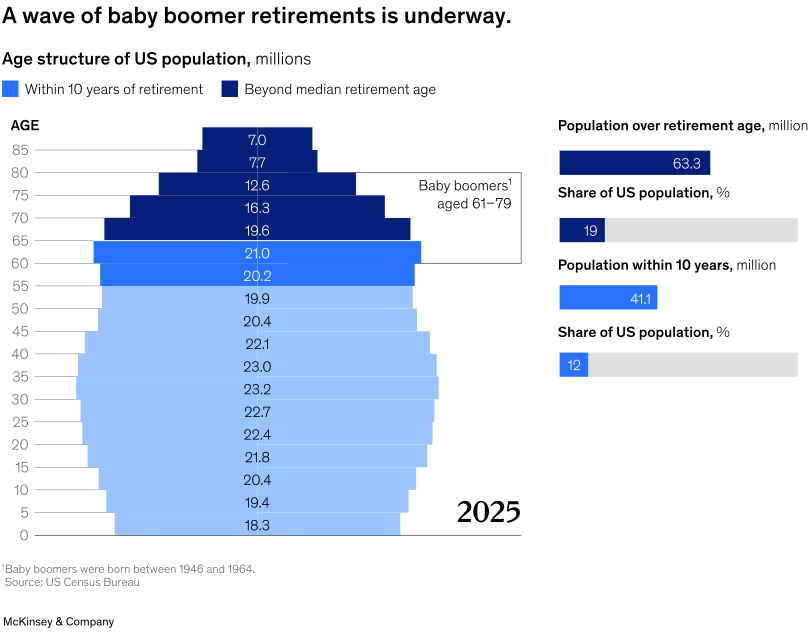
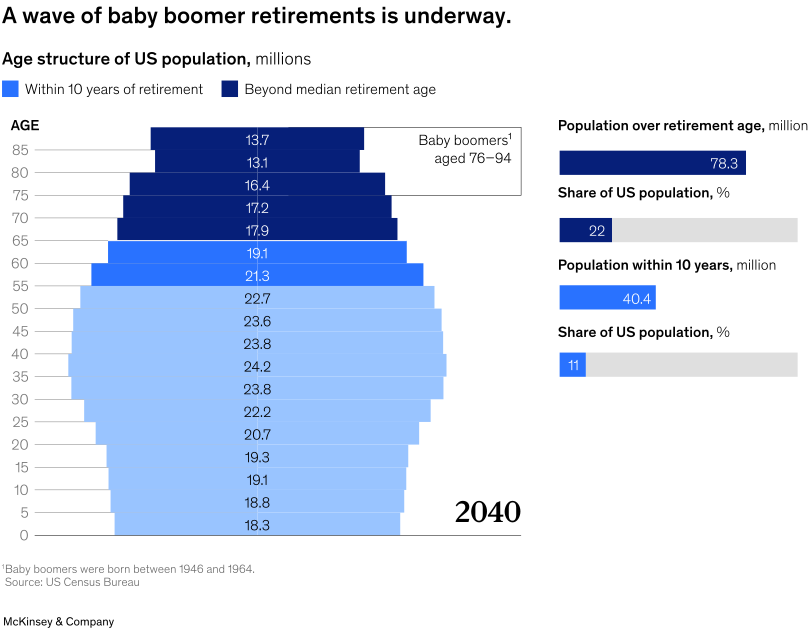
This shift has far-reaching implications for business ownership. Today, more than half of all small-business owners in the United States are over the age of 55—up from roughly 30 percent in 2002. One in four small-business owners is 65 or older. This aging cohort represents approximately 1.5 million firms across the country, with baby boomers alone owning nearly a quarter of all small businesses, about double the share held by their predecessors two decades ago.1
As these owners retire, an unprecedented number of firms will either need to change hands or shut down. Over the next decade, we estimate approximately six million small businesses—which we define as firms with fewer than 500 employees—will exit ownership, up from about 4.5 million in the prior decade. Annual exits could rise to 42 percent above 2011 levels, reaching as many as 665,000 per year.2
These small businesses span every sector of the economy, from neighborhood service providers to family-owned regional manufacturers. They collectively anchor jobs, supply chains, and local tax bases nationwide. The scale, speed, and breadth of this transition make it unlike any other previous period of business succession in US history.
Exits dominated by closure, not transfer
Despite the economic value embedded in many small businesses, closure—not continuity—is the dominant exit path today. In 2022 alone, we estimate that 510,000 SMBs exited the market. Ninety-two percent of those exits occurred through closure, 5 percent were completed as sales, and 3 percent transferred to new owners (often intergenerationally to family members).3
This pattern suggests a structural weakness rather than widespread business failure. Since 2010, 7 to 8 percent of all firms have closed each year. Our analysis suggests that 6 to 13 percent of these closures could have been avoided.4 Many stem from predictable life events such as retirement, combined with a lack of succession planning or access to buyers and financing.
Preparation among aging small-business owners remains uneven. According to a 2025 Gallup Pathways to Wealth Survey, 27 percent of employer firms with owners aged 55 and older are either unsure of their long-term plan or intend to close the business permanently. “Most owners don’t really understand their exit options,” said one leader of an organization focused on helping business owners prepare their companies for a successful transition. “Their wealth is tied up in the business, but they haven’t thought about what comes next or how it’s supposed to support the rest of their lives.” As more owners approach retirement, this lack of preparedness risks accelerating the loss of otherwise viable businesses.
Where the Great Ownership Transfer wave hits the hardest
According to the US Census Bureau, roughly 6.4 million employer firms together employ 62 million workers, accounting for nearly half of the US workforce. Collectively, they generate about $17.8 trillion in annual revenue, representing approximately 35 percent of all business receipts nationwide. They are embedded across supply chains, export markets, and local tax bases, influencing the stability and competitiveness of nearly every sector.
The wave of ownership transitions ahead will sweep across every corner of the US economy, but not evenly. Risk is concentrated where the market for small-business acquisition is weakest. The impacts often fall disproportionately on rural areas and owners from historically underrepresented racial and ethnic groups, where access to capital, advisory support, and successor networks is often more limited. Firms with smaller enterprise value and in labor-intensive sectors (such as construction, food services, and home care and healthcare) are also more at risk. Many already face structural barriers to sustaining viable businesses.
This uneven risk profile matters because small businesses employ nearly half of the US workforce and generate more than one-third of all business revenue. When ownership transitions fail, the consequences extend beyond individual owners. Jobs disappear, supply chains weaken, main streets hollow out, and communities lose essential services.
Understanding where and for whom these risks are greatest is essential to determining whether this transition becomes a story of widespread business loss or an opportunity to preserve jobs, sustain local economies, and expand pathways to new ownership.
Greater risk for rural areas
The geography of the Great Ownership Transfer reveals stark variation in where its effects will be felt most acutely. While ownership transitions create challenges and opportunities nationwide, rural America faces disproportionately more risk—not just because more firms are vulnerable, but because failure in these regions could accelerate broader economic decline. Geography determines whether ownership transitions are absorbed by new formation or compound existing fragility, shaping which communities face the greatest disruption and which benefit from renewed ownership (Exhibit 2).
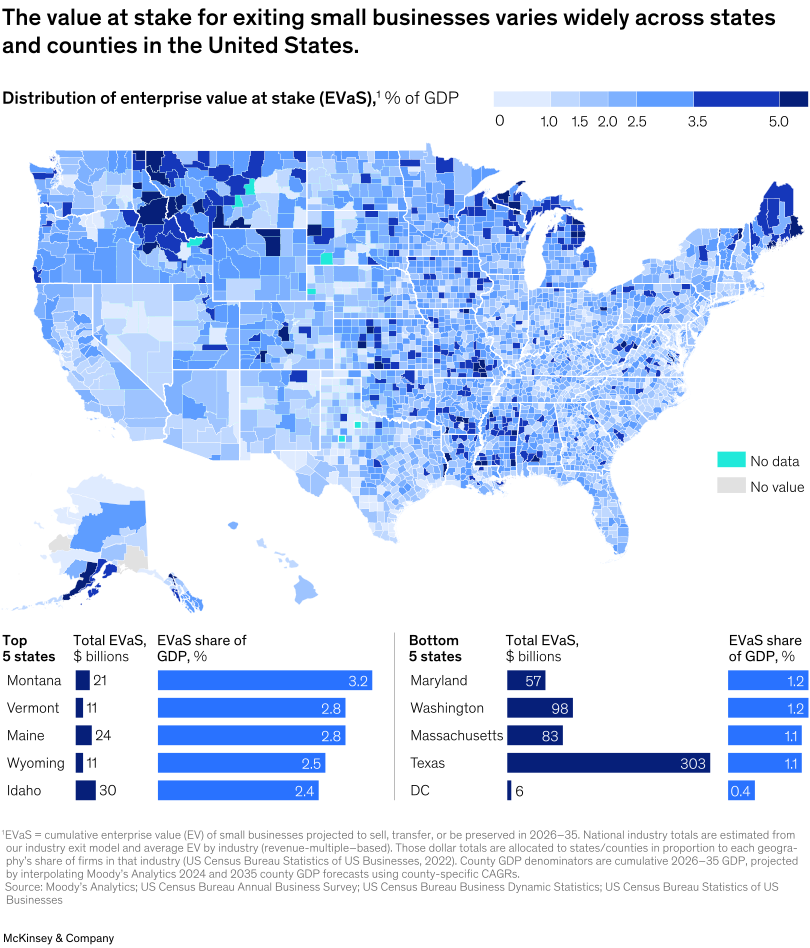
We estimate that urban counties account for roughly 86 percent of total enterprise value at risk, largely concentrated in economic powerhouses such as California, Florida, New York, and Texas. These markets benefit from deeper buyer pools, stronger advisory infrastructure, and more robust financing ecosystems, which help absorb ownership transitions even at scale. High rates of business formation, greater in-migration of entrepreneurs, and a dense set of alternative employers help offset ownership exits.
By contrast, smaller and more rural areas face higher exposure relative to their economies. In states such as Maine, Montana, Vermont, and Wyoming, SMB enterprise value at risk can be as high as 3.2 percent of state GDP. These regions depend disproportionately on small businesses for employment, with SMBs accounting for more than 50 percent of total employment.5 At the same time, they exhibit declining business dynamism, limited formation of replacement firms, and weak in-migration of new owners. As a result, even a modest increase in business closures can ripple through local economies, affecting jobs, tax revenues, and access to essential goods and services. High economic dependence combined with limited replacement capacity can create mobility traps, particularly where alternative employment is scarce.
State-level patterns also highlight how unevenly the Great Ownership Transfer will unfold. In smaller, aging states such as Maine, Montana, Vermont, and Wyoming, ownership skews older, and economies rely heavily on locally owned firms in construction, retail, and services. Many of these states have populations in which more than 20 percent of residents are aged 65 or older, compounding ownership transition pressures with workforce aging. In these contexts, firm closures often permanently break local economic ladders. By contrast, larger and more economically diversified states account for more than a quarter of total enterprise value at stake but experience lower per capita exit rates due to broader markets, higher rates of firm entry, and stronger institutional capacity to sustain churn.
At the county level, the divide between rural and urban America becomes even more pronounced. Using the geographic framework described in McKinsey Global Institute’s 2019 research on the future of work in America, major metropolitan areas hold more than three-quarters of total enterprise value at stake while exhibiting lower exit rates and greater institutional capacity to manage ownership change (Exhibit 3). Rural regions—which span six distinct and diverse archetypes identified in prior IEM research on rural America—face the steepest transition pressure. These areas combine older ownership profiles (with roughly 20 to 23 percent of owners aged 65 or above), the highest exit rates (ranging from 33 to 59 per 10,000 residents), and the thinnest replacement ecosystems. Industrial heartland regions sit between these extremes: Manufacturing metropolitan areas and rural manufacturing workshops show moderate exit intensity but high concentrations of enterprise value, where the primary challenge is ensuring sufficient capital and capability to sustain productive capacity through transition.
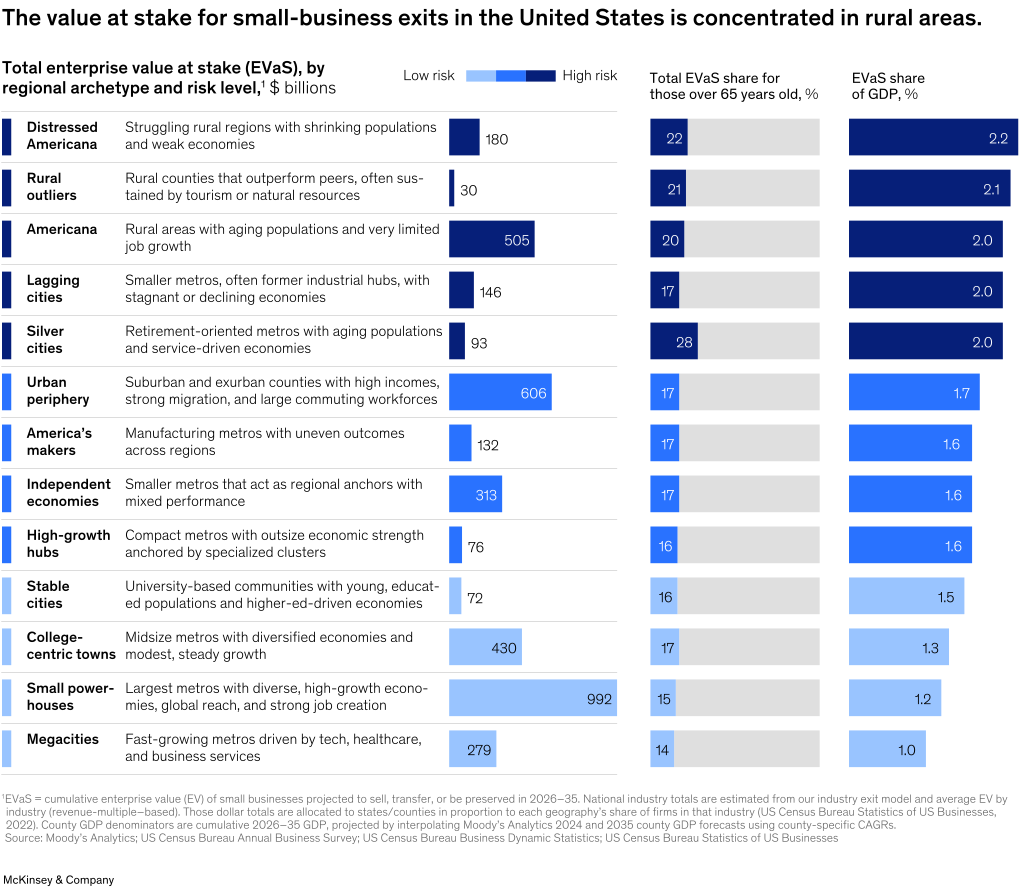
Taken together, geography amplifies both exposure and consequence. The Great Ownership Transfer will unfold as both a high-volume rural challenge and a high-value urban opportunity. Bridging these two markets—connecting the capital, advisory infrastructure, and buyer networks concentrated in cities with the smaller, locally rooted firms that sustain rural and small-town economies—will be critical to mitigating risk, capturing opportunity, and supporting economic mobility across the American landscape.
Greater risk for underrepresented owners
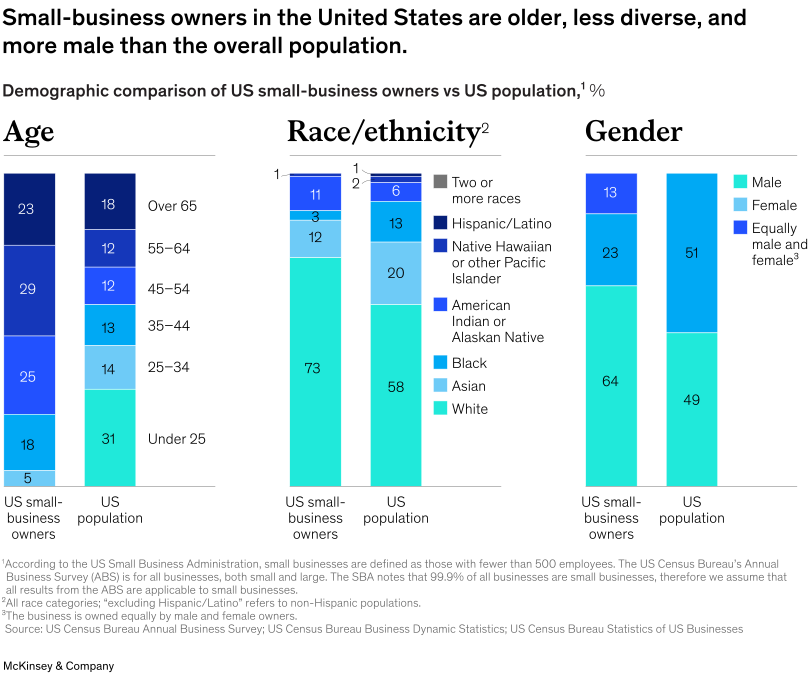
An aging, unevenly distributed small-business ownership base in the United States has led to notable gaps in succession capacity across demographic groups. Today’s small-business owners are substantially older, less diverse, and more male than the overall population: More than 70 percent are White, over 60 percent are male, and more than half are over the age of 55 (Exhibit 4).6 This demographic profile heightens near-term transition pressure because many businesses will require ownership transfers in a short time frame. Ownership transfer exposure, therefore, closely reflects who owns SMBs today, and the concentration of ownership among an aging and relatively homogeneous cohort increases disruption risk if succession pathways are not in place.
These ownership patterns are not evenly distributed across industries, concentrating transition pressure in sectors with higher underrepresented ownership. In accommodation and food services, for example, our analysis finds that an estimated 130,000 ownership exits are expected. Latino owners account for roughly 23 percent of business owners in this sector, meaning that absent effective pathways to transfer businesses to other Latino buyers, the transition wave could disproportionately erode Latino ownership in a key entry industry.
A similar dynamic is present in healthcare and social assistance, where more than 90,000 exits are expected. This sector represents a stronghold for women owners—who make up about 39 percent of owners, second only to education—as well as for Latino owners (17 percent) and Black owners (7 percent, the highest Black ownership share across industries). Concentrated exits, therefore, threaten the continuity of diverse ownership.
The risk is compounded by workforce demographics in these industries. In healthcare and social assistance, roughly 78 percent of workers are women and about 18 percent are Black—both significantly higher than their respective shares of the overall workforce. Failed ownership transitions in this sector would thus have downstream employment consequences beyond owners themselves, potentially disrupting jobs and economic stability for groups already overrepresented in frontline roles. In construction, where nearly 124,000 exits are expected, approximately 35 percent of workers are Latino, raising the stakes of ownership transitions not only for Latino owners but also for Latino workers and the communities they support. In these cases, ownership continuity is closely linked to employment continuity.
Racial and ethnic disparities further shape both the risk and opportunity of ownership transitions. According to US Census data, small-business ownership remains far less diverse than the US population overall, with White owners representing roughly 73 percent of business owners, compared with approximately 12 percent Latino and 3 percent Black ownership, even though these groups represent about 20 percent and 13 percent of the population, respectively. As a result, ownership gaps translate directly into large disparities in wealth creation during periods of transition. Of the up to $5 trillion in enterprise value at stake in the Great Ownership Transfer, we estimate that only about 28 percent would accrue to women and Black and Latino individuals combined under current participation patterns.
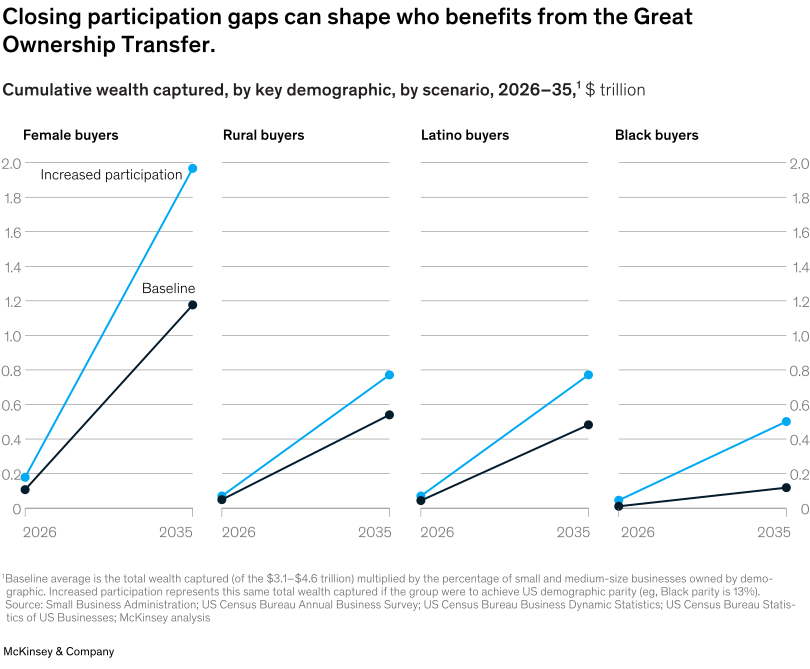
The missed opportunity is particularly stark for Black buyers. Under current dynamics, Black individuals are estimated to capture roughly $87 billion of this transferring enterprise value. Achieving parity in ownership participation, however, could increase that figure more than fourfold, to approximately $369 billion, highlighting the scale of unrealized wealth. A similar large opportunity exists for women. Although women account for only about 23 percent of business owners today, reaching parity in ownership participation could unlock approximately $700 billion in wealth capture. Together, these figures highlight that the Great Ownership Transfer is not only a risk event but also one of the largest near-term levers for shifting wealth outcomes across demographic groups.
Taken together, these demographic patterns underscore a central tension of the Great Ownership Transfer: The same concentration of ownership that heightens near-term transition risk also defines a once-in-a-generation opportunity to broaden participation in business ownership. If managed effectively, ownership transitions can preserve viable firms, sustain local employment, strengthen supplier pipelines, and expand access to wealth creation across race, gender, and geography. If left unsupported, they risk accelerating business loss and deepening the disparities that already characterize the small-business landscape.
Greater risk for lower-valued firms
Among the wide range of small businesses, we evaluated “middle market” companies and below, defined as firms with revenue below $1 billion. Lower-valued firms face greater risk of closure in the Great Ownership Transfer, even when they are economically viable, because the markets for acquisition are the weakest. Our analysis finds that nearly 80 percent of projected exits will likely occur among micro and emerging middle-market businesses—small, locally owned, community-based companies valued at less than $2 million. These firms form the backbone of local economies but often fall below traditional-deal thresholds.
Higher-value SMBs face different dynamics. They generally benefit from robust buyer interest and can tap professional intermediaries, but they account for a smaller share of total transitions. In short, most ownership changes will occur among small, local firms, even as most enterprise value sits higher upmarket.
- Micro businesses (valued under $500,000) include the restaurants, small retailers, auto-repair shops, salons, and neighborhood service providers that form the backbone of community life. They are deeply local, labor intensive, and often family run. While individually small, they collectively account for the largest share of projected ownership changes and face the highest likelihood of closure because they lack access to buyers, advisers, and financing.
- Emerging middle-market firms (valued between $500,000 and $2 million) can include small medical and dental practices, construction trades, HVAC companies, and franchises employing a few dozen workers. These firms often have stable cash flows and strong community ties, but limited access to professional intermediaries or institutional capital. They sit in the “missing middle” of the acquisition market—too large to be informal, yet too small to attract private equity or corporate buyers. As a result, many viable companies remain invisible to the market and are more likely to close than transfer.
- Lower middle-market firms (valued at $2 million to $25 million) encompass regional manufacturers, logistics providers, B2B services, and healthcare practices. These firms anchor regional supply chains and are increasingly likely to attract independent sponsors, search funds, and mission-driven investors. However, many still face limited buyer reach in rural areas and capital gaps for acquisition financing.
- Middle-market companies (valued between $25 million and $100 million) are often specialized manufacturers, software companies, and niche distributors. While fewer in number, they hold substantial enterprise value and often drive productivity and exports. They are attractive to institutional investors and strategic acquirers, and their transitions are typically managed through professional intermediaries and institutional capital.
- Upper middle-market firms (valued between $100 million and $1 billion) are diversified enterprises in sectors such as advanced manufacturing, technology, and healthcare services. These companies attract robust buyer interest from private equity and corporate strategics, but concentrated ownership among aging founders and family groups can create succession risk if leadership pipelines are weak.
Taken together, these segments illustrate the broad economic footprint of the Great Ownership Transfer. Most transitions will occur among smaller, locally rooted firms that sustain everyday commerce and employment, but more enterprise value at stake sits upmarket. Ensuring continuity across this full spectrum is critical to protecting community livelihoods and regional competitiveness.
Yet most micro and emerging middle-market businesses operate at deal sizes too modest to attract institutional capital or traditional private equity buyers, leaving them largely invisible to the market. Many lack the advisory support, financial readiness, or buyer access required to complete a sale, making closure more likely than transfer—even when the business itself is viable.
This gap reflects a structural weakness in the business ownership system, not just a market inefficiency. Whether the Great Ownership Transfer becomes a story of loss or renewal will hinge on the availability of the capital and ability of infrastructure to adapt to the high-volume, small-deal segment that anchors local economies.
Greater risk for capital- and labor-intensive industries
Risk exposure to the Great Ownership Transfer is also unevenly distributed across industries. We estimate that the value at stake in ownership transitions could be over $3 trillion, with nearly half that amount concentrated in a set of capital- and labor-intensive industries that are both foundational to local economies and structurally hard to transfer. In capital-intensive sectors such as manufacturing, mining, and utilities, about 26 percent of owners are over age 65, and more than 60 percent of owners are already over age 55 (Exhibit 5).7 These firms often rely on specialized equipment, technical know-how, and substantial working capital, making succession complex and limiting the pool of qualified buyers.
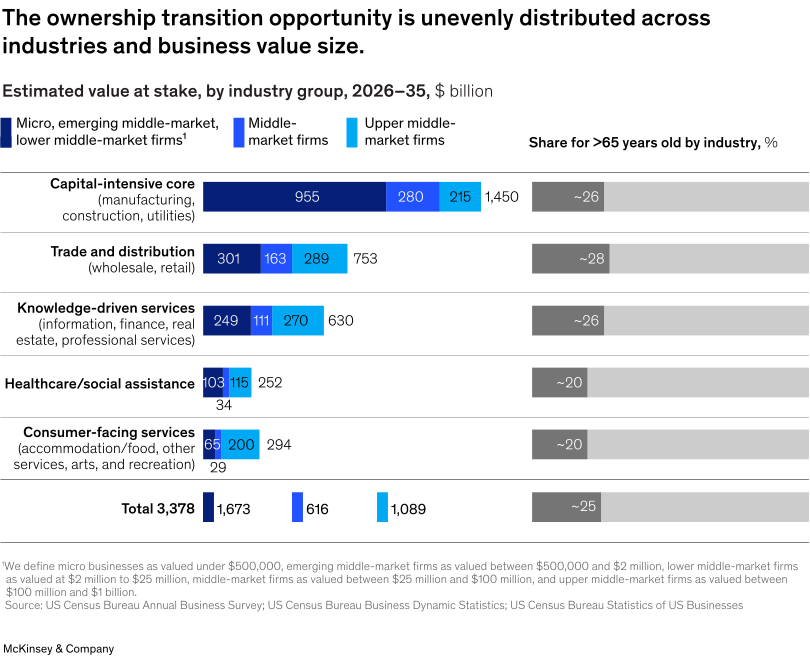
At the same time, the largest volume of ownership transitions will occur in labor-intensive, locally embedded industries that underpin daily life. Roughly one-third of all projected exits are expected in retail, construction, and professional services—industries that drive local commerce, housing, and employment. Disruptions in ownership continuity could reverberate through jobs, supply chains, and neighborhood stability.
Retail trade, accommodation and food services, professional services, and construction together account for nearly half of all anticipated transitions. At the top of the volume curve are retail trade (with approximately 145,000 projected exits); accommodation and food services (another 129,000 exits); professional, scientific, and technical services (127,000 exits); and construction (124,000 exits).
Another tier—including healthcare and social assistance (93,000 exits), manufacturing (71,000 exits), and administrative and support services (63,000 exits)—adds another large block of firms that sustain regional employment, from clinics and machine shops to logistics and back-office providers.8
These industries differ in capital intensity and skill requirements but share a common vulnerability: Most small businesses are privately held and below institutional deal thresholds.9 As a result, their transition infrastructure is thin. Owners face limited buyer visibility, scarce advisory capacity, and few standardized financing tools, even when the underlying businesses are viable. By contrast, service sectors with younger, more diverse ownership—such as arts, education, and food services—face lower near-term transition pressure, though high fragmentation still complicates orderly succession.
This matters because collectively, the industries most exposed to ownership transition risk employ tens of millions of workers and form the connective tissue of local economies. Failed transitions do not simply affect individual owners; they ripple through jobs, supply chains, housing markets, and community stability. Without stronger advisory, financing, and succession systems targeted to these high-impact industries, many otherwise healthy employers will close, eroding local income and community wealth. Conversely, focused intervention in industries where exits are most concentrated could unlock the greatest share of transferable enterprise value and deliver outsize economic and employment benefits.
Who will buy?
The Great Ownership Transfer represents not only a supply shock from firms coming to market but also a rare demand-side opening. Across the small-business landscape, a diverse set of buyers—institutional, independent, and community-based—is emerging to acquire, scale, and revitalize firms whose founders are preparing to retire. In principle, this creates space for new owners to enter, build wealth, and anchor jobs locally. In practice, demand is segmented by deal size, geography, and buyer readiness. Information gaps, financing frictions, and limited coordination still prevent even motivated buyers from capturing the full opportunity ahead.
Three broad buyer segments—institutional, independent, and community-based—are positioned to acquire retiring-owner firms. Each plays a distinct role in the transition economy. Each also faces clear limits on how much of the coming supply it can realistically absorb.
Institutional buyers: Deep demand, narrow coverage
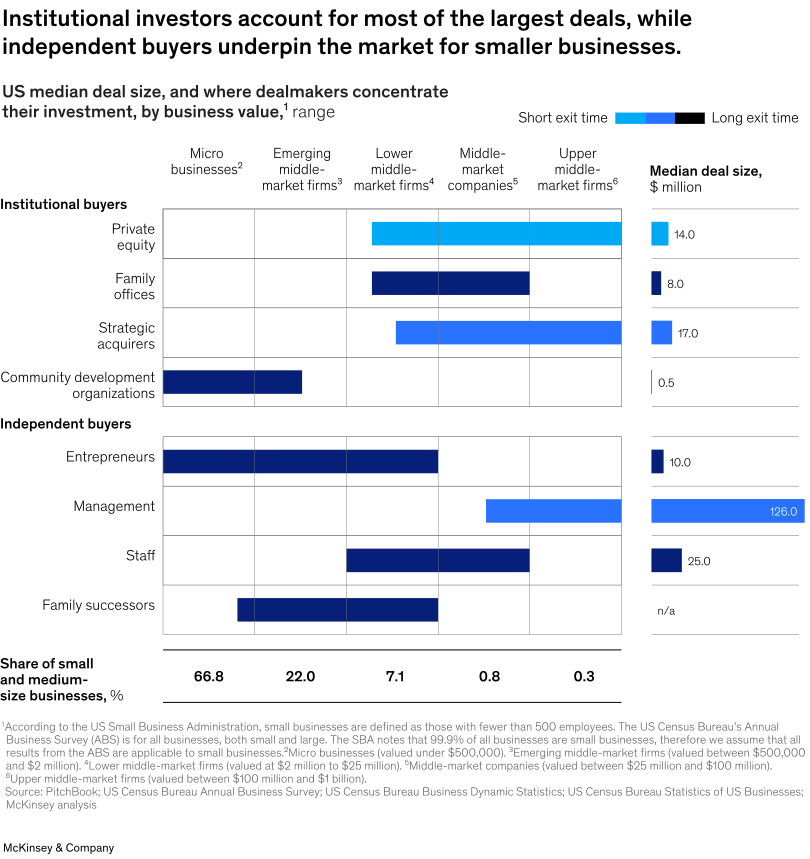
At one end of the spectrum are institutional buyers such as private equity firms, family offices, and strategic corporate acquirers. These players typically target firms with enterprise values between roughly $25 million and $1 billion, where scale, operational systems, and professional management structures support institutional investment models.

Listen to this episode of The McKinsey Podcast on the future of small-business ownership in American and the $5 trillion opportunity emerging from the Great Ownership Transfer.
In these tiers, demand is relatively strong and efficient. Institutional buyers bring efficiency, speed, and sophistication to transactions, but their reach extends only to a narrow slice of the overall transition market. The vast majority of firms coming to market—smaller, locally rooted, and often asset heavy—fall below institutional thresholds. As a result, institutional capital absorbs only a narrow slice of total supply, leaving the bulk of transitions to other buyer types.
Independent buyers: Essential demand with capacity constraints
In the middle are independent buyers: entrepreneurs, self-funded searchers, and career professionals seeking to acquire and operate small firms directly. With a concentrated interest in companies with $500,000 to $25 million in enterprise value, these acquirers are essential to absorbing the largest volume of upcoming transitions that will define the coming decade. Many are highly skilled operators with the capacity to sustain and grow businesses, but they face persistent obstacles in securing financing, accessing deal flow, and navigating the complex advisory landscape surrounding the acquisition.
This segment represents one of the most important pathways for economic mobility. It offers a route to ownership for individuals who may not have inherited wealth but possess industry experience, managerial skill, or entrepreneurial ambition—including rural residents, women, Black and Latino professionals, and others seeking durable income and asset-building opportunities.
Yet demand in this segment remains structurally constrained. While interest in acquisition has grown rapidly, many potential buyers remain on the sidelines due to fragmented deal sourcing, opaque processes, and uneven access to acquisition-ready support ecosystems. As a result, demand thins dramatically below the $5 million enterprise value range, even as supply accelerates. The constraint is system capacity, not buyer capability.
Community and employee buyers: High alignment, limited reach
At the community level—micro and emerging middle-market firms under $2 million in value— employee and mission-driven buyers play a distinct and vital role. This group includes worker cooperatives, Employee Stock Ownership Plan (ESOP) conversions, community development entities, and place-based ownership vehicles. Their priorities center on continuity of jobs, local ownership, and legacy preservation rather than maximizing sale price. These models can be powerful tools for wealth building and community stability but remain underutilized because of limited technical assistance, financing norms, and policy alignment.

The promise of employee ownership
These models offer pathways for frontline workers, longtime employees, and community members—many from lower- and moderate-income backgrounds—to build equity and stabilize local economies. In rural areas and disinvested urban neighborhoods, they may represent the best viability for businesses whose owners want continuity.
Despite strong alignment with the needs of smaller sellers, limited technical capacity, inconsistent policy frameworks, and a lack of standardized transition infrastructure constrain the number of deals these buyers can absorb. As a result, thousands of otherwise viable businesses face closure not because buyers do not exist, but because demand cannot scale fast enough to meet supply.
A fragmented demand system
Taken together, these buyer segments form a patchwork demand system, one that is unevenly distributed across deal sizes, regions, and industries. Institutional capital is concentrated in large metros and higher-value sectors such as software, manufacturing, and healthcare, while independent and community buyers are scarce in rural markets and asset-heavy industries. Community and employee buyers remain scarce in many regions despite strong local need.
This fragmentation leaves vast portions of the small-business landscape underserved. The result is a gap between the number of owners preparing to exit and the number of buyers positioned to step in.
Pathways to ownership
Even as interest in small-business acquisition grows, the pathways to ownership remain uneven, shaping who can participate and how easily they can complete a transaction. These disparities determine which buyers succeed and whether viable businesses continue.
Traditional transfers—including direct sales between private parties, private-equity buyouts, and family successions—are the most established routes. They function well for larger or professionally managed firms but require capital, networks, and expertise largely inaccessible to most first-time, independent, or community buyers. As a result, they capture only a fraction of total transitions.
Gradual or hybrid ownership models—such as seller-financed buyouts, ESOP conversions, and cooperative acquisitions—offer lower-barrier entry points and are particularly well suited to workers, local operators, and community-based buyers. These models can preserve jobs while keeping ownership local. They also support inclusion and community stability. But they remain difficult to scale due to limited technical assistance, inconsistent financing structures, and a lack of standardized guidance.
In recent years, a set of newer approaches has begun to emerge, widening access for a more diverse pool of potential buyers. Entrepreneurship through acquisition (ETA) programs, blended-capital search funds, and impact-oriented buyer accelerators train and finance entrepreneurs to acquire and operate smaller firms. These models demonstrate real potential, particularly for underrepresented demographics, but remain concentrated in elite networks and serve only a narrow slice of the overall market.

One couple’s journey with entrepreneurship through acquisition
Across all these pathways, the central challenge is not willingness to buy but practical barriers in the buying process, such as sourcing viable opportunities, securing affordable financing, and accessing postclose support. The result is a two-tiered system: one where established investors navigate mature pathways with institutional support, while smaller and first-time buyers face an unpredictable, resource-intensive process that too often prevents ownership transitions (Exhibit 6). Unless these routes become more transparent, standardized, and supported, millions of otherwise viable firms will continue to face preventable closures rather than successful transitions.
A latent economic mobility opportunity
The Great Ownership Transfer represents a rare opening for the US economy: a moment when an abundance of viable firms could drive renewal. For the first time, the country faces an oversupply of businesses for sale rather than a shortage, creating space for millions of new owners to step in and drive growth. Unlike housing, labor, or capital markets constrained by scarcity, this market is defined by an underutilized pipeline of productive assets ready to change hands.
If demand can be expanded—by increasing pathways to ownership, developing buyers at scale, and aligning transitions with workforce and community needs—the ownership transition wave could become one of the most powerful engines of economic mobility in the coming decade. Rural, Black, Latino, and female entrepreneurs especially stand to benefit, provided the systems that connect them to ownership are made visible and accessible.
Absent that expansion, current imbalances will remain. Millions of viable firms will face preventable closures because pathways to transitions remain fragmented and underdeveloped. The next decade will determine whether the Great Ownership Transfer becomes a $5 trillion opportunity for inclusive growth or instead results in an erosion of the small-business backbone that supports local economies throughout the United States.
The risk of turning opportunity into loss
Buying and selling a small business is often harder than starting one because the systems that support entrepreneurship in the United States are currently built for founding companies, not transferring them. While the entrepreneurial ecosystem is optimized for start-ups—with incubators, accelerators, and technical assistance geared toward new firm creation—acquisition remains largely invisible, unstandardized, and unsupported. As a result, buyers, sellers, and intermediaries operate in a fragmented and opaque system that turns viable firms into missed opportunities rather than successful transitions.
Across the ownership transfer journey, frictions are pervasive. Buyers and sellers struggle to find each other, assess deal quality, secure financing, and navigate complex processes without consistent standards or reliable guidance. Aspiring entrepreneurs are rarely taught how to acquire firms, owners underestimate the preparation required to sell, and intermediary quality varies widely. Financing is slow, bespoke, and often inaccessible to first-time or lower-wealth buyers, while postclose support for new owners is limited or nonexistent.
These challenges stem from several structural failures: broken markets for acquisition capital, fragmented business services, ecosystem institutions not designed for transitions, a missing bridge between small businesses and institutional capital, and a lack of early planning support for owners without strong networks. As a result, buyers and sellers struggle to connect, financing remains difficult to access, and advisory capacity serves only the upper end of the market. Institutional focus and funding have built a start-up funnel but not a succession funnel. Entry pathways, financing tools, and postclose support for acquirers remain patchy and underdeveloped. As a result, up to $5 trillion in enterprise value is at risk, millions of potential ownership transitions are stalled before they can begin, and a key pathway to wealth creation and economic mobility is cut off.
The following section examines these challenges across the five stages of the ownership journey, from aspiration to exit.
The five phases of the business acquisition journey
Ownership transfer is not a single transaction but a five-phase journey that unfolds over years and depends on the coordinated participation of a broad ecosystem of stakeholders. Across the process, banks and capital providers, corporate and anchor institutions, intermediaries and advisers, public agencies and philanthropy, and education and workforce institutions each play distinct roles. Yet the US market lacks the infrastructure to coordinate these roles across stages. The result is friction at every step: too few prepared buyers, too many unready sellers, and transaction and enabler challenges that provide too little connective tissue between the two.
Successful ownership transfer follows a predictable journey. Five stages—aspiration and preparation, search and sourcing, deal structuring and financing, ownership and value creation, and succession and exit—frame how ownership transitions are supposed to work and where the system currently breaks down. Each stage requires distinct decisions, capital, and ecosystem support. In practice, however, these actors often operate in isolation or enter too late. Fragmented systems and gaps in awareness, financing, data, and advisory support prevent otherwise viable businesses from changing hands.
Phase 1: Aspiration and preparation: Entrepreneurs don’t know acquisition is an option. Long before a deal is on the table, the pipeline of potential buyers and prepared sellers begins to narrow. The aspiration and preparation phase, where entrepreneurs first consider acquisition and owners first plan for succession, sets the conditions for every transition that follows. This is when buyers and sellers clarify their goals, assess readiness, and build leadership, financial, and operational capacity for a transition (Table 1).
Key challenges at the aspiration and preparation phase
Buyer challenges
|
Seller challenges
|
Transaction and enabler challenges
|
Yet today, this stage remains largely invisible and unsupported. “Most people don’t even realize that buying a business is an option until someone shows you that entrepreneurship through acquisition is possible,” said one founder of an investment firm that helps underrepresented entrepreneurs buy and scale existing small businesses. “Most entrepreneurs are taught how to start a business, not how to buy one, so they show up late and underprepared.” The result is a thin pipeline of ready buyers before the market even opens.
Phase 2: Search and sourcing: Buyers and sellers struggle to find each other. Once potential buyers and sellers are ready to engage, they encounter a market that rarely functions as one. The search and sourcing phase— when sellers bring opportunities to market and buyers identify potential matches through brokers, networks, or digital platforms—is marked by opacity and inefficiency. Most SMB sales happen quietly, through informal networks and inconsistent data, rather than through transparent, trusted marketplaces. “A lot of exits never show up in a formal process,” says one ownership transition investor. “Owners talk to their accountant, a trusted adviser, or someone they already know. If that doesn’t work, the business may never really go to market.”
On the buyer side, high-quality deal flow is scarce and due diligence costly; on the seller side, few owners have professional representation or accurate financials to attract credible buyers. The result is a fragmented discovery process in which viable businesses stay hidden and prepared buyers struggle to find them (Table 2).
Key challenges at the search and sourcing phase
Buyer challenges
|
Seller challenges
|
Transaction and enabler challenges
|
Phase 3: Deal structuring and financing: Financial barriers can kill deals. Even when a buyer and seller manage to find each other, the deal itself often stalls at the financing table. As a community development banking official told us, “We see viable businesses with real cash flow fail to transfer—not because there isn’t a buyer or a business worth saving, but because the financing gap can’t be bridged.” The deal structuring and financing phase—when parties secure capital, negotiate terms, and complete diligence—is where opportunity most visibly collides with system constraints around financing and transaction costs.
For most small-business acquisitions, capital access remains slow, bespoke, and inequitable. One key product, the SBA 7(a) loan—a government-backed small-business loan program offering flexible financing through approved lenders—requires high equity, personal guarantees, and lengthy approvals that few first-time buyers can meet. Seller financing, meanwhile, is inconsistent and difficult to negotiate, while diligence and legal costs consume a disproportionate share of small deals. Banks and lenders treat these transactions as one-offs rather than a scalable market, and community lenders lack the products or funding to fill the gap. The result is a system built for exceptions, not scale, causing viable acquisitions to collapse for lack of capital rather than lack of potential (Table 3).
Key challenges at the deal structuring and financing phase
Buyer challenges
|
Seller challenges
|
Transaction and enabler challenges
|
Phase 4: Ownership and value creation: New owners don’t have the scaffolding to succeed after acquisition. Even after a deal closes, the work of ownership is just beginning. New owners must stabilize operations, retain workers, and realize the business’s growth potential. Yet postclose infrastructure is often absent, leaving many buyers without support as they step into operating roles (Table 4).
Key challenges at the ownership and value creation phase
Buyer challenges
|
Seller challenges
|
Transaction and enabler challenges
|
Buyers often inherit operational complexity without structured support or knowledge transfer, especially in firms long dependent on a single founder. As one Midwestern entrepreneur who bought a small business told us, “You can’t do due diligence on everything. After the deal closes, you inevitably discover things you didn’t even know to ask about: processes, relationships, or risks that were never documented because the owner handled them personally.” Sellers typically disengage quickly, taking critical know-how with them.
Unlike the start-up ecosystem, where accelerators, mentors, and technical partners surround new ventures, the acquisition ecosystem offers almost no “aftercare.” Most small-firm operators face this stage alone, without advisory networks, shared back-office solutions, or workforce programs to sustain continuity. As a result, many promising transitions lose momentum just as success should compound, putting jobs, productivity, and community value at risk.
Phase 5: Succession and exit: Many sellers approach succession with too little, too late. By the time most owners reach the end of their tenure, the window for an orderly transition has already narrowed. The succession and exit phase exposes another gap in the system: Too many owners wait too long to plan. “Despite being closest to exit, many owners—especially baby boomers—are the least prepared,” says the Exit Planning Institute’s Snider. “Planning gets delayed because they’re so focused on running the business that exit strategy becomes an afterthought.”
Fewer than one in three small-business owners have a documented exit plan, according to the Exit Planning Institute’s 2023 National State of Owner Readiness Report. Many delay out of cost, uncertainty, or emotional reluctance to let go. Without trusted advisers or local navigator programs, even well-run firms struggle to map a future beyond the current owner.
Family and partner dynamics often complicate decision-making, while in smaller markets, legal and accounting advisers often lack the experience to guide complex transfers. When owners signal too late, buyers cannot prepare, financing falls through, and viable firms close abruptly, erasing jobs, supplier relationships, and community wealth (Table 5).
Key challenges at the success and exit phase
Buyer challenges
|
Seller challenges
|
Transaction and enabler challenges
|
Across all five phases of the ownership journey, the system fails to reduce friction, coordinate roles, or scale what works. Buyers face limited pathways, sellers lack readiness, intermediaries operate without standards, and capital markets underserve the middle of the economy. The result, as noted earlier, is a fragmented, opaque ecosystem that converts opportunity into preventable loss—where millions of viable businesses risk disappearing not for lack of value but for lack of systems that make ownership transfer routine and accessible.
Converting the Great Ownership Transfer into fuel
The Great Ownership Transfer can be viewed as a looming risk: Millions of small-business owners aging out, insufficient successors, and an ecosystem unable to manage the scale of change ahead. But this demographic wave does not have to result in erosion. With the right system in place, it can become a powerful engine of renewal—preserving productive capacity, stabilizing supply chains, broadening ownership, and strengthening economic mobility across communities.
What stands in the way is not a lack of viable businesses or willing buyers but the absence of a coordinated market for ownership transfer. Today’s environment is fragmented across capital providers, advisers, corporate buyers, and civic institutions, each operating largely in isolation. The impact is most acute in the “missing middle”: firms that are too large for start-up programs yet too small for institutional investors. These businesses face limited access to acquisition finance, uneven readiness for transition, inconsistent access to opportunity, and a patchwork of services that are difficult to navigate. Without intervention, many viable firms will simply close—even when successors exist.
A coordinated market for ownership transfer
Building a coordinated market for ownership transfer is therefore the central requirement for success. Such a market would clarify roles, align incentives, and provide shared infrastructure so that buying a business becomes as visible, supported, and scalable as starting one. If built effectively—both nationally and locally—it would allow ownership transitions to happen routinely rather than episodically, preserving firms that anchor local economies and supply chains while expanding pathways to ownership for a broader range of entrepreneurs.
Importantly, this is not a theoretical agenda. Proven playbooks already exist, but they have not yet been translated to the scale demanded by the coming wave of transitions. ETA portfolios have demonstrated how derisked acquisition models can scale when capital and support are aligned. Corporations have shown how supplier preservation programs, which combine long-term demand, transition support, and strategic engagement, can stabilize critical vendors. Business-service providers have successfully bundled legal, tax, valuation, and advisory services to reduce friction. Civic institutions have piloted navigator hubs that help owners and buyers move through complex transitions. Together, these models offer the building blocks of a functioning market; what is missing is coordination.
Addressing the ‘missing middle’
The greatest leverage lies in addressing the challenges of the missing middle. The firms in this cohort represent a large share of employment, supply chain resilience, and local economic stability, yet they fall between existing systems of support. They are too complex for start-up-oriented programs and too small to attract institutional capital, leaving them exposed at precisely the moment when ownership transition becomes unavoidable.
If this middle tier is supported—through accessible capital, readiness assistance, bundled services, and clearer pathways to opportunity—viable firms will remain productive, workers will keep their jobs, supply chains will stabilize, and underserved entrepreneurs will gain access to ownership opportunities that have historically been out of reach. Addressing the challenges for this segment enables a coordinated market to deliver outsize economic and inclusionary impact.
Who needs to do what—and why it matters now
Whether the Great Ownership Transfer becomes a story of closure or renewal depends less on abstract market forces than on the concrete actions taken by specific actors. Each holds distinct levers that shape whether ownership transitions will result in widespread firm closures or durable economic renewal. Below are the roles these actors can play, the steps they can take, and the implications of inaction:
Banking and capital providers. Banks, community development financial institutions (CDFIs), US Small Business Administration (SBA) lenders, and private credit and equity investors play a central role in determining whether ownership transfers can occur at scale. While demand for acquisitions is significant, existing financing models remain a primary constraint.
Key actions can include modernizing underwriting standards for small-business acquisitions; standardizing products for sub-$10 million transactions; and reducing equity barriers through guarantees, blended-capital structures, and risk-sharing mechanisms. Pairing capital with postclose support can further improve repayment and survival outcomes for first-time owners.
If capital providers adapt their products and risk frameworks, they can unlock a scalable asset class anchored in stable cash flows and real-economy outcomes. Without change, many otherwise viable transactions will remain unfinanceable, suppressing demand and accelerating unnecessary firm closures.
Corporate buyers and anchor institutions. Corporate buyers and large anchor institutions are exposed to ownership transitions through their supplier and contractor networks, where retirements represent an underrecognized supply chain risk.
Key actions can include identifying at-risk suppliers earlier; using procurement levers such as multiyear contracts, volume commitments, or co-investment to improve financing viability for successor owners; and, where appropriate, pursuing strategic acquisitions to preserve critical capabilities. Aligning ownership transition strategies with supplier diversity, resilience, and local economic development goals can further amplify impact.
Proactive engagement allows corporates to stabilize supply continuity, quality, and local economic ecosystems. Absent engagement, preventable supplier failures, emergency replacements, and erosion of supply chain resilience become more likely.
Business ecosystem intermediaries and advisers. Intermediaries and advisers in the business ecosystem—such as CPAs, platforms, brokers, and lawyers—play a critical role in reducing friction and enabling scale in the ownership transition market. Today, high transaction costs, fragmentation, and inconsistent quality limit participation, particularly in smaller deals.
Key actions include professionalizing small-deal infrastructure through bundled service offerings, adopting shared standards and data practices, improving visibility via registries and platforms, and providing structured postclose support to stabilize newly transferred firms.
As the ecosystem reduces friction and improves reliability, ownership transfer can shift from a bespoke process to routine infrastructure. Without such changes, fragmentation will continue to bias outcomes toward larger transactions and leave many small businesses unable to transition.
Public sector and philanthropy. Civic institutions—including public agencies, philanthropies, and community organizations—influence ownership transitions through their ability to help those in the ecosystem plan ahead, align incentives, and coordinate across economic and workforce development and policy initiatives.
Key actions include embedding succession and exit readiness into mainstream small-business and economic-development programs years before owner retirement; incorporating acquisition readiness into workforce and sector-based initiatives that prepare managers, employees, and operators for ownership; and using administrative and regional data to anticipate retirement-driven exit risk by sector and geography. Public agencies and civic convenors can further reinforce these efforts through navigator hubs and coordinated technical-assistance networks, while aligning grants, tax incentives, procurement preferences, and technical assistance to reward early preparation, continuity of operations, and gradual ownership transfer.
When these actions are coordinated early, communities are better positioned to retain employers, preserve local tax bases, and sustain essential services. Without coordination, many otherwise viable firms are likely to close due to timing and system failures rather than business fundamentals—leading to avoidable job losses and more reactive, higher-cost public interventions downstream.
Educational and workforce institutions. Educational and workforce institutions influence who enters the ownership pipeline long before transactions occur, shaping the depth and diversity of future buyers.
Key actions include integrating acquisition, succession, and employee ownership into entrepreneurship curricula; highlighting ownership transfer as a viable pathway for operators, workers, and veterans; and aligning training programs with postacquisition capability needs.
Expanding awareness of ownership pathways broadens economic mobility and strengthens the future buyer pool. Without normalization, acquisition will remain underrepresented relative to start-ups, perpetuating buyer shortages and limiting transition capacity.
Converting transition risk into a renewal agenda
When these groups act together, the Great Ownership Transfer becomes more than a risk mitigation exercise. Coordinated action could preserve up to $5 trillion in enterprise value, protect jobs, stabilize supply chains, and unlock new pathways to ownership for historically underserved entrepreneurs. Over time, a functioning market for ownership transfer becomes self-renewing: Each successful transition strengthens the infrastructure, expands the pool of experienced owners and advisers, and makes the next transition easier.
Seen through this lens, the Great Ownership Transfer is not merely a transition agenda: It is a renewal agenda. It offers the opportunity to replace a fragile, exclusionary system with one that regenerates local businesses under new leadership, investment, and ideas. If the country succeeds, this demographic wave will be remembered not as a period of widespread closures but as the inflection point when business ownership became a broader pathway to mobility—and when the small-business economy learned to renew itself at scale.
A once-in-a-generation opportunity to renew American enterprise
If managed well, the Great Ownership Transfer could prove transformative, unlocking a new era of economic renewal, inclusive ownership, and institutional strength across the US economy. Rather than allowing millions of viable firms to shutter as owners retire, a functioning ownership transition market could preserve up to $5 trillion in enterprise value, keep up to 12 million jobs in place, and protect about $250 billion in annual local spending power. For rural and midsize communities in particular, continuity of small manufacturers, trades firms, and service providers would help anchor tax bases, stabilize supply chains, and reinforce regional economic resilience. Nationally, sustaining these transitions could support GDP growth and innovation capacity during a decade of profound demographic change.

Author Talks: How a Black family of builders laid the foundation for success
Beyond continuity, this moment creates a rare opening to broaden who participates in ownership and wealth creation. With the right acquisition ecosystem in place, business ownership could become attainable for thousands of rural, Black, Latino, and female entrepreneurs—closing long-standing participation gaps and potentially generating $2 trillion to $3 trillion in new household wealth (Exhibit 7). Employee and community ownership models could further ensure that profits circulate locally, preserving jobs and strengthening civic stability. Over time, business ownership could shift from a privilege largely reserved for those with inherited capital to a mainstream pathway to economic mobility, making the economy more innovative, more representative, and more resilient.
Realizing this potential will require more than isolated transactions; it demands durable institutional capability. Coordinated data systems, credentialed intermediaries, and standardized financing products could form the backbone of a mature ownership transfer market. Public and private lenders—from the SBA to CDFIs to commercial banks—would be able to rely on consistent underwriting frameworks and transparent performance data. Professional and advisory networks could be trained to manage ownership transitions as routinely as start-ups or real estate transactions. Over time, policy, education, and capital systems could become permanently aligned around business continuity and inclusive growth—creating an ecosystem that endures well beyond the current demographic wave.
The long-term prize is a self-renewing economy. Within a decade, buying a business could be as common, visible, and supported as starting one. New and diverse owners would build on the legacies of retiring entrepreneurs, sustaining jobs while innovating for the future. Each successful transition would seed the next, forming a continuous cycle of local investment, leadership development, and opportunity. In this future, the Great Ownership Transfer becomes not just a handoff of assets but a blueprint for how the US economy renews itself generation after generation.
Ultimately, this is more than a demographic event; it is a test of institutional readiness and imagination. The choices made now will shape who owns—and who benefits from—American enterprise for decades to come. If mishandled, the transition risks eroding productive capacity, community wealth, and the diversity of ownership that underpins innovation and resilience. If managed well, it can catalyze a generation of new owners, strengthen local economies, and embed inclusion into the nation’s economic fabric. Investing now—in data, advisory capacity, capital access, and buyer development—can ensure that retiring owners pass on not just their businesses but the foundation of the next era of American prosperity.
Related Articles

One couple’s journey with entrepreneurship through acquisition