The act—or art—of CEO succession represents a major inflection point for family-owned businesses (FOBs). Consider the case of a multibillion-dollar European family conglomerate that has effectively navigated five cycles of CEO succession in its 150 years. Its sixth-generation CEO describes the identification of successors (and their preparation for the role) as the single most important choice the business makes: “It has such a big impact. If it goes well, it has a huge positive impact. And if it goes badly, the impact can be equally negative.”
Mismanaged succession at FOBs has far-reaching implications given that these businesses generate more than 70 percent of global GDP and employ approximately 60 percent of the worldwide workforce.1 And there is much more at risk for FOBs beyond just erosion of shareholder value: The family’s reputation and legacy are also on the line.
When done well, however, CEO succession can both preserve the family’s vision and catalyze institutional renewal. According to McKinsey research, FOBs consistently outperformed their non-family-owned counterparts, with returns to shareholders that were twice as high as those of non-FOBs from 2012 to 2022.2 Alongside other factors, the competitive edge of FOBs comes from their ability to consistently execute a long-term vision. Preserving that perspective across successive leadership transitions is a fundamental and complex challenge.
CEO succession at FOBs defies one-size-fits-all solutions. Every family operates within a unique context, influenced by generation, size, family dynamics, and business scale. Thus, a change in leadership requires a more tailored approach. For example, the next generation’s interests and aspirations directly determine whether the pool of potential successors includes family members, nonfamily executives, or both.
Generally, CEO succession at FOBs follows one of four transition archetypes: family to family, family to nonfamily executive, nonfamily executive to nonfamily executive, and nonfamily executive to family (table).
Four primary archetypes define leadership transitions in family enterprises.
| Archetype | What it entails | Example |
| Family CEOs to family CEOs | Leadership passes from one family member to another, usually across generations, while other family members take roles as executives, directors, or shareholders. | Spanish infrastructure and renewable energy player Acciona’s 2004 transition from José María Entrecanales y Martínez Carandeto to his son José Manuel Entrecanales Domecq, the family’s third generation.1 |
| Family CEOs to non-family- executive CEOs | Leadership shifts from family to nonfamily executives, while family members retain oversight through other roles–for instance, on the board of directors. | Brazilian steelmaker Gerdau’s 2018 transition from third-generation CEO André Gerdau Johannpeter to nonfamily executive Gustavo Werneck.2 |
| Non-family-executive CEOs to other non-family-executive CEOs | The CEO role passes between nonfamily executives as the family focuses on managing governance and ownership. | Indian consumer-goods conglomerate Dabur, where fifth- and sixth-generation family members sit on the board of directors. Since ownership and management were separated in the late 1990s, nonfamily executives have led Dabur as CEOs.3 |
| Non-family-executive CEOs to family CEOs | A family member reclaims the CEO role, typically as the next generation matures or when alignment with nonfamily leadership breaks down. | Pernod Ricard’s 2015 transition from nonfamily CEO Pierre Pringuet to third-generation heir Alexandre Ricard.4 |
To understand how FOBs can best navigate the complexity and unique risks associated with CEO succession, we analyzed 200 publicly traded FOBs and surveyed another 170 primarily private FOBs around the world. Additionally, we gathered insights through discussions with 15 key decision-makers, direct observers, and participants in CEO transitions at FOBs globally. (See sidebar “Our methodology.”)
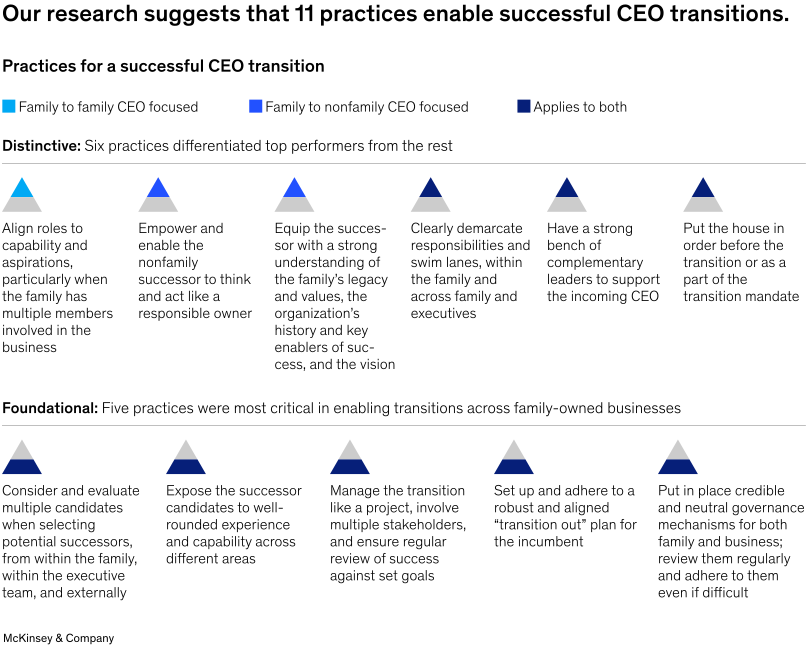
Our research reveals 11 critical succession practices that underlie growth and resilience amid CEO transitions at FOBs—five foundational practices that lay the groundwork for leadership change and six distinctive practices that top performers adopt to ensure best-in-class transitions. Change requires the following five foundational practices: evaluating multiple successor candidates, enabling those candidates to build well-rounded capabilities, managing the transition like a project, creating and following a clear plan for transitioning out, and establishing and upholding neutral governance mechanisms.
Meanwhile, best-in-class transitions involve six core practices. The first three are most relevant to specific transition archetypes: align family successors’ roles to their capabilities and aspirations (family-to-family transitions); anchor the nonfamily successor in the family’s legacy, values, and vision (family-to-nonfamily transitions); and enable nonfamily executive successors to think and act like owners (family-to-nonfamily transitions). The other three practices are applicable in transitions from family CEOs to both family and nonfamily executives: clearly demarcate roles, responsibilities and swim lanes; create a complementary team of leaders; and put the house in order to get the business transition-ready.
In this article, we review our research findings and offer practical guidance for FOBs that are in the midst of CEO succession or are facing such a foundational change in the longer term.
Family business CEO transitions, on average, erode shareholder value
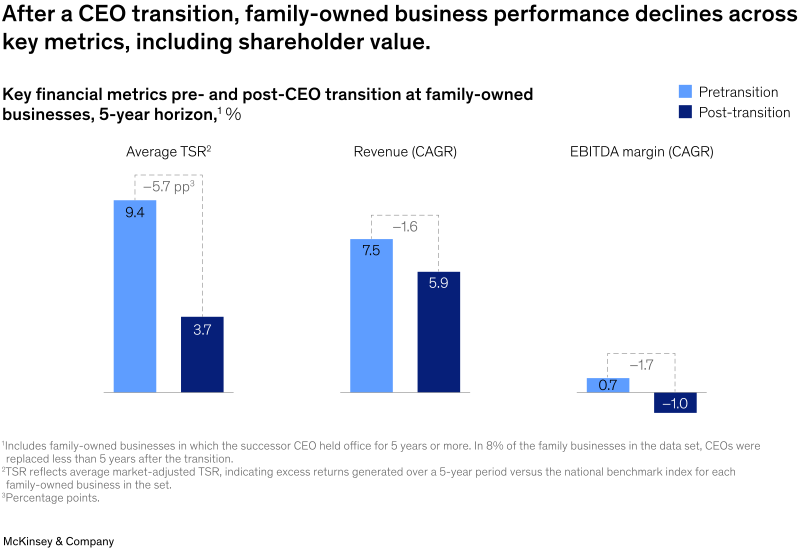
According to research by Harvard Business Review, poorly managed CEO successions can potentially wipe out up to $1 trillion in market value per year.3 McKinsey research finds that family businesses are not immune to the risk. FOBs also tend to underperform once a new CEO takes the helm. We observed that, on average, TSR declined 5.7 percentage points in the five years after the transition, compared with the five years immediately before the transition. Likewise, revenue growth and EBITDA margin growth declined after CEO changes (Exhibit 1).
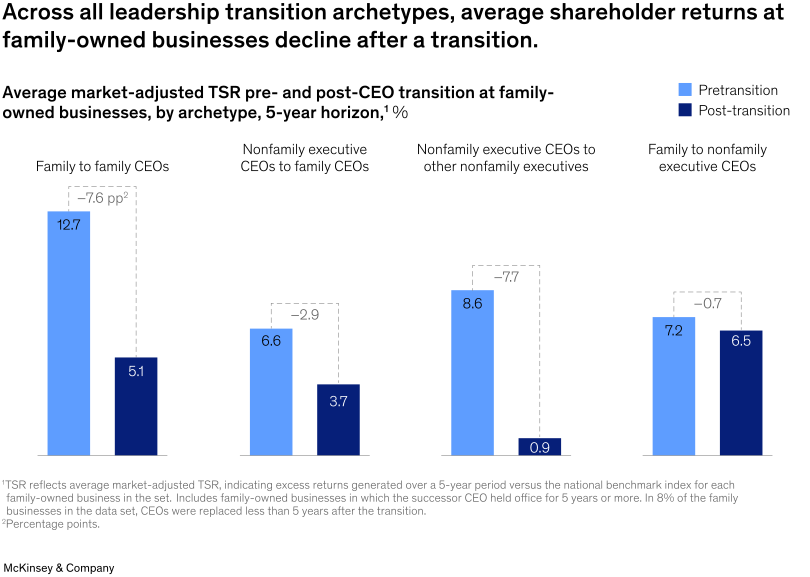
In addition, we found that no transition archetype—whether the CEO is a family or nonfamily executive—is immune to this risk (Exhibit 2). Average shareholder value fell across all transition archetypes. Furthermore, in transitions to family CEOs, this trend of value loss post-transition persisted regardless of which family generation took the helm.
Some family businesses get CEO succession right
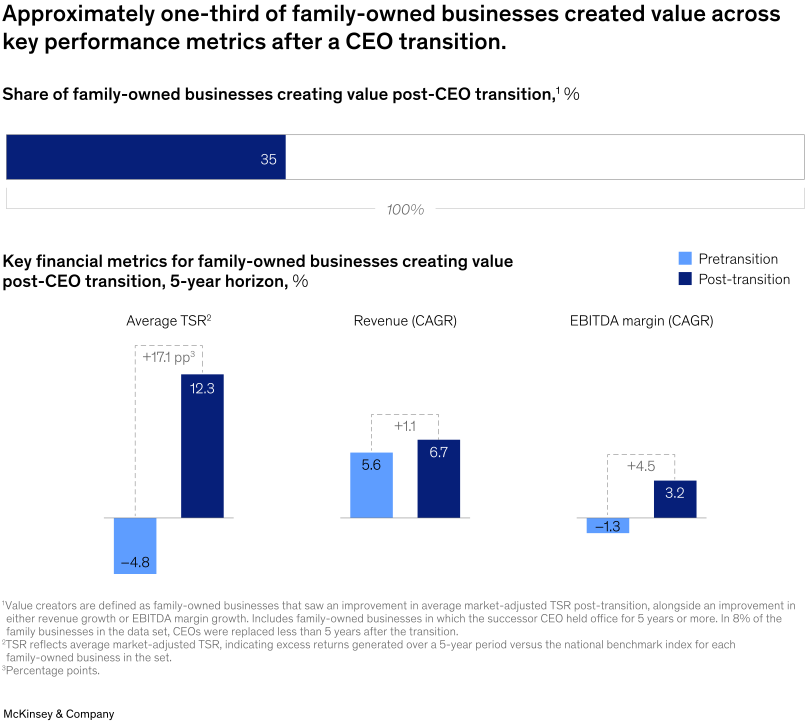
Slightly over one-third of family businesses in the dataset, however, bucked the trend of post-transition value erosion: These value creators elevated operational performance after the CEO succession, attaining higher average TSR and growth in EBITDA and revenue (Exhibit 3.)
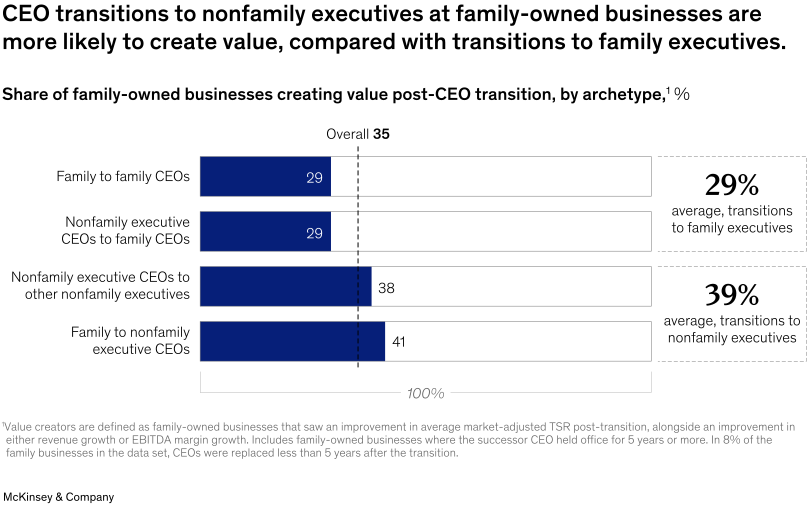
In addition, while transitions to nonfamily executives succeed more often, transitions to family executives—when successful—create greater value. Nonfamily CEOs deliver more consistent results: our analysis shows that 39 percent of transitions to nonfamily executives created value. In comparison, 29 percent of transitions to family executives created value (Exhibit 4), reflecting the relatively higher risk of value depletion in family CEO appointments.
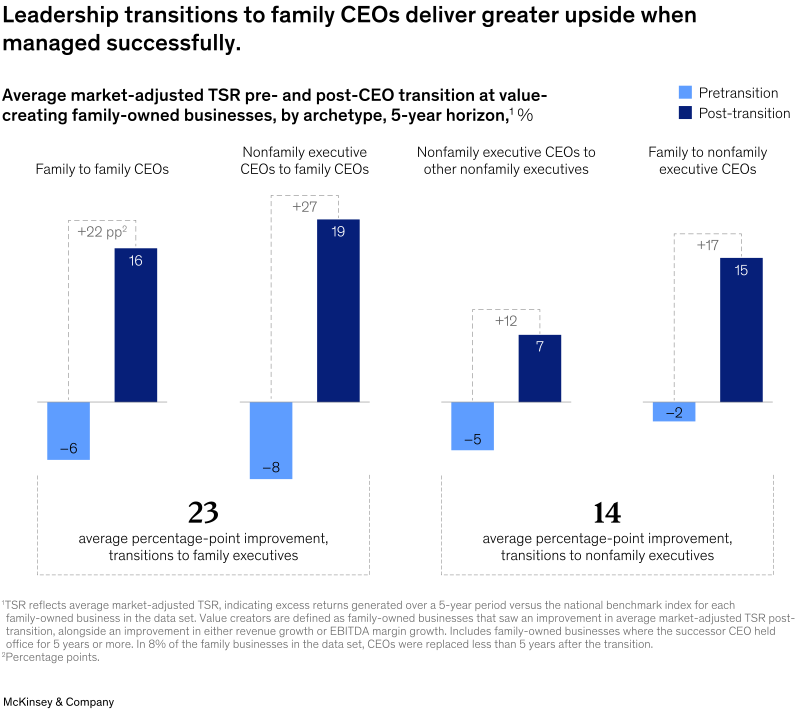
However, when family-to-family CEO transitions succeed, they generate outsize returns. Our analysis revealed a 23-percentage-point increase in average TSR for value-creating transitions to family CEOs, compared with 14 percentage points for value-creating nonfamily transitions (Exhibit 5). The implication here is that family CEO transitions are high-stakes bets that, when done right, can unlock substantial shareholder value.
How the top-performing FOBs design effective CEO transitions
Among the 170 FOBs we surveyed that had transitions from family CEOs to family or nonfamily executives, 43 emerged as top performers—that is, the top quartile of family businesses based on business performance and transition experience ratings. These companies increased revenue and EBITDA margin by approximately four percentage points over the five years following succession, surpassing peers and the industry. These transitions were also rated as highly effective by survey respondents.
Our analysis revealed 11 critical practices—five foundational practices that lay the groundwork for change, as well as six distinctive practices that make for best-in-class transitions (Exhibit 6).
The universal foundational practices
FOBs consistently rated five foundational practices as the most effective enablers of successful transitions, our survey found. These practices serve as essential building blocks of the CEO transition journey, regardless of whether the transition was to a family or nonfamily CEO.
They evaluate multiple successor candidates: Most FOBs say it is critical to identify a broad pool of high-quality CEO candidates. They sampled candidates from within the family, internal nonfamily talent, and external talent. This practice points to keeping an open mind about who is most appropriate for the role.
One North American family business in the healthcare sector, for example, maximized transparency for considering multiple candidates. “Five years before succession, the family built a comprehensive written plan with criteria for potential CEO candidates clearly laid out, including knowledge of digital health and regulations in the region,” explained one of the family owners. This plan was then disseminated to multiple potential candidates to maximize the pool of qualified, available talent at the time of successor selection.
FOBs with family members in operational roles also highlight the advantages of this approach. By considering a broader pool of candidates, they were better positioned to match next-generation members to the roles for which they were best suited. Furthermore, a structured and fair succession process signals to next-generation members that leading the family business is a privilege, not a right.
They enable successor candidates to build well-rounded capabilities: Most FOBs familiarize their successors with key functions, business units, and regions through rotational programs, on-ground immersion, and hands-on project experience. During transition, these initiatives help family CEOs build domain-specific expertise, explore their interests, and cultivate their unique value propositions. They also equip nonfamily executives with the broad perspective needed to lead the business effectively. Beyond rotations and immersion programs, FOBs report that having successors shadow board discussions and receive mentorship from board members also sharpens their view of the big picture.
Later in their tenure, giving successor candidates ownership of specific projects with an ambitious goal—whether in strategy, operations, or scaling new ventures—helps them develop essential capabilities for making decisions, nurturing teams, and building commitment. “Instead of just having them observe or attend programs, we trusted successor candidates with real responsibilities. We gave them small projects at first, then larger ones as they grew,” explained a board member at a Middle Eastern telecom business.
Many families we surveyed set a future-focused agenda for these projects, such as digitization, modernization, new product development, or expansion into new markets. Successors swiftly build a holistic leadership tool kit in this environment, where they can be tested, learn quickly, fail fast, and receive continuous feedback. For both family and nonfamily successors, wide-ranging experience also helps build strong networks across stakeholders, functions, and geographies.
The incoming leader rotated through operations, finance, and customer service departments, attending board sessions as an observer before officially joining the C-suite. When she eventually took over, she already had the respect of the workforce, which made the transition remarkably smooth.
They manage the transition like a project: FOBs that have undergone a CEO transition emphasize the importance of treating it as a project. This requires actively involving multiple stakeholders across family and business, defining specific and measurable goals for the transition journey, and tracking progress toward these goals.
Some FOBs set up a task force to oversee and centrally drive the transition, gather feedback from employees, pinpoint potential challenges and emerging risks, and escalate issues to family governance bodies to remove bottlenecks.
The turning point was forming a ‘transition council’ that included both family and nonfamily voices. It made succession less emotional and more institutional.
Multiple families describe creating transparency around transition milestones and timelines by providing monthly reports or updates to key stakeholders. Other FOBs established dashboards to centrally track succession-readiness metrics and KPIs, even setting joint KPIs for the incoming and outgoing CEOs to minimize disruption and share accountability during the handover.
They create and follow a clear transition-out plan: FOBs agreed that a plan for the incumbent CEO’s exit is as critical as the process of transitioning the successor. One of the biggest challenges during the transition is the outgoing CEO’s difficulty in relinquishing control. The FOBs we surveyed address this with a robust plan for the incumbent to exit gracefully, while providing their expertise in a hands-off advisory role. The plan has three key components: process and culture enablers that prevent key person risk, phased transfer of roles and responsibilities to the successor, and a clear plan for the incumbent’s next chapter.
Outgoing family CEOs often begin reflecting on their interests and future role in the organization early in the transition process. Many continue to guide the company as board directors, some opt for advisory positions, and others serve as business ambassadors and thought leaders in industry forums. Those who choose to stay in a different capacity take care to demarcate their new roles. Some even move their offices to a different site, as a visible sign that they have transitioned power to their successor.
After transitioning the CEO role to a nonexecutive successor and staying on as chairman of the board, a founder of a consumer goods business in Asia takes a “nose in, fingers out” approach. The key, he says, is to find a larger purpose beyond the business: “For example, I identified that I love working with entrepreneurs, so I do a lot of mentoring every month, and I don't expect anything in return.”
They establish and uphold neutral governance mechanisms: Effective CEO transitions hinge on robust family and business governance across all phases of the CEO succession journey. We observed that family governance structures—including family constitutions, councils, or assemblies—allow for communication among family members, help formalize key decisions, and keep the family aligned with its North Star. In parallel, strong business governance, through an independent board and a dedicated transition committee, ensures stability and continuity during the succession.
We acknowledged that sustainability relies on clear communication among family members, ownership, and management. A formal Family Constitution was created, and the document is now reviewed biennially, ensuring our family remains cohesive while allowing professional managers to function autonomously.
Transitioning FOBs regularly review these mechanisms to ensure they remain fit for purpose—that is, have the right members, structure, rights and decision-making powers to further the collective good. Bypassing governance is not an option for any family member, and they are mandated to abide by due process.
The distinctive practices of top performers
We identified six distinctive practices that separated top performers from the rest. The most successful FOBs prioritized these distinctive practices, making them essential components of best-in-class CEO transitions. Certain practices were important in both family-to-family and family-to-non-family-executive transitions, while others were more relevant for specific transition archetypes.
They align family successors’ roles to their capabilities and aspirations: In family-to-family transitions involving multiple potential CEO successors, top-performing FOBs adopt a bottom-up process to define roles.
They systematically capture data on interests, aspirations, and capabilities, gathered through one-on-one dialogues, discussions in family forums, and formal assessments. They then review the business’s current and emerging strategic priorities, both in the near and long term, and map the roles and responsibilities that the next generation could take on. Roles are subsequently cocreated with next-generation members, and development journeys are tailored accordingly. This creates clear pathways for family members who are not ultimately chosen as CEO, enabling them to contribute as effective operators, stewards, or responsible owners and remain a valuable support system for the successor.
In one top-performing chemical conglomerate in Asia with multiple family members in operations, roles and responsibilities emerged from their natural interests and inclinations. Some opted to hone their expertise in financial and strategic decision-making, while others focused on people and culture, capability building, and quality management. Success hinged on mutual respect and on recognition that collective leadership created more value than individual contribution.
There is no I, it’s we. There is no me, it’s us. Take the singularity out of every sentence.
Top-performing FOBs highlight that decision-making regarding family roles and responsibilities must ultimately serve the interests of the organization, often described as the family’s first child.
They anchor the nonfamily successor in family legacy, values, and vision: Top-performing FOBs say the successor needs to develop a strong sense of connection to the business’s past and present, as well as clear ownership of its future. While family successors will likely have internalized the family vision and values when growing up, top-performing FOBs with family-to-nonfamily transitions extend this same preparation to nonfamily successors.
Preserving values requires two steps: documentation and transfer. Leading families formalize their vision, values, and principles in writing, then embed them into policies, communications, and performance metrics. “We didn’t just file it away,” shared one family business steward. “We made sure these values were part of our policies, how leaders communicate, and how we measure performance. That way, even as new leaders come in and try new ideas, they’re still making decisions that fit with the long-term philosophy we care about.”
For nonfamily successors, top performers go further by familiarizing incoming executives with the family’s history, dynamics, and legacy through workshops, retreats, and informal meetings with family members. .
The new CEO went through leadership coaching and workshops that focused on the company’s heritage and family dynamics. This made the transition both smooth and respectful of the company’s long-standing traditions.
They enable non-family-executive successors to think and act like owners: To enable nonfamily executives to act like responsible owners, top-performing FOBs take three additional steps: empowering them with real decision-making authority, signaling family and CEO alignment through continuous advocacy, and integrating nonfamily executives into the family sphere through formal and informal channels.
An FOB in the retail sector in Greater China describes the concerted approach taken to develop the owner’s mindset in nonfamily successors. “In the course of the transition, we organized an internal forum that brought together the founding family and both CEOs to engage in discussions on topics such as change, adaptability and long-term stewardship,” shared a board member.
This session was recorded and preserved as part of the company’s leadership development program, as a reference for future nonfamily leaders. By spotlighting the relationship between the family and nonfamily executive cadres through this candid conversation, the FOB encouraged shared responsibility for stewardship across both groups.
However, instilling an owner’s mindset isn’t enough. The organization must also view the successor as having family-level authority. Top-performing FOBs eliminate any doubt through consistent, visible advocacy that reinforces the CEO’s confidence while signaling their legitimacy to the entire organization.
This advocacy takes both verbal and symbolic forms. “At our annual leadership summit, the outgoing CEO formally presented a framed copy of the company’s inaugural frequency license to his successor,” shared a family owner of a telecom business in Latin America that implemented a family-to-non-family-executive transition. “This was a gesture that held profound significance for both employees and regulators.”
They clearly demarcate roles, responsibilities, and swim lanes: Top-performing FOBs explicitly define roles, minimize ambiguity, and ensure that all stakeholders respect boundaries. We observed that these FOBs establish boundaries across two primary dimensions to safeguard the business during and after the transition:
- Boundaries within the family: Some FOBs create boundaries within the pool of family members to minimize internal family conflict or disagreement which could potentially compromise the business’s stability and operations.
- Boundaries between family members and nonfamily executives: Some FOBs establish boundaries to ensure clarity of decision rights and separation of authority.
Roles are demarcated through governance mechanisms such as family constitutions and transition charters, often with the oversight of external advisers. “Before the handover, the family council updated its governance charter to clearly define decision-making authority, ownership roles, and conflict resolution protocols,” shared a family owner of a North American healthcare business. “The process included legal counsel and independent advisers to prevent overlap between family interests and corporate decisions. I felt this formalization brought stability and safeguarded the incoming CEO’s autonomy.”
In transitions to family members—especially when multiple siblings are involved—creating separate swim lanes has the additional advantage of driving accountability. In one FOB in the chemical sector in Asia, different siblings were assigned sole responsibility of different businesses in distinct geographies. Describing this as a “loss of a safety net,” one family member cited it as a pivotal moment that accelerated his development trajectory.
They create a complementary team of leaders: Top-performing FOBs view succession not as an individual’s transition but as a strategic shift involving both the successor and a complementary, integrated executive team. Along with the successor CEO, these top performers develop other internal, nonfamily talent to build a capable bench of senior leaders. This practice not only builds a strong leadership pipeline in CEO transitions to nonfamily executives but also enables the development of a capable second-in-command to support the family CEOs in family-to-family transitions.
We recognized from the outset that succession is not merely about the individual who receives the title. One of the most effective actions we undertook was to cease viewing the transition merely as a handover [to an individual] and instead embrace it as a collaborative partnership.
A common approach adopted by many top-performing FOBs is to create clear leadership development plans for high-potential candidates with defined roles, timelines, and expectations. “The board took a personal approach to leadership development. We pinpointed several emerging leaders, both from within the family and outside of it, and entrusted them with genuine ownership of various projects,” explained a board member at a North American family business in the financial sector. External advisers are often onboarded to keep the process objective.
After appointing the successor, top-performing FOBs assessed the CEO’s and senior leadership team’s collective capability to ensure complementary skills and expertise, and addressed any gaps through targeted internal development or external recruitment.
They put the house in order to get the business transition-ready: Incumbent CEOs accumulate trust, authority, and political capital over their tenure and are often best placed to make difficult but necessary decisions before transition. Top-performing FOBs leverage this advantage, where outgoing CEOs clean up inefficiencies before handing over the reins. This ensures successors can focus on driving their vision rather than managing inherited problems.
In practice, this often means streamlining reporting lines and decentralizing decision-making to protect the incoming CEO’s authority. This allows the successor to focus on strategy rather than structural challenges. “Decision-making responsibilities were redistributed across categories and marketing heads,” explained a board member at a top-performing French consumer goods company. “This ensured the new CEO could focus on strategic priorities without operational bottlenecks.”
In family-to-family transitions, when multiple next-generation members seek leadership roles, incumbent CEOs often preemptively restructure the business to create clear boundaries and prevent conflict.
Many of the surveyed FOBs reported that the incumbent CEO prioritized confronting entrenched legacy systems and processes that were constraining performance and innovation. In multiple cases, addressing these required a comprehensive, end-to-end overhaul—from core infrastructure to frontline operations—which the incumbent initiated before or during the transition. This helped create a future-ready organization prepared for a next-generation successor.
When it comes to CEO succession, top-performing FOBs focus on six areas
There is no question that CEO succession is part of a long leadership journey—and a complicated one at that. (See sidebar “Preparing for succession—at all stages of leadership.”) As mentioned previously, there is no one-size-fits-all approach to succession; each business must tailor its succession plan to its context. However, our research shows that top performers typically focus on six areas to design effective CEO transitions.
- Defining roles and aspirations: Understand the expectations of different family members or CEO aspirants, the other roles in the business (operators, stewards, owners) and their responsibilities, and how to transition from one role to another.
- Developing next-generation leaders: Groom the successors through mentorship and focused leadership development to support their ascent to the top role with confidence.
- Establishing family governance: Establish formal governance structures (for example, a family council, family charter) to facilitate transparent decision-making and communication, resolve disputes, and align family values with business goals.
- Building the transition road map: Craft the road map for the current CEO to transition out and for the next CEO to transition in, with clear roles, governance mechanisms, timelines, and milestones for each.
- Aligning top team, key talent, and organizational culture: Retain and empower key leaders. Align culture with the long-term vision to ensure business continuity.
- Engaging the board for readiness and support: Engage the board for strategic guidance and support during the transition. Ensure both current and incoming leaders help to establish effective board dynamics early.
To identify and address critical gaps in the succession process, family-owned businesses can implement a transition-readiness index, which comprises a set of questions based on these critical practices along with other enablers we’ve identified through our research. The resulting score indicates the family-owned business’s readiness for CEO transition at an individual level and compared with top performers and peers, based on its transition archetype, demographic characteristics, and time to transition.
CEO succession is an eight-to-15-year journey, including five to ten years to identify, prepare, and evaluate successor candidates, followed by an additional three to five years to equip the selected successor for an effective transition. Identifying gaps in the process early can enable each family business to design succession journeys that are unique to their family’s and business’s needs.
Because the CEO succession journey unfolds over many years and shapes the business’s future, the selection and preparation of the next CEO represent the family’s most important investment. It will determine whether decades of value creation will continue or unravel. It is critical, therefore, that the family approach this moment with the same pragmatism, thoughtful planning, and rigor that they would bring to their highest-stakes capital projects.