From principles to practice: How McKinsey is helping Ownership Works scale employee ownership
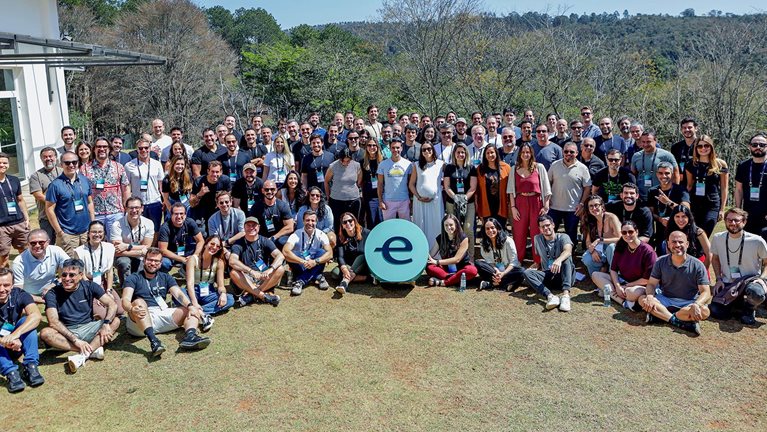
Smiles and applause filled the room as C.H.I. Overhead Doors employees came together to celebrate a milestone exit for the company. All 800 employees received a share of the company value that they helped create. Photo: Ruder Finn
Imagine a factory floor in Illinois, an insurance company in California, or a roofing materials company in Texas. Now imagine that every employee at each of these companies—from the production line to the loading dock to sales staff—could share in the wealth they help create. That is the reality at C.H.I. Overhead Doors, Integrated Specialty Coverages (ISC), SRS Distribution, and over 150 other companies where a broad-based ownership program, facilitated by the nonprofit Ownership Works, has brought equity payouts to workers.
More importantly, operational performance tells the deeper story: improvements in productivity, safety, margins, and growth, driven by employees who truly act like owners. Ownership Works, which launched in 2022 with help from McKinsey, has a mission to scale success stories like these for workers and companies around the world.
Turning a powerful idea into practical, scalable guidance
Successful shared ownership programs depend not just on broad equity participation, but on helping leadership teams build cultures where employees understand the business, feel empowered to improve it, and are supported in doing so. For Ownership Works, the challenge was developing scalable ways to support management teams on this journey.

Anna-Lisa Miller, executive director at Ownership Works, reflected on this challenge: “We needed to translate these success stories and best practices into something leaders could use day to day. McKinsey helped us translate what we were seeing in the field into a playbook that leaders could actually apply.”
The result was the new Ownership Culture Playbook, part of a broader refresh of Ownership Works’ content library. The playbook turns high-level concepts into concrete guidance, helping leadership teams move from aspiration to execution. It is organized around four pillars: sharing knowledge, sharing responsibility, showing care, and reinforcing the program through company processes and ways of working.
McKinsey helped us translate what we were seeing in the field into a playbook that leaders could actually apply.
Each pillar includes leading practices, real-world examples, and off-the-shelf tools that companies can adapt to their own context. The emphasis is not on doing everything at once, but on choosing the right starting point and building momentum over time.
McKinsey’s role: From bespoke support to scalable impact
McKinsey’s work with Ownership Works focused on helping the organization scale its impact without losing rigor or relevance. Mukund Prasad, a McKinsey partner involved in the engagement, described the challenge as one of translation and scale: “Ownership Works had incredible case examples and a model that worked. The question was how to scale that to be able to support hundreds of companies with a lean team. Our role was to help build a set of assets that support the model.”
Rather than creating a one-size-fits-all solution, the team worked together to define company archetypes and tailor guidance accordingly. The core principles and benefits of ownership culture remained consistent, but the way they showed up—in communications, KPIs, leadership actions, and employee engagement—varied by industry and operating model.
This approach enabled Ownership Works to move from a high-touch, bespoke delivery model to one that allows portfolio companies to self-serve using clear diagnostics, templates, and examples. It also strengthened Ownership Works’ credibility with C-suite leaders by providing a clear articulation of “what good looks like” when building an ownership culture.
A tool for investors and operators alike
The Ownership Culture Playbook is now being used by internal operating teams and partner portfolio companies as both a diagnostic and a roadmap. Portfolio companies’ investors assess where the companies are on their ownership journey and recommend specific tools aligned to strategic priorities.

As one investor noted, “We want to use this playbook to engage our portfolio companies by diagnosing what they need and pointing them to the resources that support their roadmap.” Another emphasized that the materials go beyond shared ownership alone, calling them “excellent human capital best practices” relevant across portfolio companies.
By grounding ownership culture in practical actions—how leaders communicate, how decisions are made, and how employees are supported—the playbook helps companies unlock the same dynamics that powered success at C.H.I., ISC, and SRS: employees who understand the business, care about outcomes, and take initiative to improve performance.
From case study to lasting model
The journey from early successes to a scalable ownership culture framework underscores a simple truth: shared ownership works best when it is treated as a system, not a program. Through its partnership with McKinsey, Ownership Works transformed a powerful idea into a practical engine for change—one that leadership teams can adapt, apply, and sustain.
For employees, this means real participation in value creation. For companies, it means stronger performance driven by engaged teams. And for investors, it means a proven pathway to long-term value creation rooted in ownership and accountability.