McKinsey and the Manufacturing Institute team up to meet the industry’s challenges
Recent data from the Bureau of Labor Statistics shows a major opportunity in manufacturing: There are nearly half a million open jobs open in the industry in the United States. The Manufacturing Institute (MI), the nonprofit workforce development and education affiliate of the National Association of Manufacturers, is at the forefront of closing this gap.
By launching initiatives, convening industry leaders, and conducting innovative research, the MI helps manufacturers access skilled talent while building career opportunities for individuals across the country, particularly among key talent pools.
“Solving the skills problem is challenging, despite the ample job opportunities in the industry,” says Carolyn Lee, president and executive director of the MI.
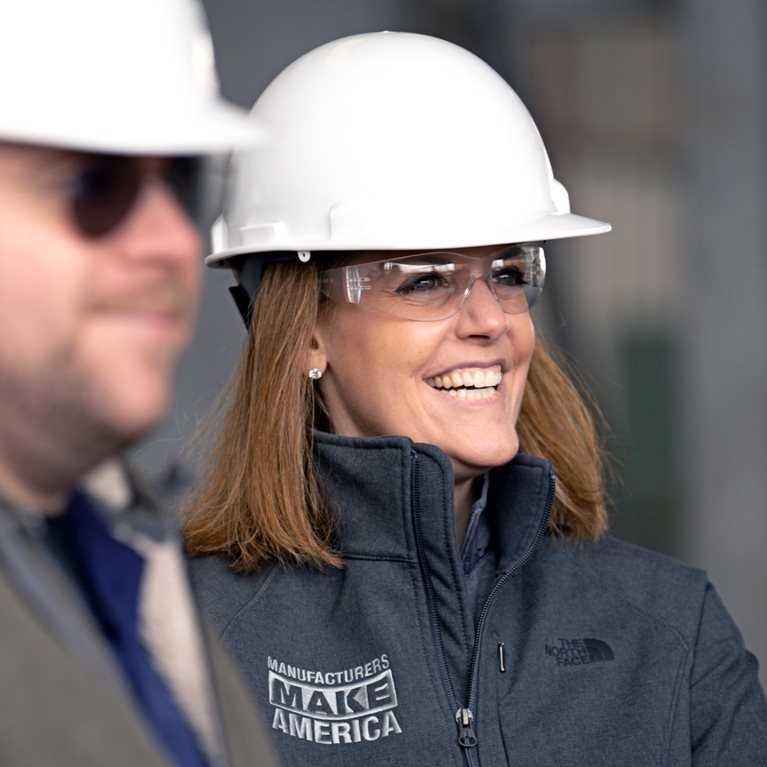
“At the heart of it, we have a perception problem,” she explains. “People think manufacturing is dirty, dark, and dangerous. But it’s actually clean, high tech, and innovative.”
To meet the needs of the industry, scaling is essential for the MI. At its most recent Workforce Summit, a key industry event, McKinsey Associate Partner Tyler Freeman approached Carolyn to ask about the MI’s plans for growth.
“Tyler helped me see that while we had defined our North Star—we needed to assess how we’d get there,” says Carolyn. “Our growth plan wasn’t in line with the scale of the problems we’re solving.”
McKinsey research shows that despite advances in technology (such as gen AI and new approaches to crew scheduling), manufacturers are still struggling to increase productivity, a challenge driven in large part by a younger, less experienced labor force. Our firm works with leaders in the manufacturing sector to think beyond talent attraction and retention, overlaying a lens of what current and future skills are needed across industries and geographies. Tyler recognized the MI was well-positioned to tackle the industry’s challenges and offered to bring a McKinsey team to identify how the organization, with just 30 staff members, could have even more impact.
“McKinsey challenged the thinking around what was possible,” Carolyn says.
Thinking big on initiatives
Two of the MI’s initiatives are Heroes MAKE America, which connects manufacturers with members of the military community, and FAME USA, an advanced apprenticeship-style program with nearly 500 manufacturers participating across over 40 chapters.
Heroes provides certifications and career-readiness training in partnership with technical and community colleges. It leverages SkillBridge, the Department of Defense’s program to help transitioning military members gain civilian work experience. It also directly engages manufacturers to connect with this talent through career fairs, resume distribution, and plant tours.

The McKinsey team assessed the skills of military service members pivoting to civilian careers, reviewed manufacturing roles across dozens of sectors, and mapped how those skills could be immediately applied in the manufacturing sector, providing the MI with a clearer understanding of how it could further tailor the Heroes initiative to serve more veterans. The number of military community members engaged through the various pathways of the initiative has the potential to increase by 33 percent annually.
“We gained a better understanding of manufacturing’s full potential for attracting talent from the military,” says Carolyn.
Obstacles to recruitment have been both issues with perception and lack of awareness of the benefits of a career in manufacturing. McKinsey’s collection and analysis of Heroes participants’ self-reported pay data found a key recruitment metric—manufacturing earnings were 20-30 percent higher than mid-level military base pay.
People think manufacturing is dirty, dark, and dangerous. But it’s actually clean, high tech, and innovative,
“Being able to demonstrate impact makes a big difference when engaging transitioning military service members who want to know that they are investing their time in a career that sets them and their families up for the future,” says Tyler, himself a veteran.
With FAME USA, McKinsey focused on the process and potential for adding new chapters, which involves forming a partnership between a group of regional manufacturers, a technical college, and a hub entity, usually a local economic development organization. Each chapter offers students two years of education, professional development, and training through on-the-job experience, resulting in an associate degree.
The McKinsey team identified a ranked list of locations primed for a FAME chapter and provided recommendations to help the MI smooth and speed its onboarding process, which could double the geographic coverage of FAME chapters by 2030.

“For FAME, it was critical to contextualize the recommendations based on the elements that make FAME a successful model,” says Hannah Kitzmiller, engagement manager at McKinsey. “It’s not only about scaling quickly but scaling sustainably in communities that have consistent, multidisciplinary job needs and a manufacturing sector presence large enough to support the program.”
The suite of recommendations was ambitious, and Carolyn says that regardless of which suggestions they ultimately implement, the process of creating them was transformative. It made space for new ideas, such as working toward regional program anchors.
“What if we could rapidly identify and support an anchor organization and have them take ownership, instead of us dedicating our time and resources in each location?” says Carolyn. “McKinsey spurred creativity on the team for a different approach.”
Proving value and sharpening messaging
Before working with McKinsey, MI’s website and messaging were focused on individual initiatives rather than overall mission, goals, and solutions. McKinsey helped the MI articulate its ROI and priorities by understanding where it can best position itself in the manufacturing workforce development market.
“The MI wanted to move to a clear message of its value proposition: recruit, train, and retain,” says Tyler. “Our work helped the MI to understand the need to highlight its role as a key convener and innovator in the manufacturing industry, not just its initiatives.”
The team also conducted data analysis to help the MI demonstrate its value. A key finding was that every dollar invested in the MI has yielded a 4.5 times ROI in terms of the economic impact created. This type of organization-level data is critical because it allows the MI to move from securing funding for specific initiatives to larger grants that support the entire organization.
“We were really good at telling our story from the human level, but we didn’t necessarily have the data to demonstrate our impact,” says Carolyn. “Being able to communicate our ROI to funders is critical for us to be able to scale.”
Growing up in a manufacturing family, she understands the importance of scaling the MI and helping more people realize the benefits that can come with a career in manufacturing.
“There’s a great wave of opportunity ahead of us,” she says. “Now, we’re in a much stronger position to deliver.”