European media investors have long been accustomed to the steady, reliable rhythms of the sector’s mergers and acquisitions deal flow. Media companies have typically had to settle for economically attractive but still relatively low-value (in comparison to US counterparts), in-country horizontal deals. Their ambitions to grow have tended to be limited by the region’s fragmentation, insufficient capital, and regulatory environment.
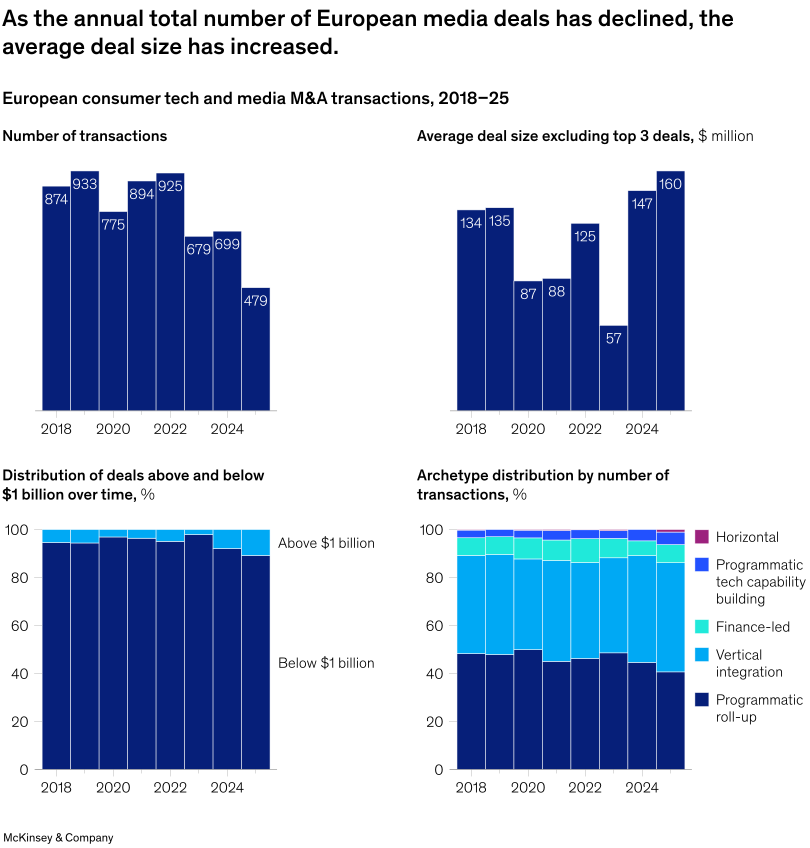
That dynamic, however, may finally be starting to change. With those types of traditional domestic deals increasingly exhausted in mature, consolidated markets, a growing number of European players are beginning to challenge purely national thinking. This evolution in strategy is reflected in M&A activity and value. Even as the total number of consumer technology and media (CTM) deals has declined close to 50 percent since 2018, the average deal size has increased by 30 to 40 percent. Recent McKinsey research suggests that M&A could be a key lever to help unlock new technology and media value pools in Europe.1
The slowly shifting European media deal-making terrain isn’t confined to traditional players such as broadcasters, publishers, and advertisers; other growing CTM categories, including e-commerce, events, marketplaces, and gaming, may well also be entering a new era of consolidation. To better understand the forces driving the next wave of transactions, we analyzed more than 6,000 CTM deals from 2018 to 2025. Based on these insights and our experience in the market, we identify the most likely next wave of transactions, the different deal archetypes that are emerging, and what it takes to execute these deals successfully.
Europe’s scale problem and the shifting M&A landscape
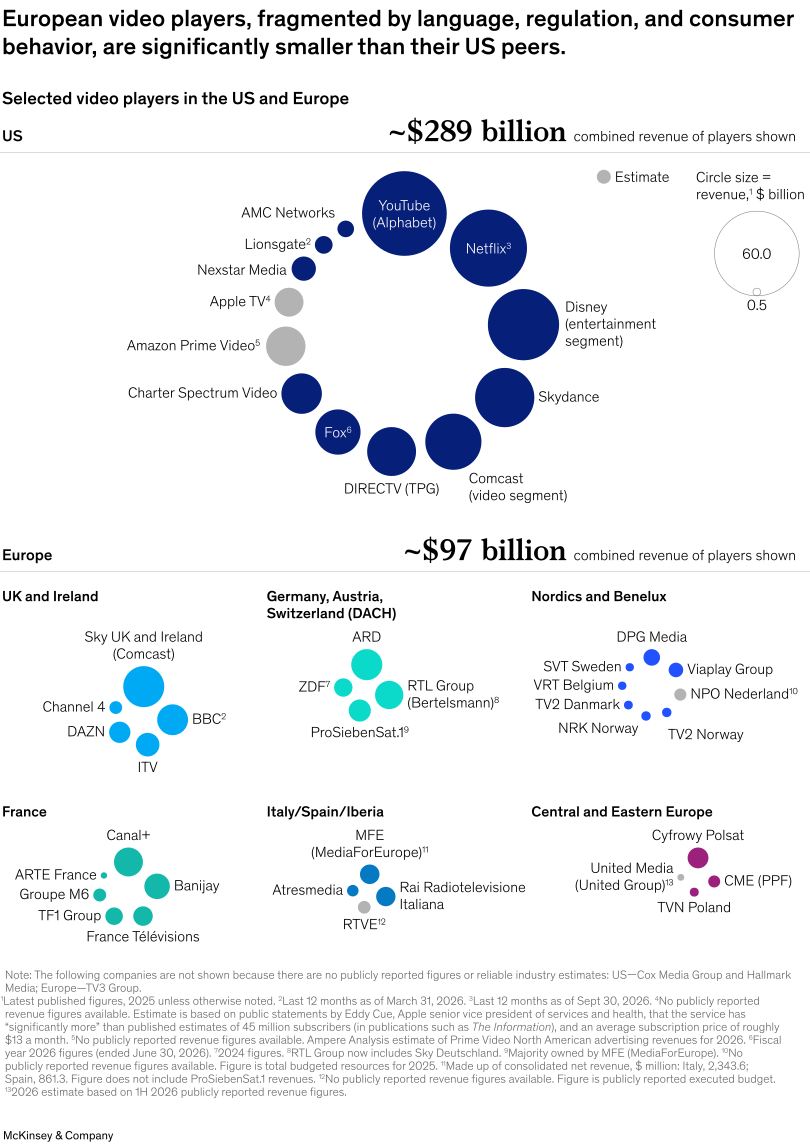
Europe has many world-class CTM companies, but the continent's structural fragmentation has long been its competitive weakness. While US media giants operate across a single, English-language market of 343 million consumers in the United States alone, European companies are divided by language, regulation, and consumer behavior. In a global industry where scale increasingly determines competitive viability, the result is that even the largest European players are a fraction of the size of their US counterparts, particularly in the video segment (Exhibit 1).
The different segments that make up the sector face varying levels of fragmentation and potential growth, however, which affects how much M&A pressure companies feel (Exhibit 2). In mature, slow-growth segments such as broadcasting, publishing, and traditional advertising, for example, achieving greater scale is one of the few reliable ways to drive profit growth. Yet given the in-country consolidation those areas have already undergone, only a relatively small number of buyers are still available; this leads to infrequent but larger deals that often include financial investors, portfolio sales, and transformations.
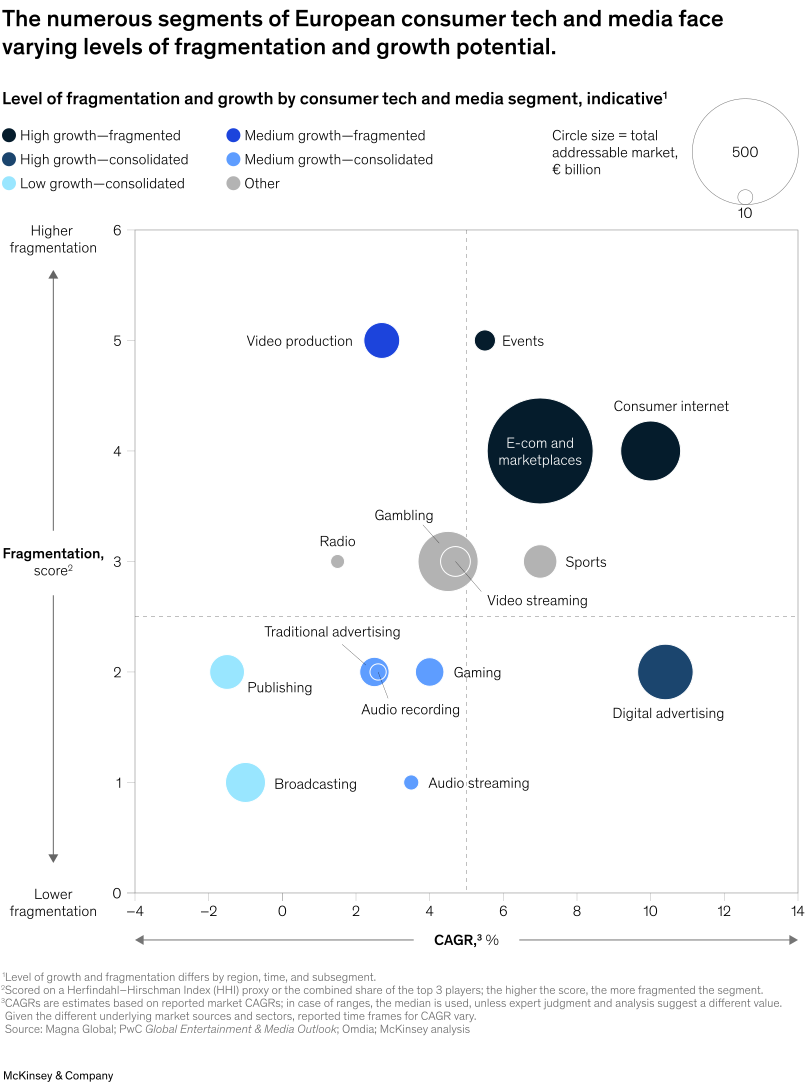
Highly fragmented segments such as consumer internet, video production, events, and e-commerce, by contrast, are still predominantly in a programmatic roll-up phase marked by smaller, more frequent deals. In these sectors, acquirers are seeking to aggregate content, intellectual property, and capabilities to enhance their offerings and leverage their scale for distribution and monetization.
With greater scale as the primary goal, deal activity across the European CTM industry has fluctuated considerably over time, affected by factors including the COVID-19 pandemic, accelerated adoption of digital media and services, maturing markets, and the availability of capital (Exhibit 3). In the past few years, however, three overarching trends have characterized the changing nature of these transactions:
- Average deal size is increasing. As fragmentation in the European CTM sector declines, the market is consolidating around a smaller number of larger transactions, with the average deal approaching $1 billion last year. Most of the straightforward, smaller targets have been acquired; the remaining independent companies to be acquired are larger, more complex, and command higher valuations.
- Large in-country horizontal consolidation is becoming more challenging. While still economically attractive, especially in mature CTM markets like publishing and broadcasting, traditional mergers that stay within the same sector and country’s borders are harder to pull off. Not only are in-market targets becoming exhausted, but some recent large in-country horizontal combinations have faced regulatory challenges. Achieving synergy goals can also be difficult. Given the significant value at stake, however, such pairings, long the dominant European media playbook, will continue to be attempted, even if not as frequently as in the past.
- At the same time, the appeal and value of cross-border deals are rising. Though the size of the prize doesn’t typically match that of domestic horizontal deals, these combinations can offer strategic value, especially from joining advertising operations. With in-country markets already so consolidated, companies increasingly are looking beyond their national markets for scale.
Four forces driving a new era of consolidation
Four structural forces are converging to drive this shifting M&A environment, as consolidation becomes the likely next step for most European CTM players.
1. Consumer attention is shifting to user-generated content
The content creation and consumption landscape is undergoing a fundamental transformation. Professional film, TV, and music studios dominated content creation for a century before social media and user-generated content (UGC) platforms began to capture attention at relatively minimal cost. Now, AI represents another significant platform shift, with the potential to impact up to 20 percent of original content production in the next five years.2 As a result, media companies are in a fight for attention that requires both scale, to distribute cost-intensive content production over a wider audience, and scope, to provide an offering that captures consumer attention across formats and categories.
Recent McKinsey research on “the attention equation,” based on a survey of 7,000 consumers worldwide, demonstrates that not all consumer attention is created equal: The quality of attention, defined by focus and intent, explains one-third of the variance in monetization across media formats that traditional commercial factors alone cannot account for. This finding has direct implications for European media economics. In the United Kingdom, where McKinsey conducted a parallel study of 997 consumers, media consumption generates average revenues of $3.33 per hour compared with $4.56 in the United States, a structural monetization gap associated with differences in scale, platform sophistication, and the regulatory environment.3
Would you like to learn more about our M&A Practice?
2. Traditional media is maturing while global digital platforms grow
Driven by shifts in consumer attention and content generation, several CTM subsegments are exhibiting slower growth or decline. Publishing revenues have contracted for over a decade, and traditional broadcast and cable programming faces structural audience erosion as younger cohorts migrate to streaming and social media. Digital platforms now account for close to two-thirds of all media time spent,4 with players like YouTube now capturing the single largest share of under-35 video consumption in Europe.
Traditional media’s share of the marketing mix is shrinking, and linear TV, with its high average revenue per user (ARPU) and multiyear contracts, is in structural decline. Thirty-six percent of European CMOs are planning to increase spend on digital media versus only five percent on traditional media.5 This shift is hitting large European legacy players particularly hard, eroding the revenue base that has historically funded premium content production and sustained competitive positioning against global platforms.
Those European incumbents already face a market that is dominated by a few large global players. US streaming platforms (including Netflix and Disney+) have amassed more than 130 million European subscribers6 and are moving into adjacent entertainment spaces such as gaming to diversify and expand their offerings and capture even more consumer attention. This activity increases the pressure on European companies further, as they need to compete with US players’ scale for content rights, technology investment, and advertiser budgets.
3. The financial and investor landscape is evolving
After several constrained years, the financing environment for European M&A is improving. Lower interest rates and more active media investors are helping to make capital more available and improve deal economics. Despite a recent hike, the European Central Bank (ECB)’s policy rate still stands at 2.65 percent, down from 4.50 percent as recently as September 2023.7
Private equity (PE) and infrastructure fund activity is also picking up globally as investors have built up large pools of funding in recent years. McKinsey estimates that more than 40 percent of the dry powder PE firms are ready to deploy today is more than two years old.8 Those PE players are increasingly entering the CTM market, attracted by recurring revenue models, intellectual property value, and digital transformation potential.
Many of these same investors are also taking a different approach to their holdings. They are operating as long-term owners who actively reshape portfolio companies, rather than financial engineers seeking quick exits. EQT Group’s acquisition of Keywords Studios represents a platform investment in gaming services with a multiyear operational transformation thesis. Apollo Global’s systematic buildout of a European online casino and betting group around Lottomatica suggests that more PE players are willing to hold, integrate, and build, bringing operational expertise and patient capital to segments ripe for consolidation.
4. The EU regulatory perspective on global media competition may be evolving
M&A activity in the European media industry operates within a well-established regulatory framework. The adoption of the European Media Freedom Act (EMFA) in 2024 introduced additional considerations for transactions, particularly in relation to cross-border activity and media plurality requirements.
European regulators consider a range of competitive dynamics when assessing media transactions, including the role of large global media and streaming platforms. The approval of the RTL-Sky Deutschland combination provides a recent example of these considerations in practice. Regulatory requirements remain an important factor, and transactions will continue to be assessed on their individual merits. But recent decisions illustrate how authorities may consider both domestic market dynamics and the broader competitive environment when evaluating consolidation in the European media sector.
European M&A archetypes: Where consolidation is most likely
As these structural forces drive a new wave of European CTM consolidation, deal activity is likely to evolve across several archetypes. These are not mutually exclusive, but they represent distinct strategic rationales.
Large national horizontal deals
Large mergers that combine direct competitors or adjacent players in the same business and country remain one of the most reliable ways for companies in maturing markets to achieve scale and increase profits. Such horizontal tie-ups allow companies to spread costs over a larger user base and realize synergies in areas such as technology, marketing, and corporate functions. They also enable companies to offer a broader, unified advertising proposition to compete with offerings from global competitors. While this archetype has a strong strategic rationale, it accounts for a very small share of deals. This reflects the small number of available, sufficiently large targets, as well as the fact that such transactions require extensive regulatory diligence and are often more lengthy and costly than smaller acquisitions.
Large cross-border horizontal deals
Given the challenges with pulling off large national horizontal deals, a small but growing number of companies are seeking to consolidate across borders. A prominent example is MediaForEurope (MFE)’s €1.8 billion takeover of ProSiebenSat.1 in 2025. The combined entity creates Europe’s largest commercial broadcasting group by audience reach, spanning several of the continent’s largest advertising markets—Austria, Germany, Italy, Spain, and Switzerland—with a combined population of around 210 million people. The companies cited content procurement synergies, shared investment synergies, and a more compelling proposition for advertisers as key rationales for the deal. Our analysis suggests these types of deals, while likely remaining a very small share of total deal volume, will become more common.
Programmatic roll-ups
A programmatic strategy of roll-ups in more fragmented markets historically account for the largest number of CTM combinations, representing nearly 50 percent of all such European deals, and most deal activity will likely continue to belong to this scale-driven category. In many cases, the target company could be worth more under new ownership than it is as a stand-alone, especially when it holds intellectual property that a larger acquirer can distribute and monetize more effectively through superior reach and technology. In content production, All3Media, Banijay, Leonine, and Mediawan have pursued serial acquisitions of independent producers to build scale in supply.

Technology, media, and telecommunications: Building the future one deal at a time
Vertical integration
CTM companies have historically engaged in two distinct models of vertical integration, together accounting for approximately 40 percent of all European deals. In the most common approach, players in a single media segment integrate adjacent players along the value and supply chain to expand market share and capture margins; Canal+’s deal with M7 and ITV’s with Plimsoll are prominent examples. The other model, cross-segment verticalization, is based on companies making moves across multiple segments to diversify their revenues and content mix, such as Vivendi’s tie-up with Lagardère or Reworld joining forces with Mondadori France. Many European single-segment media companies that face an “ecosystem disadvantage” against global platforms have chosen to strike partnerships and alliances with market leaders in other segments rather than pursuing cross-segment vertical integration. This approach allows each party to remain in control while reducing the risks of a full-scale acquisition.
Programmatic technology capability building
Building technology capabilities through a programmatic-driven series of acquisitions is another solid M&A rationale in European CTM, although it still only accounted for 4 percent of all deals in 2025, up from 2 percent in 2018. This archetype is especially relevant in segments where the business models rely more heavily on capability than on content such as advertising, social media, and marketplaces. To capitalize on one of the largest AI-driven revenue streams, hyperpersonalized marketing, companies need to invest in data analytics, targeting capabilities, and large pools of primary data, which in turn requires sufficient scale. However, 94 percent of European marketing firms today report that they have only immature gen AI marketing capabilities.9 With organic capability development both costly and time-consuming, companies are turning to M&A to fill those gaps.
Finance-led (and motivated) deals
The improved financing environment is spurring growth in two distinct types of financially motivated investor activity in European CTM. The first involves PE take-privates, breakups, and restructurings that exploit public-market discounts for companies looking to divest or change ownership structures. A prominent example of such portfolio optimization is KKR’s acquisition and subsequent restructuring of Axel Springer. The second involves financial players engaging in programmatic roll-ups within fragmented segments, such as events, e-commerce, and marketplaces, to create platforms that achieve greater scale. This model has been pursued by Providence, which bought CloserStill in 2018 and has since done six roll-ups focused on B2B events and exhibitions. This pattern is likely to intensify, as favorable financial conditions make acquisitions affordable again and maturing markets increase pressure on companies to find alternative investors.
Lessons for executives pursuing consolidation
Across the European CTM industry, several principles distinguish successful M&A programs from those that underperform.
Take a clear-eyed, independent approach to assessing synergy
Executives should establish a higher bar for value creation that goes beyond classical cost and revenue synergies, especially for deals that are not typical horizontal mergers. The synergy case can include a rigorous view on technology stack rationalization, first-party-data combination, AI capability acceleration, and cross-platform audience monetization.
For European deals, this requires a realistic assessment of in-country versus cross-country synergy. European CTM transactions face a structural challenge that US deals do not: Language differences, distinct regulatory regimes, and nationally oriented consumer behavior limit the extent to which content, operations, and commercial approaches can be shared across borders.
Link M&A to corporate strategy
Companies need to articulate clearly why, where, and how M&A advances the overarching corporate strategy, to avoid going after disconnected “shopping lists” driven by opportunity rather than intent. Every potential transaction can be evaluated against a defined set of strategic priorities: Does it close a specific capability gap? Does it address a defined scale deficiency? Does it accelerate entry into a targeted adjacency?
Build a programmatic M&A muscle
McKinsey research shows that programmatic acquirers—companies executing a steady cadence of deals aligned to a strategic thesis—generate more value than those relying on one-off large transactions: seven percentage points higher returns on average than large deals, ten percentage points higher than selective M&A, and more than four percentage points higher than organic growth. This finding is particularly relevant in the fragmented European market. Historically, a programmatic strategy in media has delivered excess total shareholder returns of 5.9 percent, twice the average return observed in other sectors.10
Building this capability requires investment in dedicated M&A resources, standardized evaluation frameworks, repeatable integration playbooks, and systematic postmerger performance tracking. Companies can also consider divestitures as actively as acquisitions: Portfolio optimization through disposal of noncore assets can fund strategic acquisitions and sharpen organizational focus.
Going forward, the most successful European CTM companies are likely to pursue programmatic M&A as their baseline strategy while also engaging in selective larger deals when transformative opportunities arise—a “programmatic-plus” approach that continuously evolves the portfolio.
Establish rigorous integration management
The integration management office (IMO) is where value creation either materializes or evaporates. Clear governance and cadences, granular workplans organized along product and offering lines, and communication plans are all essential elements of the process.
Two dynamics make integration execution particularly consequential for CTM. First, advertising revenue cycles are unforgiving: Advertiser commitments are made months in advance, and any disruption to sales relationships during integration can result in permanent revenue loss. Second, subscription businesses depend on continuity of experience: Subscriber churn can easily spike if content availability, interface quality, or pricing change abruptly during merger transitions.
Ensuring that IMO plans explicitly protect revenue and retain key talent from the outset is essential. Where integration management is lacking, it remains among the most common and costly failure modes in media M&A.
For European consumer tech and media companies, the shifting M&A landscape presents both an opportunity and a threat. As the financial environment becomes more accommodating and the regulatory posture may be evolving, the potential for more ambitious and expansive deal activity is growing. At the same time, the competitive pressure from global platforms could only intensify as AI further lowers barriers to content creation and distribution.
Making the most of this determinative moment will require focus and conviction. The capabilities required to execute programmatic M&A take time to build. The most attractive targets will likely not remain available for very long, and the cost of remaining subscale in a consolidating industry can compound with delay.
Companies that develop clear strategic frameworks for M&A, build programmatic execution capabilities, and maintain the discipline to integrate what they acquire could be best positioned to define the next chapter of European media. Those that remain a captive audience to the consolidation happening around them risk finding themselves on the wrong side of the deal, as targets rather than acquirers, and on terms likely not of their choosing.