The semiconductor industry is now one of the world’s most profitable sectors, and recent developments bode well for its future. The rise of AI, which is transforming virtually every sector, could trigger unprecedented demand for chips as companies build more data centers and increasingly rely on edge devices. According to McKinsey’s latest base-case estimate, the semiconductor industry could reach $1.6 trillion in revenue by 2030, up from $775 billion in 2024, as new computing models, domain-specific architectures, advanced chip sets, and other next-generation technologies emerge.1
Some challenges also loom, however. The semiconductor industry’s highly interdependent global value chain is now under pressure amid rising geopolitical tensions, new tariff policies, material and component shortages, and potential restrictions on exports. Given that the semiconductor industry has a winner-take-all dynamic, with a few leaders in each segment garnering most value, companies need a decisive, coordinated strategy to succeed.
But what strategies are most likely to help semiconductor companies thrive? To answer this question, we analyzed the top semiconductor companies—those few winners that generate the most profit in each industry segment. Specifically, we examined the coordinated, well-timed, large-scale initiatives, or “big moves,” they undertook to improve both portfolio and performance. We then determined how their strategic decisions about portfolio and performance allowed them to develop a clear strategic core focused on technology leadership, platform agility, or portfolio breadth.
The portfolio and performance moves that we examined are described in detail in the book Strategy Beyond the Hockey Stick (Wiley, 2018), by McKinsey Senior Partner Chris Bradley and former Senior Partners Martin Hirt and Sven Smit. We grounded our analysis in the book’s framework because we believe it provides a compelling, data-driven lens for examining and understanding company performance in today’s semiconductor industry.
A big rise in economic profit
The semiconductor industry’s average annual economic profit (EP)2 rose from 12th out of 31 industries in the early 2000s to third place for the years 2020 to 2024. Overall, EP increased about 40-fold from the early 2000s through 2025 (Exhibit 1). Total shareholder returns have also been strong over the past 15 years.
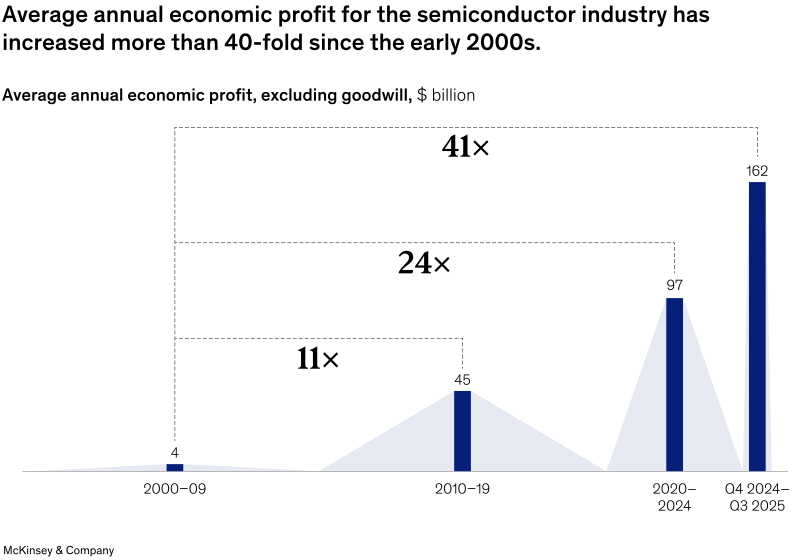
Value creation varies by company type, and the sectors accounting for the most profit are shifting. Although integrated device manufacturers (IDMs) and fully integrated companies generated the most value for many years, they have experienced slower growth. Meanwhile, captive chip players, OEMs with in-house design, and fabless companies are now generating more value.
A cross-sector recipe for success
To identify the best strategies for the evolving market, we examined the 11 semiconductor companies that had the highest EP growth in each major value chain segment—equipment, fabless, IDM, and foundry—from 2000 through 2024.3 Drawing on insights from Strategy Beyond the Hockey Stick, we concentrated on the five big moves that have delivered the greatest benefits to the semiconductor industry. The three portfolio moves are programmatic M&A, dynamic resource reallocation, and out-investing competitors; the two performance levers are improving productivity and product differentiation.
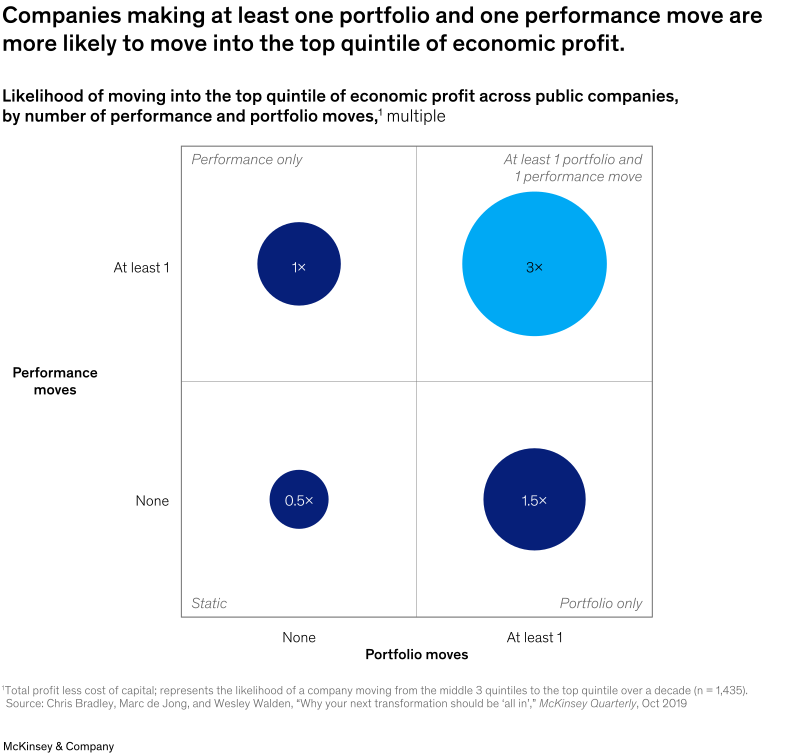
The results reveal that all 11 semiconductor leaders executed at least three of the five big moves and always included at least one portfolio and one performance move from 2020 through 2024. Note that this is markedly different from the average company, which makes an average of only one big move per decade.4 These findings are aligned with the results of the cross-industry analysis in Strategy Beyond the Hockey Stick, which showed that companies were six times more likely to move to the top quintile if they undertook at least one performance and one portfolio initiative, compared with companies that did not undertake any big moves (Exhibit 2). Overall, the average probability of moving into the top quintile was 8 percent.
Winning portfolio moves
The three big portfolio moves are resource intensive and don’t guarantee a strong ROI. However, when executed well, the benefits outweigh the risks.
Mastering the art of dynamic resource reallocation. In our analysis, top semiconductor companies strategically reallocated resources in response to market developments. Over a decade, they shifted at least 60 percent of their annual investments or capital expenditure funding to different business units.
Nvidia illustrates dynamic resource reallocation. After building its business in gaming graphics processing units (GPUs), the company recognized that GPU parallelism could accelerate a broad set of compute-intensive workloads. Over time, GPUs proved valuable not only for graphics but also for highly parallel tasks. These later included crypto mining and, ultimately, AI training and inference. As Nvidia scaled from chips to systems and then to full data center infrastructure, networking became a central part of the value proposition: Following its Mellanox acquisition, Nvidia expanded the InfiniBand and Ethernet platforms (and data processing units) that connect GPUs into clusters and turn AI servers into industrial-scale AI infrastructure. Following a dynamic strategy has helped Nvidia become the first company to reach $5 trillion in market value.5
NXP followed a similar strategy by reallocating its capital expenditure investments based on market dynamics. It exited two volatile segments, digital television and mobile, to focus on the automotive sector and secure connectivity in the late 2000s.
Outinvesting to outperform. Top performers consistently outpace their competitors in funding. Within semiconductors, the capital expenditure to revenue ratio for leading companies is 1.7 times the industry median, and some go much higher.
When the top companies make big bets, they focus on their core technologies and remain committed. Consider a few examples:
- ASML invested over $6 billion in R&D for extreme ultraviolet (EUV) lithography over more than 17 years to accelerate its core technology—about twice as much as peer companies have spent on R&D over the past decade.
- TSMC plans to invest about $165 billion to build three new fabrication plants, two advanced packaging facilities, and an R&D center in the United States.6
- SK hynix plans to invest about $75 billion in AI-optimized memory and high-density solutions.7 The company will allocate about 80 percent of the funding to its core HBM technology in an effort to secure its leadership position.
Outsize investments are particularly important in the semiconductor sector because chips have high fixed costs and long development cycles. To maximize ROI, companies should adopt a forward-looking investment strategy that concentrates R&D spending and capital expenditures in selected focus areas. This approach may create an early advantage by positioning them for the next wave of innovation long before it gains momentum. Companies that anticipate future developments are also more likely to achieve large-scale influence over industry standards and dynamics.
Generating momentum through programmatic M&A. Programmatic M&A often involves an average of at least two deals per year. Their combined value typically represents at least 30 percent of a company’s market capitalization over a decade, typically 5 to 10 percent annually, with no single deal exceeding 30 percent.
Our analysis showed that the top semiconductor players systematically acquired or merged with multiple small companies to enter high-growth adjacent markets. Broadcom, which originally focused on creating chips for wired and wireless communications, implemented a targeted and sequenced acquisition strategy to pursue compelling AI and data center opportunities. The company’s portfolio now includes switch chips, server connectivity solutions, and custom application-specific integrated circuits (ASICs).
Following a similar strategy, Applied Materials undertook programmatic M&A to expand its focus from chemical vapor deposition to physical vapor deposition, allowing the company to offer plasma etch and metrology solutions. Customers that wanted end-to-end process control responded favorably.
Performance levers that separate the best from the rest
Two performance levers that deliver great benefits—improved productivity and product differentiation—will be familiar to any business leader. They are often critically important because they provide the funding required for new portfolio initiatives. What may be surprising, however, is the extent to which they separate winners from the pack within the semiconductor industry.
Low costs, high productivity. By our definition, the best performers in productivity rank in the top 30 percent within their industry and scale efficiently. Their success requires both a focused execution strategy and a commitment to leveraging existing assets. Texas Instruments relies on lean operational efficiency and a direct-to-customer sales model to enhance productivity. For instance, the company automated equipment maintenance and divested its 150-millimeter legacy fabs after it shifted its focus to 200-millimeter and 300-millimeter wafers.
Better product differentiation, healthier margins. One insight from Strategy Beyond the Hockey Stick: Across industries, top-performing companies improved their gross margins faster than 70 percent of their peers did by creating unique, high-quality products, better pricing capabilities, and/or new business models. This finding also holds true in our sample of leading semiconductor companies, which are careful to ensure that core technology offerings provide distinct benefits and anticipate future customer needs. Consider a few examples:
- ASML developed a long-term technology road map for its core EUV technology and comprehensive lithography platform that called for continuous improvement, allowing the company to become the global leader in semiconductor equipment.
- TSMC was one of the first companies to develop and execute a technology road map for its products. Combined with the company’s strong manufacturing processes and technology leadership, the road map helped TSMC enhance its leading-edge process technology.
- Qualcomm’s focus on power-efficient, high-performance system-on-chips (SoCs) allowed the company to expand its technology offerings, originally developed for the mobile sector, into the automotive and Internet of Things segments.
Some semiconductor companies develop unique offerings by combining different elements of the technology stack or value chain in their offerings, rather than focusing on the incremental creation of separate technologies over time. By taking a platform approach, they provide their customers with greater convenience and may even shape industry standards and ecosystems. For instance, Qualcomm has helped shaped the wireless market by developing end-to-end connectivity solutions across 3G, 4G, 5G, and beyond.
The most important enablers of success for semiconductor companies
Our analysis suggested that the most successful semiconductor companies executed multiple, coordinated big moves, rather than just focusing on a single move. We also found that the companies garnered the most benefits from big moves if they also demonstrated the following characteristics:
- A commitment to integration across the tech stack or value chain. Those companies that decided to become platform players had the highest EP. One notable example is Nvidia, which transitioned from providing hardware to providing system-level AI infrastructure.
- A strong understanding of customer needs and a clear commitment to meeting them. The top companies do not simply serve customers; they develop deep customer insights and then use this knowledge to strengthen and refine their big moves. LAM Research recently diversified its production footprint to serve customers locally, with the goal of strengthening relationships and increasing trust. Similarly, Applied Materials emphasizes customer cocreation to help ensure that it develops the right products.
- Willingness to shift from a traditional vendor model to an ecosystem model with customers, suppliers, and research institutions. Instead of engaging in purely transactional relationships with vendors and customers, top performers develop partnership ecosystems. ASML has a unique system in which team members are embedded at supplier sites for a time to understand how they work. Such alignment with suppliers can enhance the benefits of multiple big moves, including those intended to lower costs and create differentiated products. ASML has also offered customers the opportunity to coinvest in its R&D programs, which reduces the risk associated with investing in innovation and ensures that it meets customer needs. Some semiconductor companies also form partnerships with research institutions to enhance innovation.
The emergence of a strategic core
The decisions that semiconductor companies make about their portfolio and performance will allow them to develop a clear strategic core—technology leadership, platform agility, or portfolio breadth—that builds both competitive resilience and EP. While companies may have elements of all three in their business model, one typically serves as the primary source of advantage.
Technology leadership. Companies that outspend their competitors to enhance their core products or services may become technology leaders, but they must continuously reinvest in improvements and investigate opportunities in close adjacencies to retain their position. TSMC followed this strategy in foundry-related offerings by investing in new areas, such as advanced packaging.
Technology leaders must also emphasize both speed and excellence when executing improvements. Companies that move from a traditional vendor model to supplier partnerships, as well as those that undertake joint R&D investments with customers or research institutions, may have an advantage as they strive for technology leadership because these arrangements can reduce risk, accelerate scaling, and increase success rates for core technology products.
Platform agility. To be able to pivot quickly to new technologies, companies should place early bets and design modular architectures that enable rapid adaptation. At the same time, they will need to leverage the strengths of their core technologies to gain an advantage over slower-moving or monolithic players. Several big moves—outspending competitors to drive innovation, improved productivity, and product differentiation—support this objective.
Nvidia achieved platform agility by designing its GPUs with a modular and scalable architecture that included the following elements:
- streaming multiprocessors that can be scaled up or down to create chips for everything from a small device to a large data center accelerator
- a common software stack that works across all applications
- hardware modules (such as memory controllers and interconnects) that can be combined flexibly to serve different workloads
By developing a modular core architecture (its proprietary compute unified device architecture, or CUDA) and moving quickly in response to trends, Nvidia was able to pivot rapidly from gaming to cryptocurrency, data centers, AI, and software offerings.
Portfolio breadth. Companies can drive growth by creating a broad, high-margin portfolio spanning multiple products across analog, connectivity, or power, provided that they focus on one clear business segment while maintaining both price discipline and quality for all offerings.
Across the semiconductor industry, multiple companies have followed this strategy. Texas Instruments built a broad portfolio while staying tightly focused on analog and embedded processing semiconductors. The company now has a catalog of over 80,000 parts that can be applied across many end markets, including industrial, automotive, communications, enterprise systems, and personal electronics.8 Within the data center segment, Broadcom built a portfolio by stacking complementary building blocks that cover the full networking and infrastructure layer needed to scale modern facilities. The company then deepened its data center focus through VMware, a software cloud platform.
Charting a bold strategy for the AI-driven future
As semiconductor companies contemplate past successes and develop new strategies, they must consider critical questions related to both products and markets.
Which disruptive trends will reshape my core markets and technologies? Although semiconductor companies face much uncertainty, their leaders can begin shaping their long-term strategies now. The following questions may help them focus:
- How are AI, edge computing, automotive electrification, or robotics shifting design requirements, node economics, and customer expectations?
- Which end markets are accelerating development timelines or demanding vertical integration, and how should we align our strategies to succeed in these markets to gain an edge while preserving flexibility?
Where do we hold durable advantages across the technology stack, product portfolio, and ecosystem? This question relates to maintaining a long-term competitive advantage, and the answer may require companies to adjust their traditional strategies. As leaders attempt to answer it, they should consider the following issues:
- How should we rethink our product portfolio to build a scalable platform that supports long-term growth across adjacent markets?
- How are we driving breakthroughs in architecture, interconnect, materials, or packaging? If there are no breakthroughs, what needs to change?
- Do we hold advantaged access to foundries, OEMs, hyperscalers, or national funding programs?
What bold portfolio and performance moves are essential? Companies that execute at least three big moves in portfolio and performance are most likely to excel. But which ones should they select? The answer will vary by product and market, but companies can narrow their options by considering the following questions:
- Are we best positioned to double down on deep core technology leadership, pivot our technology platform into high-growth verticals, or expand with a broad offering?
- How could we benefit from making a transformative acquisition, entering new value chains, or radically reallocating capital expenditures and R&D investment?
- Based on our core markets, where should we invest—and with whom should we partner—to build a high-impact ecosystem that can act as a flywheel for innovation and scale?
To compete in an industry where advantage is increasingly concentrated among a few highly successful companies, semiconductor leaders must act now. The leaders that will shape the next era will be those that translate insight into commitment, making the required portfolio and performance moves at full scale and then adhering to a strategic core to accelerate innovation and resilience. The path is demanding, but the payoff is equally significant. By making deliberate choices now—about where to lead, how to build, and with whom to align—companies can define the industry’s next wave of value creation.