Imagine that you’re a retail merchant or category manager who has just hired the analyst of your dreams. Whatever task you assign to them—pricing analyses, assortment diagnostics, vendor materials drafting, and more—they execute with rigor, accuracy, and extraordinary speed. They keep an eye on the business at all times, even on weekends and holidays. They’re proactive, scouring through massive amounts of performance data to flag potential issues for buyers and providing actionable recommendations on where interventions are necessary before you ask them to.
Now, imagine you have 20 of these analysts—for every single buyer. This is the new reality that agentic AI systems (autonomous, goal-driven AI systems that can plan, act, and learn) are bringing to retail merchandising.1 Decision-making no longer needs to follow static weekly cycles, since AI agents can continuously tune assortments, adjust prices, refine promotions, and deliver rich, real-time insights.
The impact of agentic AI on retail merchandising could be profound. Historically, the merchant role requires spending critical time and energy on manual, repetitive tasks. By offloading it to AI agents, merchants2 could reclaim up to 40 percent of their time to do what they do best: focus on strategy, find great products, understand customers, and optimize vendor negotiations.3 Early agentic AI adopters are already seeing the benefits of this new frontier, with significant revenue and margin lifts resulting from stronger assortment decisions and data-backed bargaining capabilities.
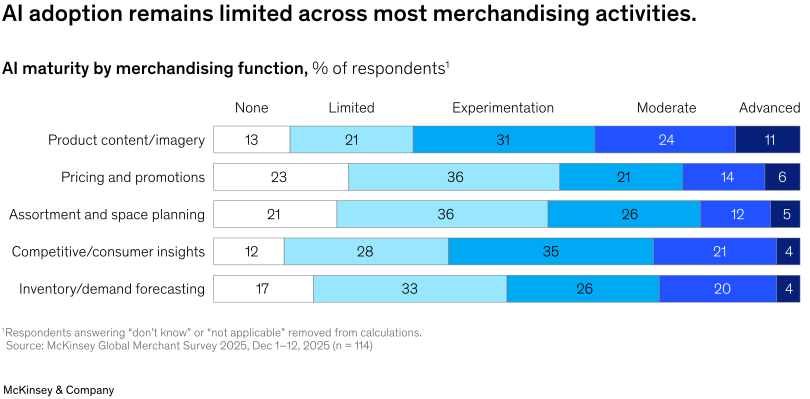
However, our work with global retailers tells us that most aren’t ready for this transformation. While most retail merchandising teams have invested in automation tools4 and experimented with AI, 71 percent of merchants in a new McKinsey survey say that AI merchandising tools have had limited to no effect on their business so far.5 The challenge often lies less in the technology than in how it’s integrated and used. Systems remain fragmented, data is too messy to use to deliver useful recommendations, and adoption is uneven: 61 percent of respondents say that their organization isn’t at all or is only slightly prepared to scale AI across merchandising.
This article explores how the new frontier of agentic AI could overcome these challenges to fundamentally transform the merchandising function and what it will take for retailers to realize the technology’s full benefits.
Leapfrogging from modernization to transformation
Retailers have steadily modernized the merchandising function with automation tools and analytical AI.6 These technologies have delivered some gains: Automated replenishment is reducing manual effort, predictive models are starting to sharpen forecasts, and pricing engines are simulating scenarios that once took weeks to iterate.
These capabilities are making merchandising more data driven. Yet the transformation is far from complete: Survey respondents tell us that they still spend 40 percent of their time on completing low-value tasks (such as data system consolidation and repetitive spreadsheet work required for performance reporting) and reconciling data across siloed systems. And even when merchants do use AI, few are using it across the activities where it would be most helpful (Exhibit 1).7
Part of the challenge lies in how automation and gen AI8 operate. These tools work with incomplete data, using algorithms to fill gaps and infer connections across fragmented systems. While large language models can handle unstructured text, these technologies struggle with fragmented commercial data, such as conflicting SKU files and inconsistent pricing history. Their outputs are often inconsistent.
Such outcomes are good enough for directional insight but not reliable enough for day-to-day decisions. Generating them also requires heavy up-front system integration and human oversight, creating friction that limits effectiveness and trust. Configuring and interpreting results from automation tools and gen AI often means that merchants are spending less time doing the work that moves the needle.
Agentic AI changes the dynamic. First, agents can work through messy data more effectively. They can cleanse and reconcile information on their own and, importantly, get better with every cycle. Second, agents can generate and test scenarios at scale, using natural language to run and refine analyses in real time while improving explainability.9 Third, AI agents across functions can work together, creating a simple, automated workflow that extends from the vendor to the store shelf and improves visibility across functions and cross-functional collaboration.
These capabilities—autonomous data improvement, scalable scenario generation, workflow automation and orchestration, cross-functional and cross-domain optimization, and explainability as a driver of change management—make agentic AI more powerful than its AI predecessors. Merchants can use agents that continuously learn, execute decisions, and improve automatically as data and models evolve, as early adopters are beginning to see for themselves.
A day in the life of the agentic-AI-empowered merchant
To understand how profoundly agentic AI could transform merchandising, it helps to look at how a single day in the life of an agentic-AI-empowered merchant could unfold. While the specific impact will vary by sector, the following example describes how a hypothetical grocery category manager—let’s say, a woman who we’ll call “Natalie”—uses agentic AI in ways that completely reshape her day. Similar shifts could apply across apparel, electronics, and general merchandise.
Currently, Natalie’s time at work revolves around manual planning and constant “firefighting” for course correction. Forecasting tools and early AI models support her planning work, but their outputs are static, requiring manual validation and rarely guiding daily decisions. Natalie often spots performance gaps in price, margin, or availability later than she’d like to, forcing her to fix issues reactively and make decisions that are driven more by hindsight than foresight. This leaves her with little time for strategizing and forward thinking.
With agentic AI, that cadence shifts completely, compressing what might have been a week’s worth of work into a day.
After implementing agentic AI, Natalie’s Monday starts at 8:30 a.m. with a review of the signal brief, or a unified, prioritized dashboard that agentic AI generates (Exhibit 2). Instead of scrolling through sales reports, Natalie sees exactly where to act: An energy drink promotion is underperforming, there’s a pricing discrepancy across several city stores, and a markdown opportunity has emerged in seasonal snacks. Within minutes, she approves agent-recommended changes directly in the system. The approvals prompt domain-specific agents to redirect the promotional budget, adjust local prices to restore fairness, and rebalance inventory across the affected stores.
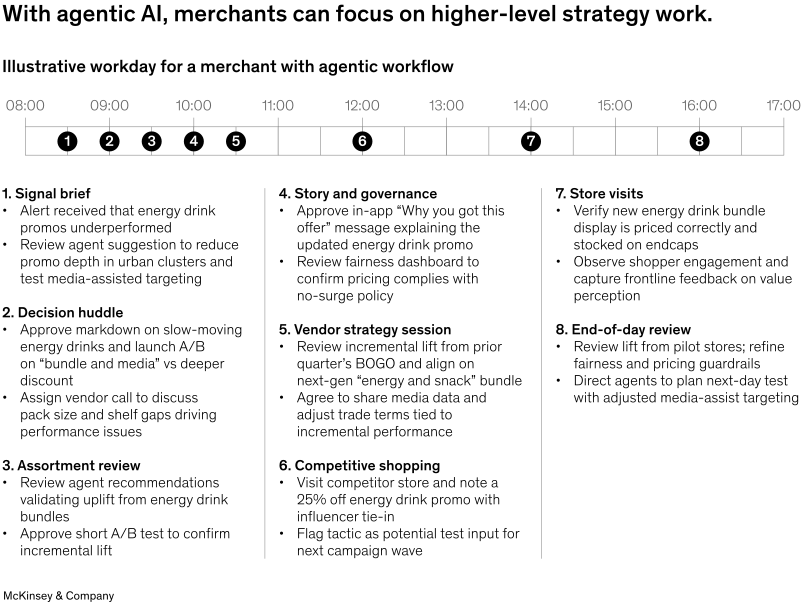
Next, a cross-functional daily decision huddle replaces Natalie’s weekly leadership performance review. The performance review might have lasted only 30 minutes, but it required teams to spend hours beforehand assembling performance decks, reconciling conflicting reports, or debating the root causes of the past week’s results. The daily huddle, which might still take 30 minutes, instead focuses on deciding which agentic-AI-recommended actions to take immediately—and eliminates the need for follow-up research or subsequent decision meetings.
By 9:30 a.m., Natalie moves into an assortment review, where agents have already validated uplift projections, run A/B tests on display bundles, and simulated pricing outcomes. Instead of manually building the next campaign, she approves AI-suggested tactics, such as testing a new bundle-and-media promotion that links product bundles with targeted ad placements across select stores.
Then Natalie pivots to higher-order tasks: reviewing fairness metrics and confirming that pricing aligns with corporate guardrails. In this future state, agents feed causal insights into the system automatically (one such insight could be that out-of-stock items in the northeast region drove 35 percent of the margin miss), so there’s no longer a need for a standing midweek performance review.
Around midday, during a vendor strategy session, Natalie enters negotiations equipped with AI-agent-generated benchmarking. The agent provides live supplier cost trends, margin forecasts, and incremental lift from prior promotions. It also scripts out specific points to negotiate with the vendor, along with associated carrot-and-stick items.
These sessions, once quarterly and focused on past results (with only high-level outlines of new actions to consider), are now part of rolling council meetings on vendor growth, which are forward looking and occur monthly. Teams use agentic AI to surface new partnership and media opportunities, transforming vendor check-ins from transactional updates into joint growth-planning meetings.
Real-time dashboards that flag on-shelf compliance and shopper engagement inform store visits that Natalie makes later in the day. By 4:00 p.m., instead of responding to store or vendor escalations or preparing decks for tomorrow’s meetings, she wraps with an end-of-day review, which includes a short synthesis of what the AI agents had learned, what was adjusted automatically, and which decisions still needed human input. The agent, with Natalie’s approval, has already executed replenishment exceptions, price tests, and promo updates, with results feeding into the next day’s models.
In this future state, up to 60 percent of Natalie’s once-manual tasks, which are crucial for decision-making, could be automated or standardized. With that additional time, Natalie could work on strategic category and business planning or on deepening customer insights, both of which are areas where merchants tell us that they would reinvest their new capacity.
Reimagined roles and ways of working
Agentic AI delivers speed and precision, but its impact depends on people and processes evolving alongside it. For retailers, that means reimagining the organization itself: flattening hierarchies, redefining roles, introducing new operating rhythms, and rewiring end-to-end processes.
Agentic-AI-upgraded organizational chart
Agentic AI could reshape how merchandising teams are built. Traditionally, category teams have been made up of several assistant category managers and analysts and supported by functional partners in areas such as merchandising analytics, pricing, promotions, space planning, and inventory. AI agents will provide 24/7, automated support to merchandising teams in the future, allowing team members to be redeployed to higher-value areas, such as cross-functional coordination.
Squads of AI agents would provide the analyses and recommendations to each category manager. A category data partner, along with merchandising operations functional leads (such as those who oversee pricing and promotions), will coordinate the work that agents do. They will also set agent policy and guardrails across categories.
Redefined roles and responsibilities
In a transformed category team, the category manager will be the strategic orchestrator for the category. They will still shape the category and customer strategy, but now they will also set the direction for the AI agents, guide assortment across channels, and communicate directly with customers and partners. The category manager’s new job description will cover new capabilities, including understanding AI-guardrail-governance and fairness policies, agent orchestration, coaching, and prompt discipline.10 These capabilities will require meaningful training: Only 24 percent of merchants in our survey say that their organizations currently provide moderate-to-extensive AI upskilling.11 But they will also restore focus on the fundamentals: shaping strategy and building the assortment rather than generating reports and reacting to issues. In effect, the merchant will once again sit at the center of merchandising.
Employees in category support roles will also need to be reskilled. One new role will be that of the category data partner, who executes the direction that the category manager sets. This person will be an “intelligence integrator,” connecting data pipelines with AI agents to validate models and ensure that insights drive commercial outcomes. The role will require deep data fluency, causal reasoning, and an ability to translate analytics into business action. Data partners must understand bias detection and governance to maintain trust in AI-driven decisions. This will be a shift from the work that assistant category managers have typically done, such as report generation, to work that involves supporting and optimizing AI agents.
Retailers should also create new roles focused on cross-functional activation and vendor success. These team members (who could be reskilled former assistant category managers or new hires altogether) will make sure that the actions that AI agents recommend are carried out across the organization. For example, if an agent were to identify a store-level out-of-stock risk, the cross-functional activation lead would coordinate with store operations to execute a restock. Or if an agent were to surface a high-ROI promotion, this team member would work with marketing to secure the right digital or in-store placement. And if an agent were to flag opportunities with suppliers, the vendor success lead would collaborate with vendors to adjust funding, update terms, or codevelop new offers. These colleagues must be able to interpret AI outputs, translate them into clear commercial actions, and collaborate effectively with internal partners and vendors.
Today, merchandising operations managers oversee teams of analysts who support category-level pricing, promotions, and placement work. In the future, they will instead set broader, corporate-level strategies, as well as agent guardrails and policies (such as maximum price increases, promotion rules, and cross-category strategies). Skills required for the role will include agent orchestration and management capabilities instead of only the traditional people management skills. Merchandising operations leaders will work closely with trust and policy stewards (also a new role). These trust and policy workers will ensure that AI actions meet fairness and compliance standards, updating policies as systems evolve, and will be able to identify which agents may not be working properly and reset them as needed.
Pitfalls to avoid when adopting agentic AI
Realizing the full value of agentic AI in merchandising requires a rewired operating model that spans six dimensions: strategy and value, operating model, talent, technology, data, and adoption.12 Merchandising leaders should prioritize redesigning workflows, refreshing roles and success measures, and building the skills required to interpret AI outputs and partner with agents.
Without this foundation, even well-designed agentic systems can fall short of their potential. But we have also seen that early agentic AI adopters in retail merchandising face common pitfalls:
- Autopilot without policy (activating AI agents before fairness, brand, and price thresholds are codified) can lead to inconsistent shelf pricing and mismatched promotions. Shoppers are quick to spot and complain about these pricing inconsistencies, which threaten customer loyalty.
- System backsliding (reverting to manual work, old spreadsheets, or legacy tools out of inertia or piecemeal tech adoption) risks undoing the efficiency gains that agentic AI offers. Teams should commit to a single, trusted system rather than bounce among multiple systems to gather performance insights or execute changes.
- Click-through mirage arises when merchants configure AI agents to achieve short-term wins, such as customer engagement and promotional lift, rather than longer-term category health. Merchants and category data partners should configure agents to focus on factors that meaningfully affect category profitability, such as item-level margin differences.
- Change fatigue sets in when teams are asked to adopt new ways of working without clear roles or success measures while still being expected to maintain old reporting and forum routines without the support that they previously had.
- Security slip-ups (using gen AI or agentic AI tools that aren’t behind a company’s firewall or disregard governance policy) can expose sensitive data and undermine trust, making it essential to keep humans in the loop and enforce responsible AI protocols.
To avoid these traps, retailers should adopt a phased approach to agentic AI implementation. Once AI agents are producing reliable outputs in a controlled environment, we recommend piloting the new structure and ways of working in a small business unit to test the design, demonstrate value, and validate agent effectiveness before scaling more broadly.
With agentic AI, a retailer’s merchandising function becomes a continuous learning system. Human judgment defines priorities, AI agents handle analysis and execution, and agentic insights feed back into human-led strategy every day. While the merchant role will always require a combination of art and science, agents will enable more cost-effective, faster, and smarter work to be done. The result? Merchants are back at the center, spending less time explaining the past and more time shaping the future.