Your company just crossed the $1 billion valuation threshold—a moment that probably feels like you’ve achieved “escape velocity” after everything it took to turn your idea into a viable company. You pushed through the proof-of-concept phase, built a product that creates market demand, and proved that your business can attract talent and capital, at scale.
It’s a hard-earned triumph after an intense journey. But what happens next?
The reality is, many founder-led companies lose momentum after reaching the $1 billion mark. Our analysis of more than 2,700 founder-led companies shows that only about 10 percent reach a $10 billion valuation, and only 2 percent exceed $50 billion (Exhibit 1).1
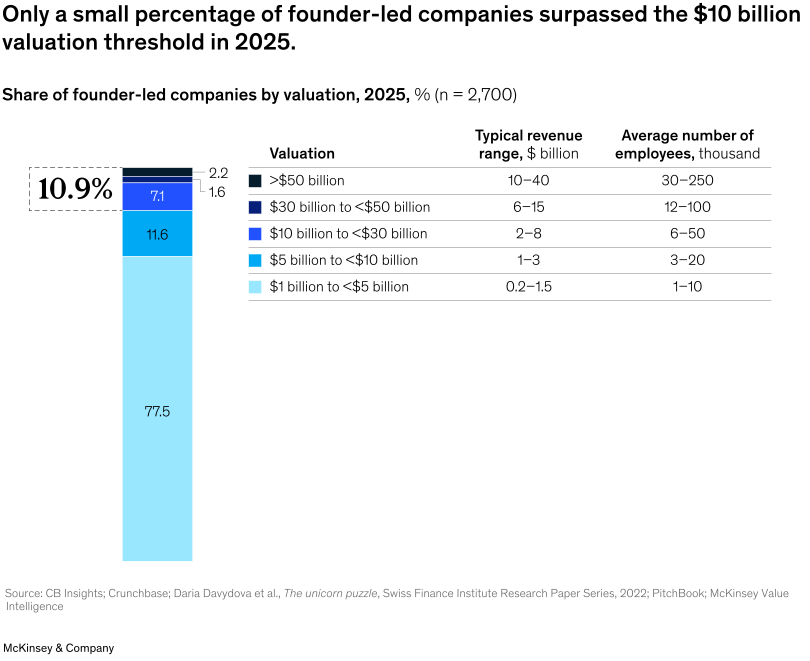
The rest do not experience a spectacular collapse, of course; their ideas are still innovative, their operations still viable. But in those companies, explosive growth sputters under the weight of increased complexity—and then, for many founders, growth freezes. The freeze is often gradual: Revenues plateau, growth slows, decisions stall, and the instincts that fueled success become constraints.
For some leaders, managing through economic uncertainty is a key impediment to growth. Not so for founders; for them, “unfreezing” their organizations is arguably the harder task—particularly these days, when AI, disruptive competitors, geopolitical fragmentation, and other factors are making it harder than ever to create and sustain profitable growth.
To understand what it takes to grow a company from $1 billion to $10 billion and beyond, we supplemented our primary research and our client service and partnerships with founder-led companies with interviews with more than 40 founders globally. We explored the decisions made by founders of today’s $50 billion-plus companies when their businesses were at early stages of growth. Every growth journey is unique, yet common patterns emerge as companies scale, complexity rises, and the stakes grow.
Our research and experience working with founders show that scaling beyond $10 billion requires navigating two parallel transformations. The first is strategic: How you navigate five core inflection points can determine how fast and far your company can fly. These include choices on where to grow, how to evolve the business model, which partnerships to pursue, how to structure capital, and how to build systems that can operate without your constant control. The second transformation is personal: Successfully making three shifts in your own operating system can help make the strategic choices possible. These shifts include redesigning the institution, building the leadership team, and evolving as a leader.
Companies that keep flying master both.
Five inflection points every founder must navigate
As your business grows, the strategies, operating model, and leadership instincts that enabled early success may become constraints in the next phase of growth. This challenge is even greater in the age of AI. Competitive advantage is becoming easier to replicate, business models are evolving faster, and leadership expectations are shifting just as quickly. The founders responding most effectively treat AI as a personal mandate—not a delegated initiative. They tie it directly to resource allocation decisions, set clear expectations for how teams can use AI, and push for measurable results in weeks, not years. They also build an advantage from their proprietary data, workflows, and deep customer relationships that competitors cannot easily replicate.
Our research shows that founder-led companies typically encounter five critical inflection points: expanding beyond the core, transforming the business model, building new capabilities through partnerships, using capital as a strategic scaling lever, and building systems that can sustain growth beyond the founder.
Expand beyond the core
Over time, maturity takes hold in every business. You may find that customer acquisition costs creep up, renewal rates flatten, and each new phase of growth demands greater investment in sales, marketing, and product development.
At our annual Founder Excellence program held at Harvard Business School in June, a founder emphasized the risk of organizations becoming more rigid as they scale, and reiterated the importance of continually asking, “How could we make this business ten times bigger?”
The strongest founder-led companies resist the temptation to pursue adjacencies for their own sake. They make expansion decisions based on where they can create competitive advantage and where their company has the greatest right to win—by building on capabilities, customer relationships, data, or distribution advantages that competitors cannot easily replicate. That could mean reinforcing the core business or selectively expanding into adjacent markets.
Many successful founders follow this principle through disciplined acquisitions. One approach is to acquire a steady stream of small to midsize deals that strengthen the core. Such a programmatic approach can generate stronger returns than relying on organic growth alone.2
The examples below illustrate how some founders pursued expansion only where they could reinforce existing strengths instead of adding complexity that their organizations were not yet equipped to manage.
- Google: Larry Page and Sergey Brin made a series of forward-looking investments between 2004 and 2006 to position the company for the next wave of growth. These moves included the acquisition of Android to establish a foothold in mobile computing, followed by YouTube, which expanded Google’s reach into video and created a new platform for advertising.
- Inditex (Zara): As Inditex, the parent company of Zara, scaled past the billion-dollar mark, cofounder Amancio Ortega resisted the trend of completely offshoring its manufacturing. Keeping much of that manufacturing in Spain, Portugal, Morocco, and Turkey allowed the company to move designs from concept to store in just two weeks and replenish inventory in small batches.3 Daily sales data fed directly into design and production decisions, allowing the business to react to actual customer demand rather than forecasts.4
Transform your business model
Publicly, you may extol the virtues of the business model that got the company to $1 billion; privately, its limitations may begin to show. Profit margins may have eroded, or market shifts may have increased the risks associated with relying on a single source of revenue.
At this stage, you can redesign the company’s business model before shrinking growth and profits force your hand. The window for doing so is narrower than it appears. Research suggests that the journey from product–market fit to lasting profitability hinges on an ostensibly simple yet often overlooked stage: ensuring that each additional customer contributes incremental revenue above marginal cost5 (Exhibit 2).
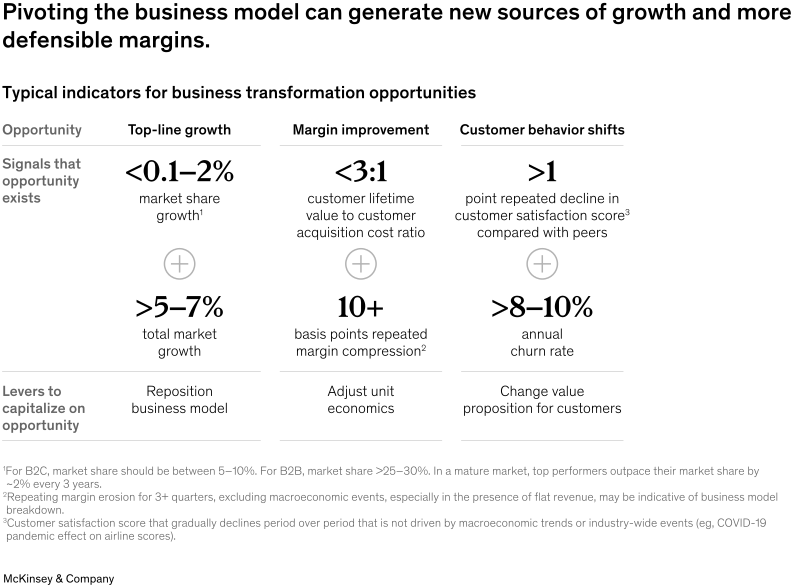
The pivot could take many forms, as the below examples illustrate—turning an internal tool into a product, shifting from product to platform, or bringing the supply chain in-house:
- Spotify: As Spotify scaled, cofounder Daniel Ek pursued multiple parallel ventures to diversify revenue, deepen access, and drive commercial excellence—including investing in podcasts and other nonmusic audio formats, audiobooks, advertising technology, creator tools, and B2B extensions.6
- BlackRock: The global asset manager’s Aladdin platform combined advanced analytics with real-time data and helped the firm manage risks and investments.7 Larry Fink’s decision to sell Aladdin to external insurers and asset managers ensured that the platform remained a critical part of its clients’ daily operations.
Scaling could change the basis of competition. In our interviews, many founders described the need to continually question which parts of their business model were enduring advantages, and which had become sacred cows. As one healthcare founder put it, “Becoming a unicorn exposes your strategy and diminishes your moat—you need to evolve what made you successful to regain your edge.”
Build your capabilities through partnerships
One way your company can quickly gain new capabilities and achieve distribution scale is through partnerships. These can be structured in various ways, including as minority investments, joint ventures, or strategic alliances—but the form tends to matter less than the rigor of execution. Our analysis shows that partnerships that build capability and productivity outperform those pursued for speed or public relations alone (Exhibit 3).
In fact, prior McKinsey research revealed that a sample of 84 S&P 500 companies with identified scale-up partnerships showed higher total shareholder returns than the broader market over the past five years. Meanwhile, a sample of European scale-ups (between Series B and IPO) that formed corporate partnerships raised roughly five times as much funding as peers without reported partnerships.8
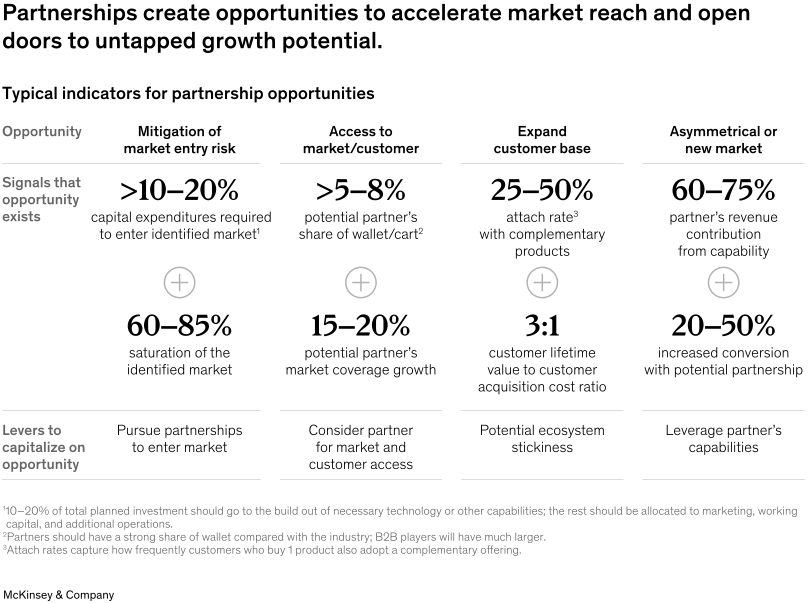
Consider how the founders in the following companies used partnerships to help them scale:
- Tesla: As the automaker scaled the production of its luxury electric sedan and prepared for the mass-market launch of another electric car in 2014, it faced a critical constraint: access to a sufficient, cost-effective supply of batteries. Rather than relying on traditional supplier relationships, Tesla established a partnership with a manufacturing partner to codevelop and operate a large-scale battery manufacturing plant in the United States.9
- BioNTech: The biotech company’s founders, Uğur Şahin and Özlem Türeci, and their team had been working on the possible use of the messenger RNA (mRNA) technology for individualized cancer vaccines.10 When the COVID-19 pandemic struck, they were able to quickly shift their research and teamed up with Pfizer to bring the first-of-its-kind vaccine based on mRNA to billions of people around the world.11
When founders emphasize only the speed and PR of a partnership, it may fall flat. The odds are humbling: Only about 24 percent of large-scale partnerships last beyond three years, and just 28 percent of start-ups report being fully satisfied with their corporate partnerships.12 In fact, our research and experience with founders show that a lack of cultural fit is the most common reason integrations fall short of value expectations; conversely, partners who deliberately manage these differences are up to 70 percent more likely to surpass revenue targets.13
Use capital structure as a scaling lever
Choosing the right mix of equity, debt, and ownership design can accelerate your company’s strategy and preserve the flexibility to pursue long-term priorities. Founders who treat capital as a deliberate scaling and value creation lever—using structures such as dual-class shares and well-designed debt-financed acquisitions—tend to outperform peers, as the below examples show.14 For instance, programmatic M&A has historically performed better than single big-ticket transactions when integration capacity is the binding constraint.15
- Dell: In 2013, Michael Dell chose to take Dell private through a leveraged buyout.16 This shift in the ownership structure was expected to reduce the intensity of quarterly earnings expectations and give the leadership greater flexibility to reposition its portfolio and capabilities.
- XPO Logistics: Founder Brad Jacobs launched the company as a small trucking brokerage in 2011, and in the past decade the company has made 18 acquisitions.17 He followed a consolidation strategy in a highly fragmented market and used capital as a core strategic lever.
To optimize the capital structure, you can consider choosing investors whose principles and worldview explicitly align with yours, and there is evidence from their track record that gives you confidence (not just promises made in a competitive bidding process). As optionality grows, you may still strive to reclaim the decisiveness of an earlier, capital-constrained phase (for example, the urgency of having 90 days of cash and a Series A mindset). However, you must pay closer attention to shaping their capital structure, including your mix of investors, ownership structure, and financing terms. As the capitalization table grows more complex, particularly after an initial public offering (IPO), you need to spend real time (and not delegate just to your CFO) to align an increasingly diverse group of investors while preserving the flexibility to pursue long-term value creation.
“Liquidation preferences and ratchets may appear attractive on paper, but they can dilute founder control and make it harder to align different groups of investors in a crisis—precisely when fast and focused action is required,” a consumer tech founder told us.
Scale systems before complexity overwhelms you
At the $1 billion mark, many founders may have been spread too thin, struggling to keep up with the volume of operations and activities across the entire business. As one fintech founder told us, “If an organization scales rapidly, culture and legacy practices often fail to keep pace. Teams lose clarity on direction, and it becomes harder to maintain effectiveness, consistency, and robust systems.”
As a company scales, it may become impractical for you to stay close to every talent, operational, and financial decision. Your job, instead, is to build robust systems that can, in effect, take your place. A key element of that is building organizational health—your teams’ ability to align, execute, and renew themselves faster than competitors can.
This was the situation at one global bank. At HDFC Bank, the company’s founder CEO set principles that were focused on customer focus, risk management, technology-led innovation, and a “first among equals” culture.18 For instance, the founder and others in the organization made credit a separate structure from sales and marketing to keep it independent right from the beginning, which made them much more resilient through credit cycles.19
A simple test of an organization’s health is to ask your leadership team: If every member of the C-suite were replaced tomorrow, how would the next team make decisions? Any gap between their answers and yours often reveals where critical knowledge remains in the founder’s head rather than embedded within the organization’s systems.
Three shifts in the founder’s operating system
The five inflection points we just described are common to many founder-led companies, although the forces shaping them may vary. Navigating them successfully, however, may require a different type of transformation—one that begins inside the company and with you personally as the founder.
This is not about stepping back—it is about stepping forward with a new operating model. The inner game of CEO leadership and the micro habits that span self, team, and organization, set out in The Journey of Leadership, apply with special force when the company is still in your image.20
In our discussions with dozens of founders, only half believed the company could drive revenue without them—pointing to both the opportunity and the challenge of changing your operating system. Specifically, you will need to redesign three interconnected dimensions: the institution, the team, and yourself (see box, “Key questions for founders”).
Key questions for founders to gauge your company and your own readiness
- Expansion: Are your expansion efforts into new segments or markets building on your core strengths, or simply chasing new revenue?
- Business model: What are the fundamental limits on profit or growth in your current business model, and what will it take to break through them?
- Partnerships: If your single most important partnership ended tomorrow, would it cause a genuine strategic crisis or just a temporary PR headache?
- Capital: Does your financing strategy give you the flexibility to make long-term decisions, or are you constrained by the timelines of your investors?
- Systems: Think of a recent decision made while you were away. Did the team execute with speed and clarity, or did they hesitate, perhaps waiting for your approval?
- Your organization and team: Is your strategy reflected in how you deploy your best people and capital—or only in what you say?
- You, the founder: Of the last 20 decisions that you were involved in, how many could have been made by your leadership team? If more than half, you may be the company’s chief bottleneck, not its chief executive.
Redesign the organization
In the early stages of your company’s growth, you set direction and shape culture directly. At scale, the work is institutional: forging a republic, not a principality. The hardest part is not choosing what to do but deciding the hundred good things you will no longer do, and making values explicit through hiring, rituals, and decision rights so others can act when you are not in the room. Shared ownership means delegating decisions without abdicating standards and embedding new leaders gradually to protect the culture.
As Amazon scaled beyond $1 billion in market capitalization, Jeff Bezos institutionalized mechanisms such as creating two-pizza teams21 to keep units small and, as detailed in shareholder letters,22 encouraged leaders to write six-page narrative memos for meetings. The objective was to ensure that important decisions of a growing company were driven by deep thought and data.
Meanwhile, at Canva, cofounder Melanie Perkins articulated a two-step direction for the organization: first, to build one of the world’s most valuable companies, and second, to “do the most good we can.” The philosophy became embedded in the company’s culture, talent proposition, and long-term priorities—including investments in initiatives such as Canva for Education and the founders’ decision to pledge part of their wealth to philanthropic causes.23
Redesign the leadership model
When it comes to pushing through the $1 billion to $10 billion barrier, your time and attention could become a bottleneck. To break through it, you become the chief architect of a leadership factory. Spending more time developing others—as much as 50 percent for some—can be a critical driver of growth.24
At Salesforce, cofounder Marc Benioff institutionalized a leadership framework called V2MOM (vision, values, methods, obstacles, and measures) to create alignment and autonomy.25 Every employee published a V2MOM, with the objective of aligning individual priorities with the company’s vision and creating accountability for measurable outcomes.
Meanwhile, Pony Ma, the cofounder of the Chinese multinational conglomerate Tencent, fosters innovation by encouraging multiple small, autonomous teams to build competing products with their own resources and leaders. The messaging app WeChat, for example, emerged not because it was centrally planned but because its small team executed more effectively than several internal rivals.26
Redesigning the leadership model will inevitably require difficult talent decisions, particularly in the age of AI. Investors estimate that nearly 65 percent of portfolio companies fail due to people and organizational issues.27 Yet more than half of founders in the United States hinder growth by delaying upgrading talent and removing underperformers.28
As AI redefines what high performance looks like, the employees who fueled exceptional impact three years ago are not necessarily the ones creating the greatest impact today. Founders should pay close attention, in particular, to “high-skill, low-will” employees—talented people who may struggle to adapt as the organization and its priorities change.
Redesign your role
As a company grows, the adrenaline of survival begins to fade into the sustained pressure of achieving scale. You must shift from being the “chief doer” to, as mentioned earlier, becoming the “chief architect,” focusing on only the decisions you can make. “A real litmus test of your impact is how many days you can take off without anyone needing you,” one founder noted.
How you lead and how you engage with the board are both up for reinvention too. The authors of A CEO for All Seasons noted that as leaders move from building the company to serving as stewards (in the later stages of their tenure), their relationship with the board should similarly evolve. You can structure the board meetings around decisions that matter most, not operational updates.
Consider what happened at the Chinese manufacturing company BYD. Founder Wang Chuanfu transformed the company from a component supplier into a vertically integrated automotive and energy company, evolving his own role from being a hands-on technical leader to the CEO of a much broader enterprise. As the company scaled, he drew upon deep expertise in battery engineering to guide decisions about the core technology.
And as HCLTech scaled in the 2000s and 2010s, Shiv Nadar, founder of HCL Group and chairman of HCL Technologies, increasingly focused on guiding the company’s long-term direction, anticipating technological shifts, and positioning HCLTech for successive waves of transformation. Rather than concentrating on day-to-day operations, he emphasized preparing the company for the next phase of transformation before change became unavoidable.29
Getting a company off the ground requires thrust. Staying airborne requires constant navigation and course correction. Stories about founder-led companies that froze are not tales of bad ideas; they are examples of successful formulas applied for too long. What separates the 10 percent who continue scaling is their willingness to challenge the instincts and operating model that produced their early success; they continually reinvent their businesses at the key turning points we have described.
Above all, founders must lead that reinvention. Institutions rarely outgrow their founders, but founders must continually outgrow old operating models and assumptions that built the business.