The energy landscape is constantly evolving, driven by macroeconomic uncertainty, shifting geopolitical dynamics, fluctuating policies, and rising energy demand. While renewable penetration continues to grow, oil and gas are still expected to play a significant role in the energy mix well beyond 2050, given the increasing need for an affordable, reliable, and resilient energy system.
Nearly ten years ago, McKinsey’s article “The oil and gas organization of the future” highlighted five big ideas for how organizations could adapt to potential disruptions in the industry. Many of the ideas we anticipated have since become embedded in leading organizations. However, as the challenges that companies face evolve, so too must their operating models. In this article, we explore how forces reshaping the energy sector could redefine how oil and gas companies operate in the decade to come.
What has changed in the last decade?
In 2015, most oil and gas organizations were designed for a world of resource scarcity. Their large, complex structures and strong centralized functions enabled them to tackle technical challenges and manage risks effectively, but added layers of cost and complexity, often slowing decision-making and stifling innovation.
A decade later, where are we now?
Almost ten years ago, we had five big ideas for how oil and gas organizations could adapt to emerging trends at the time: a world of resource abundance, profound technological advances, and demographic shifts. While some of our predictions were realized and others not, many trends emerging then remain relevant today:
- Organizational agility. Over the past decade, we have seen many asset-heavy companies adopt agile principles, particularly in oil and gas, leading to a more motivated and productive workforce through multidisciplinary squads working in rapid cycles toward clear missions. While some organizations succeeded, others fell short, driven by a reluctance to adapt the core processes that underpin an agile operating model, such as budgeting, governance, and talent management.
- Digital organization. Companies have invested heavily in digital tools for technical and nontechnical applications in the last decade, with celebrated use cases in predictive maintenance, digitally enabled safety systems, and production optimization, among others. However, despite this progress, many digital transformations delivered only a fraction of their expected value, often because core operating model elements, such as workflows, governance, and capability building, were not rewired to unlock the full potential of digital technologies. While use cases have proliferated, the industry is still awaiting the emergence of true “digital organizations.”
- Millennial-managed organization. Company structures have changed substantially as millennials climb into executive roles, expecting more flexible structures and a new working environment. Dramatically accelerated by the COVID-19 pandemic when employees could no longer collaborate in-person, the use of remote working models and digital communication tools increased significantly. Today, the world of work remains in flux as many companies continue to follow hybrid and work-from-home models, while others are starting to push for a return to the office.1
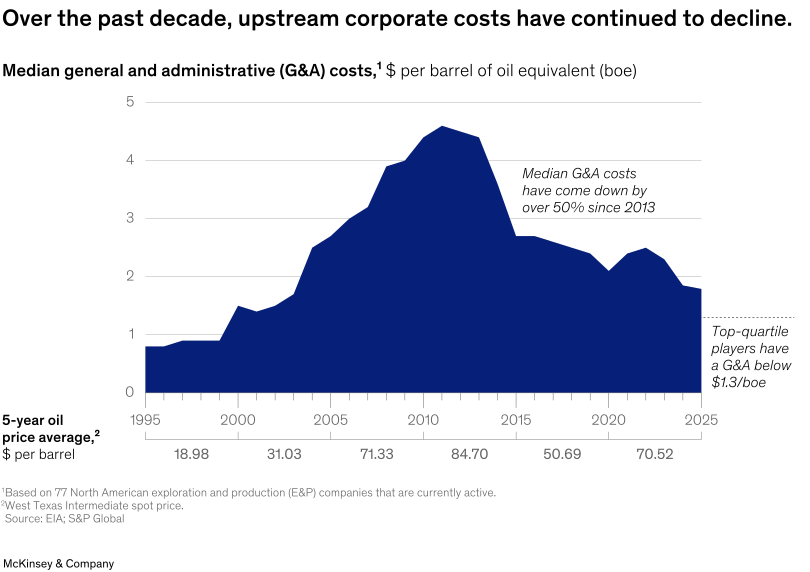
- The decentralized company. Following a period of expanding corporate centers and greater technical centralization, the pendulum swung back as falling crude prices made large overheads unsustainable. Between 2013 and 2015, corporate costs for North American upstream players declined sharply, with a further 20 percent reduction over the following decade (exhibit). Many operators adopted “two-speed” models that combined local empowerment for lower-risk assets with stronger central oversight for technically complex operations.
- Redefinition of core activities. The definition of what is “core” has evolved across the industry. Some companies expanded into integrated power or built out trading capabilities. Others shifted their approaches to exploration, either scaling back to focus on lower-carbon strategies or doubling down to deliver material discoveries. Strategic partnerships have also become more prominent, including engineering workshare partnerships, project development collaborations, and technology-focused alliances.2
We recognized that change was needed, so we set out five big ideas for how oil and gas organizations might evolve. Over the decade that followed, many of these ideas took hold (see sidebar, “A decade later, where are we now?”). These included the rising adoption of agile principles, the growing influence of digital technologies, and the redefinition of core activities.
However, fully embedding agility and digital into legacy operating models has proved difficult, and the pace of adoption has been uneven. Perhaps the most unforeseen factor was the COVID-19 pandemic, which accelerated the rise of hybrid and remote work models and fundamentally changed how organizations function.
After this decade of transformation, one thing is clear: The next decade demands operating models built for consistent change.
Trends shaping the industry’s future
Three key trends will impact the oil and gas industry significantly over the next decade:
1. The global energy demand is expected to rise, with fossil fuels retaining a large share of the mix
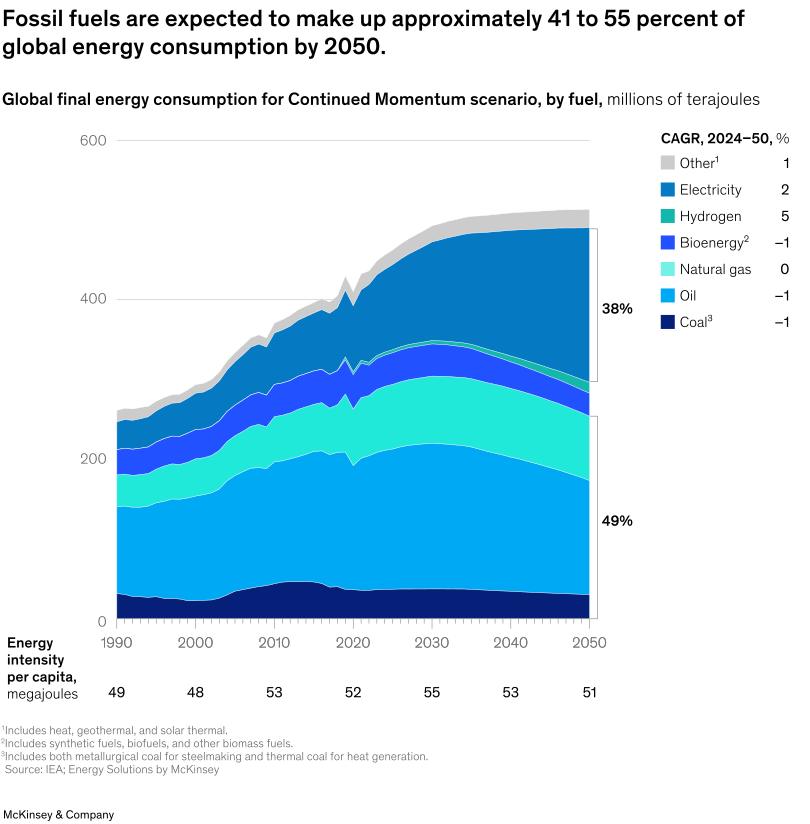
Global energy demand is expected to increase through to 2050, primarily driven by rapid economic growth in emerging economies and new sources of demand such as data centers. Despite progress in building out renewable energy sources (RES), the energy transition has been slower than expected and several transition energy sources are not yet mature, scalable, or cost-effective. Over the coming decades, oil demand is projected to level off into an extended plateau as natural gas demand continues to expand, largely driven by rising electricity needs (Exhibit 1).
2. Investors continue to focus on returns, cash flow, and capital discipline
After years of poor performance and overinvestment in the 2010s, the oil and gas sector has regained investor confidence by steadily increasing dividends and buybacks, while maintaining capital discipline.1 As a result, shareholder returns have significantly improved over the past five years (Exhibit 2).
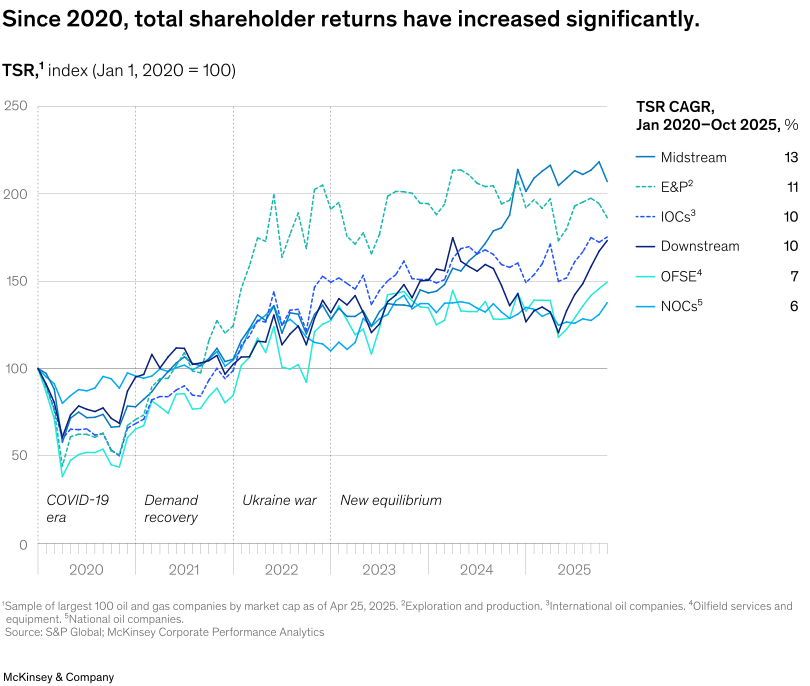
However, investors are still cautious, as shareholder pressure—from passive indexers to activist funds—could remain. Competition for capital could continue to shape strategic priorities as investors look for companies that operate leanly and deliver predictable cash flow, low leverage, and attractive distributions.
3. Rapid technological evolution, specifically in AI, is redefining the industry
Gen AI is already accelerating how oil and gas companies analyze data and generate insights.2 Agentic AI is the next digital wave, offering even more by orchestrating multistep workflows, executing decisions, and optimizing operations with limited to no human input.3 Coupled with advances in robotics, sensors, digital twins, and edge computing, these technologies could change how work gets done and how value is unlocked across the industry.
Shifts redefining the operating model of the future
To survive and thrive against the backdrop of these evolving trends, we foresee four shifts for oil and gas operating models over the coming decade.
Embracing AI across the industry
The oil and gas industry is entering a new frontier with AI, one that could transform the entire value chain from the wellhead to the consumer.
Across the value chain, AI offers powerful ways to reimagine how work gets done. In the upstream sector, AI agents can ingest seismic, well, and production data to suggest drilling locations or optimize throughput. In downstream, AI can integrate sensor data and maintenance records to adjust equipment strategies or can analyze customer and competitor behaviors to set the price at the fuel station.
Realizing this potential will require a fundamental rewiring of the operating model, allowing humans and AI agents to work together in new, collaborative ways. Organizations will likely become flatter and role mandates could expand as AI allows individuals to perform work that once took entire departments. Workflows will shift toward continuous learning loops, where humans and agents collaborate in real time and processes evolve dynamically based on new data and feedback. While AI can take on many tasks and decisions, human oversight will remain essential to verify outputs, manage risks, and ensure that AI-driven decisions align with the broader business objectives.
This shift will have profound implications for talent development and career progression. Currently, roles in the industry follow a clear path: junior engineer to senior engineer, for example. With AI consolidating and integrating many specialized roles, career paths and talent development approaches could be unrecognizable in the future. The focus will likely shift from narrow technical expertise to broader, more integrated capabilities, such as managing AI-driven workflows, interpreting AI outputs, and applying judgement to make decisions. New approaches to building capabilities will become essential, particularly as AI transforms how foundational knowledge is acquired at early career stages.
In parallel, governance frameworks need to evolve to establish clear principles and guardrails where AI has decision-making power, and to identify which human is ultimately accountable. The industry’s future operating model will need to carefully balance speed and innovation with control.
The implication is clear: AI has potential to reimagine the industry. But moving from hype to impact requires rewiring the organization and relearning roles. Companies that achieve this could move fast from experimentation to scaled impact and set the next frontier of performance.
(Re)focusing on asset performance
As investors continue to prioritize cash flow and returns, oil and gas companies could optimize the performance of every asset they own. Many companies currently manage their portfolios with a one-size-fits-all operating approach, with little tailoring to help each asset achieve its full potential. Taking performance to the next level requires a more nuanced approach, one that adapts the operating model based on each asset’s contribution to the portfolio.
For assets that are designed to maximize cash generation, such as late-life upstream assets and noncore refining and upstream facilities, the operating model should emphasize integrated accountability at the asset level. The assets will operate with lean oversight from the center and rigorous prioritization of activities, focusing on safety, compliance, and interventions that directly protect production or reduce costs.
In maintenance, this means driving greater efficiency, critically evaluating the necessity of predictive maintenance programs, and scrutinizing corrective maintenance activities to ensure they add value. For capital projects, it requires a disciplined approach: prioritizing projects that directly support safety and reliability, and rigorously applying industry standards to those that remain.
In contrast, growth-oriented assets, such as those for country entry or greenfield development, and assets with high technical complexity will still rely on strong central functions to deliver activities and for decision-making. However, these functions will need to evolve to provide more than just scale, and will have to offer differentiated expertise, advanced tools, and AI-driven workflow improvements. For example, in capital projects, this means operating at a global level while delivering fast-cycle, cash-flow-optimized outcomes for the assets.
The benefits of scale, consistency, and portfolio-optimized decisions are significant, and we do not expect a return to the asset-centric organizations of the past. Instead, oil and gas companies could increasingly group their assets based on their roles in the portfolio and create distinct operating models for each. The rest of the organization would need to adapt to support this differentiation: Central functions could continue to provide standards, insights, and specialized expertise, but in ways that reflect each asset’s role.
Exploration is a good example of this type of evolution, as it offers a preview of how central functions could change. Increasingly run as a global business rather than a function, this segment now operates with explicit commercial targets, treating licenses as assets to be optimized, traded, or exited.
Ultimately, the oil and gas organization of the future could have a much stronger performance culture, with a greater emphasis on accountability, speed, and innovation. Regardless of asset type, there will likely be more transparent performance tracking, greater efforts to foster an ownership mindset, and a risk-based approach to maintain strong operational performance.
Rethinking operatorship and evolving ownership structures
Historically, most oil and gas companies have emphasized integration to leverage scale, strengthen market position, and optimize resources. New acquisitions were folded into existing operating models, leading to common support from both technical and nontechnical functions, and similar career paths and compensation models. However, this is changing: Financial and operational challenges are now pushing these companies to adapt, potentially requiring their operating models to account for a greater variety of ownership structures.
The markets are increasingly skeptical about the ability of companies to create value from portfolios that span diverse risk and return profiles, whether it is integrating traditional hydrocarbons with renewable energy assets or balancing upstream, midstream, and downstream operations.4 Even within upstream, different asset classes have varying capital needs and returns profiles that may be better served by alternative ownerships structures, for example, an independent joint venture (IJV) that can raise independent financing. Over the past few years, many companies have found that organizational integration may be more of a hindrance than a help when attempting to build and grow new energy businesses.5
In response, more companies are rethinking their ownership structures for certain types of assets, and challenging long-held beliefs about what they operate themselves versus where they can rely on partners. Some companies have spun out or ring-fenced their lower-carbon businesses to attract new capital and accelerate innovation. Others are pursuing a “satellite” model, with many former core upstream assets rolled into joint ventures with considerable strategic and operational independence. These moves are driven by the belief that the characteristics required for success are different across the businesses, for example, different risk profiles requiring different operating standards or different cultures and competitors for talent.
Such moves, which we expect to accelerate over the coming decade, have profound implications for organizations and operating models. The number of IJVs is expected to increase, each of which needs the scale and capability to be successful on a stand-alone basis and compete with other players in the market. Shareholder companies will need to develop superior asset management capabilities, allowing them to add value through creative financing and ongoing, active portfolio management.
This evolution in partnerships and ownership models raises a fundamental question: What is the minimum viable core that an oil and gas company should retain to remain distinctive and competitive? Striking the right balance between operational control and partnership flexibility will be essential. The operating model could adapt, defining where decisions are made, how performance is governed, and which capabilities must remain in-house versus accessed through partners.
Whether through ring-fenced ventures, integrated models, or hybrid structures, success will depend on an organization’s ability to combine the discipline of focus with the agility of collaboration. By mastering this balance, companies can scale faster, innovate more effectively, and deliver higher returns.
Adapting the organization to a fragmenting world
Tariffs, trade controls, and geopolitical shifts are introducing new uncertainty, reshaping cost structures, and redefining competitive advantage. This evolving landscape requires oil and gas companies to rethink their resilience strategies to adapt to a more fragmented world. While global footprints are expected to remain, operating models may need to adapt to address localization requirements, talent constraints, and shifting trade dynamics. The next phase of competitiveness will likely come from organizations that can effectively deploy talent and capability where they create the most value.
Consider a company with legacy assets in the North Sea and new plays in Latin America or sub-Saharan Africa. Mature basins require steady operators and proven processes, while early-phase projects need builders and problem-solvers. The operating model must therefore be flexible. Key individuals should be moved to where they are needed globally, local skills should be developed fast, and local teams should be connected to global experts using the latest remote-working technologies.
Guyana exemplifies this approach, with operators hiring and training locally to meet mandates, cutting reliance on expatriates, building trust, and lifting performance.6 In the future, companies can increasingly plan the workforce by skills and mobility—not just location—so teams can change as the portfolio evolves.
This shift will also lead to the next generation of global capability centers (GCCs), which are fast becoming extensions of global asset teams rather than back-office support. Traditionally viewed as shared service centers handling tasks in HR, finance, and IT, today’s GCCs are emerging as strategic capability hubs that enable access to global talent and deliver round-the-clock technical execution at pace and scale.
In locations such as Argentina, India, and the Philippines, these centers are delivering not only cost efficiency but also high-value engineering and operational work, from subsurface modeling and early-phase design to remote operations, maintenance optimization, and real-time performance monitoring.7 We see a growing role for such centers in the oil and gas organizations of the future, working seamlessly with local asset teams and taking the lead on rewiring the organization through digital and AI.
Looking ahead, leading organizations will be defined less by where they operate and more by how they mobilize and develop talent across their footprint. To position themselves as front-runners in an era where adaptability, not scale alone, determines competitive advantage, companies need to build globally connected, skill-aligned, and flexible workforce strategies—combining local empowerment with global integration.
The path forward
Success over the next decade will belong to companies that not only set the right strategy but also build the right operating model to deliver their full potential. In recent years, many organizations have already begun adapting how they operate to compete more effectively. Several leading companies have announced quantifiable targets for structural cost reduction, amounting to billions of dollars, largely enabled by operating model improvements. Some are creating value by streamlining ways of working and reducing organizational complexity, while others are consolidating activities across value chains and centralizing key functions to ensure more consistent execution while maintaining clear accountability for performance within the assets.8
These moves underscore the fact that updating the operating model is now a critical driver of value creation. The focus on reimagining how work is done, which accelerated after the price collapse in 2015, will not only continue but also intensify as the industry navigates the energy transition. As oil and gas demand plateaus, companies will need to sharpen their focus on delivering competitive returns from core operations while selectively investing in higher-risk, higher-potential new energy ventures.
Ultimately, the companies that build operating models that are adaptable, agile, and resilient—and capable of responding to volatility while advancing their transition ambitions—will be best positioned to lead through the uncertainty ahead. Those that move early will shape the next decade of performance.