For decades, customer experience (CX) in medtech has rarely been questioned or measured. That’s not because companies believed they were delivering a flawless care journey but because CX was never a design or strategic priority. Products were engineered for clinical efficacy and performance first, and the experience around them (onboarding, training, service) was added afterward. High barriers to entry and switching meant that everyone tolerated some friction in the system.
Imagine, though, how much more adoption, loyalty, and efficiencies in care delivery medtechs could capture by removing that friction or as much of it as possible. Client organizations would get a smoother, more reliable experience and patients would get faster access to therapies, fewer care disruptions, and more consistent clinical outcomes.
There are early signs the industry is starting to pay attention to CX. McKinsey’s analysis of the top 50 medtech companies globally based on 2024 revenue shows that the share formally naming CX as a strategic priority grew from 20 percent in 2023 to 32 percent in 2025 and in H1 2026. Moreover, the number who include CX as an operating priority, with executive accountability for CX or planned disclosures investors, tripled from three companies (6 percent) to nine (18 percent) over the same period (exhibit). No company reduced its stated CX commitment over this period, and early signs from H1 2026 suggest further escalation.
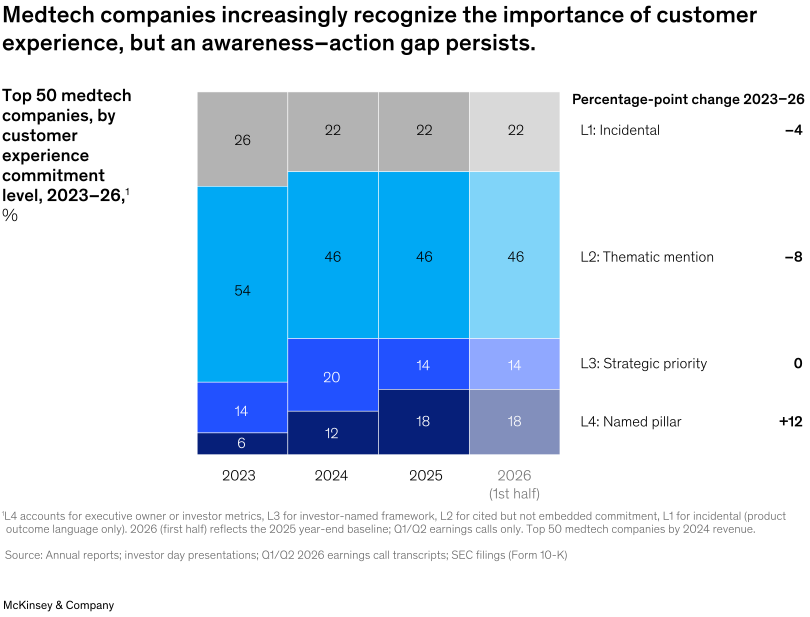
The numbers are trending upward, but there is still a yawning gap between awareness and action. While 78 percent of top 50 medtechs now substantively reference CX in investor-facing communications, fewer than one in five have embedded it as a formal operating priority. Only three companies publicly disclose a customer satisfaction metric to investors at all.
To move from awareness to action, medtechs will need to stop treating CX as a service wrapped around the product and start treating it as a part of the product itself. That means reconsidering the operating models that underpin the delivery of their products, from structuring commercial teams differently to redefining the metrics that executives are accountable for.
More to the point, medtechs will need to understand what is making CX more consequential, build the capabilities to deliver it systematically, and focus their investments on the journeys and outcomes that matter most.
Market forces are increasing the competitive importance of CX
The medtech industry is operating within a structure that reduces the competitive importance of CX. Clinical efficacy takes precedence, reinforced by regulatory requirements and in some segments, meaningful barriers to entry and costs of switching. Commercial models built on face-to-face engagement, such as in-person product training and hands-on support from sales and clinical representatives, often compensate for cumbersome onboarding and inconsistent services. Clinical-care organizations largely absorb this friction, and since decision-making is distributed across clinicians, administrators, and procurement teams, end user feedback is indirect and easier to overlook.
That tolerance is eroding. A convergence of economic, clinical, and technological forces is making CX both more visible and more consequential. What was once manageable friction—an extra training session, a cumbersome workflow, a delayed service response—can increasingly affect adoption, productivity, and the total cost of ownership. The bar for a good product is therefore shifting: It is no longer a device that performs clinically with sufficient support but an end-to-end experience that is intuitive, efficient, and easy to integrate from day one.
First, most clinical-care organizations are facing intense margin pressure, which in turn is increasing their scrutiny on the total cost of ownership. Buyers are increasingly prioritizing onboarding efficiency, workflow integration, and service responsiveness in their procurement decisions.
Second, organizations are expanding care delivery into ambulatory, home-based, and digital settings where the tolerance for complexity is low. The Centers for Medicare and Medicaid Services’ 2026 Hospital Outpatient Prospective Payment System and Ambulatory Surgical Center (ASC) Final Rule accelerates this shift by expanding the list of procedures performed at an ASC that are eligible for reimbursement to include higher-acuity cases like cardiac ablation. As clinical-care organizations shift and more procedures migrate to ASCs, medtechs must adapt their CX infrastructure to serve more diverse, lower-resourced sites of care.
Third, clinician expectations of medtechs are higher than ever. Rising workloads and staffing constraints are pushing clinicians to place a premium on usability and efficiency. They increasingly value experiences that reduce cognitive load and integrate seamlessly into daily routines.
Finally, advances in AI are raising the baseline for what customers expect. AI-powered ordering and account management portals now learn purchasing patterns and surface relevant products proactively, shifting the commercial relationship from transactional to anticipatory. Predictive service models flag device performance issues before a customer places a call, redefining what “responsive” means. Digital listening tools synthesize feedback from hundreds of clinician interactions simultaneously, enabling companies to detect and address friction points faster than any traditional voice-of-customer program could. Companies that deploy these capabilities can expect measurable improvements in account retention.
When one set of customers experiences this level of service, it recalibrates expectations across the market. The bar rises for everyone, including those who have not yet made the investment. As AI becomes embedded in the commercial model rather than layered on top of it, the line between product performance and experience quality begins to blur. Customers no longer separate how well a device works from how well the company behind it works. Experience is now part of the product, not a service that follows it. Operational excellence and clinical credibility remain necessary, but the companies that capture disproportionate loyalty will be those that design the experience of working with them into their offering and then measure it deliberately.
Apart from these converging forces, three structural shifts are turning customer experience into a primary basis for competition:
- Emerging commercial models: Usage-based pricing and outcome-linked agreements depend entirely on sustained adoption, making a frictionless experience essential for revenue realization and controlling the cost to serve.
- Digital-first disruptors: New entrants are resetting expectations for simplicity and accessibility. Companies like Viz.ai, which streamlines stroke triage through mobile alerts, are proving that medtech can deliver highly user-centric workflows. While this does not negate the clinical strengths of incumbents, it forces legacy players to evolve how their experiences are designed and delivered.
- Independent service organizations (ISOs): Medtech companies no longer have a lock on post-sale service, as ISOs increasingly compete for this business. As ISOs offer flexible, lower-cost alternatives, a superior end-to-end CX becomes a critical differentiator for retaining accounts.
CX needs to shift from a function to a system of capabilities
As customer expectations evolve, CX can no longer be viewed as a series of isolated interactions managed by a single function. It must be designed into the product from the start, with product, digital, commercial, and service teams working from the same blueprint. Medtech companies will need to approach CX as a system of capabilities that connects journeys, data, decision-making, and execution into a unified operating model. Product, digital, commercial, and service functions must work together to orchestrate and deliver a strong customer experience. They will need to emphasize consistent messaging, seamless handoffs, proactive support, and common data sets. This requires embedding decision-making and automation into workflows rather than layering them on top.
Building this system requires five interlocking capabilities:
- Data and intelligence foundation: Establish a unified data layer with robust governance and compliance controls to enable AI to operate safely and effectively at scale.
- Persona-designed experiences: Structure touchpoints around distinct user workflows, addressing unique priorities for clinicians, administrators, procurement teams, and patients.
- CX orchestration: Connect fragmented signals to deploy AI agents and copilots with clear governance for autonomous action, employee support, and human escalation.
- Enterprise integration: Integrate directly into provider electronic health records, customer relationship management platforms, and identity systems to eliminate stand-alone log-ins.
- Omnichannel engagement: Establish shared customer context and coordinated ownership across digital, device, and field channels to prevent redundant customer inputs.
Three actions can turn CX ambition into execution
Competing on CX demands clarity on which user journeys matter most, defined ownership of those journeys, and governance models that support cross-functional execution. To begin this transformation, leaders across the enterprise should focus on three pragmatic actions:
- Define the end-to-end journeys that matter most. This includes identifying the key moments that shape customer perception and aligning the organization to provide a consistent experience at each one.
- Connect capabilities into a cohesive system. Investments in digital, service, data, and operating model redesign must be aligned around a unified customer view to ensure improvements are scalable, not siloed.
- Link experience to economic outcomes. Metrics such as adoption speed, retention, and cost to serve provide a direct connection between experience and business performance, enabling better prioritization and accountability.
Acting on these steps requires more than incremental change. Meaningful CX transformation calls for a deliberate redesign of how that experience is delivered across journeys, while building the capabilities and the underlying operating model needed to deliver a better experience overall. A structured, end-to-end approach to CX can translate a company’s ambition into an experience that differentiates it from its competitors, building an advantage that lasts. The companies that succeed will be those that stop asking how to support the product and start designing the experience as part of it from day one.