While technology and consumer companies dominate headlines, the industrial sector remains a critical, if frequently underappreciated, pillar of the US economy. And much of the sector’s historically reliable strength and adaptability can be attributed to the small- and mid-cap industrial companies that make up what we call the “Titanium Economy.”1 These companies form the backbone of American industry and generate an outsize economic impact relative to their modest share of the workforce and GDP.
Titanium Economy players have several inherent advantages over their larger industrial peers, including greater agility, faster decision-making, deep expertise, long-serving employees, and strong community ties. In fact, leading small- and mid-cap companies are leveraging these advantages to power a new wave of global industrial innovation. They are the dynamic force propelling emerging trends such as data center growth and electrification, readily adapting to market changes. Flexible and nimble, these small- and mid-cap businesses are fueling a new wave of industrial innovation around the world, supplying critical parts and services throughout the economy. The global industrial sector cannot grow without these smaller players.
Looking ahead, the Titanium Economy holds immense potential to continue empowering US growth and innovation. By embracing leading companies’ strategies for digital and AI transformation, programmatic M&A, workforce development, and more, the broader Titanium Economy can unlock significant value and expand its competitive edge. Notably, several former mid-cap players have become industry leaders in the past decade and have some of the world’s largest market capitalizations. Their growth highlights how rapidly small- and mid-cap players can create considerable value. And as the Titanium Economy continues to evolve, its leading companies offer a compelling blueprint for sustained and inclusive growth.
The Titanium Economy’s growing prominence in the US economy
The industrial sector has been a pillar of the US economy for decades. In 2024, the sector contributed $12 trillion (around 20 percent) of US market capitalization, 18 percent of employment, and around 14 percent ($3 trillion) of revenue.2 The roughly 2,500 public companies in the Titanium Economy represent a significant share of the industrial sector, accounting for around 20 percent of the sector’s market capitalization; in 2024, these players generated $1.2 trillion in revenue—around 38 percent of the sector’s total.3 In addition, there are more than 4,000 privately held small- and mid-cap companies powering the Titanium Economy.
According to McKinsey analysis, the industrial sector achieved significant multiple4 expansion (68 percent) from 2019 to 2024, outpacing multiple expansions in the technology sector (25 percent) and consumer sector (2 percent) during the same period. Titanium Economy companies performed well, with a 22 percent multiple increase, but outside of the top ten companies, larger industrial companies achieved only a 13 percent multiple expansion. Over the same period, the industrial sector delivered TSR of 61 percent, outperforming the broader market’s 34 percent. Drivers of the sector’s growth were relatively balanced, with 68 percent multiple expansion and 44 percent economic profit.
Additionally, Titanium Economy companies’ market capitalization achieved growth of 12 percent per annum in 2019–24, slightly higher than their large-cap counterparts’ 10 percent per annum. Collectively, these small- and mid-cap companies were worth $2.2 trillion in 2024, according to McKinsey analysis.
Upward mobility among small- and mid-cap players within the US industrial sector is considerable. We found that from 2014 to 2024, 33 Titanium Economy companies surpassed $7 billion revenue to become large-cap players. In fact, the industrial sector’s remarkable growth in the past ten years is illustrated by the exceptional trajectory of the three top-performing industrial companies. In 2014, these were Titanium Economy companies with a combined market capitalization of $64 billion. In 2024, they were large-cap companies with a combined market capitalization of $5.7 trillion, reflecting growth of 57 percent per annum for the ten-year period.
Powered by the Titanium Economy, manufacturing can strengthen the US economy
The US manufacturing sector has long been central to the US economy. The small- and mid-cap companies that make up the bulk of manufacturing consistently help deliver an outsize economic impact relative to manufacturing’s modest share of the workforce and GDP. While manufacturing accounts for only about 8 percent of the US workforce and 10 percent of total GDP, it is responsible for approximately 55 percent of all patents, 53 percent of R&D spending, 20 percent of net capital stock, 35 percent of productivity growth, and 60 percent of US exports.1 As such, Titanium Economy manufacturers play a critical role in driving technological advancement, global competitiveness, and positive economic impact, particularly in smaller US regional economies.
Titanium Economy manufacturers are not only economic engines but also powerful enablers of economic mobility. On average, US manufacturing jobs pay 80 percent more than roles in the leisure and hospitality sector.2 Manufacturing also provides greater job stability, with average tenures of approximately five years, more than double the tenure in leisure and hospitality roles.3 Moreover, the sector boasts a total job multiplier of 9.5, meaning that one manufacturing job creates 9.5 total jobs—1.0 direct job in manufacturing and 8.5 indirect jobs. This makes manufacturing second only to mining for job multipliers in comparable industries.4
The gradual shift of the US economy away from manufacturing over the past several decades coincided with a rise in income inequality. Since 1980, a ten-percentage-point decline in manufacturing’s share of GDP has paralleled a five-percentage-point increase in the Gini coefficient, a key measure of income inequality.5 At the state level, increases in manufacturing jobs as a percentage of total employment are correlated with reductions in income disparity. Similarly, unemployment rates are lower in states where manufacturing contributes a higher share of total employment, since manufacturing facilities often provide stable employment to large workforces (exhibit). These facilities can help foster community resilience and create knock-on effects that benefit local economies, such as longer-term financial security, greater upward mobility, and increased leisure spending.
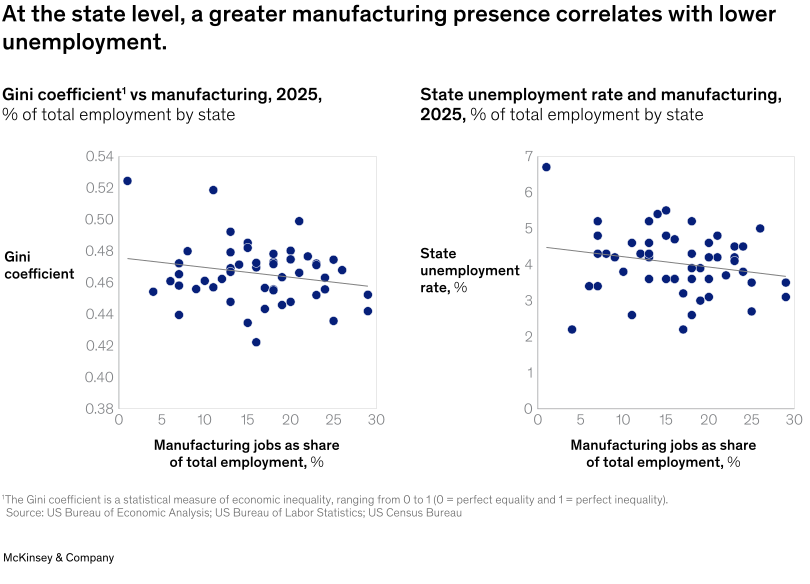
Revitalizing US manufacturing via Titanium Economy companies could yield immense benefits. A strategic transformation of the industrial landscape, supported with new investments and increased onshoring of manufacturing in industries such as electronics and semiconductors, could create more than 400,000 jobs by 2030.6
Beyond manufacturing’s direct economic benefits, manufacturing investments often initiate the “Great Amplification Cycle,” a virtuous cycle of sustained and consistent growth that can begin with a single facility.7 The idea is simple: When industrial companies bring facilities and manufacturing to a region, they create jobs with good wages. With these higher wages, residents spend money within their local economies (such as shopping, entertainment and leisure, and home buying). This allows their communities to flourish, which in turn attracts more talented people to the area, sparking new ideas and innovation. Local education systems start training the local workforce to fill the growing need for talent. These new cohorts of workers, along with increased public and private investment in research and innovation, accelerate economic growth and attract new companies and new talent. And so, the cycle begins again.
Manufacturing companies around the country have demonstrated the transformative impact that they can have on individuals and communities. Heico, a manufacturer of aircraft components and aerospace systems, employs more than 6,000 individuals in its US plants, with nearly 1,100 employees in the Rust Belt. These workers earn triple the average salary in the service sector, and many have 401(k) retirement plans worth more than $1 million.8
Indeed, Titanium Economy manufacturers can unlock substantial economic value in the United States, contribute to value creation in smaller regions, and lay the foundation for a more resilient economy.
The increased market recognition for small- and mid-cap companies is not just a matter of numbers; it reflects a broader shift in investor sentiment and strategic focus. These companies are often more agile and innovative than larger companies, able to adapt quickly to changing market conditions and rapid technological advancements. And their agility makes them attractive to investors seeking growth opportunities in today’s volatile macroeconomic landscape (see sidebar, “Powered by the Titanium Economy, manufacturing can strengthen the US economy”).
How micro-verticals influence the Titanium Economy’s trajectory
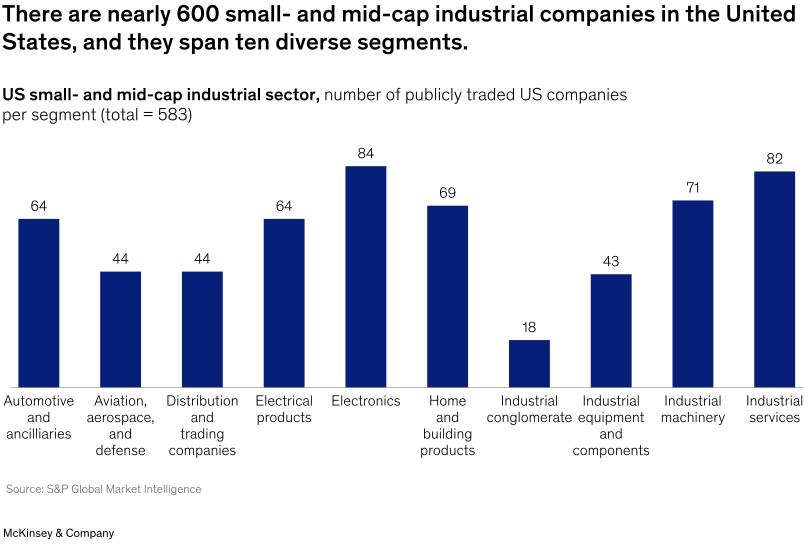
Small- and mid-cap industrial companies are often overlooked. This is in part because of the diversity and complexity of the Titanium Economy’s structure. The sector represents ten broad-ranging segments, such as automotive, electronics, and aerospace and defense, containing more than 100 micro-verticals—groups of companies that provide similar products and services within a segment (Exhibit 1). Examples of these micro-verticals include commercial vehicle and equipment OEMs, building technology suppliers, and thermal management players. The variety of micro-verticals illustrates the diversity and specialization within the Titanium Economy as well as the intricate and interconnected nature of modern industrial ecosystems.
Both who you are and what you do determine Titanium Economy company performance
A Titanium Economy company’s identity is largely defined by the micro-verticals it operates in, and this identity can affect its performance significantly. A company’s choices about which niches to compete in determine its exposure to high-growth opportunities and its ability to ride the tailwinds of transformative trends. The best-performing micro-verticals in recent years are those accelerated by macro trends in AI, electrification, and reshoring. In 2019–24, TSR annual growth was between 18 percent and 40 percent for the following micro-verticals: semiconductor power and memory, solar equipment and inputs, aerospace and defense components, and industrial electronics (such as printed circuit boards and connectors).
While micro-vertical alignment is a critical determinant of a company’s success, it is not the sole driver of outperformance. Equally important to a company’s performance are its actions and strategies, including operational excellence, strategic portfolio moves, and an ability to adapt to changing market conditions. The impact of these actions and strategies is reflected in the significant variation in TSR performance among different Titanium Economy companies within the same micro-verticals. From 2019 to 2024, the TSR growth spread among individual small- and mid-cap industrial companies was 4,700 basis points, while the spread among companies within the same micro-vertical was 2,500 basis points (Exhibit 2). Thus, despite larger performance variation between micro-verticals, there are outperformers—even within lower-performing verticals (for example, players in the bottom quintile). This demonstrates the potential for superior value creation through exceptional execution.
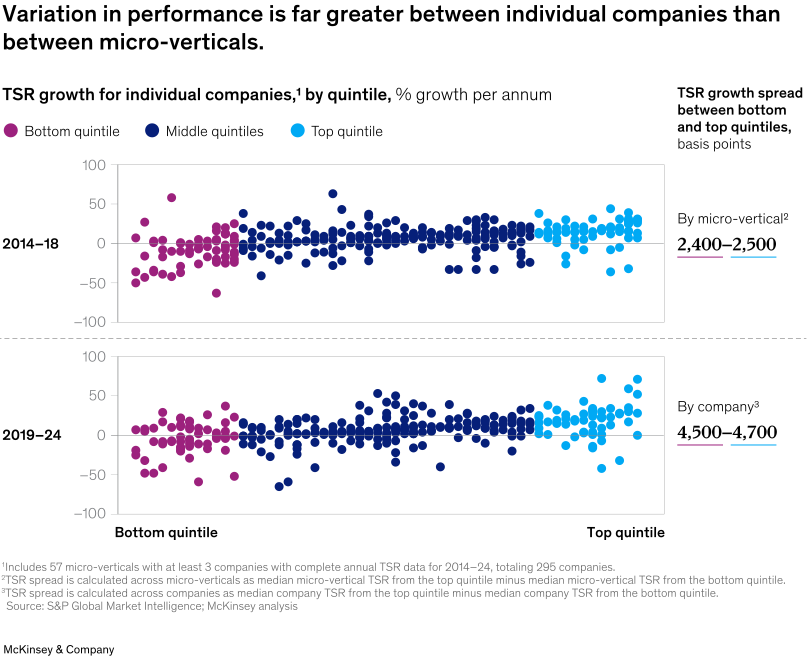
In short, both who a company is and what a company does matter. Together, these two dimensions create a powerful framework for driving superior value. Industrial companies that align their identity with high-potential micro-verticals and execute with precision and foresight are best positioned to thrive in an increasingly competitive and dynamic global economy.
Sustaining top-tier performance: Challenging but rewarding for Titanium Economy companies
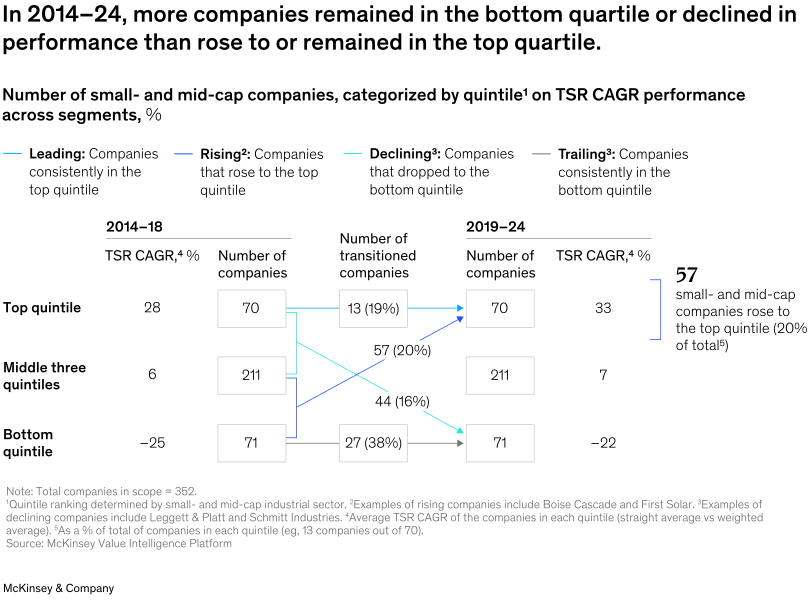
Sustaining top-tier performance over the long term is challenging; only about 20 percent of Titanium Economy companies in the top quintile managed to maintain their high TSR growth from 2014 to 2024. During the same decade, around 40 percent of companies in the bottom quintile remained there, highlighting the difficulty of breaking out of lower performance brackets and the competitive nature of the industrial sector. Despite the difficulties, there were a few companies that moved to higher performance brackets: 20 percent of companies in the bottom and middle quintiles rose to the top quintile (Exhibit 3).
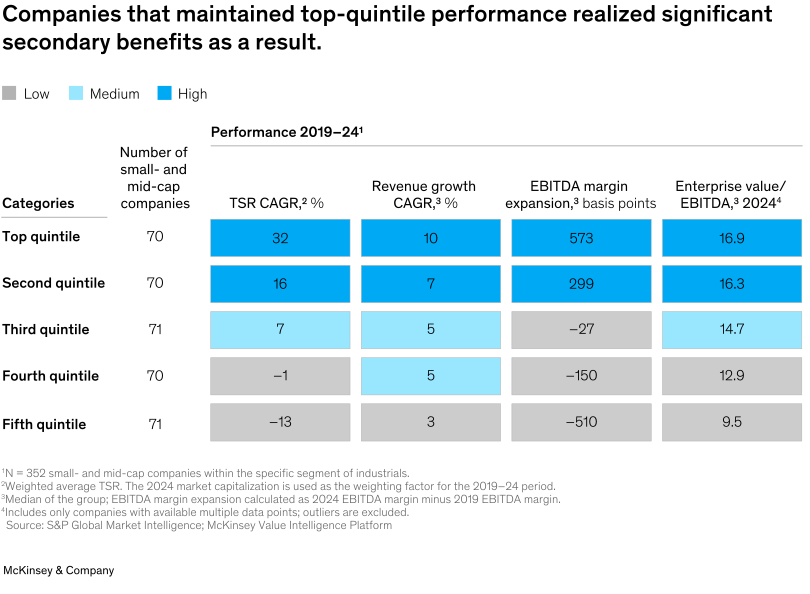
Achieving top-quintile performance is highly rewarding. Comparing top-quintile companies with bottom-quintile companies in 2019–24, the TSR CAGR spread was 45 percentage points, EBITDA margin expansion was more than 1,000 basis points higher, and enterprise value (EV)/EBITDA multiple was 78 percent higher (Exhibit 4).
Leading small- and mid-cap industrial companies are raising the Titanium Economy’s profile as an industrial and economic powerhouse. By adopting the strategies that underpin today’s leading performers, other small- and mid-cap players can capture new opportunities to accelerate and broaden the sector’s momentum, ultimately contributing to a more dynamic and prosperous future for the United States.
Titanium Economy leaders offer a blueprint for success
In the dynamic landscape of the industrial sector, one group of Titanium Economy companies has consistently outperformed its peers. How? By embracing a set of strategic imperatives. These leaders have demonstrated that success in a rapidly evolving economic environment requires deliberate choices and disciplined execution, and they are charting a path that others can follow to unlock value and drive consistent growth.
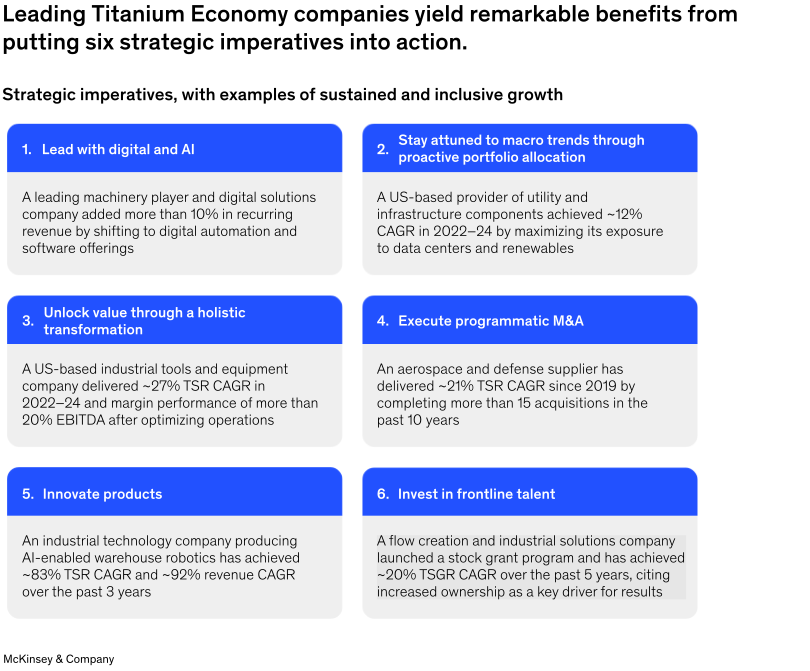
Leading Titanium Economy companies adapt, grow, and maintain their competitive edge through six strategic imperatives: driving digital and AI transformations; staying attuned to macroeconomic trends through proactive strategic portfolio allocation; pursuing holistic transformations that enhance both top-line growth and bottom-line profitability; executing programmatic M&A; innovating products to meet evolving customer needs; and investing in their workforce (Exhibit 5).
Lead with digital and AI
At the heart of leading Titanium Economy companies’ success lies a critical driver of performance: digital transformation. Gen AI has the potential to boost performance and unlock around $4.4 trillion across industries and around $350 billion in industrial sector company operations alone.5
According to our research, large industrial companies are currently leading in scaling AI.6 For example, Siemens has implemented AI-led predictive maintenance at its factories.7 Large companies have advantages that help enable faster adoption and value capture at scale, including proprietary data, established digital infrastructure, greater financial resources, and robust change management capabilities. Nevertheless, leading Titanium Economy companies can leverage their inherent advantages over larger players (for example, fewer legacy systems and greater agility) to level the playing field and accelerate next-generation digital and gen AI–led transformations.
Small- and mid-cap outperformers are already showing what’s possible by using digital and AI technologies, including the following:
- accelerating product development through simulation and model-based design
- improving manufacturing via predictive maintenance and digital twins
- strengthening supply chains with AI-driven forecasting
By focusing on these and other levers, industrial companies can convert digital maturity into resilience, growth, and sustained returns.
Stay attuned to macro trends through proactive portfolio allocation
Trends such as the adoption of AI, data center expansion, and electrification are reshaping industries and creating new opportunities for growth. The potential scale of this transformation is evidenced by annual cleantech spending of $640 billion, as well as projections that electricity demand will triple by 2050.8 One Titanium Economy company (a US-based provider of critical utility and grid infrastructure components) is seizing this opportunity, achieving growth of approximately 12 percent per annum from 2022 to 2024 by maximizing its exposure to data centers and renewables end-markets through innovations in grid automation, new modular or prefab solutions, and focused customer intimacy.
Unlock value through a holistic transformation
Top Titanium Economy performers deliver outsize returns by strengthening operating performance rather than relying on multiple expansion. According to McKinsey analysis, from 2019 to 2024, industrial companies in the top quintile (based on TSR) achieved 18 percent EBITDA margin annual growth, compared with a 10 percent contraction for bottom-quintile firms. Through a holistic transformation, small- and mid-cap companies have significantly enhanced their performance, achieving notable improvements in both top-line growth and bottom-line profitability. This operational discipline has allowed these businesses to build stronger, more resilient operations, underscoring the importance of efficiency as a value creation lever. One example is a US-based industrial tools player that implemented a multiyear transformation focused on organic growth, margin expansion (such as pricing), and operational efficiency, enabling it to increase EBITDA margins by more than 1,200 basis points over that period.
Execute programmatic M&A
We found that programmatic M&A has allowed top Titanium Economy companies to expand their market reach and capabilities. Approximately twice as many top-quintile companies made acquisitions in at least three of the past six years compared with their bottom-quintile peers. For example, a US-based aerospace and defense supplier achieved TSR growth of 21 percent per annum from 2019 to 2024 by making more than 15 acquisitions in various sectors beginning in 2015. Similarly, a US-based electronic-components provider and a US-based industrial-technology company have leveraged both transformational and programmatic acquisitions to achieve double-digit growth, enhance EBITDA margins, and expand their market capitalizations.
Innovate products
Throughout the Titanium Economy, leading players exemplify the power of innovation and strategic focus. Top performers have accelerated R&D spending, with growth 15 percentage points higher than their bottom-quintile peers from 2019 to 2024, according to McKinsey analysis. Leaders have also focused their R&D efforts on high-growth, high-margin areas, aligning investments with the most attractive opportunities. A US-based public safety solution manufacturer, for example, has invested significantly to drive innovation and expand into complementary categories, creating an integrated ecosystem and shifting to a subscription-based revenue model. Another example is a US-based provider of electrical energy distribution and control systems that has aligned its R&D with industry megatrends such as grid automation and digital asset monitoring, focusing on high-value solutions and modular product platforms that enable scalable innovation. These strategies not only drive growth but also create enduring customer relationships and recurring revenue streams.
Invest in frontline talent
Even leading Titanium Economy companies are not immune from the industrial sector’s major talent challenges, which include unsuccessful talent acquisition, low returns on skill investments, and increased attrition. In a McKinsey survey from September 2025, approximately 35 percent of workers reported they planned to quit in the next three to six months, with most citing a lack of career development opportunities as their reason. And in the same survey, eight in nine new hires reported they lack proficiency in the core skills required for their job.9 A robust talent strategy is crucial because even the most advanced business strategies can falter without the right people to execute them.
While no universal playbook exists, Titanium Economy companies can draw on proven practices10 to attract, develop, and retain the workforce needed to compete:
- Attract. Talent attraction best practices include articulating a clear employee value proposition, building robust company-led workforce ecosystems (for example, partnering with community colleges, trade schools, and non-profits such as Opportunity@Work11 to build targeted pathways and apprenticeship programs), and reimagining how talent is sourced (for example, deploying AI matching tools to streamline recruiting and candidate selection).
- For example, by flagging candidates with in-demand skills, Aramco’s AI-driven matching and forecasting tool reduced the time to fill open positions by 43 percent and improved new hires’ job satisfaction.12
- Develop. Winning talent development strategies include building a continuous learning culture anchored in frontline AI proficiency,13 co-developing technical curriculums with academic partners tailored to digitalized manufacturing, and creating structured advancement pathways that reward upskilling.
- For example, Western Digital’s university collaboration (designing a multidisciplinary curriculum for digitalized manufacturing) yielded a 49 percent increase in frontline workers trained in the industrial Internet of Things and a 27 percent rise in employee promotions.14
- Retain. Effective talent retention requires systematically understanding how employees spend their time and why (for example, by using digital tools to surface performance patterns); honestly assessing the gap between the reality and the ideal, linking those insights to clear performance goals; and committing resources to the initiatives most likely to make a lasting difference, such as performance-based incentives and career progression clarity.
- For example, Haier COSMOPlat’s workforce initiatives, including dynamic work assigning, gamified skill competitions, and pay transparency, cut attrition from 7 percent to 3 percent and improved employee satisfaction by 12 percent.15
While challenges in attraction, development, and retention have long affected Titanium Economy companies, supply chain disruptions continue to accelerate nearshoring trends, making the strategic importance of domestic manufacturing—and the workforce that powers it—greater than ever. Addressing these challenges requires a fundamental shift in mindset, away from viewing talent as a cost and toward recognizing that talent is a long-term investment in building a sustainable competitive advantage—one that creates pathways for new talent and strengthens the communities Titanium Economy companies call home.
The examples set by these leading small- and mid-cap industrial companies provide a compelling template for others aiming to thrive in the Titanium Economy. By leading with digital transformation, staying attuned to macro-trends, unlocking value through efficiency, executing programmatic M&A, innovating products, and developing the workforce, all small- and mid-cap industrials can position themselves for long-term success. In a world of constant change, the ability to adapt, innovate, and execute separates leaders from laggards. For those willing to embrace this challenge, the rewards are clear: sustained, inclusive growth and a lasting competitive edge.
The industrial sector is a bastion of economic resilience and growth in the United States and globally; Titanium Economy companies within it are spearheading the innovation that will shape the sector’s future as well as the global economy. As the Titanium Economy continues to evolve, unlocking its full potential will depend on broad adoption of the deliberate choices and disciplined execution demonstrated by its leading companies. To navigate today’s complex and dynamic landscape, small- and mid-cap company leaders should prioritize identifying high-growth micro-verticals, crafting programmatic M&A strategies, and embedding AI-enabled transformation into their core operations. With data-driven insights and analysis, businesses of all sizes can address challenges, capitalize on emerging opportunities, unlock value, build resilience, and position themselves for sustained success in the evolving industrial economy.
Related Articles

The next big arenas of competition

.jpg?cq=50&mw=767&car=16:9&cpy=Center)