Put yourself in the shoes of someone who manages a large equipment assembly plant in Alabama. Or a few discount stores in Ohio. Or a healthcare network in Colorado.
For years, you’ve seen how little labor productivity has grown, and how hard it has been to attract and retain your frontline workers. Recent US employment data may show more slack than in the early 2020s, but those years saw some of the tightest labor market statistics on record. Finding workers still isn’t easy.
AI offers some hope that technology could fill your workforce gaps. It’s helping in a few areas already: Maybe your schedules are more flexible now, which helped you find some candidates who can’t work standard ten-hour shifts. Maybe you can better coordinate deliveries to reduce overtime costs. Maybe real-time analytics now alert you to operational problems that can be fixed right away, rather than taking hundreds of work hours to diagnose and resolve.
Yet your operations are still short-staffed. Your workers say that some of the AI tools you support generate interesting analysis but don’t save much time or effort. And you, as manager, have been told to hold the line on hiring and bonuses because of the current cost environment and AI’s productivity promise. That leaves you with the multimillion-dollar question: How can AI make your team more productive?
This scenario is all too real. Companies in the United States spent more than $1 trillion on IT last year, including hundreds of billions of dollars on AI, gen AI, and agentic AI. Yet lasting positive returns have been hard to come by. The latest McKinsey survey datafinds that although almost 80 percent of companies are using gen AI, more than 60 percent report seeing no significant bottom-line impact. Moreover, a mid-2025 survey of manufacturing COOs found that only one-third of surveyed companies have scaled any AI solutions across their networks, and only 2 percent say that AI is fully embedded across all their operations.
For all of AI’s breakthroughs in extracting strategic insights from data, translating those insights into action is proving far more difficult—particularly at scale across an entire operation. The critical reason: too few workers with the capabilities needed to collaborate effectively with AI. Almost half of US C-suite executives report that their deployment of AI tools is too slow, and the number one reason they offer for the delay is “talent skill gaps.” Nearly all employees are experimenting with gen AI tools—but since only a small fraction of organizations have built structured talent strategies to improve AI fluency, it’s hard for workers to do more with the technology.
The skills gap may be most worrisome at the front line. The frontline workforce—staff who work directly with customers or are directly involved in making, moving, or selling a product or providing a service—is the biggest workforce in the US economy. Companies in sectors ranging from healthcare and retail to manufacturing, construction, and transportation employ some 100 million Americans.
For years, employers in frontline-heavy industries have battled to find, hire, engage, and retain talent. Now employers say it’s not just a matter of having enough workers—it’s having workers with the right skills as AI and related technologies transform frontline jobs. At the most advanced sites, production workers now do real-time, on-site analysis of data that once had to be painstakingly extracted and sent to an office before it could be of any use on the front line.
In this article, we’ll look at a solution that is working for some of the top-performing companies in the world—ensuring that frontline workers have the skills they need before implementing ambitious technology efforts. By taking the bold step of rethinking their investment approach and building human capital first, these organizations have reversed the ROI trends, increased productivity, and started to create real value from their AI investments. It means taking training far more seriously than has been typical in many frontline-heavy workplaces.
Understaffed, underskilled, and underinvested
Previous McKinsey research has found that companies in the industries whose spending on talent dwarfs spending on capital (by an average ratio of 2.8 to 1.0) have little clarity on the return on their investment in talent. The analysis also showed that to generate meaningful ROI on their talent spending, these companies need to continuously raise the productivity of their frontline workers. Here are three key challenges bedeviling such organizations.
Filling gaps in the front line
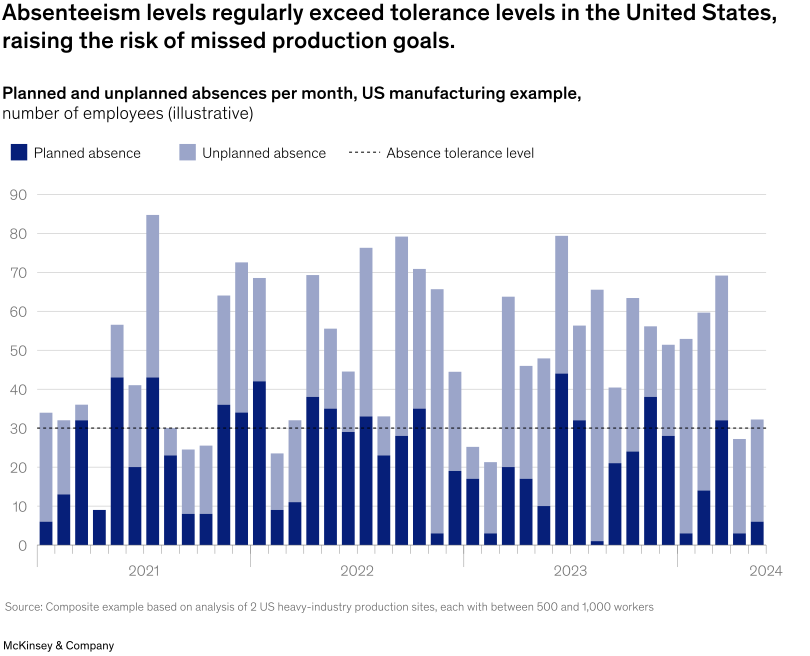
Despite a partial easing of the US labor market since the pandemic, many employers face both short- and long-term talent shortages. Quit rates in the United States have only recently reverted to historic norms after reaching multidecade highs in 2022. Moreover, in some sectors employers say that turnover and absenteeism levels are unsustainable (Exhibit 1).
And then there’s the question of who has been quitting. Often the workers who leave are the most experienced since they have the widest opportunities during historically tight labor markets. Even now, as labor demand eases, it’s tough to keep workers with one to three years of experience. At one large industrial-services provider, attrition among these “midtenure” workers is almost 70 percent.
This pattern keeps repeating across the United States, where few companies have successfully replenished dwindling pools of experienced frontline workers. Temps don’t sustainably fill the gap, even among companies with established temporary-to-permanent hiring pipelines. In 2024, one US manufacturer onboarded about 700 temp workers, but only 200 converted to full-time status—and many of those workers left in less than a year. Instability at this scale doesn’t bode well for businesses trying to manage their current operations, let alone rewire themselves for AI.
Developing workers’ skills
Nevertheless, it may be possible for companies to address both productivity and retention at once. How? In addition to basic employee experience factors such as compensation and incentives, flexibility, and growth potential, more and better training plays an outsize role. McKinsey research suggests that when workers believe they have the skills they need to work effectively, they tend to stick around and be more productive. That’s why workers welcome meaningful training—especially younger workers who are critical to manufacturing’s future.
Yet few organizations make skills development a budget priority. One recent study found that on average, companies spend an estimated $9,100 annually just on software as a service per employee—not including other IT costs. They spend just $1,200 per employee on training and development.
Furthermore, our latest talent trends research suggests that manufacturers’ current investments in talent aren’t translating into workers feeling adequately skilled. Nearly three-quarters of workers we surveyed report experiencing skill gaps, both on foundational frontline operational skills, such as general equipment maintenance and repair, and on core skills for craft or technician roles.
Understanding which skills matter
There’s also a gap between leaders and employees on what skills matter most. More than half—65 percent—of surveyed leaders list technological skills as one of the two most important skill types to invest in for employees, while only 35 percent of employees agree. Conversely, 50 percent of surveyed employees report socioemotional skills as one of the two most important skill types, compared with only 36 percent of leaders.
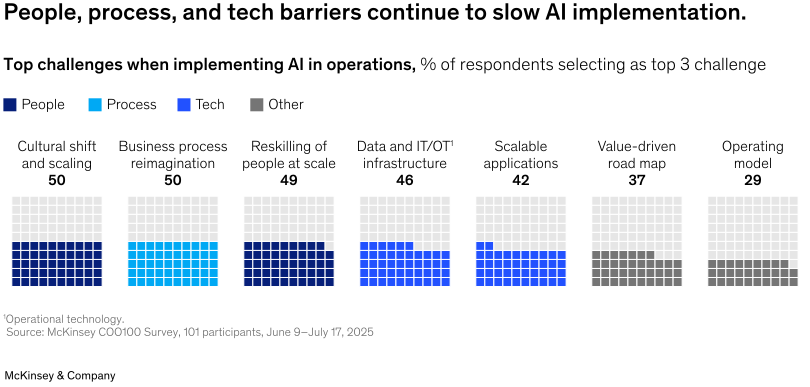
Our research suggests that both sides have a point. Workers are spot-on when they say they need both functional and socioemotional skills. Leaders aren’t wrong to think their workers need better digital skills to successfully deploy the technology the company needs to stay in business. In fact, when manufacturing COOs were asked about the barriers they faced to implementing AI successfully, they listed “cultural shift” and “reskilling” as two of the top three obstacles (Exhibit 2). Clearly, better training is needed in both the soft and hard skills.
Leaders that are getting it right
Our analysis shows that it doesn’t have to be this way. We looked closely at members of the World Economic Forum’s Global Lighthouse Network, which includes advanced production sites and service-sector leaders in industries ranging from mining and metals to healthcare. These organizations are some of the world’s most effective at generating value from technology. Our analysis of Lighthouse data finds that for every two dollars that the average Lighthouse spends on technology, it spends three on revamping processes and five on scaling and adoption—much of which is for capability building at the front line.
The commitment made by these top-performing sites is backed up by performance gains. These organizations are deploying advanced technologies, particularly AI and gen AI, while also building a wide range of capabilities that help workers use the technologies more effectively. The combination reduces attrition while increasing operational performance.
The following examples illustrate how structured talent investments and cross-functional collaboration can enhance productivity, innovation, and long-term competitiveness by empowering every employee.
Developing digital leaders
At Western Digital’s plant in Prachin Buri, Thailand, leaders sought major efficiency improvements to respond to industry-wide pressures in Western Digital’s core data storage business. A critical target: lost production capacity due to equipment failures. Further examination revealed that the root cause was a maintenance organization burdened with overly complex processes, which often resulted in faulty repairs. Recognizing that new technologies would likely require a very different set of skills from the ones the site had long emphasized, local managers reviewed the entire site’s approach to talent.
This integrated perspective resulted in a skills reset. A company-wide digital leadership program has increased employee engagement by more than 20 percent and reduced worker anxieties over automation. In parallel, to reduce maintenance workloads, an AI-based root-cause problem-solving system has cut mean time to repair (MTTR) by more than 75 percent, while increasing repair accuracy has increased by almost 20 percent. Technicians are now able to focus more on higher-complexity tasks and on upgrading their skills to match.
Raising AI skills, mine output, and sustainability
Global mining company SQM, one of the world’s largest producers of lithium, has long focused on talent development as part of a broader continuous-improvement culture. More recently, rising process complexity—in response to new demands from customers and sustainability concerns about water and energy use—has amplified the company’s focus on skill building.
A company-wide training and transformation program has equipped frontline employees to use AI- and gen-AI-based tools to adapt production to constantly changing technical requirements when the properties of raw materials, such as ore and brine, are extracted. Drone-based sensors provide real-time data on production conditions at remote locations, which AI analyzes in real time so that employees can more precisely adjust irrigation levels, optimizing output and water usage. Some of SQM’s sites have managed to increase output by more than 60 percent while raising product quality, reducing resource waste, and cutting costs by 20 percent.
Turning a control tower into a training powerhouse
Lenovo’s factory in Monterrey, Mexico, faced a familiar challenge in high-volume manufacturing, in that frontline workers could not diagnose and resolve production issues in real time. There was no shortage of data: A manufacturing control tower processed 3.7 gigabytes of inputs per hour and tracked more than 30,000 historical issues. The challenge was to translate the insights into immediate, practical action.
The solution was to integrate a problem-solving, gen-AI-based coach into the control tower. Workers can now interact with the system conversationally to analyze root causes and develop instant corrective recommendations. The result is a continuous on-the-job reskilling program that lets workers make decisions while keeping production moving. Productivity has increased by more than 40 percent, with repair times falling by 95 percent.
Building AI capabilities to reach the ‘long tail’ of customers
For the leaders of a North American tech services company, AI was a golden opportunity to expand sales among customers that were too small to reach effectively via a traditional agent-led sales model. But the trick wasn’t simply to develop an autonomous AI sales agent—it was for human and AI agents to collaborate, with the AI agent increasing the human agents’ capacity to serve more customers.
This goal meant making a serious commitment to training human agents to use the capabilities of their automated coworkers. Accordingly, the AI sales agent was complemented by three additional AI agents: an assistant agent to automate time-consuming clerical tasks; a customer-service agent to resolve simple client issues; and—most important—a coach agent to provide personalized feedback and coaching on skills such as call preparation and offering design.
By adapting sales agents to new processes, this capability-first approach led to quick impact. The outcomes included a projected $400 million to $700 million increase in annual revenue and a 25 percent productivity gain from freeing agents’ capacity.
More companies are realizing that sustaining value from AI, gen AI, and agentic AI isn’t just a matter of delivering new tools. Employees at every level will need training to use these new technologies effectively and to integrate agents, their new digital coworkers, into day-to-day work. By adopting a capabilities-first mindset, businesses can betterrewire their organizations for a new era of productivity.