Material wholesalers and service centers sit at the center of the industrial economy. They connect mills to manufacturers and quietly enable production across nearly every industrial sector—from aerospace and automotive to construction, renewable energy, and data centers. Without these players in the middle of the value chain, factories would struggle to secure the right materials, in the right format, at the right time. They are, in essence, the system integrators of the physical world, translating raw output into production-ready input at industrial scale.
Their coordinating roles are becoming even more critical as the operating environment for sourcing materials grows more complex. Rising geopolitical tension, trade fragmentation, and localized disruptions are increasing volatility across material supply chains. What was once optimized primarily for cost and efficiency is now, by necessity, being redesigned for resilience. Customers increasingly expect continuity of supply, short lead times, and greater flexibility.
At the same time, new demand engines are accelerating. Technologies such as artificial intelligence, electric vehicles (EVs), and renewable-energy infrastructure are driving demand for specific materials. Manufacturers are also increasingly choosing to outsource, pushing more processing, customization, and inventory risk onto wholesalers and service centers.
Amid these shifts, the role of those occupying the middle of the supply chain is changing. In this article, we explore the risks and opportunities for these players.
An era of change for the materials value chain
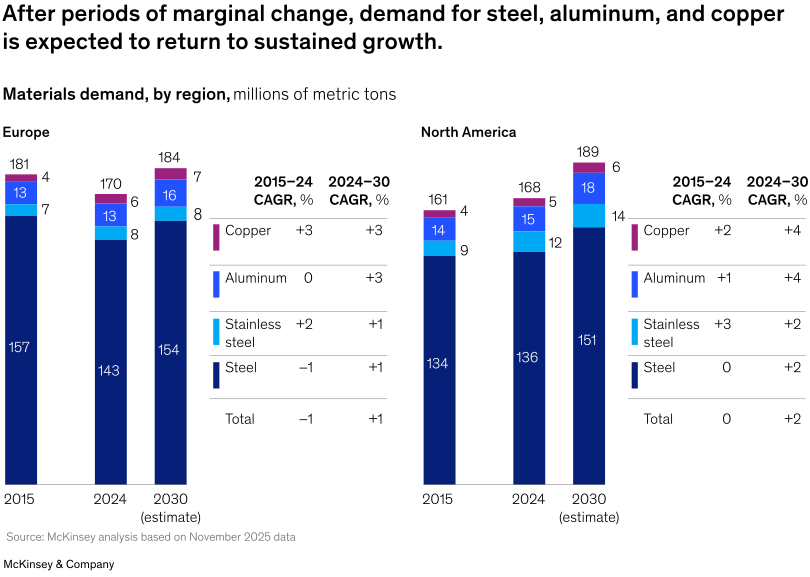
For much of the past decade, materials demand in Europe and North America was largely flat. From 2015 to 2024, total consumption of steel, aluminum, copper, and stainless steel moved only marginally. Looking ahead to 2030, however, demand is expected to accelerate, with all four materials returning to sustained growth (Exhibit 1).
This turnaround reflects four structural forces reshaping both materials demand and service requirements in Europe and North America:
- Geopolitical realignment is transforming the materials demand curve. Geopolitically driven supply chain reorganization—including reshoring of many industrial processes—is causing a step change in domestic materials demand. For example, average monthly construction spending for US manufacturing facilities rose to $235 billion in 2024, from an average of $76 billion monthly in 2015 to 2020, fueled by US investments in semiconductor chip manufacturing and supply chain reshoring.1 Similar infrastructure investment across manufacturing, grids, and energy is expected to sustain elevated materials demand through the decade.
- Decarbonization is redefining material specifications. Globally, buyers plan to raise green metals’ share from approximately 21 percent today to 32 percent by 2030.2 However, momentum is diverging: Asia is now leading in corporate climate commitments, while Europe and North America are slowing down.3 In response to these commitments, wholesalers and service centers are offering differentiated products that include capabilities such as carbon reporting, segregated green flows, and recycling integration.
- New technology is creating new growth engines. Data centers, electric vehicles, and renewable-energy equipment are generating sustained high demand for steel, aluminum, and copper. AI-driven data center investments alone could range from $3.5 trillion to $8.0 trillion by 2030, according to McKinsey analysis. IT equipment remains the dominant capital expenditure driver, accounting for the majority of spend. These sectors require higher-quality materials with tighter tolerances, raising the bar for service center capabilities.
- Outsourcing is restructuring the value chain. Facing cost pressures and complexity, manufacturers in America and Europe are increasingly outsourcing processing (such as cutting, slitting, and forming) and logistics services. An annual third-party logistics survey found that 87 percent of customers planned to increase logistics outsourcing in 2025, a 25 percent increase compared with the previous year.4 Rather than investing in equipment and labor for in-house processing or logistics, many companies are relying on wholesalers or service centers for these value-added services.
Remaking the materials value chain to meet the moment
For decades, the materials value chain followed a predictable pattern. Mills produced materials that flowed through wholesalers and service centers to end users (Exhibit 2). Players in the middle competed on scale, inventory management, and transactional efficiency.
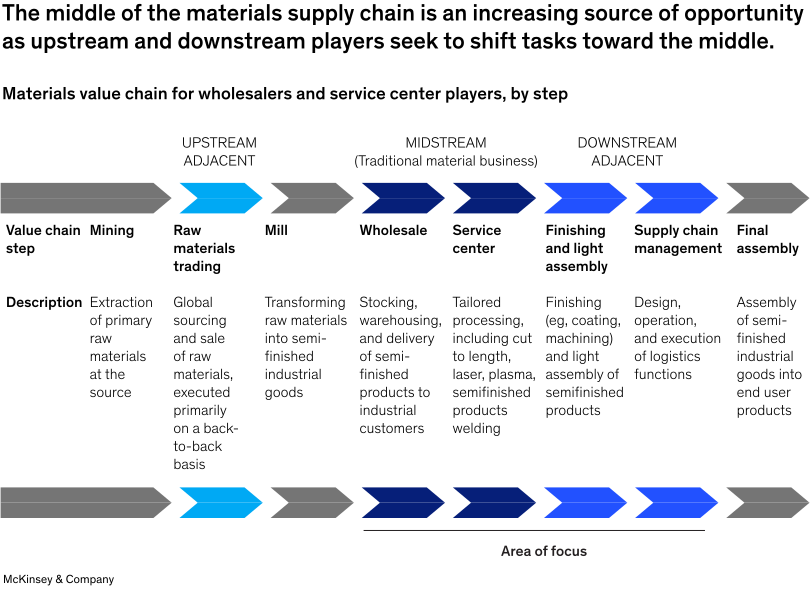
That model is now evolving. End customers are facing labor shortages, rising manufacturing costs, increasing supply chain complexity, and the need to deliver on shorter lead times. In response, they are increasingly shifting downstream tasks to trusted partners that can combine material supply with processing, fabrication, and logistics orchestration. Distributors and service centers are rising to the challenge by becoming integrated solutions providers, sometimes expanding into multiple materials or adding specialty products. Activities such as finishing, light assembly, and integrated logistics—once peripheral—have become strategic growth arenas. Illustrating this trend, the traditional materials business, including the downstream adjacency market across North America and Europe, valued at more than €440 billion in 2024, is expected to grow to about €540 billion by 2030.
Opportunities for growth are uneven
Growth is uneven across segments (Exhibit 3). The North American and European wholesale distribution business, a roughly €140 billion market in 2024, is expected to expand at only about 2 percent CAGR through 2030. This is because wholesalers’ growth is mainly limited to materials demand growth. The sector’s minimal value-add capabilities limit participation in OEM outsourcing trends. This means that pure-play wholesalers capture tonnage growth but have minimal exposure to downstream margin pools.
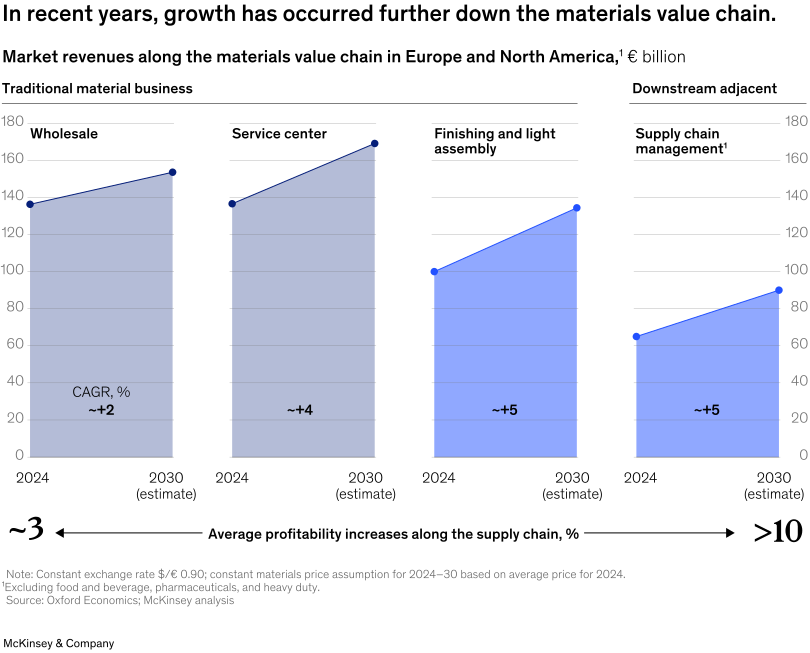
In contrast, service centers and finishing/light-assembly services are expected to expand 4 to 5 percent annually, nearly twice as fast as wholesalers, because these industries are well positioned to offer the outsourcing services that OEMs are looking for.
Logistics-driven adjacencies tell a similar story. Supply chain management services such as third-party logistics (3PL) and fourth-party logistics (4PL) “control tower” services are expected to grow by approximately 5 percent annually, reflecting demand for their ability to support digitally integrated, traceable, and resilient supply chains. Complexities resulting from tariffs, reshoring initiatives, and regionalization are adding nodes and risk to supply chains, increasing demand for partners that can seamlessly manage processing, storage, and logistics.
As these downstream segments gain momentum, they capture higher profit margins. The result is a clear divergence across the value chain: Growth and profitability are migrating away from basic-materials movement toward service-rich, customer-integrated models.
Upstream adjacencies also present opportunities. The global raw and semifinished-materials trading market, estimated at €300 billion to €400 billion in 2024, is expected to grow at about a 3 to 4 percent CAGR through 2030. While it delivers lower margins than downstream services, trading is increasingly valuable for securing supply, managing price volatility, and providing mill-independent access in a fragmented geopolitical environment.
High-growth, high-value segments are redefining the opportunity set
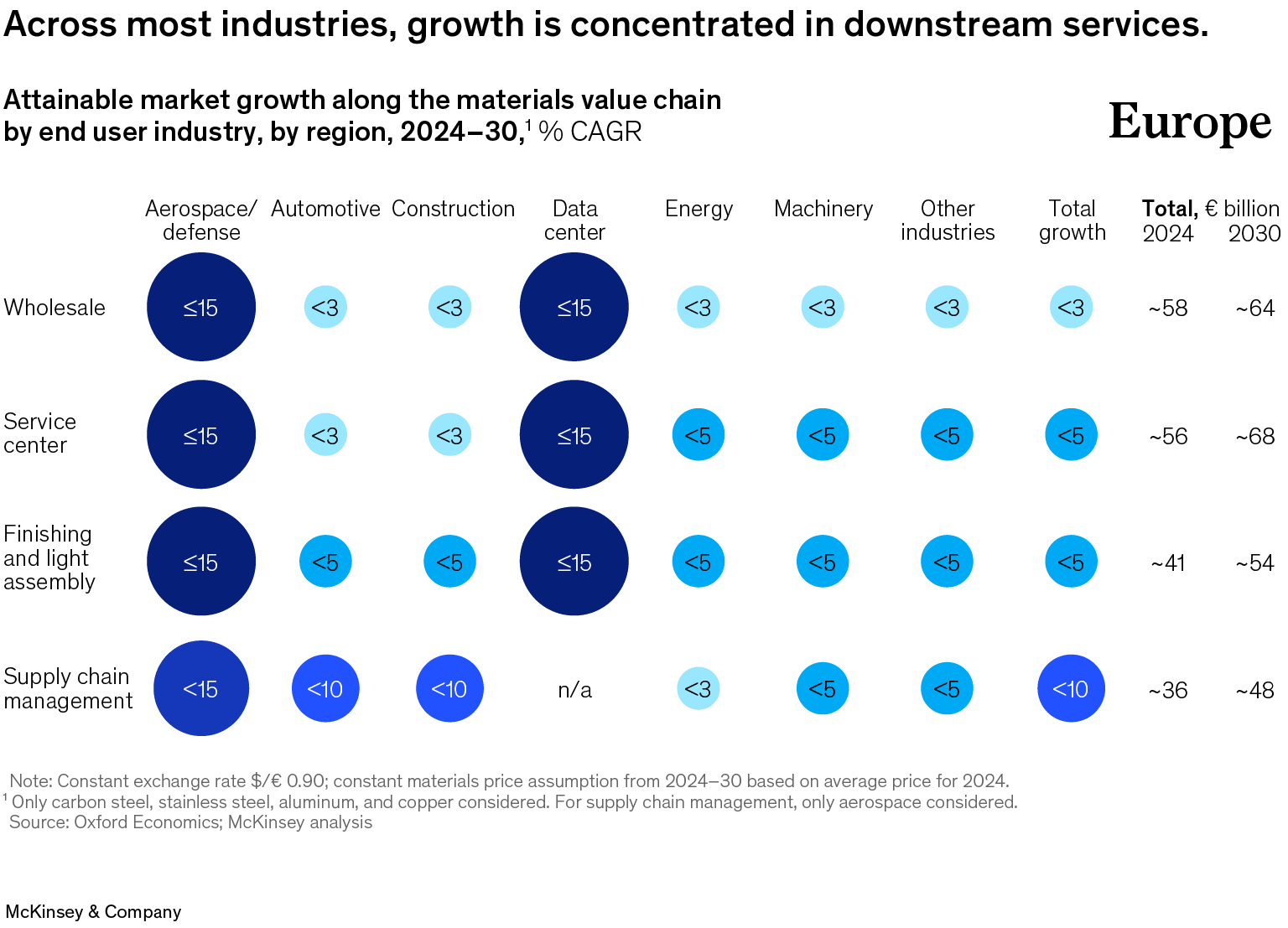
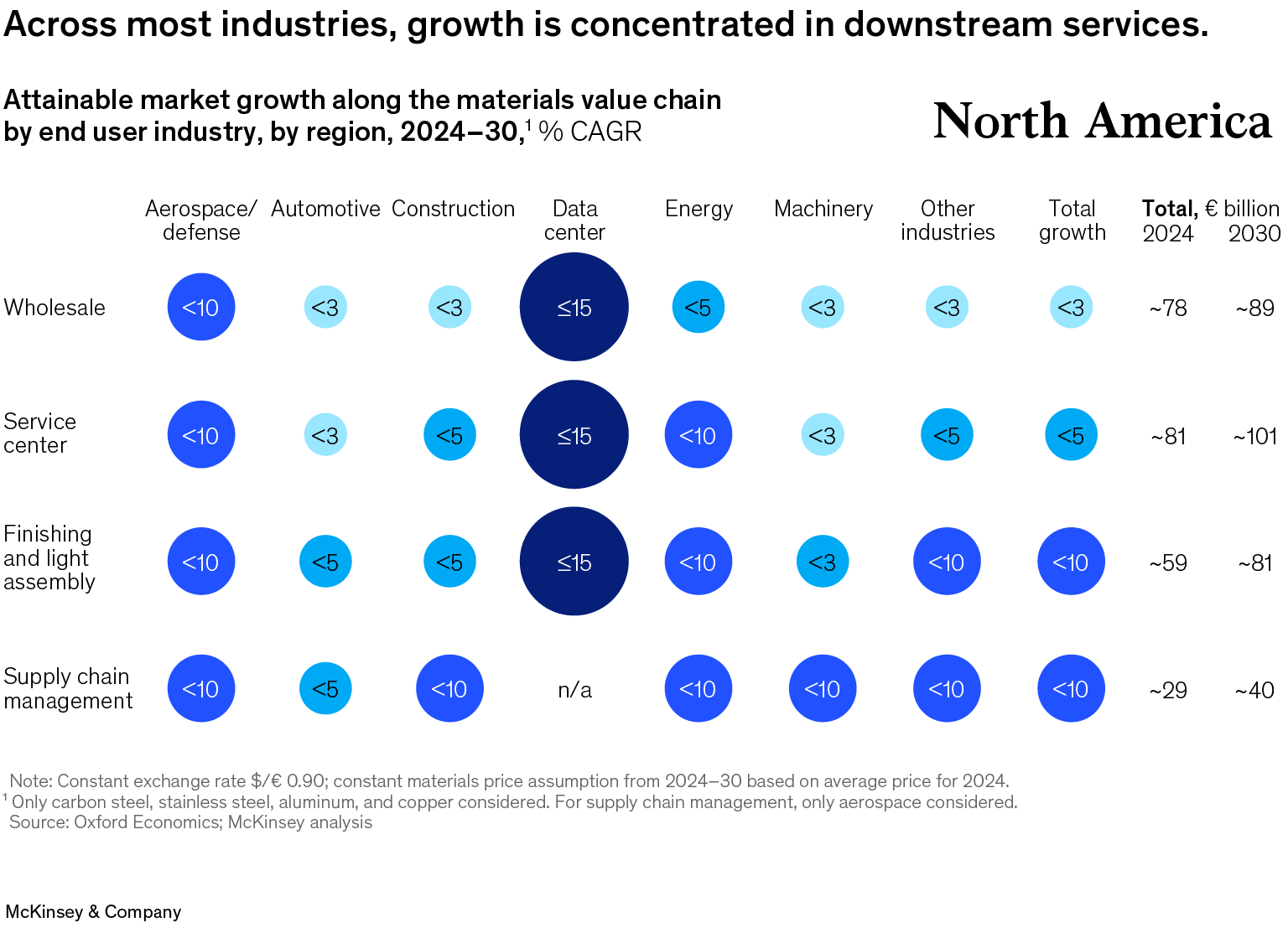
The shift toward downstream services is amplified by growth in several high-demand segments that require complex materials processing, high reliability, and integrated logistics. These sectors disproportionately benefit distributors and service centers that have scaled processing and value-added capabilities (Exhibit 4):
- Data center infrastructure: According to McKinsey analysis, data center capacity in North America and Europe could double or even triple by 2030, driven by AI, cloud computing, and edge networks. Demand for metals and fabricated components is growing at approximately 22 percent annually, with data centers potentially consuming up to 6 percent of copper in North American and Europe by 2030. Service centers can play a critical role in this industry by offering prefabricated structures, electrical enclosures, racks, cooling components, and logistics coordination that together enable rapid construction timelines.
- Defense in Europe: European countries are rebuilding defense capabilities, moving toward or above 2 percent of GDP spending. Incremental defense outlays of €700 billion to €800 billion are projected for 2022 to 2028, potentially lifting annual spend to approximately €500 billion by 2028.5 Modernization and ammunition replenishment plans are driving 18 percent annual growth in relevant materials categories. Integrated service centers with logistics capabilities are positioned to provide certified materials, kitted components, and supply chain solutions.
- Energy in North America: After decades of flat load, US power demand is now expected to grow by 3 percent per year until 2030, driven by re-industrialization and reshoring, EV demand, and AI data centers.6 This rapid electrification means substantial investment in generation capacity (including renewables and grid batteries), transmission lines, and distribution networks, accelerating demand for materials. This creates a strong role for distributors and service centers that can supply modular assemblies, fabricated housing, transmission components, and multiregional logistics.
- Finishing and light assembly in North America: Reshoring of final production stages in several industries (appliances, automotive, and electronics) is creating new local finishing needs. Several large companies have announced US manufacturing investments, including GE Appliances, which said it will move washing machine production from China to the United States with a $490 million investment. With 5 percent CAGR through 2030, finishing has become the bridge between raw materials and OEM production lines as OEMs across industries increasingly rely on partners that can deliver near-net-shape or sub-assembled components. Finishing and fabrication are where distributors move from supplying materials to supplying solutions.
- Supply chain management: This sector is growing approximately 5 percent annually, reflecting the need for regionalized, high-visibility, multimodal supply chain orchestration. The return of manufacturing is driving demand for sophisticated 3PL and 4PL capabilities. For material distributors, logistics integration is a natural adjacency that deepens customer relationships and enhances life cycle value.
The case for consolidation strengthens
Despite its scale and importance to industrial supply chains, the materials distribution and processing market in Europe and North America remains structurally fragmented. This fragmentation has persisted for decades, shaped by regional customer bases and limited incentives to consolidate. Now, however, the forces reshaping the value chain—such as rising service intensity, increasing costs, and more rigorous technical specifications for products—are altering the strategic logic. The industry has entered a consolidation phase as players seek scale, capability depth, and stronger competitive positioning.
Across Europe and North America, even the largest players maintain modest relative shares (Exhibit 5). The remainder of the market comprises hundreds of regional and midsize service centers, processors, and niche specialists.
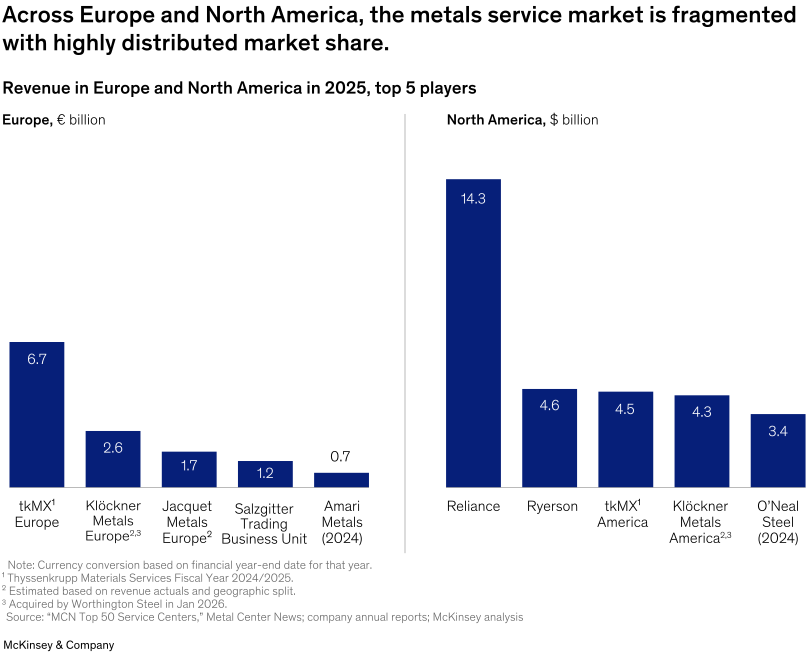
This fragmentation creates inefficiencies—in capacity utilization and technology investment, for instance—and network coverage gaps. These inefficiencies create opportunities that consolidated players are increasingly seeking to exploit. 2025 marked a year of intense M&A in the steel-processing sector in North America. For example, the Ryerson–Olympic Steel merger expanded the companies’ footprint and capabilities.7 Worthington Steel’s acquisition of processor Klöckner & Co. signals growing interest in combining processing depth with advanced supply chain services.8 Worthington Steel has stated that its aim is to invest in value-added and specialty steel products in niche markets because of the higher margins these segments provide.9 These recent moves illustrate the acceleration of scale, market leadership, and capability-led consolidation in the current fragmented competitive landscape.
Four strategic levers to capture opportunity
As growth and value pools shift downstream, four strategic levers stand out for expanding into new opportunities:
- Leading in a well-chosen segment. Focus resources on high-value niche segments with strong growth tailwinds. Compete where your capabilities—whether technical, regulatory, or in your service model—give you an advantage.
- Offering solutions, not materials. Evolve from being a materials provider to an end-to-end solutions partner across the value chain, offering services such as kitting, light assembly, and integrated logistics. Capture the higher margins downstream as customers outsource more and pay for outcomes, not just inputs.
- Building local scale and presence. Capture reshoring-driven demand by building dense local networks close to customers, enabling faster delivery, stronger relationships, and resilience. Scale selectively, using targeted consolidation in fragmented markets.
- Pursuing customer insights and operational excellence. Develop insight-rich account management to anticipate shifts in customer demand. Maintain cost discipline by leveraging digital tools and automation, especially agentic AI. This lever underpins the ability to deliver on other priorities.
The materials value chain in North America and Europe is entering a period of structural transformation in which complexity, volatility, and new demand patterns are redefining where and how value is created. Players in the middle of the value chain—long focused on scale and transactional efficiency—are now positioned to capture opportunities by evolving into integrated solutions providers. As growth and margins shift downstream and high-demand sectors raise the bar for capability and reliability, success will increasingly depend on strategic focus, operational excellence, and the ability to align closely with customer needs.