New pressures are building beneath the surface in commodity trading. Although margins remained similar with 2024, fewer organizations now control increasingly larger amounts of global commodity flows, and many are positioning themselves for the next supercycle. At the same time, new entrants such as national oil companies (NOCs), mining companies, hedge funds, and renewables players with energy management capabilities are building trading capabilities to participate in emerging opportunities, and agentic AI is starting to change the operating model of the entire industry.
Many of these pressures are likely to erupt sooner rather than later. The question is how players can succeed in these new markets. Looking at industry performance over the past year, we focus on key future success factors, including investment appetite and AI transformations. The resulting insights provide an overview of the industry’s performance while considering how it could evolve in the decade to come.
You’re Invited: McKinsey Commodity Trading Webinars
Join the authors on March 24–25 to discuss navigating the new era of commodity trading.
Taking stock of commodity trading
There is a new normal in commodity trading, with overall industry value now roughly twice as large as pre-COVID-19 levels, yet significantly down from 2022–23 heights.1 In fact, overall global value pools in 2025 decreased by approximately 5 percent from the previous year (Exhibit 1). The decline was primarily driven by softness in power trading, particularly in Europe, with fewer opportunities to monetize price movements.
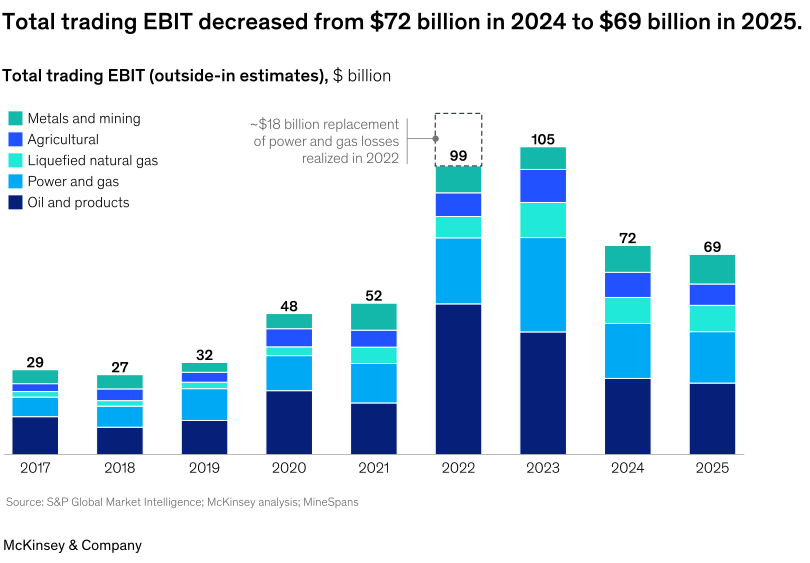
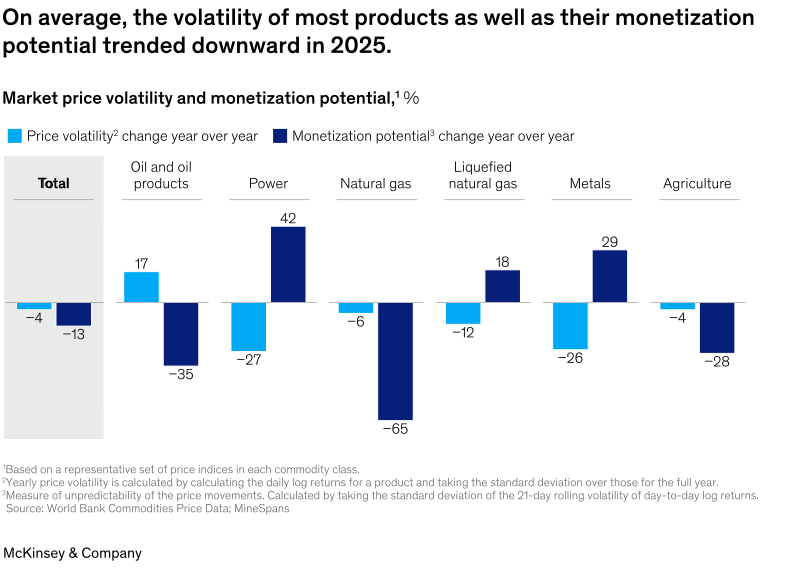
Although volatility dropped only slightly from 2024, geopolitical uncertainty limited trading opportunities in several commodity classes, especially at the beginning of 2025 (Exhibit 2).
Strong data analytics and access to the broader flexibility portfolio allowed some physical merchant traders to maintain stable results. By contrast, the mixed results of hedge funds highlight the difficulty of generating profits, particularly when it comes to competing with established players in physical markets. Slowly but steadily, some hedge funds have moved to asset acquisitions to diversify their finance-heavy portfolios as well as to secure access to valuable commodity-flow data. In oil and oil products, several companies refined their investment strategies by prioritizing projects with the highest returns. This was especially the case for European international oil companies (IOCs) reducing investments in green energy-transition technologies (mainly offshore wind) to fund renewed hydrocarbon ambitions.
Taking a step back, the most prominent macrotrends across trading in 2025 were geopolitical disruption, changing priorities in the global energy transition, and AI.2
On the first point, recent trade policy changes have led to additional uncertainty in global markets, which made capturing value from volatility with traditional models difficult. Access to commodities is increasingly seen as critical to staying competitive on the national level, reconfiguring some established commodity flows.
Second, the energy trilemma—referring to the need to balance energy security, affordability, and decarbonization—is increasingly evolving into an energy quadrilemma, reflecting rising structural-energy demand. Recent priorities have tilted toward security and affordability. At the same time, sustained demand growth implies that both hydrocarbons and low-carbon sources are required for longer than previously anticipated, with hydrocarbons retaining a larger share of the energy mix through 2035 than earlier forecasts suggested.3
Finally, many players started their AI journeys while continuing to invest in data and advanced analytics. As these journeys are being implemented, there is growing conviction among industry players that AI could profoundly transform trading organizations.
An era of heightened volatility and market dynamics ahead
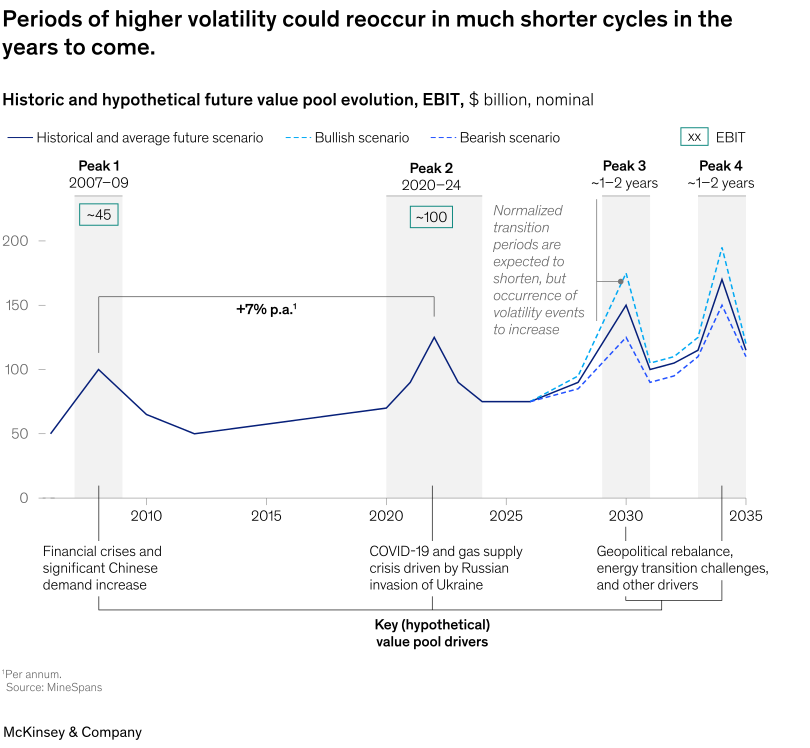
Until about 2020, commodity trading was exposed to relatively few periods of high volatility,4 driven primarily by market-specific supply shocks, with so-called supercycles occurring approximately every ten to 15 years. Since then, the trading industry has experienced a longer cycle of high volatility as multiple disruptive events occurred. Some changes have been global—such as the COVID-19 pandemic, affecting nearly all commodity classes—while others have been regional, such as the European gas crisis following the Russian invasion of Ukraine, initially affecting individual commodities or markets and then spreading across the world.5
This period of higher market volatility also increased participation and liquidity. Hedge funds were attracted back to the market alongside the arrival of new entrants, particularly data-driven traders active in European power and gas markets. These extracted significant value, especially in power and gas, sometimes increasing profits four- or fivefold in the course of a year. Meanwhile, existing players focused on upskilling. Trading houses with physical exposures diversified across commodities, increased their asset footprints, and showed agility in deploying both working and risk capital. Other players, such as producers in oil, mining, and power, improved their trading capabilities to extract more value, subsequently obtaining more downside protection from negative price movements.
As previously stated, new pressures are building beneath the surface. Although value pools have essentially settled in the past two years, the so-called new normal will not remain for long as the frequency of events creating increased volatility accelerates.
Current trends—such as policy changes related to the energy transition, geopolitical involvement and trade fragmentation, and the increased frequency of extreme climate events66—suggest that higher volatility could reoccur in much shorter cycles (Exhibit 3). Commodity markets are particularly sensitive to external shocks because of their concentrated production, low demand elasticity, and limited supply chain diversification.7
Geopolitics are changing trade patterns
Access to core commodities—which are critical foundations for growth and innovation—is increasingly seen as a competitive advantage. The move from “stable multilateralism” to a more pragmatic, flexible “minilateralism” based on common interests could continue in the years ahead, resulting in greater focus on security of supply and self-sufficiency.
Some governments are aiming for more physical control and diversified supply, leading to uncertainty about future trade patterns and subsequently rebalancing physical supply beyond purely market-based logic. On this point, more frequent geopolitical intervention typically entails trade flow reconfiguration, which ultimately leads to increased volatility.8
A recent McKinsey article found that diversification is particularly challenging in the mining and agriculture sectors.9 Materials such as nickel, cobalt, and lithium play critical roles in the energy transition, and lead times to establish alternative supply routes sometimes persist for a decade, leading to high price sensitivity against potential supply disruption. Concentration of production is also a challenge in agriculture; extreme weather events or environmental challenges can disrupt global supply chains if a product is dependent on a single location.
Although less concentrated, oil and gas see similar challenges. Achieving supplier diversification typically takes time and significant costs, including building and retrofitting infrastructure such as pipelines and refineries.10
The energy transition is driving supply-and-demand swings
Any way you look at it, the energy transition is a challenging undertaking. Today’s energy system is both deeply enmeshed in the global economy and responsible for more than 85 percent of CO2 emissions. Many physical challenges must be overcome for decarbonization to succeed—from developing and scaling new low-emissions technologies to building the supply chains and infrastructure they depend on—yet only approximately 13.5 percent of those technologies had been deployed by 2025.11
Transitioning toward a new system that is affordable, is reliable, and increases access to energy will likely be a multidecade challenge. Global systems will need to be rebalanced, significantly affecting supply and demand. Apart from the time required and the complexity of the situation, recent energy policy shifts show the path forward is uncertain.
Several technologies are competing for prominence, making it challenging to allocate capital to secure supply against future demand, which in itself is affected by the same dilemma.12 The combination of short-term shifts in policy and the wider uncertainty on supply and demand, combined with long lead times of investments needed to meet future energy requirements, exposes energy commodities to higher volatility.13
Wider factors amplifying volatility
Higher liquidity is typically seen as a positive because it implies narrowing bid–ask spreads, easing price discovery and dampening small, unexpected price changes. However, commodity traders can more quickly reposition significant volumes in stressed markets with deep liquidity, therefore increasing volatility.14
Continued uncertainty around GDP growth, compounded by unclear future demand from data centers and AI, is affecting commodity prices as supply-and-demand fundamentals become harder to match. Similarly, volatility in several commodity markets is further amplified by the growing frequency of adverse weather events.
Reshaping the business landscape ahead
The new era of price volatility will be accompanied by three business trends; together, they are poised to fundamentally change the trading landscape in the years to come. First, higher market consolidation could be triggered by players with access to key success capabilities. Second, the AI transformation could rewire how these companies operate and enable those embracing it to create more value. And third, the overall appetite for investments in trading capabilities could increase, leading to higher levels of opportunity and risk management as well as new entrants.
Successful IOCs and merchants could lead to increased market concentration
In our perspective, value could continue migrating toward trading houses that combine access to deployable capital, trading-centric growth mandates, and willingness to invest in underlying capabilities while continuously looking to expand through acquisitions, contractual partnerships, or even joint ventures (JVs). NOCs across regions are building professional trading capabilities on top of their production bases, while US IOCs are doubling down on monetizing optionality in oil and liquefied natural gas trading. By contrast, EU IOCs and some European refiners are refocusing on core activities, facing tighter balance sheets and leaner downstream bases.
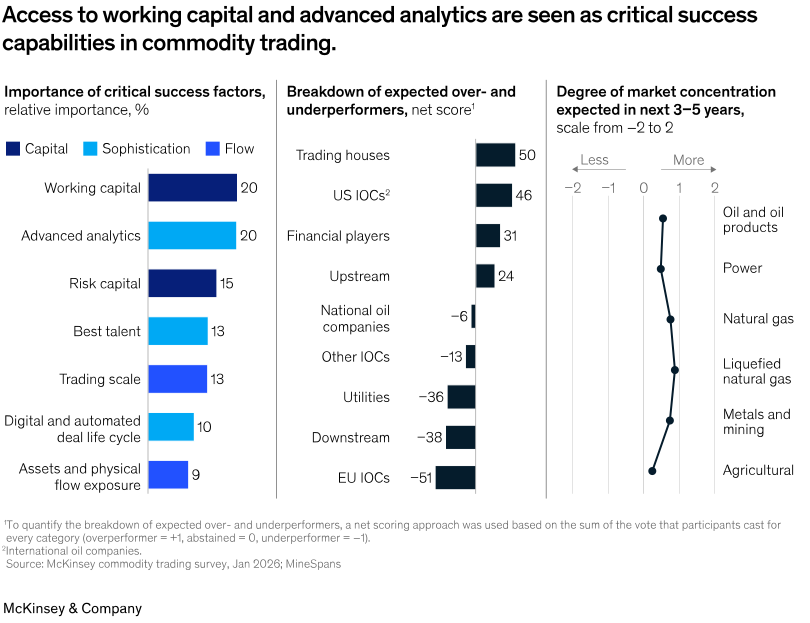
These points in mind, there are three key success capabilities needed to succeed in future commodity-trading markets: access to capital, improved sophistication, and access to physical flows. All three are necessary to outperform.
The ability to operate successfully in the market can empower leading players to extract more value in times of high volatility as well as to expand scale. This essentially creates a virtuous cycle of increased returns, which can then be reinvested. Naturally, the increasing control of physical flows and asset intensity, as well as trading scale, could lead to more concentration in the hands of the so-called privileged few.
Access to capital in highly volatile markets will remain a differentiator, with an understanding of how to deploy that capital emerging as a critical capability.15 Players with flexible balance sheets can scale into dislocations, time arbitrage with storage (when the market pays for it), and remain in trades that others are forced to unwind. Doing so, however, requires steering the trading risk triangle (market, credit, and liquidity) while managing working capital—and not treating them as separate activities. Leading firms handle these trade-offs as deliberately as they handle profit and loss statements (P&L), with the understanding that resilience can reduce capital drag, preserve optionality, and enable growth amid volatility. By contrast, players with limited access—or those lacking the ability to steer, scale, and distribute access along key global opportunities—will likely participate less in high-margin events.
High levels of trading sophistication in areas such as data analytics or origination can lead to higher returns. Information can be converted into trading decisions and P&L faster and more reliably, enabling players to better manage asset-backed optionality at scale (from storage and logistics to structured products). In a world of reconfiguring trade flows, there is increased need to structure tailored, complex agreements. As an example, some trading houses have intensified collaboration with governments or government-owned entities to gain access to supply rights in oil and gas flows in exchange for funding and operational improvements.
In physical markets, access to flow is both an information advantage and a commercial strategy, providing scale and real-time market intelligence as well as repeated “first touch” opportunities to package optionality, which can then be monetized. For the past few years, trading houses have recognized the economic potential of physical flows and assets. Similarly, hedge funds are increasingly interested in access to flows and physical assets as a way of gaining critical market information and access to optionality as well as increasing their trade volumes and asset bases.
As previously highlighted, performance promotes size and therefore market consolidation. The intensity of consolidation, however, depends on products and to some degree on regions. As a truly global commodity system, hydrocarbons are likely to be most affected by market share consolidation. By contrast, Europe’s power market could see new entrants, given the relatively low barriers to entry, which could offset some effects of concentration.
Success in the years to come will likely be determined by how companies manage capital needs and sharpen their capabilities to compete for assets and talent. In the same vein, established players will likely need to define a response to data-driven trading houses with increased appetite to invest in physical assets.
Our market survey of more than 150 commodity traders confirmed the importance of all success factors, with roughly 80 percent of respondents considering “access to capital” and “level of sophistication” success factors as the most critical priorities (Exhibit 4). When it comes to future over- and underperformers, trading houses, US IOCs, financial players, and upstream players are expected to overperform relative to downstream players, utilities, and European IOCs.
Industry players believe AI has the potential to reduce costs by 60 percent
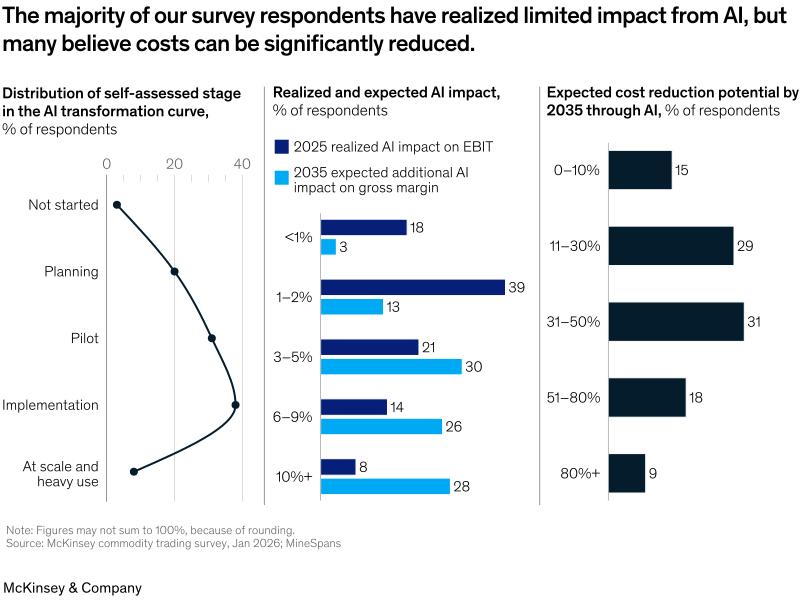
Treating AI agents as a new workforce that is governed, monitored, and benchmarked rather than a bolt-on robotic-process-automation upgrade could help companies increase efficiency by 50 to 60 percent. Evidence from early deployments shows that labor efforts for parts of the deal life cycle can be reduced by 20 to 40 percent, with survey results showing that industry participants believe cost reductions of more than 80 percent are achievable once end-to-end workflows are redesigned.
In this way, AI has been fully accepted by leading players to support front-office decision making, but it is now also transforming the post-trade engine room underpinning every commodity book.16 As agentic AI is implemented, and the creation of automatic digital employees accelerates, players could decrease data to trade time, limit errors, and increase trade life cycle efficiency. That said, few trading organizations have scaled AI across the business, with most leading organizations still in the deployment phase.
Still, the urgency and future impact of AI cannot be underestimated: Those that quickly rewire post-trade will likely run faster books, unlock balance sheet optionality sooner, price more clients with less latency, and redeploy human expertise toward origination and complex risk steering rather than administrative tasks. The back office is no longer overhead; it’s a competitive tool for the front office.
The question for every trading leadership team is no longer about whether agentic AI will reshape their economics but rather how the right use case and the quality of deployment can be designed for impact. Recent McKinsey research shows that agentic AI could disrupt operating models and dramatically change what trading organizations look like, with human and AI agents working hand in hand and achieving outcomes faster and with less cost.17 In the years to come, leading trading houses could shift toward fully agentic architectures—multi-agent systems autonomously executing trade capture, confirmations, logistics updates, “know your customer” (KYC), credit memo drafting, reconciliations, and settlement checks—with humans supervising at the edges.
The impact will not be incremental. For traders, cost reductions translate directly into sharper execution and higher confidence. Deal capture agents are already proficient at turning unstructured chats, emails, and voice transcripts into structured bookings. As an example, a leading commodity trader recently used credit agents to prepopulate memos in minutes rather than hours, accelerating limit decisions by approximately 30 percent. In addition, KYC squads of more than 100 microagents were able to automatically process 12 of the company’s 18 onboarding steps, improving the speed of counterparty enablement and reducing slippage from operational bottlenecks.
What makes this AI shift structurally different from historical waves of automation is the sheer level of autonomy. AI agents don’t just recommend and execute, they synthesize. This means triggering pricing calls, updating supply-and-demand data points, launching reconciliation routines, monitoring vessel messages, and escalating exceptions, all based on different types of complex information received during the process. As digital factories take shape, middle- and back-office managers can supervise anywhere from 15 to 20 agents each, helping improve support-to-producer ratios.
Not taking AI seriously means potentially missing out on significant cost reductions for support functions. Our research suggests that AI deployment could decrease the producer-to-support ratio by 60 percent, freeing up the cost equivalent of more than 10 percent of global value pools on top of margin generation in front-office applications. These cost reductions could be redistributed to shareholders directly or turned into a competitive advantage by redeploying the capital. One option is to bolster risk or working capital. Additional working capital could increase the effectiveness of origination by allowing deployment of tools such as equity for supply or equity rights without negatively affecting the rating of the company.
Clearly, AI still has a ways to go before it reaches maturity. In the near term, organizations will likely bolt on agents to legacy flows. As technology develops and organizational AI sophistication increases, the focus could switch to redesigning end-to-end processes. Leading firms already pair agents with rigorous human-in-the-loop thresholds, replatform workflows centered on multi-agent orchestration, and are moving toward scaling as initial savings of 25 percent per trader materializes.
That said, adoption requires discipline. Today’s AI models can misinterpret rare or extreme situations, struggle with multivariable judgment, and are occasionally “too nice,” accepting counterparty changes without grounding them in real evidence.
The market survey confirmed our perspective: Approximately 40 percent of respondents have entered AI’s implementation phase, an additional 30 percent are in the pilot phase, and less than 5 percent have yet to begin any AI activities. Although the impact of AI on trading results has so far been relatively minor (with more than 50 percent of respondents seeing less than 2 percent impact on EBIT), about one-third of respondents anticipate gross margins improving by more than 10 percent by 2035 (Exhibit 5). The full impact of AI on EBIT will be further amplified by potential cost reductions, with 15 percent of respondents believing costs can be reduced by up to 10 percent and 9 percent of respondents estimating reductions of more than 80 percent are possible. On average, the AI optimists in our survey expect an efficiency impact of 54 percent, with the most significant efficiency gains made in the back office, trading operations, and IT.
Partnerships in oil and products could create an additional $20 billion in trading value
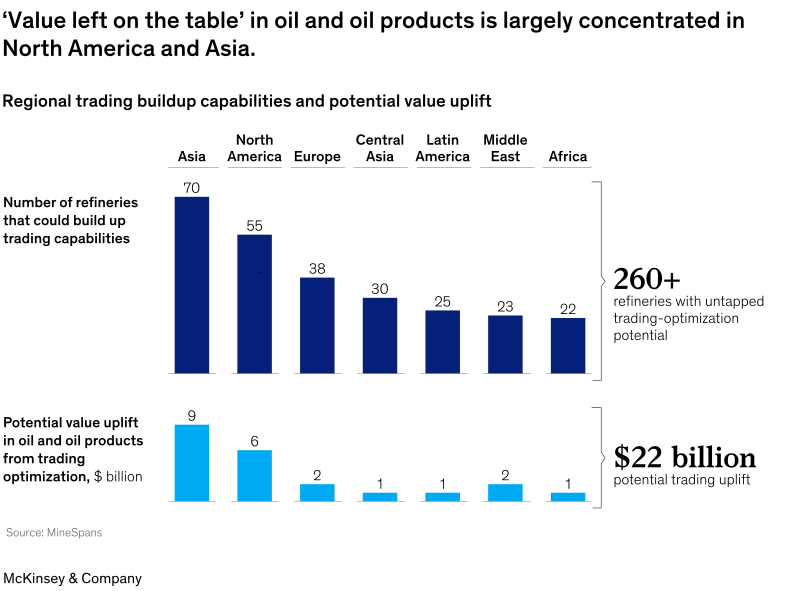
Our research indicates that approximately $20 billion of additional optimization value is left on the table in oil and oil products alone (Exhibit 6).18 Today, a meaningful volume of barrels is operated under marketing or asset optimization models that do not systematically capture value, which will create a significant push for investment in trading capabilities in the years to come.
There are three pathways to build trading capabilities—organic entry, JV or partnership with an experienced trader, and acquisition—with each pathway offering distinct trade-offs. While the optimal route depends on individual needs, JVs or partnerships are increasingly relevant, especially for asset-backed players seeking faster access to best-in-class systems, front-office expertise, risk management processes, and a performance-driven culture without the long capability ramp-up and risks associated with organic builds.
Although M&A remains a potential pathway, it often faces structural limitations, including the risk of losing critical talent and the challenge of preserving an entrepreneurial trading culture. For a pure organic entry, most exposed players lack the scale, sophistication in risk management, systems, and (most importantly) the talent and trading culture needed to organically build a trading function. In many scenarios, JVs and partnerships can accelerate the development of capabilities and unlock value that might otherwise take years to realize. Likewise, established traders can look to further increase their systems and are proactively seeking to develop partnership opportunities.
The growing interest in hybrid and partnership-based models points to a gradual convergence of capabilities across the sector, with JVs serving as one of several emerging pathways enabling players to more rapidly access trading value pools. At the same time, securing flows and managing exposures is necessary for maintaining scale in a more competitive trading landscape, motivating many traders to partner with up- and downstream players.
The potential for producers and consumers to increase value through better trading capability also applies to markets beyond oil and oil products. For instance, independent power producers and industrial energy consumers are increasingly aiming to insulate themselves against price risk from spot markets by externalizing the spot price and balancing risk. Specialized service providers with revenue-share models are often utilized to extract more value from flexibility exposures, helping those players keep some value upside.19
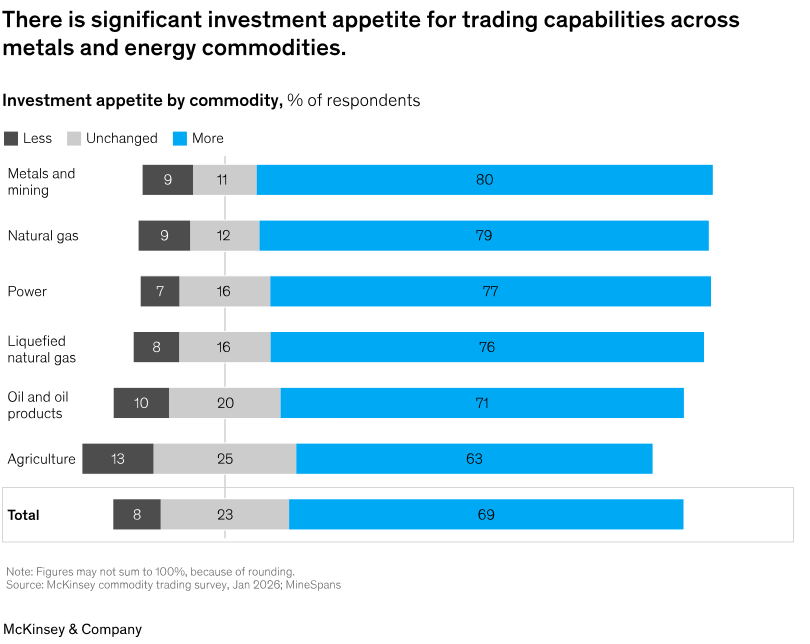
Our market survey indicates that 49 percent of players prefer a partnership model, 27 percent prefer acquisitions, and the remaining 24 percent prefer to organically build trading capabilities. The survey data confirms our perspective on attractiveness (Exhibit 7). Participants show a significant market appetite to increase trading capability, especially in Asia (78 percent) and the United States (80 percent).
Outlook on the landscape
Commodity trading is at an inflection point. In just a few years, industry leaders could be made up of just a few powerful global trading systems, what we call the “privileged few.” Given the gradual convergence of trading capabilities in some areas, players will need to operate at the highest standards, become deeply embedded in the physical value chains of commodities they trade, and embrace AI technologies for both higher trading margins and efficiency advantages. In the next five to ten years, AI could dramatically change how trading organizations will look from the inside, with human and AI agents working hand in hand, not only achieving outcomes more quickly but also with lower costs.
The compounding effect of the trends outlined in this article could create major market and organizational shifts. What’s clear is that organizations that invest in these transformative capabilities early—such as developing reusable agent architectures, shared data foundations, and systematically retraining the workforce to build and govern agents—will be able to act more decisively and at a structurally lower cost base. Currently, merchant trading houses, IOCs, and large data-native traders seem to be performing well. Because time is limited and the gap could accelerate before the next volatility crisis, organizations will likely need to act now to increase resilience as well as to capture value.
The following strategies can help commodity traders stay competitive in the years to come:
- Critical success capabilities. Aim to strengthen critical capabilities, including access to capital and risk steering, data analytics, market intelligence, and attraction of top talent. This can be clearly linked to concrete value-creation opportunities, allowing for a potentially “self-funded” transformation journeys.
- Market engagement. Identify and engage up- and downstream players with significant exposure. Doing so can help secure access to flow and scale across commodity classes. It’s not enough to simply manage owned assets. Rather, sophisticated trading players pursue opportunities to tap into additional flows and exposures, which could involve JVs, asset investments (including those based on third-party capital), or service models.
- AI capabilities and transformation. Simply put, it’s time to embrace AI. Although the exact speed of each organizational transformation is uncertain, players that clearly articulate foundational builds and focus on implementation will be best positioned to create value faster, helping keep the organization efficient and driving more value from trading.
Three factors are necessary to be successful in trading: access to flow, capital, and sophistication. Those that struggle in the years to come will either lack access to physical assets or have difficulty accessing capital or remain too small to make the necessary investments in AI to build sophistication. It is increasingly important that players think about which areas to play in as well as how to focus on these areas to build strategies that help them continue to be strong participants.