Commodity trading reached new heights in 2022 and 2023. Record volatility, shifts in global trade routes, and significant changes to counterparty creditworthiness all contributed to a dramatic increase in industry margins. The result? Commodity traders saw more than $100 billion EBIT in 2023.1
Not everyone thrived in these years. Many factors likely contributed to how players performed, such as risk appetite and access to capital. But the majority of those that banked record profits excelled in one critical area: balancing the classic risk triangle of market, credit, and liquidity risks, as well as working capital (see sidebar, “Understanding the commodity trading market”). Instead of viewing each of these scarce resources in isolation, they monitored and steered them jointly—the same way they manage their P&L and other performance metrics. This allowed them to understand how deep their pockets were, what risks they could take, and when they needed to exit the market.
Today, overall returns in the trading space have dropped by more than 30 percent since 2023—though they are still 30 to 50 percent above the historical averages of the 2010s. However, with some players seeing dips of more than 50 percent year over year,2 it begs the question: Did players absorb the lessons of the volatile years, or is fragility creeping back in?
The lessons around strong capital allocation and robust risk management are more relevant than ever—and will help traders going forward, given the projected growth in value pools. But doing this well isn’t easy. It requires, for instance, collecting and processing vast amounts of data every single day—and using that data to inform how scarce resources are distributed.
We set out to better understand where players are in the wake of 2023 and what current approaches to commodity trading risk management look like. To do so, we conducted a survey and a series of interviews of players in the asset-backed trading space and merchant traders. Below, we dig into the results and suggest some best practices that can guide players as they seek to create transparency across risks, helping them lower capital costs and build resilience.
The current state of commodity trading risk management
To understand how players in different commodities are managing scarce resources, we surveyed and interviewed 14 commodity traders across the spectrum.3
Do industry players understand the value of managing the risk triangle holistically? Yes. But the sophistication of their approaches varies significantly. Our research points to four stages of maturity (Exhibit 1).
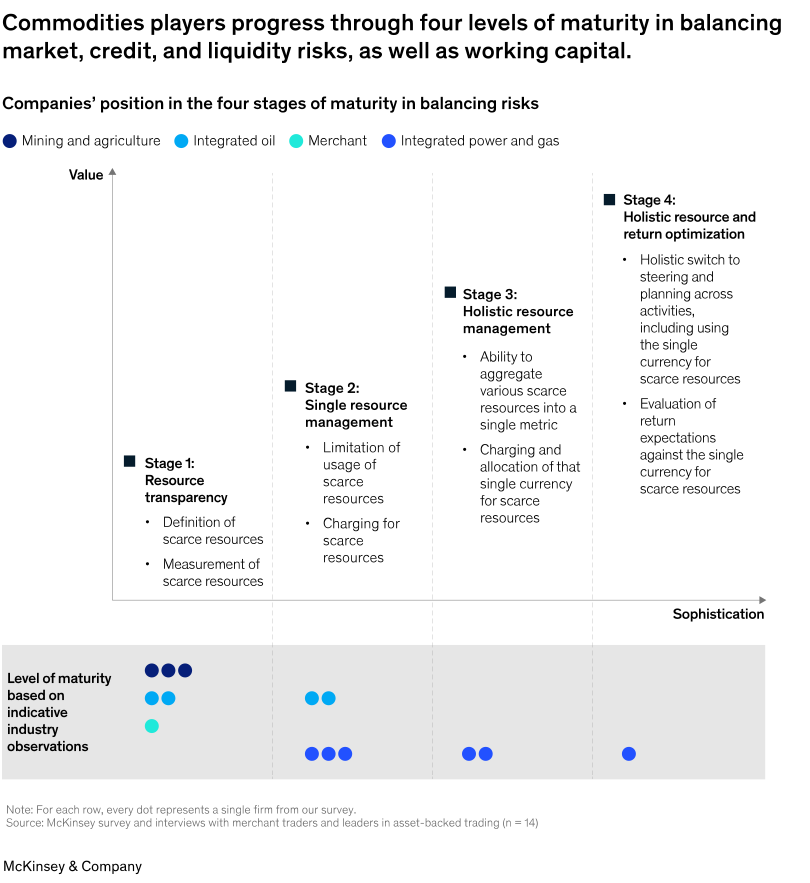
Image description:
A bar chart shows how commodities players progress through 4 levels of maturity in balancing market, credit, and liquidity risks, as well as working capital. Stage 1 is resource transparency, including definition of scarce resources and measurement of scarce resources. Stage 2 is single resource management, including limitation of usage of scarce resources and charging for scarce resources. Stage 3 is holistic resource and return optimization, including ability to aggregate various scarce resources into a single metric and charging and allocation of that single currency for scarce resources. Stage 4 is holistic resource and return optimization, which encompasses a holistic switch to steering and planning across activities, including using the single currency for scarce resources, and evaluation of return expectations against the single currency for scarce resources.
The chart maps the maturity level of companies in 4 sectors: mining and agriculture, integrated oil, merchant, and integrated power and gas. 14 dots represent individual companies. Six dots appear in stage 1, 5 in stage 2, 2 in stage 3, and 1 in stage 4.
Note: For each row, every dot represents a single firm from our survey.
Source: McKinsey survey and interviews with merchant traders and leaders in asset-backed trading (n = 14)
End of image description.
Stage one: Resource transparency. At this most basic level, companies measure their exposures daily across scarce resources—that is, the capital or capital buffers available for market, credit, and liquidity risk and working capital. Some companies measure a more extended set of metrics at this stage, while others focus on a limited set of metrics they then use for monitoring and periodic performance conversations. They do not charge for these risks, and limits are softer or indicative.
Stage two: Single resource management. Players here build on stage one by implementing robust methods to measure the use of scarce resources. They also charge and limit individual resources to optimize the deployed risk capital. Players in this stage realize that use of scarce resources should not be free or unlimited. This usually includes a limit for working capital and risk capital, as well as an appropriate differentiated charge rate.
Stage three: Holistic resource management. These players realize the trade-offs among the scarce resources and create an aggregated metric that represents the total budget for all four resources, or at least the three risk triangle dimensions. They approach risk steering and charging dynamically among the scarce resources: They don’t just measure individual resources; they aggregate the use in a common currency (for example, risk capital) and limit it. This gives traders more freedom to balance the resources they deploy while allowing them to steer the maximum overall risk-taking as well as charge the appropriate rate and set return expectations.
Stage four: Holistic resource and return optimization. Players in the most mature stage take a more deliberate approach to the risk triangle, integrating risk capital into their broader steering and target-setting process. When making any critical decision or plan, these companies ask: How can we optimize our scarce resources? What are the implicit trade-offs? This usually includes an estimate of risk-adjusted returns for business units other than trading, as well as a comprehensive performance comparison.
Overall findings: Who, what, and where
Maturity is increasing overall: All the players in our research have invested significantly in risk management in recent years. That said, most players are still in the first two stages. They measure exposures for scarce resources and limit or charge traders for these exposures and make it bonus relevant—deducting the charge for the capital used from the trading result. Only a handful of players are in stage three. As for stage four, companies aren’t quite there yet—primarily because they are not fully equipped to measure risk-adjusted returns for their nontrading activities.
Maturity level varies by industry: Power and gas (P&G) traders report the most sophisticated management capabilities, followed by oil and gas traders. Merchant traders have frameworks—though inconsistent and ineffective ones—while mining and agriculture traders remain in stage one, focused on getting the basics right. Players take different approaches based on the main commodities they trade, and a firm’s commodities history often defines its firmwide approach. Overall, traders are exploring a diverse and commodity-specific set of practices, though the category they belong to is a strong indicator of the practices they are likely to use.
And the leading players? They make the aggregate risk capital metric an important KPI for short- and long-term planning and across all major business decisions and processes—including investment decisions.
Zooming in on individual scarce resources
A closer look across scarce resources reveals several insights (Exhibit 2). Measuring all four risk dimensions is standard practice across the commodities industry, with the exception of mining and agriculture players. As is charging working capital. Players are more likely to measure and charge for market risk than other risks, followed by credit risk. Meanwhile, liquidity risk practices are mostly still emerging; only advanced players take a robust approach to managing and charging in this dimension.
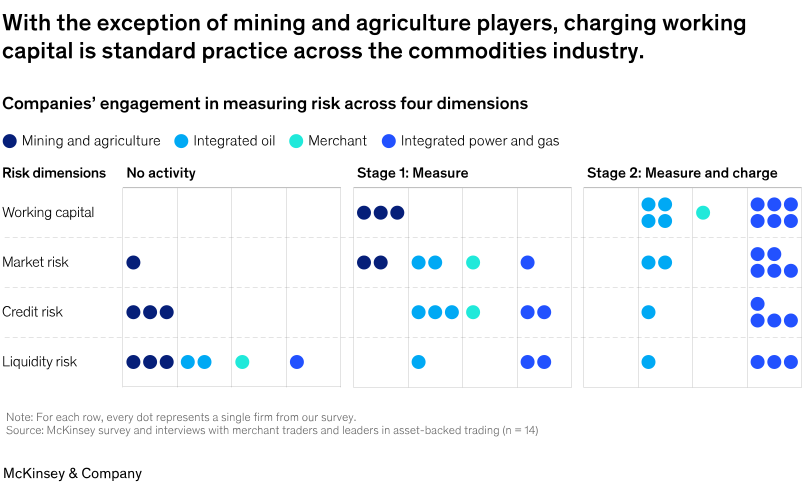
Image description:
A chart shows how commodities firms engage in risk measurement across 4 risk dimensions: working capital, market risk, credit risk, and liquidity risk.
The chart outlines the engagement of companies in 4 sectors: mining and agriculture, integrated oil, merchant, and integrated power and gas. A series of dots representing individual companies shows that with the exception of mining and agriculture players, charging working capital is standard practice across the commodities industry. Overall, 11 companies engage in no activities, 18 engage in measuring, and 27 are both measuring and charging.
Note: For each row, every dot represents a single firm from our survey.
Source: McKinsey survey and interviews with merchant traders and leaders in asset-backed trading (n = 14)
End of image description.
Very few players, and only those in the P&G space, are aggregating risk capital to a single scarce resource—primarily credit and market risk. Even fewer are including other risk types (mostly on a business unit, not single trade, level) and liquidity risk.
Commodity trading risk management best practices
The data speaks for itself: Practices vary widely, and while companies are trending in the right direction, there’s a lot of room for improvement.
It’s worth the effort. Players that successfully manage their scarce resources can achieve their desired risk profile at a lower cost. And because they price risks appropriately, they eliminate arbitrage or gaming of the system. They also gain the ability to clearly communicate an advanced risk framework to investors and banks, likely lowering financing costs.
For their part, banks often factor in a risk buffer in case they have a limited view of their borrowers’ financial position. Players that demonstrate leading practices, strong controls, and forward-looking risk management can reduce uncertainty for banks, leading to lower capital costs. Given borrowing lines worth tens of billions of dollars, the financial benefits could be enormous. Consider: Many traders have a borrowing base of $10 billion or more—some leading merchant traders secure almost $80 billion credit lines. If borrowing costs are reduced by 20 basis points, the trader would see an additional $20 million on top of savings from improved capital allocation and optimization.
Our conversations suggest that players at more mature stages often perform better than peers throughout the cycle and yield better returns on scarce resources. So how can players get there? A handful of practices can help traders progress toward stages three and four, thus preparing them for the next disruption—and opportunity—in the commodity trading markets.
Create full transparency on activities’ risk contributions for all risk types and on working capital use for individual deals and across the business. This usually includes an overhaul of the trading and risk management system and requires more from the risk team in terms of data granularity, data infrastructure, and analytics.
Adopt an integrated framework. This approach enables players to create a unified risk budget for all four risk types—and potentially for additional risks, such as operational risk. Traders continue to measure each risk individually, but a unified approach eliminates blind spots—providing a more comprehensive view of total risk and resource consumption. This approach should include internal arbitrage opportunities for traders.
Create a risk appetite or tolerance statement linked to the available risk-bearing capacity. An integrated framework is a great tool, but it’s insufficient—and inefficient—unless players have aligned the right boundaries and top-down metrics. A comprehensive risk appetite statement closes this gap and translates leadership perspectives and guidelines into everyday management decisions and limitations.
Charge for risk implemented in performance management and compensation logic. In addition, the metrics players use to steer the business must directly influence performance management and compensation. Calculating risk-adjusted profit and loss is a good start, but it needs to be the basis for compensation and incentives. Otherwise, the effects of these additional metrics might be limited because traders will not consider them in daily trade-off decisions.
Adopting these practices will help players understand the trade-offs and costs between risk types—that is, allow them to convert risk from one type to another—and position them to optimize their risk management efforts. This will look different for each company.
For example, the leaders and shareholders at a Central European electric power and natural gas company may have a solid acceptance of market risk but no tolerance for credit risk and variability in dividends or liquidity. Understanding this allows the company’s risk department to steer behaviors and offset potential risks, minimizing the costs for this desired risk exposure.
Meanwhile, the leaders and shareholders of another company may have limited tolerance for working capital or liquidity risk, but they accept some credit risk. This enables the risk department to, say, avoid initial and variation margins that they would have to post on exchanges and pursue a bilateral swap; this approach might avoid consuming working capital and liquidity and flatten market risk while exposing the company and counterparty to significant credit risk.
Managing the classic risk triangle and working capital is critical, though it is admittedly not the whole journey. Once players are successfully managing their scarce resources, they can turn their attention to capital allocation and other optimization factors. After all, a well-managed risk triangle is just one facet of effectively navigating the energy trilemma: ensuring a stable supply chain, protecting competitiveness, and pursuing decarbonization.
Bringing all this together is the next challenge for these companies in the years ahead—and doing so will likely require joint effort from different departments and business units. It may not be easy, but it’s the next step to further enhancing returns, steering the risk profile, and building resilience against whatever the market brings.