From the store shelf to the digital aisle, the state of play in the consumer-packaged-goods (CPG) market is being reorganized. CPG growth began to slow dramatically in 2022. Today, in the categories that account for nearly 85 percent of retail sales value in the sector, growth continues to decelerate, and in most categories it’s slowing rapidly. But there is still growth to be found, and across categories, much of it is being driven by new entrants rewriting the rules: disruptor brands.
These brands—defined by their rapid, outsize growth1—are connecting deeply with consumers and reshaping the competitive landscape. While the emergence of smaller brands began before the pandemic, their presence has accelerated in the past two to three years. In categories ranging from salty snacks and beverages to vitamins and supplements, disruptors are accounting for a growing share of total category expansion. Incumbents, long buffered by their scale and long-term brand equity, are now struggling to keep pace with changing consumer expectations and faster-moving competitors.
Incumbent CPG brands can close the growth gap—but only if they shift their mindset and operating model. In this article, we identify the tailwinds supporting disruptor brand growth, outline five disruption archetypes across the CPG space, and define the hallmark traits disruptors embody and incumbent CPG brands can adopt to reclaim growth.
The forces behind disruptor brand growth
While category performance varies, the overall trend is clear: Growth across more than 40 CPG categories has slowed sharply. In most cases, current growth rates are more than two percentage points below their historical averages, according to a McKinsey analysis.
For established players, traditional scale advantages—broad distribution, shelf space, and procurement leverage—no longer guarantee growth. Although CPG companies have adopted more agile ways of working and have experimented with different marketing tactics including collaborations and partnerships, innovation cycles are still slow, while the pace of innovation across the sector has accelerated. Additionally, CPG giants may have acquired disruptor brands but have not incorporated their playbooks into their broader portfolio, resulting in lower market share.
These structural challenges stand in sharp contrast to the environment fueling disruptors. On one side, consumer behavior is shifting in ways that favor disruptors. According to McKinsey ConsumerWise consumer sentiment research, roughly 37 percent of consumers have tried a new brand in the past three months, and 40 percent say they plan to splurge or treat themselves soon—often choosing premium, “better for you” options, or those that provide clear need fulfilment. This shift is pronounced in ways the CPG space has not seen before—consumers are even willing to experiment in routine purchase categories.
On the other side, retail dynamics increasingly support disruptor growth. Retailers are more open to onboarding emerging brands because they see the benefits firsthand: They bring higher foot traffic, renewed category excitement, and valuable insights from early-stage innovation. Onboarding disruptor brands earlier also gives retailers real-time data on consumer response, which they can use to strengthen and accelerate development of their own private-label offerings.
At the same time, the risk of introducing new entrants has fallen sharply thanks to advances in demand-transfer analytics—models that use historical sales and shopper data to predict how demand shifts when new brands are added or existing ones are removed. With these tools, retailers can anticipate whether a disruptor will expand, rather than cannibalize, total category sales. This analytical confidence allows them to make earlier, better-targeted bets—giving disruptors faster access to shelves and scale.
Five archetypes of CPG disruption
Disruption in CPG falls into five distinct archetypes based on category size, maturity, and the speed at which innovation occurs: limited disruption, nascent disruption, scaled disruption, intense disruption, and transformative disruption (Exhibit 1).
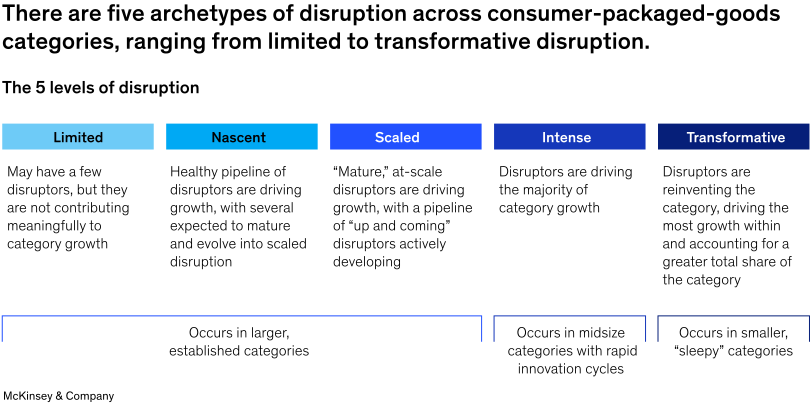
Across this continuum, incumbents face different challenges—but the warning is consistent: Disruption can happen at any time and in any category. Nobody should stand still.
Limited disruption: Incumbents still dominate
Approximately 30 percent of the categories remain largely disruption-limited—spaces where new entrants exist but have yet to materially influence overall growth. In this segment, incumbents account for more than 90 percent of category expansion, and fewer than one in ten brands qualify as disruptors. Disruption-limited categories—including dairy, condiments, meat, produce, and canned products—tend to be commodity-driven, have high private label presence, and on balance come in at lower absolute price points. Additionally, consumers tend to purchase from these categories consistently. In these categories, scale and incumbency still confer real advantages—at least for now.
Nascent disruption: Still subscale, but growing fast
In this archetype, emerging brands remain subscale but are building momentum. We are seeing nascent disruption most often in larger, established categories, and more specifically in sweet snacks and frozen foods. A dozen disruptor brands compete in sweet snacks, and most generated around $170 million in annual revenues.
In frozen foods, over the past five years, disruptors have driven 11 percent of growth. Disruptors such as Just Bare (premium frozen chicken), TrüFrü (chocolate-covered frozen fruit), Authentic Motor City Pizza Co. (Detroit-style frozen pizza), and Rao’s Specialty Foods (pasta sauce and frozen Italian meals)2 offer consumers new kinds of convenience and quality that are resonating; since 2019, TrüFrü alone grew its annual revenues 20-fold.3 These brands form a healthy pipeline that could soon move their categories into the “scaled disruption” archetype.
Scaled disruption: New players fuel growth
As with nascent disruption, scaled disruptors—which include beverages, salty snacks, and refrigerated foods—are most often seen in larger, established categories (Exhibit 2). Scaled disruptors capture share with need-based value propositions and innovative formats. Mature disruptors are fueling category growth, while a pipeline of additional up-and-coming entrants continues to develop. In an effort to reinvigorate their portfolios, leading CPG companies have acquired several of the fastest-growing disruptors in the scaled-disruption archetype, further intensifying competitive pressure in this space.
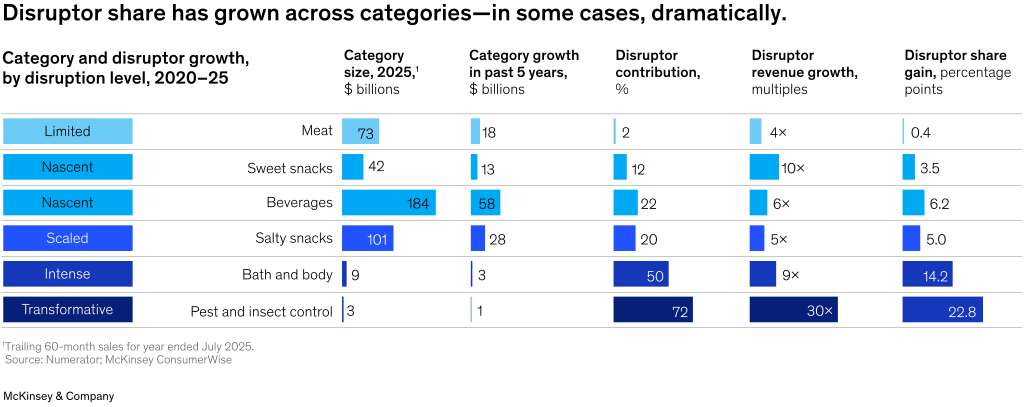
Beverages, a $184 billion category, offers the clearest example of what scaled disruption looks like. The category includes 35 disruptor brands, the most of any CPG category, and these disruptors contributed 22 percent of overall category growth (Exhibit 3). Twelve of these players have more than $500 million in annual sales, and four—energy drink players Celsius and Alani Nu, as well as electrolyte labels BodyArmor and Liquid I.V.—exceed $1 billion annually.
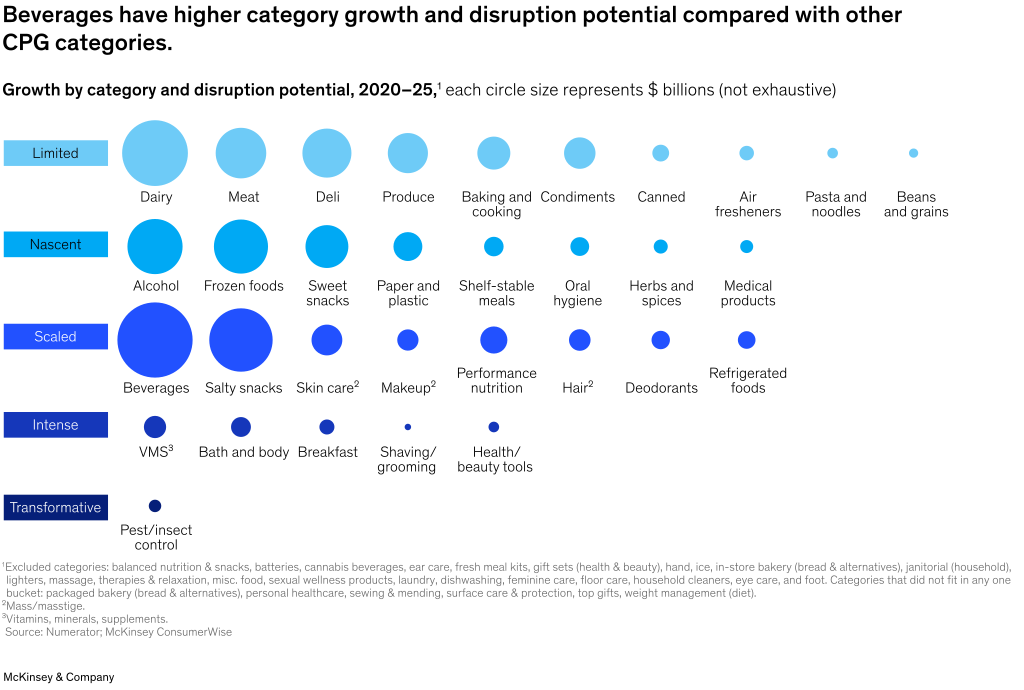
In salty snacks, a $103 billion category, there are 33 disruptor brands, 12 of which posted more than $500 million in annual sales, including Quest Nutrition, Dots Homestyle Pretzels, and CHOMPS meat sticks. Here, better-for-you positioning—or products that have a higher amount of protein or unprocessed ingredients—underpins momentum. (This is also evident in tortilla-chip maker Siete and snack-bar brand Nature’s Bakery.) In refrigerated foods, disruptors such as Kevin’s Natural Foods, Amylu Foods, and Real Good Foods now contribute about 23 percent of category growth.
In these high-velocity markets, consumer needs are constantly evolving, offering continual openings for new entrants. Incumbents must stay vigilant as disruptors continue to scale with startling speed.
Intense disruption: Challengers take control
In many midsize categories with rapid innovation cycles, disruptors already dominate. In vitamins, minerals, and supplements—an $18 billion category that grew by about $4 billion in the last five years—roughly half of new growth came from disruptor brands such as Vital Proteins, Olly Vitamins & Supplements, and Force Factor. These brands have gained traction through effective marketing, as well as the adoption of trendy ingredients and formats, such as collagen and gummies, respectively.
The same is true in bath and body. While it may be a smaller category (worth $9 billion in 2025, up from about $6 billion in 2020), disruptors including Dr. Squatch, Tree Hut Shea, Native, Method Products, Every Man Jack, and Duke Cannon deliver about half of category growth, often via clean-label formulations and products targeted to men. Other segments—shaving and grooming (brands such as Billie, Tree Hut Shea, Manscaped) and performance nutrition (Fairlife, Owyn, Nutricost, and Alani Nu)—show the same pattern, with disruptors contributing 50 percent or more of growth. In these categories, incumbents face a sharper challenge: Disruptors are no longer emerging—they’re setting the pace.
Transformative disruption: Disruptors rewriting the rules
At the far end of the spectrum are “sleepy” categories that are being completely redefined. In pest and insect control, just two brands—Zevo and STEM—are responsible for roughly 70 percent of total growth and a 20-point share gain. Their success hinges on reframing the category: marketing themselves as safer, more natural, and plant-derived or bio-selective alternatives to harsh chemical sprays. In smaller, slower-moving categories like these, the warning to incumbents is stark: Prepare for disruptors to redefine the category.
Six hallmarks of a disruptor brand
Together, these archetypes show that disruption is not a uniform phenomenon. It takes different forms depending on category size, maturity, and innovation speed. That said, across categories, six traits consistently distinguish disruptor brands and explain how they achieve outsize growth.
- Bold and culturally relevant messaging: Disruptors reach consumers with a bold, original, or novel message on social media and across digital platforms, leaning into cultural conversations to stay relevant. Their marketing evolves in real time with the communities they engage. By using data analytics, social listening platforms, and AI-powered sentiment and trend tools, incumbents can uncover what’s shaping consumer conversations in real time. Translating those insights into creative marketing that reflects the culture and deploying it dynamically through personalized content engines and automated media tools allows them to reach the right audience at the right moment.
- Unique physical sales strategy: Consumers today discover brands both online and in person, meaning real-world activations remain as critical as digital ones (arguably, the stakes may be higher for real-world activations, since consumers can try products for themselves across these formats). Disruptor brands are therefore making their mark in the physical world in unexpected ways—whether as one of the few branded options on a shelf dominated by private labels; through booths at consumer events, concerts, or conferences; via immersive pop-up experiences; or even in airports with experiential points of sale. Whatever form their physical presence takes, the key for disruptor brands is to engage consumers and seamlessly connect the in-person experience to the broader purchase journey—through tactics such as email sign ups, QR code activations, loyalty program enrollment, or social-sharing incentives. Doing so helps break through the noise of the crowded CPG landscape and build authentic, enduring connections with consumers.
- Distinctive product innovation: At the product level, disruptors continuously experiment with new and creative formulations, packaging, form factors, and benefit combinations, often with a relentless focus on cocreating with communities. This constant iteration keeps them closely aligned with emerging consumer preferences. Incumbents can use AI-driven insight platforms, digital prototyping, and small-batch production to test and refine new formulations, packaging, and benefits at speed—while actively cocreating with consumer communities through social listening and feedback loops. By embedding digital tools across the innovation process—from concept generation to in-market testing—companies can shorten development cycles, scale ideas faster, and stay in lockstep with evolving consumer preferences.
- Digital fluency: A digital-first DNA underpins everything disruptors do. They leverage digital channels for marketing, customer acquisition, and community building, relying heavily on social, direct-to-consumer (D2C), and influencer ecosystems to reach and retain their audiences. To rewire their organizations for the digital era, CPG incumbents could build cross-functional marketing “pods” that unite data scientists, creatives, and channel experts to act in real time; invest in modern martech and automation tools to personalize engagement across social, D2C, and influencer channels; and empower teams with agile ways of working so they can test, learn, and optimize campaigns continuously.
- Speed and agility: Disruptors are agile, able to rapidly react and adapt to consumer and market signals and to nimbly change direction on product, pricing, and marketing. They remain open to disruptive partnerships and collaborations that help them move faster and stay ahead. To replicate this, incumbents should embrace a start-up mindset and “fail fast” experimentation—for example, by building and testing minimum viable products and scaling what works.
- Consumer-centric purpose: Finally, the purpose of disruptor brands is clear to consumers. Each meets an unmet or deeply felt need from consumers, anchored by a mission that aligns closely with consumer values. Incumbent CPGs can pair their scale and data sophistication to uncover what’s driving new consumer priorities and preferences—why people are choosing to buy less, buy differently, or pay more for perceived value. By combining quantitative signals from AI and social listening with qualitative insights from community cocreation and feedback loops, they can identify growth areas—such as wellness, functional nutrition, and better-for-you products—and translate them into purpose-led innovation that builds lasting trust.
To thrive in this new environment, incumbents should stay relentlessly consumer-obsessed, use technology to detect and respond to emerging trends, and rethink their innovation and marketing playbooks. The disruptor era represents a fundamental shift in how growth happens in CPG. The brands that learn from today’s disruptors will be the ones leading tomorrow’s growth.